
Weekly Research
Credit Analysis Must Stress Costs and Demand Together
- Report or archive date
- Coverage April 20–26, 2026
- Reading time
- 10 min read

Summary
April 20–26: the energy shock raises a balance-sheet question as well as an inflation question.
A lender testing a restaurant group's ability to repay usually asks what happens if customer traffic falls. Another reviewer may ask what happens if food, refrigeration, and delivery get more expensive. Both tests can pass while the loan is in trouble. The important mistake is to run the tests on separate pages and assume that the borrower will experience them separately. By the week ending April 26, the sharp energy-led rise in March consumer prices had supplied a reason to consider an unfavorable combination of costs and demand. Its size did not tell a bank how much any individual borrower would lose. The bank had to open the accounts.
The March all-items CPI rose 0.9 percent from February on a seasonally adjusted basis, while the measure excluding food and energy rose 0.2 percent. Those figures belong to a consumer basket, not a restaurant's cost ledger. They do identify a plausible channel: expensive transportation or utilities can strain the business while reducing cash available to some of its customers. A useful credit investigation asks which expenses are exposed, which customers are able to pay more, and whether enough cash remains on the dates the loan contract specifies.
Begin with a borrower that passes the ordinary test
Consider a group of neighborhood restaurants generating $5 million of quarterly revenue. Variable food and packaging costs equal 40 percent of sales, or $2 million. Rent, baseline staffing, utility commitments, and other operating cash expenses are $2.4 million for the quarter. Revenue less these operating cash costs leaves $600,000 before debt service. Contractual interest and principal payments together require $300,000. The borrower has two times coverage on the stated measure and $300,000 left after debt service, before taxes, maintenance, and working-capital changes.
A credit memo should define its numerator. Operating income, earnings before interest and depreciation, and cash available after maintenance spending can all produce different coverage ratios. Here the numerator is cash revenue less food, packaging and the listed operating cash costs. Taxes, maintenance spending and working-capital needs have yet to be deducted. A lender can compare actual collections with accrued revenue to see how much arrived before the payment date. A bank covenant may use a negotiated definition incorporating permitted adjustments. A comfortable result under one definition does not establish compliance under another.
Take a cost-only stress. Suppose the variable cost per unit sold increases 10 percent, with menu prices and traffic unchanged. Variable costs rise from $2 million to $2.2 million. Operating cash profit falls to $400,000, which covers $300,000 in debt service about 1.33 times. The loan still appears serviceable on this limited view, leaving $100,000 after contractual payments. Only variable costs rise in this calculation. Applying it to every dollar of rent and other committed costs would tell a different story without any basis in the assumption.
Now take a demand-only stress. Revenue falls 8 percent to $4.6 million because fewer meals are sold at unchanged prices. Variable cost at the original 40 percent ratio falls to $1.84 million. The other $2.4 million in expenses does not adjust immediately. Operating cash profit becomes $360,000, or 1.20 times debt service. The restaurant group again passes a simple coverage test. That is the moment when an investor who has reviewed two pages can easily stop one page too early.

Combine the stresses using the correct quantity
Under both stresses the group sells 8 percent fewer meals and pays 10 percent more for the variable inputs used per meal. Variable costs are $2 million multiplied by 0.92 and 1.10, or $2.024 million. Subtract that and $2.4 million of other costs from $4.6 million of revenue. Operating cash profit is $176,000. Debt service of $300,000 now exceeds the operating surplus by $124,000. Coverage is about 0.59 times. Both individual tests passed, while their combination creates a cash deficit before maintenance and other omitted needs.
Why not just subtract the separate $200,000 and $240,000 profit hits from the original $600,000? That would give $160,000, understating the combined result by $16,000. The input price increase applies to fewer meals once traffic falls. The difference happens to make the combined outcome less bad than a crude subtraction, but the loan still fails the coverage test. Explicitly modeling price and quantity matters both when it improves a scenario and when it worsens one. The point of stress testing is to represent the business accurately, not to maximize the size of the loss.
The assumption that variable costs fall with meals deserves scrutiny. A restaurant may have minimum purchase commitments, spoilage, or promotional inventory ordered before the slowdown. If 10 percent of expected volume is already committed and cannot be used elsewhere, costs may decline less promptly than the simplified model suggests. Conversely, management may adjust menus or substitute ingredients, subject to customer acceptance and quality requirements. A borrower with credible purchasing flexibility can improve the modeled result. Credibility requires contracts and operating evidence rather than a generic assurance that management will respond.
A similar issue arises with labor. Calling baseline staffing fixed for one quarter might be reasonable for a restaurant operating minimum safe shifts under existing leases. Over several quarters the group could close unprofitable periods, renegotiate hours, or shut a location. Each action has a cost. Closing early can reduce wages and also drive away customers whose visits were profitable. Closing a store can leave lease obligations outstanding. A sustainable credit case should show the cash consequences of each response, including any lost contribution and the time before savings arrive.
Can a price increase repair the coverage gap?
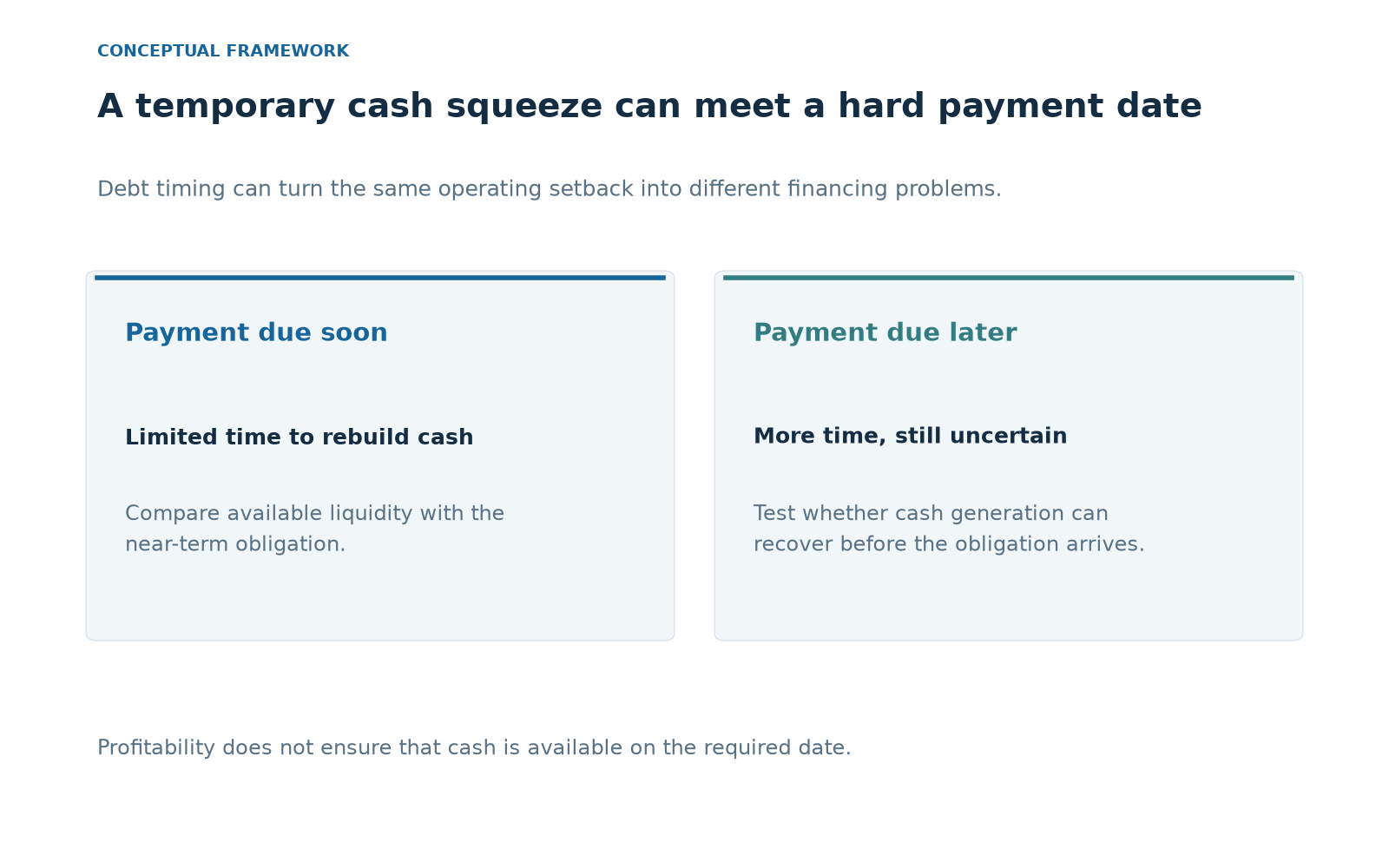
In the combined scenario the group is short $124,000 relative to debt service. If sales volume did not change and no additional fee or cost were triggered, it would take $124,000 of extra selling revenue to restore exactly one-times coverage. Relative to the stressed $4.6 million of sales, that is about 2.70 percent. A spreadsheet can calculate that threshold. It cannot establish that customers will accept it. Some may order less often, switch to lower-priced meals, or take their business elsewhere. Payment-processing fees or royalties based on sales can also absorb part of the increase.
Assume the group raises prices 3 percent on the already stressed sales and volume holds. Revenue becomes $4.738 million. Keeping the modeled costs unchanged, operating cash profit reaches $314,000, only $14,000 above debt service. If volume falls another 2 percent in response, revenue becomes about $4.64324 million. Variable costs fall from $2.024 million to $1.98352 million under the same unit-cost assumptions; the other costs stay at $2.4 million. Cash operating profit becomes $259,720, leaving the group $40,280 short of debt service. A price change that appears adequate under static volume can fail under a modest response.
Management can investigate which menu items have room to reprice and which function as visible price comparisons for customers. Raising prices on a low-volume specialty may protect traffic but recover little cash. Increasing the price of a frequently purchased item might have a larger immediate effect and a greater risk of losing visits. A creditor needs an estimate of total contribution after the response, not just a list of items whose posted prices rose. The next useful evidence would be transaction counts, check size adjusted for mix, and gross profit dollars at comparable restaurants.
The cash trough can arrive before the quarter ends
Even one-times coverage for a full quarter would not guarantee repayment on a particular day. Suppliers could require payment early, payroll could arrive before a holiday sales weekend, or a loan installment could be due at midquarter. Model the weakest week. If the borrower starts with $200,000 of unrestricted cash and needs to retain at least $120,000 to keep operating normally, it can use the remaining $80,000 to bridge a shortfall. A quarterly deficit of $124,000 would exceed it by $44,000, and a concentrated early payment could create a larger temporary gap before sales recover.
A rescue that relies on stretching suppliers can transfer the risk. Delaying $100,000 of payments improves the restaurant's immediate cash but may cause suppliers to remove discounts, limit deliveries, or require cash on delivery next month. A supplier dependent on this group could itself draw more credit. The lender must examine whether the deferral is authorized and sustainable. Cash temporarily retained by failing to meet one obligation cannot be treated as an unqualified improvement in the borrower's capacity to meet others.
A working-capital line can help if it is committed and available. If the restaurant relies on inventory or receivables as collateral, falling sales, spoilage, or aging invoices can affect how much it may borrow. A line “up to $500,000” may already be partly drawn or subject to conditions the borrower is close to breaching. Request the latest borrowing-base calculation and show the balance still available under the combined stress. Testing operating risk and credit availability separately can repeat the same analytical mistake made with demand and costs.
What would the lender recover?
Coverage tests mainly concern the probability of a payment problem. A separate inquiry concerns what the lender might recover if a problem becomes serious. Specialized kitchen fittings may have a book value far above their resale proceeds once removal costs are considered. A lease assignment can require landlord consent. A valuable restaurant brand can lose value if locations close or employees leave. Valuing collateral under normal operating conditions may offer an optimistic guide to proceeds in an urgent sale. The relevant questions are who has priority, what can be sold, how long it takes, and what costs come first.

Suppose a lender holds a $1 million claim and expects gross collateral proceeds of $850,000 in an adverse case. If costs of sale and senior claims consume $150,000, only $700,000 is available for this lender under the stated assumptions. The resulting loss is $300,000 before considering timing or other recoveries. Applying a 15 percent haircut to the loan balance merely because gross proceeds are 85 percent of the claim would miss the priority of those deductions. A separate guarantee might improve recovery if enforceable and collectible. Its face amount should not be added without examining the guarantor's resources under the same stress.
A borrower may be worth more operating than liquidated. Short-term relief can preserve jobs, customer relationships, and the cash flow from viable locations. It can also delay recognition of a business that cannot operate profitably at realistic prices. A creditor evaluating a waiver should ask what the extra time achieves: a signed rent concession, documented menu repricing with retained traffic, a committed equity injection, or a sale of a nonessential asset. A calendar extension by itself creates no new source of repayment.
Compare franchises and company-operated sites on the right basis
Two restaurant groups can report the same number of locations and very different credit exposures. A company-operated location typically collects the meal revenue and pays the operating expenses directly. A franchisor may collect a percentage of sales and leave much of the food and labor expense with the franchisee. A rise in food cost can initially squeeze the operator's margin more than the franchisor's royalty revenue. If stores close or franchisees cannot pay, the strain can move upstream later. A consolidated revenue comparison that ignores this arrangement may understate risk in one company and overstate it in another.
Suppose a franchisor earns a 5 percent royalty on $1 million of quarterly store sales. Royalty revenue is $50,000. If store sales stay flat while food costs rise, the nominal royalty is still $50,000 under that simple contract. If site sales later fall 8 percent, the royalty falls to $46,000. If the operator falls behind on payments, cash received can be lower still. The lender should ask whether the reported royalty was collected, whether the store remains economically viable after paying it, and whether the franchisor has offered concessions. A revenue line protected from the first movement in costs may acquire a significant credit exposure to the party that initially absorbed them. A monthly comparison of royalties billed with royalties actually deposited would give the lender an early, concrete check on that possibility.
A weekly monitoring sheet with a purpose
The restaurant group's file can fit on one page if it tracks the right items. Show meals sold at continuing sites, realized revenue per meal after discounts, variable cost per meal, the next four payroll and supplier dates, minimum operating cash, undrawn usable credit, and the next loan payment. Put the combined scenario next to the individual cost and demand cases. Record the smallest change in price, traffic, or cash timing that pushes coverage below the agreed floor. Then the analyst knows which new observation can actually change the credit decision.
The economic release matters because it makes it reasonable to test a combination that might otherwise have been ignored. It does not dictate the restaurant group's result. Some borrowers have contracts that recover costs automatically, enough liquidity to wait, or customers whose spending remains stable. Others have thin margins and obligations due before any response takes effect. By April 26 the useful credit conclusion was more precise than “energy is expensive.” A lender has to establish whether the same development can raise a borrower's costs, reduce its customers' purchases, and restrict the financing available to bridge the gap. Only the combined calculation shows whether those individually manageable risks can coexist on payment day.
Related research
Weekly Research
The April Global Outlook Makes Its Conflict Assumption Explicit
April 13–19: a conditional baseline should be read together with its limits.

Weekly Research
April’s Policy Hold Comes With a More Explicit Inflation Problem
April 27–May 3: the Fed links elevated inflation partly to higher global energy prices.

Weekly Research
March CPI Shows a Large Energy-Led Increase
April 6–12: the immediate price shock is visible; its persistence remains the central question.