
Weekly Research
Imported Costs Can Become a Currency and Financing Problem
- Report or archive date
- Coverage May 18–24, 2026
- Reading time
- 10 min read
Summary
May 18–24: the global baseline needs a balance-of-payments perspective.
A cargo of fertilizer arrives at a port. The importer takes ownership today, the supplier is owed dollars in sixty days, and the farmer buying the fertilizer will not sell the crop for several months. The ship's arrival can count as evidence of trade long before the importer has the dollars to pay. That timing gap is the starting point for this week's look at imported costs. A rising import bill can increase pressure on a country's external financing and on a company's working capital, but the route from one to the other is specific. A country's trade balance, its official reserves, a bank's dollar funding, and an importer's cash balance are four different quantities.
The April global outlook used in the week ending May 24 projected 3.1 percent world growth in 2026 under a limited-conflict assumption. That baseline leaves room for considerable differences between exporters and importers of essential goods. Even a country with steady real output can experience a deterioration in the purchasing power of what it exports relative to what it imports. An importer can buy the same physical quantity and need considerably more foreign currency to finance it. The resulting strain depends on the terms of trade, exchange rates, access to credit, and the date payment falls due.
Read the price before reading the balance
Imagine an economy exporting 100 units of a good for $100 each and importing 100 units of another good at the same price. Its goods exports and imports each total $10,000 in this small illustration. If the import price rises to $120 and quantities and export prices initially hold, imports rise to $12,000 and the goods balance becomes a $2,000 deficit. The country has not imported more units. Its existing export proceeds purchase fewer imports. The simple ratio of the export price to the import price falls from one to about 0.8333, a decline of roughly 16.67 percent.
It would be incorrect to call that a loss of 16.67 percent of the country's GDP. The example measures a relative price change between two goods. Its impact on real income depends on the scale of trade, domestic production, substitutes, and the income flows of households and firms. In a real country there are many goods and services, and the current account also includes primary and secondary income. The goods deficit alone cannot establish the entire external balance. Its accounting tells us which transaction to investigate next rather than providing a summary judgment about national solvency.
The exporter and importer may be entirely different people. The exporter receiving $10,000 may have its own dollar costs or a loan due abroad. Nothing in the country-level arithmetic transfers its dollars automatically to the importer. A bank can intermediate between the two, a foreign supplier can extend credit, or a borrower can obtain new external funding. The conditions and cost of that intermediation determine whether the importer can continue buying the same quantity. A macro account recording both sides of a transaction does not guarantee a frictionless market for credit at the exact time one business needs it.
Follow the fertilizer invoice
Suppose a distributor orders 1,000 metric tons for $400 per ton. Its invoice is $400,000, due two months after it takes ownership. Before the next order, the dollar price rises to $480 per ton. The physical order is unchanged but the invoice rises to $480,000. If the exchange rate moves from ten to eleven local currency units per dollar, the local value of the invoice rises from 4 million to 5.28 million. The combined increase is 32 percent: a 20 percent increase in the dollar price multiplied by a 10 percent increase in the local cost of a dollar.
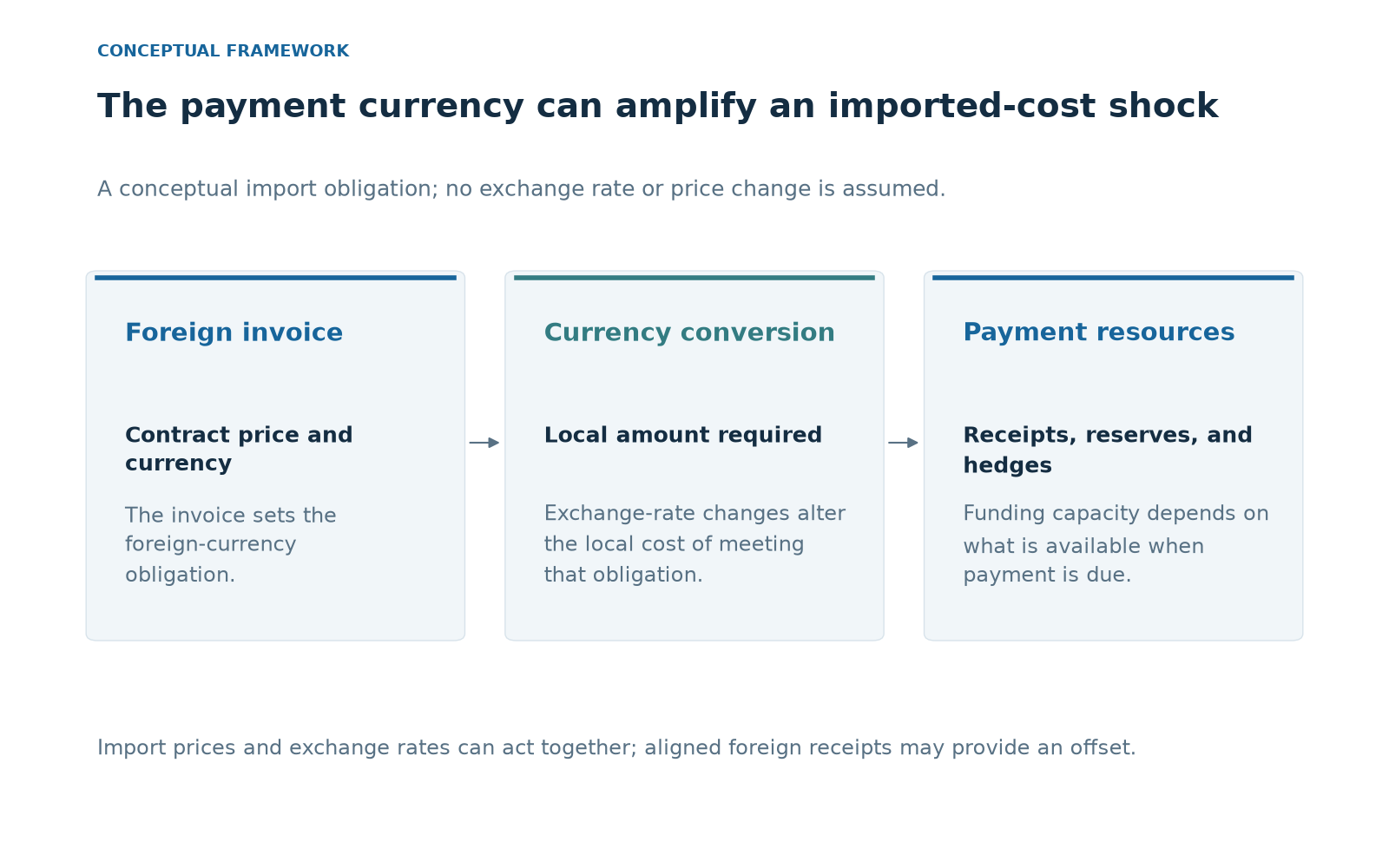
The supplier's credit period matters. The importer can receive the goods and incur a payable to a nonresident before buying dollars for settlement. In balance-of-payments terms, the goods transaction has a financial counterpart, such as trade credit. Later settlement reduces the payable and uses a means of payment. Counting the purchase of fertilizer and the later settlement as two imports would double-count the same shipment. Conversely, treating the absence of immediate cash payment as evidence that the import required no financing would overlook the liability coming due.
Now imagine the supplier changes its policy from sixty days of credit to payment on shipment. The nominal invoice remains $480,000. The importer needs the money roughly two months earlier. If its bank had planned to lend against receivables from farmers after delivery, that collateral may not exist when prepayment is required. The firm might seek a letter of credit, cash collateral, customer deposits, or a new bank facility. Any of them could make the sale possible, but each has a cost or a condition. A tightening of supplier terms can choke trade volume without a further change in the world price.
At an annual dollar borrowing rate of 8 percent and a simple sixty-day period on a 360-day year, financing $480,000 costs $6,400. That is the cost of the specified borrowing on the stated convention, not the entire economic cost of the order. Additional fees, the need to post collateral, currency conversion, insurance, and possible delay all affect the actual economics. A bank might offer a lower dollar interest rate than the local-currency rate while leaving the importer exposed to exchange movements until farmers pay. The cost comparison is incomplete unless the currency of sales and the timing of conversion are explicit.
What the country's reserves can and cannot pay
Official foreign exchange reserves belong to the relevant monetary authorities and serve public purposes. They are not the importer's bank deposit. A country may have a substantial reserve position while individual firms have difficulty obtaining affordable trade finance. There may be legal restrictions, collateral requirements, or simply a lender unwilling to assume the buyer's risk. Conversely, a company with stable foreign-currency receipts and a strong banking arrangement can remain well funded despite pressure elsewhere in its economy. Aggregate external vulnerability and corporate payment capacity are related but require separate evidence.
An analyst sometimes divides official reserves by average monthly imports to report months of import cover. It is a descriptive comparison, not a countdown clock. Suppose reserves are $6 billion and monthly imports $1 billion, producing six months on that arithmetic. If the dollar cost of the same import quantities rises to $1.2 billion, the ratio falls to five months even if reserves are unchanged. That does not establish a date on which imports must stop. Countries continue exporting, borrowing, and receiving other flows, while reserves may face demands beyond imports. The arithmetic is useful precisely because it isolates the denominator effect.

For a borrower, a more direct measure would be days until a dollar obligation exceeds confirmed dollar resources. Suppose the fertilizer importer has $100,000 available and a committed dollar line of $300,000 it can draw before shipment. Those sources total $400,000, leaving $80,000 uncovered on a $480,000 prepayment. Stating that national reserves provide five months of import cover does nothing to fill the $80,000 unless an actual facility connects the funds to this borrower on time. A creditor should ask for the agreement, the drawing conditions, and the date the bank confirms availability.
The farmer's response feeds back into credit
The importer could pass the higher local cost to farmers. Whether it can do so depends on crop prices, access to credit, the planting calendar, and alternatives. Suppose its original sale price is 5,000 local units per ton against product cost of 4,000 per ton. Including no other costs, selling 1,000 tons produces 1 million local units of gross profit. At the new local product cost of 5,280, retaining the original price creates a gross loss before freight and financing. The company can be selling an essential product and still be unable to afford the next shipment.
If it raises its price to 6,000 per ton and sells 850 units, gross profit on the units sold is 850 times 720, or 612,000 local units. The remaining 150 units are inventory, assuming they were all purchased and no spoilage or other adjustment occurs. At 5,280 per ton they tie up 792,000 local units at product cost. Cash needed to pay the foreign supplier includes all 1,000 purchased units, not only the 850 already sold. A model that applies the new margin to sales and ignores the unsold stock can present a profitable quarter while missing a looming dollar payment.
The bank financing the next cycle should examine whether those 150 tons can be sold before the relevant agricultural window closes. A product retained until another planting season can require longer financing and face quality or storage risks. Farmers offered extended payment terms may be able to buy today but remain vulnerable to harvest prices or weather. A company reporting robust sales through supplier-provided farmer credit may have exchanged inventory exposure for receivable exposure. Neither is necessarily better without knowing the collateral, timing, and actual likelihood of collection.
A country can adjust physically as well. Buyers can substitute a domestic input, reduce usage, or change the mix of imports. A lower dollar import bill after a shock may indicate successful substitution. It could also indicate rationing or lost productive capacity. If farmers apply less fertilizer and output subsequently falls, the initial improvement in the trade balance may come with a delayed domestic cost. Before interpreting lower imports as improved resilience, examine quantities, domestic alternatives, and the output those imports were meant to support.

What changes when the buyer asks for a smaller shipment?
Ordering 800 tons instead of 1,000 would reduce the next invoice from $480,000 to $384,000 at the assumed new dollar price. The confirmed $400,000 of dollar resources would cover the invoice, leaving $16,000 for other dollar obligations before fees. On paper the funding gap has disappeared. But shipping charges per ton might rise if the order no longer fills the contracted space, and farmers may need the missing 200 tons before another cargo arrives. Reducing a purchase is a financing solution with an operating consequence. Credit conditions can thus change the physical volume traded even when final users would have bought more on affordable terms.
The reduced shipment also changes the risk of losing a long-term account to another distributor. That loss can outlast a short-lived shortage of dollars. The research task is to identify how the firm would choose those 800 tons and their buyers. It might prioritize farmers able to pay deposits, favor longstanding accounts, ration supplies across regions, or raise prices to clear the available quantity. Those choices affect revenue, credit risk, and the relationship with suppliers for the following season. Two firms facing an identical foreign exchange rate can make different decisions because one has more reliable prepayments and a broader base of lenders. Comparing them solely by their country's exchange-rate movement would miss the very adaptation that determines which firm keeps its customers.
A currency hedge solves one part of the chain
Suppose the importer contracts to buy its $480,000 at a fixed local-currency rate before settlement. That can reduce uncertainty about the local cost of the known dollar invoice. It does not guarantee farmers will buy all the goods at the expected price or grant the bank a claim on cash not yet collected. If shipment is cancelled, the importer may have a currency contract without the original dollar obligation. If the invoice is larger than expected, the excess remains uncovered. The hedge should match a specified amount and date and be monitored when the commercial transaction changes.
Consider the opposite exposure at an exporter. A company expecting dollar revenue may look well placed in a weakening local currency. It may also borrow dollars, import fuel, or have agreed to sell dollars forward. Its effective exposure depends on net contractual cash flows rather than the sign of gross exports. If the export buyer is also delaying payment, favorable exchange movements on paper can coexist with an urgent lack of cash. Portfolio analysts who group all exporters as beneficiaries and all importers as losers can miss the ownership and financing details that determine the actual result.
To examine a country-sensitive investment, write down the economic transaction in its original currency first. Then identify the legal payer, the legal recipient, any financial intermediary, and the date each must provide funds. Finally ask which cash flow changes if the commodity becomes more expensive, local currency weakens, or the supplier withdraws credit. A company whose earnings are reasonably matched may still need collateral during the interval before settlement. A company reporting a temporary accounting loss may have secured the actual dollars needed to operate. These are findings one can verify against contracts.
The rise in imported costs is therefore neither simply an inflation number nor simply a foreign exchange story. It can alter how much capital must be committed to move an unchanged quantity of a necessary good from one country to another. The May 24 review is strongest where it identifies that commitment in cash and time. For the distributor in this example, the decisive questions are whether $480,000 can be obtained on the shipping date and whether 1,000 tons can be converted into collectible local sales. A global baseline and a national reserve figure are informative context. The business succeeds or fails at the invoice.
Related research

Weekly Research
April Inflation Raises the Question of Broader Pass-Through
May 11–17: both headline and core prices require attention.

Weekly Research
Nominal Resilience Can Conceal a Household Squeeze
May 25–31: inflation changes the meaning of a stable spending total.

Weekly Research
April Hiring Remains Positive but Needs an Income Check
May 4–10: the employment release supports a measured view of labor demand.