
Weekly Research
July’s Hold Includes Dissent in Favor of Higher Rates
- Report or archive date
- Coverage July 27–August 2, 2026
- Reading time
- 10 min read
Summary
July 27–August 2: disagreement highlights uncertainty about the inflation path.
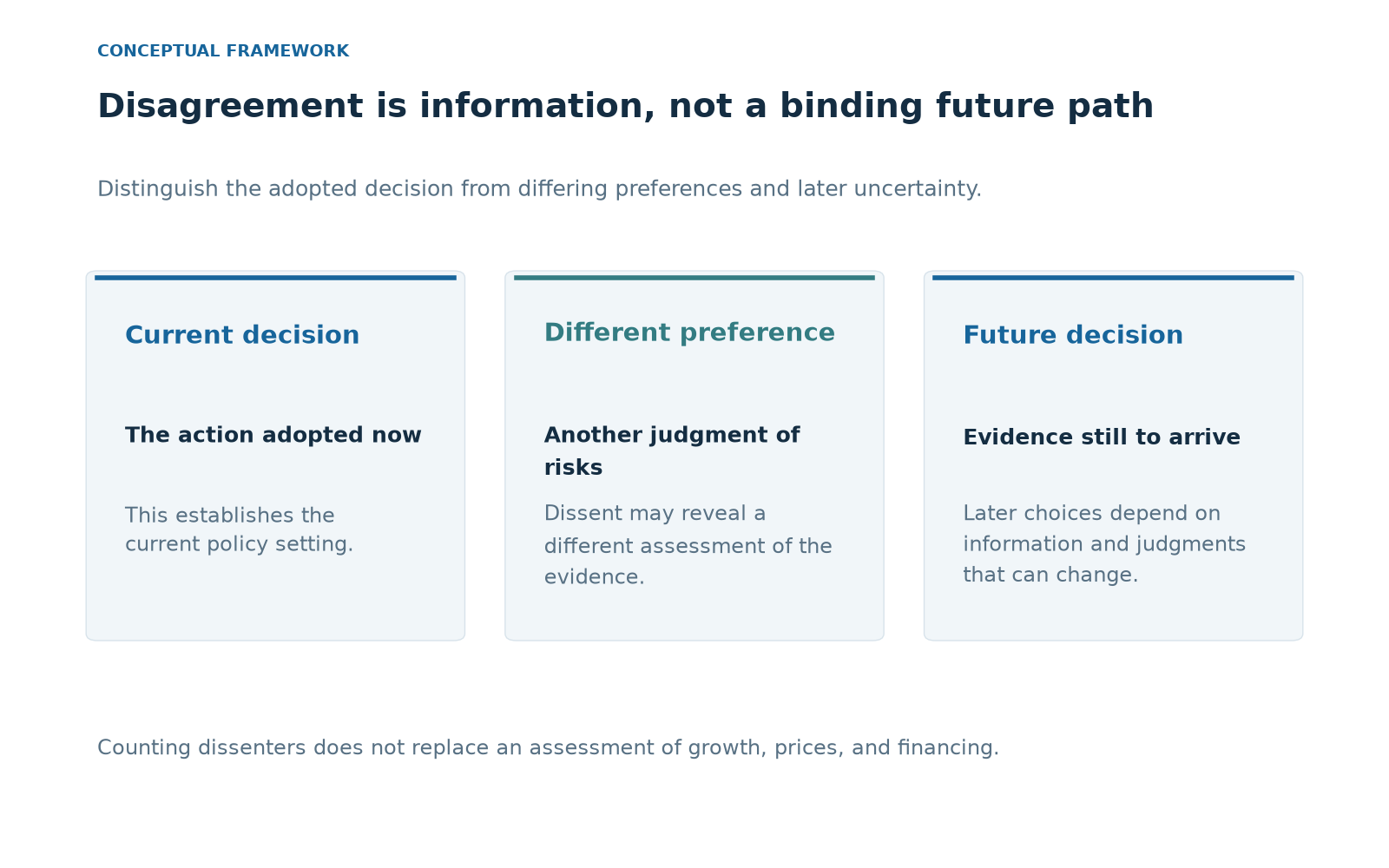
A committee can agree on where interest rates are today and disagree about the cost of waiting. On July 29 the Federal Reserve retained a federal funds target range of 3.50 to 3.75 percent. Nine members voted for that action. Three preferred a quarter-point increase at the meeting. In June all twelve voters had approved the hold. The July vote therefore contained new information even though neither boundary of the range changed. It identified a specific alternative that attracted support. It did not assign a probability to that alternative at the next meeting.
The week through August 2 came after a June CPI reading that showed a 0.4 percent monthly decline in headline prices and no monthly change in the index excluding food and energy. That reading gave weight to an argument that the energy surge was partially reversing. The committee nevertheless described inflation as elevated relative to its goal, with supply shocks including energy part of the explanation. A decision involves the distribution of possible future outcomes, not just the direction of the latest release. An investor who treats three dissenting votes as a simple forecast can miss the practical question. What happens to the investment if the cost of waiting turns out to be larger than expected in either direction?
A vote is a decision under uncertainty
Imagine two policymakers agree on the same central forecast for inflation but place different weight on adverse outcomes. One believes another month of observation could distinguish temporary energy pressure from broader persistence at relatively low cost. The other believes delay could allow more businesses to reset prices and make later restraint more expensive. They can disagree on today's action without disagreeing on every economic fact. Similarly, one could see more serious employment risks or judge that existing restraint will affect activity with a longer lag. The published vote establishes the preferred actions. To identify an individual voter’s reasoning, compare the vote with that member’s own statement.
Three out of twelve is a quarter of the votes cast, not a one-in-four probability of a future increase. Voting members exercise judgment under a common mandate, discuss the same evidence, and observe one another; their decisions are not independent draws from a random process. Future data can change the views of the majority and dissenters alike. Market prices reflecting future short rates are also not raw probabilities without assumptions about instruments, payout conventions, and risk premia. Multiplying a quarter-point increase by a quarter of the committee gives a number but no defensible forecast.
A more useful distinction is among the action, the language, and the alternative. The action left current policy within its previous range. The language retained concern about inflation and supply pressures. The disclosed alternative would have moved the range up 25 basis points immediately. A research note can hold these statements separately and then test whether later evidence supports one line of reasoning more strongly; it need not force all three into a single adjective. This framework also helps avoid interpreting a vote for a hold as an endorsement of a particular choice at the subsequent meeting.
What waiting costs a borrower with a deadline
Consider a community theater converting a warehouse into a rehearsal and performance space. It has $8 million of construction borrowing due to be refinanced into a fifteen-year facility. Performances will begin in four months if the occupancy permit arrives. A rate quote is valid for only thirty days. The directors face a practical analogue to the policy debate about waiting. Delaying the loan commitment might reveal whether ticket subscriptions are strong enough. It might also leave the theater exposed to a higher rate or a lender that is no longer willing to fund the entire amount. There is value to information, and there is a price for keeping the decision open.
Suppose the initial quote is 6 percent fixed and a later quote might be 6.25 or 5.75 percent. On an unchanged $8 million balance the first-year interest-only equivalent is $480,000 at 6 percent, $500,000 at 6.25 percent, or $460,000 at 5.75 percent. The variation is $20,000 a year for a quarter-point change. It would be wrong to multiply $20,000 by fifteen and call the result the exact lifetime cost. A normal amortizing loan has declining principal, cash flows at different dates have different present values, and repayment or refinancing can occur early. The simple interest calculation is a measure of exposure on the initial balance, not the final financing decision.
Compare these rate outcomes with the risk of delay in opening. If the venue expects 8,000 paid visits a month and earns an average $12 of contribution per visit after admission-related variable costs, missing one full month costs $96,000 of contribution before unavoidable rent, interest, and salaried staff. The $96,000 contribution at risk in one month is 4.8 times the $20,000 annual interest difference on the original balance. The rate quoted matters, but prompt access to enough cash to finish the building might matter more. Looking only at which committee members preferred an increase would direct the board's attention to a secondary risk.
Calculate when locking the rate pays off
Suppose the lender offers a thirty-day lock for a nonrefundable $12,000 fee and guarantees the 6 percent quote only if the theater satisfies the original credit and completion conditions. To recover that fee from avoiding a $20,000 annual interest increase on the original balance would take about 0.6 years, roughly seven months, ignoring amortization and the time value of money. If the debt is repaid earlier, the fee could exceed the interest saved even in the higher-rate scenario. If market rates fall and the theater cannot take the better rate under the lock, the economic cost can be larger than the fee alone. A lock with a right to float down is a different contract with a different price.
The financing team must also read what is guaranteed. The lock may apply to a benchmark while leaving the corporate spread open until the permit arrives. Some commitments expire or become void if cost overruns exceed a threshold. A lender can keep the quoted rate but approve less principal, requiring another donor or subordinate financing. The directors should identify the benchmark, spread, committed amount, expiry date, prepayment terms, and conditions attached. Policy commentary can suggest which scenario to test. It cannot tell the theater whether the words in its commitment letter have removed the exposure it cares about.
Imagine the bank reduces approved principal from $8 million to $7.6 million but offers the old interest rate. The theater now needs $400,000 from another source. Raising that amount through a donor campaign can take months. An emergency bridge at a much higher rate may cure the closing shortfall while placing the next year's program under pressure. A narrow report saying financing costs were unchanged would miss the effect on access. For businesses and nonprofits alike, the quantity and reliability of financing can change even when the price of the first dollar looks stable.

Why a split vote and a steeper curve can coexist
From July 24 to July 31, the two-year Treasury par yield moved from 4.33 to 4.28 percent. The ten-year rose from 4.69 to 4.75 percent. The difference between the ten-year and the two-year widened from 36 to 47 basis points. A single characterization such as a rise in interest rates would be incomplete. The short benchmark declined five basis points and the longer one increased six. Those changes span an entire week. They cannot isolate what the dissent did to any individual rate or establish what the market had expected immediately before the announcement.
A venue planning long-lived improvements might pay more attention to multi-year financing than to the overnight rate. Yet a revolving line used for seasonal ticket-sale timing could reset much faster. If the theater receives ticket proceeds before delivering performances, those balances are partly obligations to future attendees. Using all advance sales to reduce floating debt can leave insufficient funds for refunds or production costs. A balance sheet therefore needs more than a maturity date. It needs to identify which cash is genuinely available, what must be reserved, what is contractually committed, and how much can be raised before an obligation falls due.
For an investor in a bond fund, the curve movement has a different meaning. A mix of short and long securities can respond differently from a concentrated two-year ladder. A bond's sensitivity depends on its cash-flow schedule, and a corporate issuer can gain or lose credit spread independently of government yields. Assigning the market movement to a headline is unnecessary to calculate a plausible sensitivity. State the portfolio's duration by maturity segment, apply changes to the matching segment, and treat the result as an approximation that omits convexity, carry, and other changes. The value lies in exposing the position's dependence on the curve, not in claiming a trading windfall from guessing a vote.
What the incoming evidence could decide
One question after July was whether lower energy prices would reduce costs before broader wages and service prices incorporated the earlier shock. A sustained period of slower underlying inflation, steady employment, and stable expectations would strengthen one interpretation of the benefits of waiting. A renewed rise in a broad group of prices while demand stayed strong would give more weight to the cost of delay. A sharp deterioration in hiring alongside elevated prices would present a different problem involving both sides of the mandate. The action appropriate to one case need not be appropriate to the others. As of August 2, the next readings on hiring and service prices were central to distinguishing these paths.
Separate the market's expectation from the institution's actual interest rate. If most participants had already priced a future increase, a hold accompanied by explicit dissent could produce a smaller market reaction than a reader focused on a newspaper headline might expect. Conversely, a modest wording change can matter if it changes beliefs about a long sequence of future settings. To quantify such a response one would examine prices shortly before and after the announcement, relative movements at several maturities, and other news released in the interval. A week-to-week curve comparison is a description of the environment, not a controlled experiment.

The theater can emulate this distinction in a useful way. The project plan already assumes some cost overruns and a delay contingency. A rumor of a two-week inspection delay should change the budget only to the extent that two weeks were not already covered. Similarly, higher construction wage quotes do not worsen the project by the entire difference from last year's wage if the approved budget already contains most of the increase. Decision makers should compare new evidence with the assumptions embedded in an existing plan. Comparing everything with a long-vanished baseline can lead them to pay twice for risk that was already recognized.
A practical test of the decision to wait
The directors could distinguish information that will arrive within the lock period from information that will remain uncertain anyway. A signed inspection appointment, a binding subscription tally, and an updated contractor demand for payment may be obtainable within thirty days. The long-run popularity of a new venue will not be known. If the decision depends mostly on information they cannot acquire soon, waiting buys little; if a permit will settle a major credit condition next week, waiting may have real value. The opportunity to wait should be tested against actual new information, its timing, and the financing cost of learning it.
They can also define reversible steps. Negotiating a shorter commitment extension, obtaining a smaller bridge backed by committed donations, or staging nonessential seating upgrades can protect the opening date without locking every financing term today. Each option has an observable cost. A bridge may have fees, deferred seats may reduce revenue, and a commitment extension may leave the spread open. Comparing the alternatives in dollars and dates makes the decision more transparent than arguing about whether interest rates are generally high or low. It also makes the board accountable for the exposures it deliberately retains.
A final question is who absorbs the loss if the optimistic case fails. The bank may require a completion guarantee, the landlord may refuse to delay rent, donors may restrict gifts to equipment, and refund rights may protect ticket buyers before unsecured suppliers are paid. An apparently diversified set of funding sources can still depend on the same occupancy permit. Mapping these contingent claims can reveal a common risk that a simple total of available cash conceals. It also clarifies why locking the benchmark alone would not secure the future of the project. The legal and operating milestones must be achievable as well.
Revisiting that map when an inspection clears can justify changing the financing plan even if the policy rate has remained exactly where it was.
July's hold maintained a known policy range and revealed disagreement over the value of an immediate increase. For the theater, for creditors, and for a multi-asset portfolio, the task is not to turn the vote count into odds. It is to quantify the exposure that exists today, the cost of waiting, the benefit of information likely to arrive, and the conditions under which the chosen protection would actually pay. The vote tells us which alternative was on the table. The maturity schedule and the operating calendar tell us what that alternative would mean in practice.
Related research

Weekly Research
A Price Reversal Should Be Tested Against Demand and Contracts
July 20–26: June’s inflation relief needs a transmission check.

Weekly Research
July Payrolls and Unemployment Move in Different Directions
August 3–9: the two labor measures require an explanation, not a forced reconciliation.

Weekly Research
June CPI Falls, but One Reversal Is Not a Complete Trend
July 13–19: a decline in headline prices provides relief while raising questions about durability.