
Weekly Research
Lower Inflation Does Not Make Every Valuation Attractive
- Report or archive date
- Coverage August 17–23, 2026
- Reading time
- 10 min read

Summary
August 17–23: a more favorable macro input still needs to be compared with price.
Imagine bidding for a license to operate a city parking garage for five years. Two bidders know the same number of spaces, charge the same rates, and read the same report showing milder consumer inflation. One bids $3.5 million; the other bids $5 million. Even if the forecast of garage cash flow proves exactly right, the returns to those two bids will differ. The economic news can improve the outlook for the business without making every price paid for the business attractive. That distinction is often clearest in an asset with a finite life and no convenient assumption that an even more enthusiastic buyer will arrive later.
The information available in the August 17–23 review included a July increase of 0.1 percent in the U.S. consumer price index, following June's 0.4 percent decline. July's core measure increased 0.2 percent and twelve-month headline inflation was 3.4 percent. These observations provided some relief compared with spring pressure, while leaving service prices, future energy costs, and monetary policy uncertain. The Federal Reserve had held its range in July in a split vote. The question for valuation is how much a change in actual or expected inflation alters cash flows and required returns relative to what the asset's price already demands.
Buy a stream of cash, not a good description
Suppose the parking concession produces $1 million of free cash at the end of each of five years. The city then takes back the garage without paying a residual amount. All required maintenance, operating expenses, and contracted fees are already deducted from those five payments. With a constant required nominal annual return of 8 percent, the present value is about $3.993 million. The calculation discounts each payment for its date. It gives less weight to the fifth year's $1 million than to the first year's. A bid of $3.5 million leaves a margin relative to these assumptions; a bid of $5 million equals the sum of undiscounted payments and earns zero if all five arrive as forecast.
Now lower the required return to 7 percent while leaving all five nominal cash flows unchanged. Present value rises to about $4.100 million, a gain of roughly $107,000 or 2.7 percent relative to the 8 percent case. Lower discount rates help a fixed stream of future cash. They do not turn the $5 million bid into an 8 percent investment, and the recent CPI report supplies no reason to assume the concession's required return automatically fell by exactly one percentage point. A market price changes the expected return independently of whether the original macro thesis was sensible.
One can invert the calculation. At an 8 percent required return, the five-year annuity factor is about 3.993. A $5 million bid would therefore require roughly $1.252 million of level annual free cash instead of $1 million. An investor could ask what would generate the extra $252,000 each year. More paid spaces, higher rates, lower labor expense, additional advertising income, or a longer license might contribute. If none is permitted or supported by the contract, enthusiasm about inflation cannot fill the gap. The reverse calculation turns a discussion about a high valuation into a set of concrete operating assumptions that can be investigated.
Inflation affects the numerator too
The fixed cash-flow example isolates one effect. Most actual businesses have revenues and costs that respond differently to inflation. Suppose the garage initially collects $3 million and pays $2 million in operating and maintenance costs, leaving the assumed $1 million. The city permits parking rates to rise once a year with a specified inflation index, but the maintenance contract escalates 4 percent and wages reset through a separately negotiated schedule. If revenue rises 2 percent while aggregate costs rise 4 percent in the first year, revenue becomes $3.06 million and expense $2.08 million, leaving $980,000. Nominal revenue has grown and nominal cash has fallen. The terms, not just the direction of inflation, control the outcome.
If lower inflation slows permitted parking-price increases while wages and maintenance are already committed, the nominal cash outlook could deteriorate. Conversely, if the garage sells parking at market rates and utility costs fall promptly, its margin might improve. A tourist location with limited alternatives could pass costs through more readily than a commuter garage competing with public transit. A company with long-term prepaid parking contracts might look stable until renewal, when price and demand adjust together. Appraising the asset requires the pricing calendar, elasticity of demand, and the distinction between expenses fixed in dollars and expenses indexed to something else.
The index cited in a concession can also differ from the index in the news. A local agreement may use a regional annual measure, a lagged calendar-year comparison, or a cap that limits increases even if prices rise faster. The July national monthly CPI reading might not enter the next contractual reset at all. If an analyst models a prompt reduction in cost of capital and continued rapid increases in revenue, the combination can make an expensive asset appear inexpensive. It may also mix mutually inconsistent assumptions about the same economic environment. Test each contractual cash flow before calling a valuation benefit structural.
Count the hours a space is really available
To make the forecast auditable, start with the garage's usable capacity and the price actually collected per occupied hour. Suppose it has 300 spaces available twelve chargeable hours a day for 350 days, or 1.26 million space-hours. At 60 percent paid occupancy and a net $4 per paid hour, annual parking revenue is $3.024 million. A one-percentage-point change in occupancy, not a one percent relative change, represents 12,600 paid hours and $50,400 of revenue before incremental expense. The difference between 60 and 66 percent occupancy would be six points, or $302,400 of revenue under the same assumptions. This creates a tangible way to assess the additional cash required by a high bid.
There are good reasons not to insert all $302,400 directly into free cash. Higher utilization can increase cleaning, payment processing, staffing at peak times, and repairs. Traffic may be concentrated in a few hours when the garage is already full. An annual average of 60 percent can conceal sold-out mornings and nearly empty evenings. Raising capacity in the wrong hour does not address the bottleneck. Nor can the operator count spaces closed for structural repairs as available without planning lost revenue. A bidder expecting higher occupancy should identify the hours, days, and customers that can plausibly fill the available spaces, at the net rate required.
Consider a proposed validation agreement with nearby retailers. It may bring more cars while lowering the amount collected per hour. If occupancy rises from 60 to 66 percent but net receipts per paid hour fall from $4.00 to $3.60, annual revenue is 1.26 million times 0.66 times $3.60, or about $2.994 million. The busier garage earns slightly less than the original $3.024 million before considering additional costs. An observed increase in traffic can therefore support a weaker valuation if the way it was obtained reduces realized prices. An investment presentation should reconcile paid occupancy and price per occupied hour with actual collections, including validation subsidies and refunds.

Nominal and real models must tell the same story
An analyst can discount nominal dollars with a nominal required return, or inflation-adjusted purchasing power with a compatible real return. Mixing the two introduces a bias. For example, a nominal required return of 8 percent and assumed inflation of 2 percent imply a real return of 1.08 divided by 1.02 minus one, about 5.88 percent. Discounting constant-dollar cash flows at 8 percent while also removing inflation from forecast receipts burdens the cash twice. Using the lower real discount rate on growing nominal cash flows gives the opposite advantage. Define the units before adjusting the model in response to an inflation release.
The nominal required return also contains more than expected inflation. Government rates, project creditworthiness, liquidity, term, operating uncertainty, and investors' required compensation can change independently. From August 14 to 21 the two-year U.S. Treasury par rate rose from 4.17 to 4.24 percent and the ten-year from 4.68 to 4.74 percent. A prior favorable CPI reading did not make these yields lower at the later weekly endpoint. The observations do not explain why the yields moved or establish what happened to the garage's financing quote. They do illustrate the danger of treating a slower trailing inflation statistic as a one-for-one reduction in every discount rate.
A parking operator carrying fixed-rate debt might see little immediate change in its contractual interest bill. A new bidder has to finance today's purchase at terms available today. Existing equity owners and new buyers therefore need different cash-flow calculations even if they value the same operating business. When valuing the enterprise before financing, do not deduct debt interest from the operating cash flow and then use a discount rate that already reflects both debt and equity financing in a way that counts the debt cost twice. When valuing cash available to equity, do account for required interest, principal, and any new borrowing. Consistency matters more than the appearance of mathematical sophistication.
The final year offers a useful antidote to optimism
With a five-year concession, the last cash flow is visible. The investor cannot assume that the garage will be sold on a generous multiple if legal rights revert to the city without compensation. There may even be a handback obligation to resurface floors or replace equipment. A $500,000 payment at the end of year five has a present cost of about $340,000 at 8 percent. That would more than offset the roughly $107,000 valuation increase produced earlier by reducing the discount rate one point with unchanged cash flows. Reading the final pages of the contract can matter more than fine-tuning the macro forecast.
A long-lived public company has no known concession end date in many cases, but a terminal valuation still deserves a comparable challenge. Which competitive advantage permits cash flows to continue? What investment must be made to maintain them? Is growth funded by incremental capital or assumed costless? How much of the estimated value comes from forecasts beyond the period in which demand can be judged with reasonable confidence? A decline in required return can have a large impact when most value resides far in the future. It simultaneously increases sensitivity to small errors in terminal cash and sustainable growth assumptions.

Reported accounting profit can blur this issue. Depreciation may reflect historical construction costs while the next rehabilitation must be paid at today's prices. Deferring maintenance can make current cash look attractive until the concession agreement requires a larger final payment. Counting cash available for distribution after adequate maintenance is more informative than simply capitalizing the latest earnings. When construction prices rise, replacing a physical asset can become more expensive long before depreciation based on its original purchase price reflects the higher cost. Lower inflation reduces the pace of new cost growth; it does not undo past increases already incorporated in the next contractor bid.
Decisions that survive an error in the forecast
The bidding team can prepare a short table for itself, even if it gives the board a prose explanation. In one case keep annual cash at $1 million and use 8 percent. In another reduce the rate to 7 percent. In a third retain 8 percent but cut annual cash by 10 percent to $900,000, giving a present value around $3.593 million. In a fourth include the handback cost. The estimates need not be averaged into a single precise target. Their value lies in identifying whether a proposed bid depends on a lower discount rate, strong occupancy, low future costs, or all three arriving together.
The next piece of evidence ought to match the assumption doing the most work. If the gap is primarily occupancy, seek hourly transaction records and city traffic changes. If it is the eventual handback, obtain a physical condition assessment. If it is financing, get a binding term sheet and understand fees, amortization, and default provisions. If the nominal revenue forecast depends on inflation pass-through, read the specific escalation clause. Asking the economist for a more precise CPI forecast while ignoring a missing engineering report would spend effort on the wrong uncertainty.
The city might also retain the right to close streets for public events without compensating the operator for lost access. Event days could bring visitors to the area while temporarily preventing cars from reaching the garage. A forecast based on total neighborhood foot traffic would then exaggerate the value of those dates. Comparing the city's closure calendar with hourly paid entries would test the assumption directly. Small contractual exceptions of this kind can affect the highest-revenue hours in the year. Their effect cannot be discovered by applying a lower discount rate to last year's undifferentiated total.
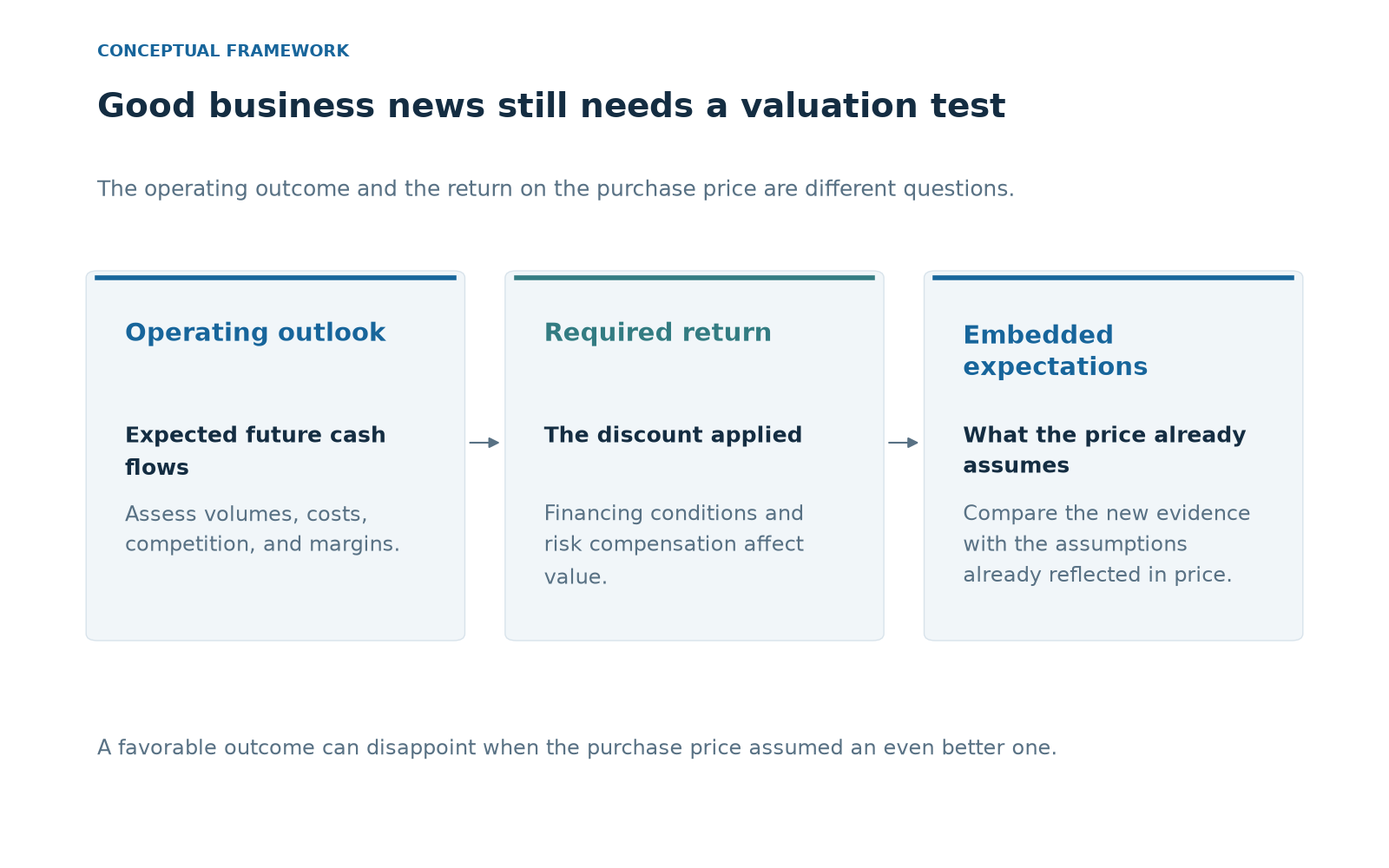
Separate the quality of the operation from the return on the purchase price. Even a well-run garage can leave the investor with an inadequate return at an aggressive bid. A lower price can compensate for identifiable risk, subject to the investor's ability to finance and tolerate the adverse case. The August evidence improved the description of the economic environment. It did not repeal arithmetic. Before treating slower inflation as a reason to pay more, identify how much extra cash the price assumes, who is contractually entitled to that cash, and how long the right to collect it actually lasts.
Related research

Weekly Research
July Inflation Moderates Without Ending the Policy Debate
August 10–16: the latest price data offer relief, but the underlying path remains conditional.

Weekly Research
The Late-Summer Review Should Stress Both Rates and Earnings
August 24–30: one favorable scenario is not enough to assess portfolio resilience.

Weekly Research
July Payrolls and Unemployment Move in Different Directions
August 3–9: the two labor measures require an explanation, not a forced reconciliation.