
Monthly Research
March 2026: A Wider Range of Outcomes Enters the Policy Discussion
- Report or archive date
- Coverage March 1–31, 2026
- Reading time
- 14 min read

Summary
The labor and inflation evidence must be read alongside explicitly recognized geopolitical uncertainty.
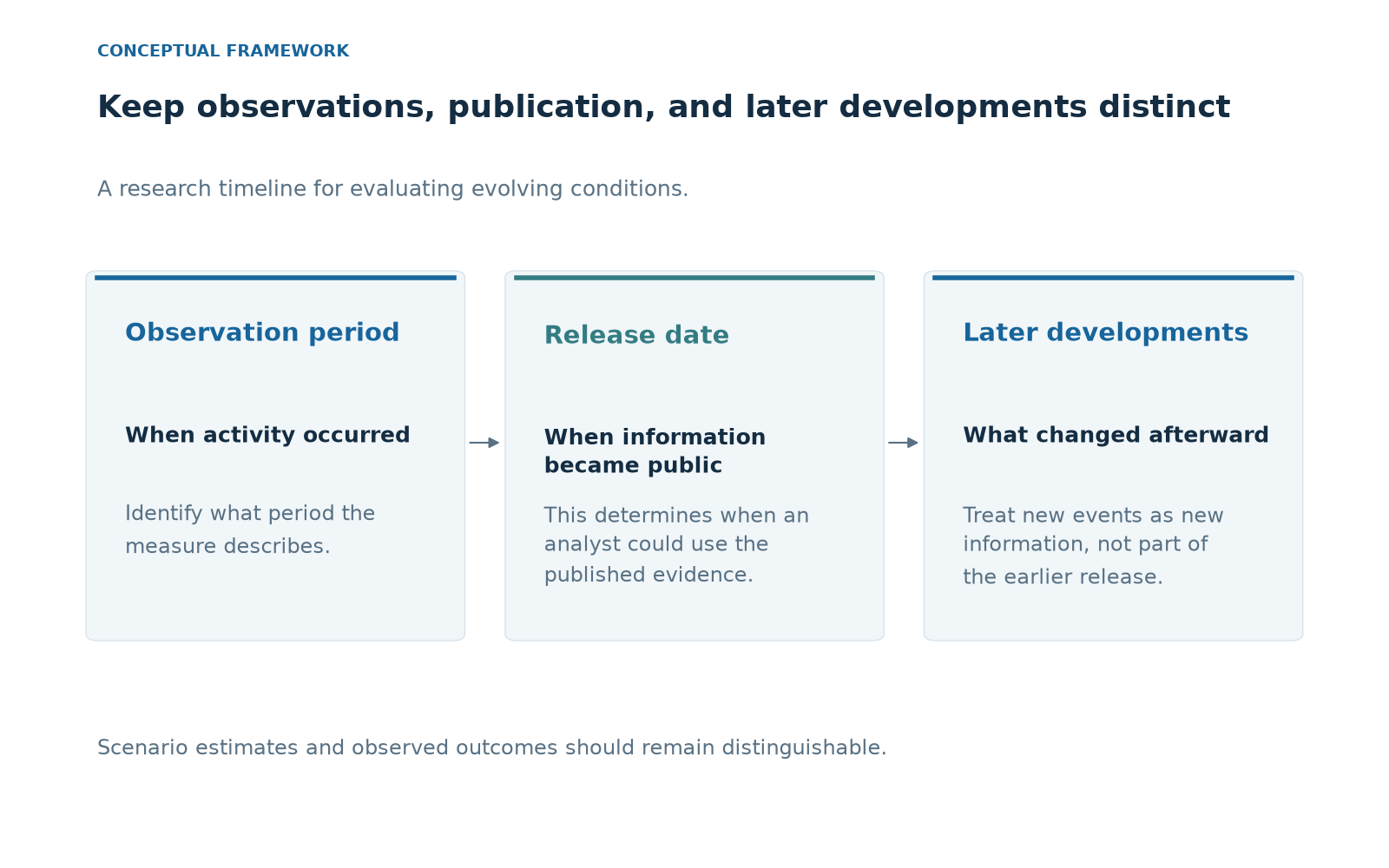
On the last day of March, a business could buy fuel at an actual quoted price, sign an actual sales contract, and owe a bank an actual payment. It could not yet read the U.S. consumer price index for the whole of March or the employment report for the same month. That gap is central to a retrospective review. By March 31 the available evidence included February's payroll decline, February consumer prices, and the Federal Reserve's decision to maintain its policy range while acknowledging uncertainty about developments in the Middle East. Later information may help explain which scenario materialized. It cannot be inserted into the decision file as if management already possessed it.
The central question changed in March. January and February had supplied increasingly detailed observations about employment and prices. March required an investor to ask how existing commitments would behave if costs and demand moved in unfavorable directions at the same time. It was no longer enough to model a strong economy and a weak one along a single line. A company could face firm selling prices, soft volumes, higher input expense, and customers asking for longer payment terms all at once. What mattered was which of those changes it could absorb and which could force a decision before the next official release.
The evidence had three different dates
On March 6 the initial payroll estimate showed a February decline of 92,000 and unemployment of 4.4 percent. Strike activity contributed to a reduction in health care payrolls, while information and federal employment also trended down. The release put January's increase at a revised 126,000. Adding January and February gave a two-month gain of 34,000 on the estimates then available. An average of 17,000 per month smoothed the contrast without establishing that underlying hiring was rising steadily at that pace. The two months had different industry composition and different temporary influences.
On March 11 the February consumer price release showed a seasonally adjusted monthly rise of 0.3 percent for all items and 0.2 percent excluding food and energy. The year-over-year rates were 2.4 percent and 2.5 percent respectively. These observations established the consumer price baseline through February. They did not observe the full effect of any change in the following month. A business contemplating a new delivered-price quote could not infer its March freight bill by multiplying last month's headline CPI by its inventory budget.
On March 18 the Federal Reserve maintained the federal funds target range at 3.50 to 3.75 percent. The statement noted uncertainty about the U.S. economic implications of developments in the Middle East. That language identified an issue capable of affecting the outlook without fixing the size, direction, or duration of the effect. A central bank can be attentive to employment weakness and inflation pressure simultaneously. A decision to hold its target range does not settle whether a particular lender will renew a loan, whether a particular borrower can recover more expensive inputs, or whether consumers will accept a higher price.
Putting these dates in order matters to evidence quality. A payroll figure observed in February and released in early March can describe an important vulnerability entering the month. It cannot prove that a later development produced that February figure. A policy statement can acknowledge uncertainty without claiming that a particular price movement has occurred. An investor who keeps the event, measurement, and publication dates separate can revise a view as evidence arrives without quietly granting the earlier portfolio manager the benefit of later observations.
Reconstruct a business that has to commit now
Imagine a regional cold-storage operator serving food distributors. It rents space by the pallet, pays for electricity continuously, and has debt payments due monthly. Customers pay invoices thirty to sixty days after service. The business cannot switch off occupied refrigeration units to save money when the energy market becomes uncertain. It can negotiate a surcharge on some contracts, defer a planned building addition, or seek more working capital. The existing contracts determine which decisions are available and when each can affect cash.
Start with a month in which storage revenue is $1 million. Electricity costs $200,000, other operating cash costs $600,000, and scheduled interest and principal payments total $100,000. Before taxes, capital spending, and working-capital changes, the operator has $100,000 left after debt service. If electricity expense rises by one-quarter with usage unchanged, it becomes $250,000. If nothing can be passed through, the remaining amount falls to $50,000. Electricity rose 25 percent while the residual available for other needs fell 50 percent. The denominator changes between the two statements.

Now assume specified customer contracts allow the firm to recover half the extra electricity cost with a two-month lag. Once billed, the surcharge is $25,000 per month under the sustained price assumption. If customers pay a month after billing, the operator can face approximately three months of additional outlay before collecting its first recovery. The contract's detailed treatment of intervening costs determines whether earlier months are eventually reimbursed. A decision-maker should distinguish a permanent loss, a deferred receivable, and cash needed to cover the collection gap. The three can appear in the same conversation under the loose phrase “we can pass it through.”
Physical utilization introduces another dimension. Refrigeration systems have costs even when a building is partly empty. If a distributor stores fewer pallets, revenue may decline faster than electricity consumption. If high inventory occupancy reflects customers' goods moving more slowly, occupied capacity might look strong while the risk of late payment rises. A warehouse photo cannot show either condition. The relevant records are pallet-days, average revenue per pallet-day, kilowatt-hours per occupied unit, customer payment dates, and minimum charges. Those observations move the research process from a macro theme to a balance sheet exposed to it.
A two-by-two scenario that can change a decision
Review the operator under two independent-looking questions. Does energy expense rise? Do customers retain their storage volume? Compare four combinations before assigning probabilities. If energy remains at $200,000 and revenue stays at $1 million, the cash remaining after debt service remains $100,000. If energy rises to $250,000 with that revenue intact, it falls to $50,000 before surcharge collections. If revenue drops to $920,000 with energy unchanged and other costs temporarily fixed, it falls to $20,000. If both unfavorable changes occur together, the result is a $30,000 deficit.
The fourth cell is the important one for liquidity. Each individual adverse development leaves a positive amount, and a committee looking at only one variable at a time could conclude that the operation retains a cushion. Allowing both to change reveals a deficit. The common cause could be more expensive food delivery reducing customer volumes and higher power costs reaching the storage operator. Check whether both changes could occur together for this business. Assuming independence solely because the two inputs occupy separate rows in a spreadsheet can understate exposure.
There are practical ways to improve the grid. Split other costs into genuinely fixed obligations and costs that decline with activity. Account for minimum monthly charges on take-or-pay contracts. Allow energy usage to fall somewhat with lower occupancy if the plant can consolidate goods into fewer zones. Add a payment lag if weaker customers take longer to pay. Each addition should change the estimated cash profile for an identifiable reason. Adding several arbitrary percentage shocks simply to make a downside case look severe does little to clarify what management could actually do.
A useful scenario also identifies an action threshold. If monthly cash use exceeds a certain amount for three successive months, the operator may have to draw its credit line. If a major customer fails to renew, a proposed expansion may no longer meet its return requirement. If a surcharge begins earlier than expected, the business may retain enough cash to avoid delaying maintenance. A forecast need not predict one outcome precisely to identify which decision will become unavoidable and the date on which the board must make it.
The payroll link runs through people and payments
The February payroll decline called for a careful look at household income without declaring that every affected worker had lost a permanent job. A worker absent from payroll for an entire reference pay period during a strike can later return. The worker may still experience a missed paycheck, a late bill, or a need to delay a purchase. A business can lose receipts while services are interrupted and regain some of them later. A temporary observation in the national series can therefore produce real, uneven cash effects at the household and firm levels.
The storage operator's most immediate employment exposure is its own staffing. It needs employees to receive and move pallets safely. Cutting hours too aggressively can delay deliveries, breach contract standards, and reduce revenue. Retaining staff during a brief disruption can be less expensive than losing a skilled crew and recruiting again. If the underlying problem is a lasting reduction in demand, the same decision can erode liquidity. A payroll forecast should show how long management expects to maintain capacity and what new contracts or volume thresholds would justify a change.

Its customers introduce an indirect employment exposure. Restaurants, retailers, and distributors serve households whose spending depends on income stability as well as price levels. A worker uncertain about next month's hours might shift from restaurant meals to groceries. That could change the types of food stored, turnover speed, and customers using the facility without a large change in total calories purchased. An investor who simply lowers the warehouse's revenue in proportion to national job losses would miss the mix effect. Contracts and actual occupancy patterns offer more direct evidence.
Examine the supplier side too. A refrigeration maintenance company could face robust demand for emergency repairs even as clients postpone discretionary upgrades. Its service employees may remain busy while its new-equipment orders fall. A lender evaluating that supplier should separate contracted maintenance receipts, one-time emergency calls, and proposed installations awaiting financing. Broad employment weakness can be relevant to all three activities without determining any one of them. This is the benefit of starting from a business process rather than trying to extract a complete investment signal from a single headline statistic.
Price exposure depends on whose price is fixed
A long-term agreement can protect a buyer and expose a seller. If a retailer has a fixed delivered price from its food distributor, it may initially experience little cost increase even as its distributor pays higher freight. If the distributor also has a fixed storage fee, the cold-storage operator may bear more of the pressure. Follow the contract boundaries before adding up industry effects. A price that one business successfully passed on appears as another's added expense unless a final buyer pays more, product quantities change, or some other cost offsets it.
Suppose a storage contract pays $80,000 per month and costs $65,000 to fulfill, including $20,000 of power. A 25 percent rise in that power component adds $5,000, cutting contribution from $15,000 to $10,000. An immediate $3,000 contract surcharge would restore contribution to $13,000, assuming no change in other costs or customer volume. If a customer can cancel and shift to a competing warehouse, recovering a larger amount on each retained pallet could still reduce total contribution. The right measure for pricing power is the contribution earned after the customer's response, not the size of the surcharge the seller announced.
A contract reset can also create an apparently favorable quarter followed by a difficult one. Old inventory, a favorable energy agreement, or a prior hedge can delay the effect of new prices. If an analyst annualizes the protected quarter, the forecast implicitly assumes that old terms can be renewed. The same error can run in reverse after a temporary surcharge catches up with earlier costs. A monthly review should identify several dates: when the current cost protection expires, when the customer price may reset, when the new invoice is issued, and when the customer normally pays.
The inflation debate often uses the language of second-round effects. At the business level, a second round is a sequence of decisions that can be documented. A supplier raises an invoice. A buyer accepts, negotiates, or switches. A retailer changes its price or its assortment. Households alter quantities or spending elsewhere. Workers and employers respond through hours, wages, or hiring. The sequence need not complete every link. The February CPI data established part of the starting consumer basket. Whether subsequent costs would spread required new transactions and further observations beyond the monthly cutoff.
A balance-sheet test beyond the policy meeting
Assume the storage operator has $250,000 in unrestricted cash above its ordinary working minimum and a $180,000 principal payment due in ninety days. Under the unfavorable joint scenario, a $30,000 monthly deficit for three months uses $90,000. If the $180,000 payment is additional to the monthly debt service already included, the two uses total $270,000, exceeding the available cushion by $20,000. Stating explicitly that the balloon is additional prevents double-counting debt service. The immediate question becomes whether the operator can finance $20,000 plus any necessary reserve for further uncertainty.
A lender may reasonably insist on more than that bare minimum. A major customer paying thirty days late could easily require additional cash. The plant may need critical maintenance that cannot be deferred safely. A credit facility may include a covenant tested at quarter-end. The borrower can address these issues by confirming available borrowing, negotiating the balloon earlier, seeking a deposit from customers on unusually large inventories, or reducing spending that is genuinely discretionary. Each action has terms and trade-offs. A generic promise to conserve cash offers little evidence unless it identifies the payment that will change.
A long-term investor can reach a different conclusion about the same operation. If the facility occupies a hard-to-replace site, has loyal customers, and can obtain bridge financing, a temporary liquidity deficit need not destroy its economic value. If the financing gap forces a sale before rents or margins recover, owners can lose value in a business that would eventually have been viable. The equity and credit analyses meet at the dates when control over the asset could change. That is where the March policy backdrop becomes relevant through actual available financing terms rather than through a rate headline.
The question hidden in the accounts receivable balance
A balance expressed as days of sales can make an otherwise manageable shortfall look smaller or larger depending on the sales period used. Suppose a business has $1.5 million of receivables and invoices $1 million in a thirty-day month. Dividing the balance by average daily sales gives forty-five days. If new monthly sales fall to $750,000 before older receivables are substantially collected, the same $1.5 million balance becomes sixty days against the lower sales run rate. The apparent deterioration in days can arise partly from the denominator. Conversely, rapidly growing billings can make days look stable while older invoices become harder to collect.
For the cold-storage operator, the better follow-up is an aged list by customer, along with payments actually received after the statement date. Several small accounts routinely paying on the forty-fifth day present a different risk from a single disputed invoice representing two months of forecast cash cushion. A dispute over whether a surcharge was permitted can delay the original charge as well as the disputed amount, depending on how the customer processes payments. That is another reason to examine acceptance of the contract terms before treating newly billed surcharges as cash available for a loan installment.
The portfolio analyst can ask a parallel question about the bank lending to the operator. Is the credit line secured by all receivables or only by eligible invoices within a defined age? Does a dispute suspend eligibility? If the customer payment is delayed and the borrowing base shrinks at the same time, two sources of liquidity disappear together. Modeling the late receipt while assuming unchanged borrowing capacity can understate the effect. A signed waiver, a new cash deposit, or a payment from the account in dispute would be concrete evidence that the risk had diminished. A more favorable general growth forecast would still leave the operational question open.
A receivable can stop qualifying as collateral just as a principal payment comes due. A company with apparently adequate annual operating profit and a willing lender can still run short in the week when an invoice becomes ineligible and principal comes due. Conversely, a verified collection before that week can cure the shortfall without any improvement in the global outlook. Compare the bank’s eligibility cutoff with the date the customer’s payment cleared. A receipt in the following week cannot pay an installment already due this Friday.
What March leaves open
As of March 31, the complete March employment and consumer price reports had yet to appear. It was too early to establish how long external uncertainty would persist, whether customers would accept new charges, and how much of any cost movement suppliers had already contracted away. The available evidence included a February labor decline with an identifiable temporary element, a measured February consumer price increase, and a March policy decision recognizing uncertain economic implications. Those facts support conditional analysis with specific tests.
For the storage operator, the next tests are signed surcharge terms, actual occupancy, power bills, collections, and the financing of the ninety-day balloon. For the board, they include the lowest projected weekly cash balance under alternative combinations of demand and cost. For an investor holding the operator alongside its lender and its largest customer, they include the common exposures the three positions share. None requires the false precision of declaring exactly where an energy price or a policy rate will be in six months.
March's contribution to the research record is a wider set of plausible outcomes and a way to distinguish them. When a business is exposed on both its cost and its demand sides, modeling either side in isolation can produce a misleading sense of safety. When payments come due before the data do, waiting for certainty can itself be expensive. An analysis that names the contract, the cash balance, and the decision date can remain useful even before the economic statistics catch up.
Related research

Monthly Research
February 2026: Better Detail, Still No Single Economic Verdict
Employment and inflation data sharpen the questions about purchasing power and earnings quality.
Monthly Research
April 2026: The Energy Shock Becomes Visible in Consumer Prices
A large headline increase and a conditional global forecast sharpen the growth-inflation trade-off.

Monthly Research
January 2026: A Stable Policy Rate, an Uneven Evidence Base
The opening month establishes a framework for comparing labor, inflation, and global growth.