
Weekly Research
October Hiring Improves the Initial Labor Picture
- Report or archive date
- Coverage November 2–8, 2026
- Reading time
- 10 min read

Summary
November 2–8: the latest employment release supplies a firmer observation after September.
In a warehouse handling parcels for several retailers, the most important measure before the holiday season may be how many packages reach the correct truck before the dispatch cutoff. Hiring more workers can improve that figure if labor was the constraint. It can leave output unchanged if sorting equipment is already running at capacity or if parcels arrive too late to load. October's U.S. employment release showed a stronger labor market observation and substantial upward revisions. For an investor, the opportunity is to identify where stronger hiring is converting into productive activity, where it represents a costly bet on future demand, and what the report genuinely changed about the preceding months.
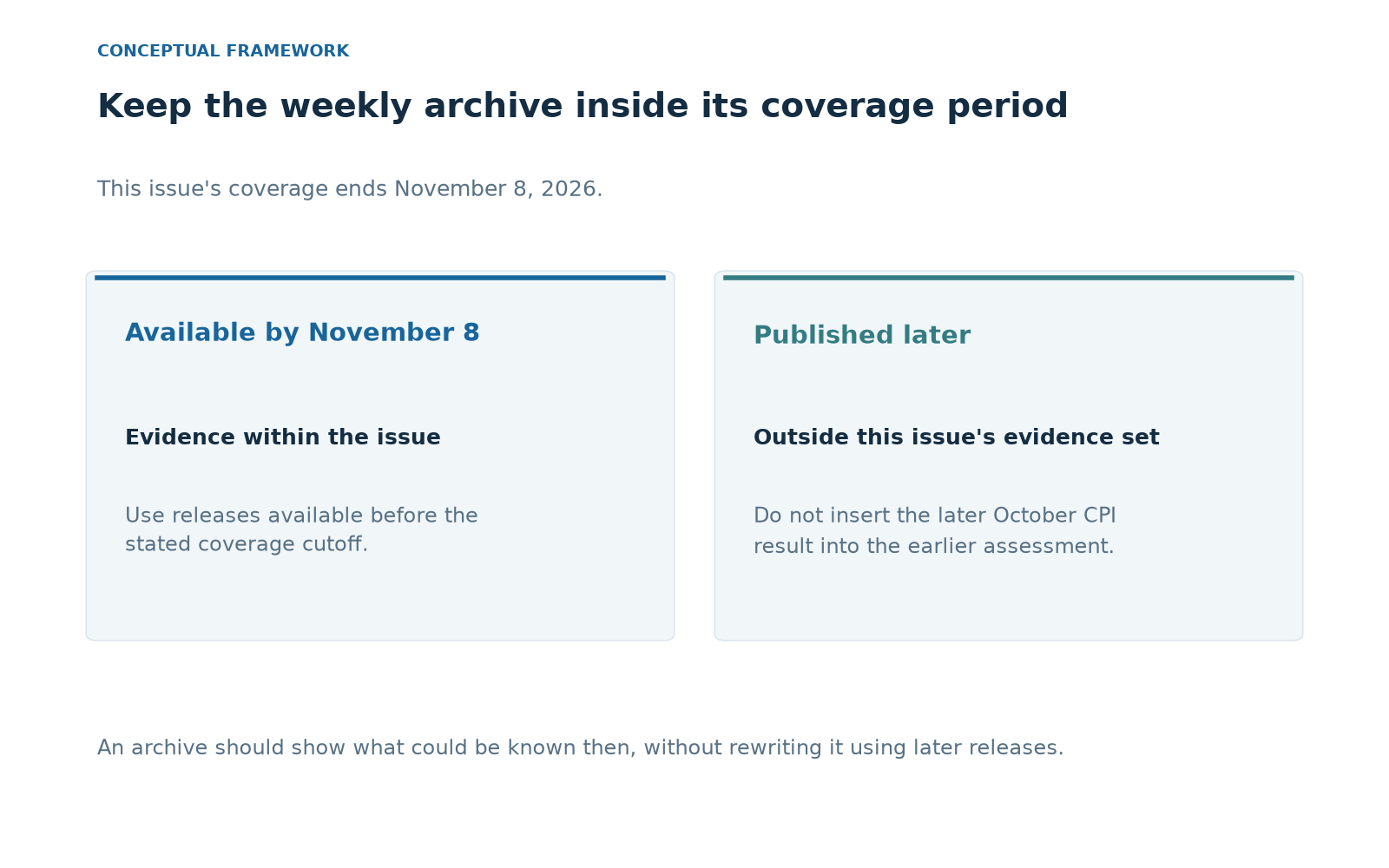
The November 6 release initially put the October nonfarm payroll gain at 165,000, above the preceding twelve-month average of 48,000. The unemployment rate was 4.1 percent and had remained in a narrow range since March. Professional and business services, health care, and transportation and warehousing were prominent contributors. The gains were meaningful after September's initial estimate of only 29,000. But October was a new reference period, and the same release rewrote part of the summer history. By this week's November 8 cutoff the October CPI reading had not yet been released, so October real earnings cannot be calculated using an observed October CPI figure in this issue.
The revision tells nearly as much as the headline
August payroll growth was revised from 133,000 to 186,000, and September from 29,000 to 60,000. Together the revisions added 84,000 jobs to the previously reported changes for those months. The new three-month sequence is 186,000, 60,000, and 165,000. The sum is 411,000 and the average 137,000 per month. That recent average is materially higher than the 48,000 average over the prior twelve months identified in the release. It is not a guarantee of the pace the labor market can sustain, especially since two of the three observations have already been revised and the last is initial.
Nonfarm employment estimates carry a release date. The October 2 release initially estimated an increase of 29,000, which was the evidence available to readers at that time. The November release raised that estimate to 60,000. Calling September a month with 29,000 current estimated gains would ignore the revision. Using 60,000 in a simulation of an October 2 trading decision would introduce information that was unavailable that day. A new vintage changes what a current economic history should display without changing what a previous observer could reasonably have known. The distinction is important for evaluating forecasts and for backtesting any investment rule that purports to react to public information in real time.
A net job gain is also different from the amount of new information about the payroll level. If one adds the 84,000 revision to the 165,000 new monthly estimate, the combined update is 249,000 relative to a baseline extending the previous reported path with no October growth. It is not an October hiring figure of 249,000. Businesses made their August and September staffing decisions before the new surveys were complete. Revisions reflected additional responses and updated seasonal calculations. The data process improved our knowledge of the past; it did not create jobs retroactively. That simple distinction prevents a surprisingly large error in interpreting the latest momentum.
Where the jobs were reported
Professional and business services gained 70,000 jobs. The increase included roughly 33,000 in professional, scientific, and technical services, 28,000 in administrative and support and related services, and 9,000 in management of companies and enterprises. The three groups add to the 70,000 total. Treating a parent sector's increase as an extra amount on top of its components would double count. The gains cover many kinds of work with different wages and demand drivers. They cannot be assigned wholesale to artificial intelligence or corporate consulting simply because those activities appear within broad professional categories.

Health care gained 42,000 jobs, including 16,000 in hospitals and 11,000 in home health care. Transportation and warehousing added 25,000, including 17,000 in couriers and messengers and 4,000 in air transportation. Taken together the three major sectors contributed 137,000, roughly 83 percent of the net headline gain. Manufacturing continued to trend up by 19,000, with gains in computer and electronic products, machinery, and primary metals. The remainder of the aggregate reflects the net of many sectors and rounding. These observations demonstrate both a firmer total and noticeable concentration. It is possible for a national hiring picture to improve without the same improvement appearing in every industry or local labor market.
A company can also move a job between classifications without materially changing the underlying service. A retailer shifting delivery work from in-house staff to an independent courier may reduce staff at the store and increase jobs at a transportation provider. Customers can receive the same number of packages. A new route serving previously inaccessible neighborhoods, by contrast, can require more staff and deliver genuinely more output. To distinguish those stories, look for parcel counts, stop density, service days, and service contracts at the particular companies. Payroll classification helps locate where labor is paid; it does not fully describe the end market generating the work.
What the household survey adds
The household survey put participation at 61.9 percent and the employment-population ratio at 59.3 percent. Both showed little net change since January in this release. The number unemployed was about 7.1 million. People working part time for economic reasons increased by 339,000 to 4.8 million, even with the stronger payroll result. The group includes people working fewer hours than they would prefer for economic reasons. They are employed, so an increase in that group does not automatically raise the unemployment rate. An economy can add payroll positions and still leave a significant number of people seeking more hours.
Long-term unemployment also persisted, accounting for 27.6 percent of people classified as unemployed. This percentage does not describe the entire workforce. For households, an extended spell without earnings can be more damaging than a brief gap between jobs even if both people are counted as unemployed during a survey week. For lenders, the difference can show up in the depletion of savings or a gradual rise in revolving balances. The aggregate labor data can motivate examination of these risks, but they do not reveal credit performance at a particular bank. The loans, underwriting, and geographic exposure must match the labor conditions being analyzed.
Average hourly earnings for private nonfarm employees rose fourteen cents to $38.00, up 0.4 percent for the month and 3.1 percent over twelve months. The average private workweek remained 34.4 hours. Multiplying the two rounded current levels gives $1,307.20 of weekly gross earnings at these average measures. The increase of fourteen cents an hour corresponds to about $4.82 over 34.4 hours if hours are unchanged. These calculations do not account for taxes, benefits, or the changing mix of jobs. Nor do they measure how much more the average worker could buy without a matched price observation for the same period.

An extra shift at the parcel depot
Consider a depot sorting 24,000 packages each night. It employs thirty sorters working eight hours each, or 240 paid sorter-hours, giving an average of 100 packages per sorter-hour. Management is considering adding six workers to cover increased volumes. If total packages rise to 28,800 and hours rise proportionally to 288, physical productivity remains 100 packages per hour even though total output and payroll increase. If packages rise to only 25,200 at the new staffing level, productivity falls to 87.5 per paid hour. The second case can still be worthwhile if the new staffing reduces missed connections or damage. The point is to measure the reason for adding staff before judging the result.
Suppose the depot receives a net handling fee of $1.10 per additional package, with 35 cents of variable nonlabor expense. The six additional eight-hour shifts cost $1,200 per night at a fully loaded $25 an hour. The incremental contribution per package before those new wages is 75 cents, so it needs 1,600 additional packages per night to cover the shift cost under these assumptions. An increase from 24,000 to 25,200 supplies 1,200 extra packages and $900, leaving a $300 shortfall. An increase to 28,800 supplies 4,800 extra packages and $3,600, leaving $2,400 after the extra wages. A staffing decision can be reasonable under one plausible volume and costly under another.
The machinery can invalidate either estimate. If a conveyor can process only 26,000 packages before the last truck leaves, the optimistic 28,800 case cannot be realized on that shift without a faster sort, different arrival times, or more dispatch capacity. At 26,000 actual packages the 2,000 incremental packages contribute $1,500 before new wages and $300 afterward. That is positive but much smaller than the $2,400 in the unconstrained case. It may not justify a new capital purchase. A convincing claim of profitable growth should match available labor, equipment throughput, inbound arrivals, and outbound dispatch windows on the same clock.
The value of service quality can be measured
Suppose missing a departure creates an average $4 in rehandling and contractual penalties per affected parcel. If the new workers prevent 150 missed departures for individual parcels nightly, the expected saving is $600 per night. Added to the $300 shortfall in the low-volume case, it changes the net effect to a $300 benefit, provided the penalty saving is not already counted in the 35-cent variable-cost assumption. This is why an apparently unproductive additional shift can make commercial sense. The relevant denominator might be packages dispatched correctly on time, not raw packages moved past a scanner.
Measure the same outcome across comparable nights. Weather, promotional campaigns, the mix of small parcels and oversized goods, and the timing of inbound flights can all change sorting volume and missed connections. A reduction in incidents after new staff arrive could instead reflect a lighter product mix or an earlier arrival schedule. The communication between operations and finance should specify which improvement is expected, how long training will take, and what happens if volume falls after the seasonal peak. Counting every temporary holiday shift as a permanent increase in productive capacity would overstate the long-run payroll and earnings implications.
Working capital matters as well. Wages and fuel may be paid weekly, whereas the principal retailer pays its handling bill forty-five days later and can dispute service charges. The depot may need extra short-term borrowing in its busiest, most profitable month. A lender should check receivable eligibility, contract concentration, and accrued penalties alongside gross volumes. A shareholder may care whether the depot earns a proper return on the conveyor required to remove its bottleneck. Both might welcome the reported growth in couriers and transportation employment while reaching different views of the value of a particular depot.
What this changes about the broader outlook
The employment release strengthens the evidence of recent labor demand relative to what was known a month earlier. It does not eliminate the distinction between quantity of jobs, hours available, and purchasing power. Nor does it settle the path of inflation. On October 28 the Federal Reserve retained its target range of 3.75–4.00 percent, with two dissenters preferring an increase. October's jobs report arrived afterward. A reader can discuss how the new evidence might affect a future assessment, but should not attribute the October policy vote to this subsequently released payroll number. The order of events matters as much as their content.
The U.S. two-year Treasury par rate declined from 4.56 percent on October 30 to 4.51 percent on November 6. The ten-year fell from 4.94 to 4.86 percent over the same endpoints. These five- and eight-basis-point moves do not mean stronger hiring mechanically lowered yields. The market had expectations, revisions contained separate information, and the comparison spans a week of other events. It does demonstrate why a simple rule tying every strong payroll report to a higher weekly closing yield is unreliable. For a corporate borrower, the actual new rate also includes credit spread and contractual terms.
One detail can change how the depot interprets its own payroll increase. An outside staffing firm may supply temporary sorters whose wages appear in the staffing firm's industry, while the depot records a purchased service. Bringing those same workers onto the depot payroll can raise its headcount without adding a single package of capacity. Moving skilled dispatchers the other way can have the opposite effect. A useful internal comparison includes hours purchased from contractors as well as hours paid directly, while keeping the two costs visible. That helps distinguish a change in who issues the paycheck from a change in how much work the transportation network actually performs.
Four observations would help establish whether the gains are lasting. Are employment gains broadening beyond the largest contributing industries? Are people who want more hours finding them? Do the revisions remain favorable, and does actual output support the higher payroll cost? In the depot those questions become packages, paid hours, missed departures, and collected handling fees. At the national level they require additional labor and price releases and attention to how sectors fit together. As of November 8 the initial October gain and the upward revisions deserved a firmer labor assessment. The quality and durability of that improvement remained questions to investigate, not assumptions to insert into every earnings forecast.
Related research

Weekly Research
October’s Hold Leaves Inflation at the Center of the Assessment
October 26–November 1: a stable target range does not establish that the tightening cycle is finished.

Weekly Research
October CPI Adds Evidence, With a Missing Annual Comparison
October consumer and producer prices and a new reading on unemployment claims shed light on different parts of the inflation and demand picture.

Weekly Research
The Latest Inflation Reading Needs a Margin and Demand Test
October 19–25: the price shock matters through the behavior it produces.