
Weekly Research
Opening the Year With a Conditional Policy Baseline
- Report or archive date
- Coverage December 29, 2025–January 4, 2026
- Reading time
- 10 min read

Summary
The Fed’s December minutes and year-end claims show why a policy decision and its effects follow different timelines.
The calendar changed in the middle of this reporting week; the policy rate did not. From Monday, December 29, 2025, through Sunday, January 4, 2026, the starting point for U.S. borrowers was the federal funds target range of 3.50%–3.75% set on December 10. Two publications made the week worth examining in its own right. The Fed released the record of its December meeting on Tuesday. On Wednesday, a new reading on unemployment claims gave readers a more recent, if narrower, view of the labor market. One release looked backward at a decision; the other measured applications for benefits. Reading them in publication order helps explain what changed over the week without suggesting that either the holiday or the release of the minutes constituted a second policy decision.
Tuesday: read a disagreement in both directions
The minutes released December 30 describe a meeting held on December 9–10. The distinction is more than a footnote. A decision affects the policy setting when it takes effect; a record of the discussion can later change the way people understand that decision without changing the rate again. The vote offers a useful example. Two dissenters preferred no change, and a different dissenter preferred a half-point cut. Counting all the dissents as votes for a tighter stance would put one voter on the wrong side of the argument. Nor does counting the votes forecast how the same people would vote at their next meeting. A vote is tied to the information and the alternatives before the committee at the time. Evidence that arrived after the meeting was not evidence the committee could have weighed at it.
A useful way to read those positions is to ask what sort of mistake each approach seeks to avoid. Holding rates steady can reflect concern about easing while price pressures are still persistent. A larger reduction can reflect concern that waiting for clearer signs of weak employment will delay relief until after the damage is done. These are ways to understand the competing risks, not claims about anyone’s private motives. They also suggest different tests. A broad and sustained easing of price pressures would matter for the first concern; deterioration across hiring, hours and income would matter for the second. A single improvement in either area would not settle the balance between them. The minutes helped frame the questions. They did not provide a schedule of answers for the new year.
Wednesday: why fewer claims and a higher average can coexist
The December 31 release put initial unemployment claims for the week ending December 27 at 199,000, a seasonally adjusted advance estimate. That was down 16,000 from the revised prior week’s 215,000. Yet the four-week average rose to 218,750 from a revised 217,000. Readers could easily extract opposite headlines from the same page. Both figures are internally consistent. The weekly comparison asks whether the latest observation was higher or lower than the one immediately before it. The moving average also drops an older observation as it adds the newest. Its direction therefore depends on a different comparison. Neither figure needs to be discarded to make the other one true. It is the question attached to the figure that determines which is more useful.
There is a practical check on the arithmetic. The average rose by 1,750. Across four weeks that means the sum in the window rose by 7,000. If the three overlapping observations are held fixed at the same release vintage, the new observation of 199,000 therefore replaced one of 192,000. A new observation can be smaller than last week’s 215,000 yet bigger than the observation leaving the average. That is the entire apparent paradox. The 192,000 is an implied figure from the published averages under that overlap assumption, not a separate estimate of new layoffs. The distinction matters whenever a note compares releases: a revision to one of the overlapping weeks can also move the average. Rebuild the calculation using one vintage before attributing the difference to economic news.

Initial claims count applications for unemployment insurance. They do not count all job losses, all people without work, or newly created jobs. Someone entering the labor force for the first time need not appear; neither must someone who loses work but does not file a claim. For an employer evaluating demand, the weekly figure is one clue about separations, not a substitute for customer orders or hours worked. For a household considering a loan, the national total is even further removed from the stability of a particular paycheck. The year-end release is valuable because it is timely. Timeliness should not be mistaken for complete coverage. A stronger labor-market inference would require corroboration from measures that include hiring and continued employment, not simply a more emphatic interpretation of one holiday-week observation.
Follow the contract before assigning the benefit of a cut
Consider two manufacturers with the same outstanding debt and similar orders. One pays a floating reference rate plus a contractual spread. The other locked in a fixed coupon for several years. If the floating benchmark falls and the contract resets, the first firm may see lower payments soon. The second does not receive a retroactive discount on debt it already issued. Its opportunity may come at refinancing, when the benchmark, its credit spread and issuance fees could all differ from today’s. The fact that the firms make similar products does not give them the same cash-flow response. A useful first line in a research note is the part of the balance that actually reprices, followed by the reset date. The national policy rate alone supplies neither piece of information.
The difference can be illustrated without forecasting a market rate. Suppose a business has $2 million of debt outstanding, half of it floating. If the rate on that half falls by a quarter of a percentage point for a full year, simple annual interest expense falls by $2,500 before taxes. Apply the change to the whole balance and the answer incorrectly doubles. Apply a full year of savings to a loan that resets halfway through the year and the timing is wrong even with the correct principal. In this example there is no floor, no change in the spread and no change in the outstanding balance. Those conditions do not come bundled with a central bank announcement. They have to be checked against the agreement. An economic story becomes a cash-flow estimate only after that work is done.
The same distinction matters to savers. Lower short-term rates may reduce the interest available when a deposit matures, but they need not alter the interest already promised on an existing fixed-term deposit. A household that both holds deposits and owes on a floating loan faces effects on opposite sides of its balance sheet. Comparing only the loan payments would exaggerate the improvement in the household’s budget. Comparing only the savings rate could suggest a deterioration where the net effect is favorable. The relevant amounts and dates can differ, so it is rarely enough to subtract one quoted rate from another. List the balance that earns interest, the balance that incurs it, and when each rate changes. This is a more informative starting point than treating every household as uniformly helped or hurt by a cut.

The price of credit includes more than the benchmark
A bank can reduce a reference rate while tightening the conditions under which it will lend. For example, a borrower whose existing contract resets automatically may benefit even while a similar firm seeking a new loan is asked for additional collateral. An increase in the spread on the proposed loan might offset the decline in the reference rate. A shorter maturity might increase the frequency of refinancing, even if the initial coupon looks attractive. None of these outcomes is asserted to have occurred during this week. They are distinct channels to investigate before describing credit as easier. A rate quote identifies a price conditional on being able to borrow on the stated terms. It cannot tell the reader how many applicants qualified or how much they could actually draw.
For a capital project, the cost of money is only one part of the decision. Imagine a supplier considering a new production line. Its expected cash receipts depend on how many units buyers order, how long they take to pay, and whether the supplier must build inventory first. If weaker demand is the reason interest rates have fallen, savings on financing can coexist with a less attractive project. If instead inflation eases while orders hold up, the same interest saving may improve project economics. These examples explain why a rate reduction does not carry a single, automatic implication for corporate earnings. To distinguish them, the researcher would want contract renewal rates, backlog conversion and collection trends. Those records provide information about the numerator of a valuation, whereas the financing discussion often concerns only the denominator.
A balance-sheet operation is a separate question
The December meeting record also discussed short-term Treasury purchases to maintain ample reserves. It is tempting to treat all central bank purchases as interchangeable or to count the purchases as another cut in the policy rate. That shortcut overlooks the stated operating purpose. Reserve balances help banks settle payments. Demand for them and their distribution can affect how smoothly short-term markets implement the intended policy setting. A transaction designed to keep reserves ample can coexist with a debate about whether the rate itself should move. The two decisions use different instruments and address different questions. For this weekly review the practical implication is narrow: keep the target range in one line of the research record, and the arrangements for implementing it in another. Do not add them together as if both were percentage-point changes.
This separation also matters when interpreting bond prices. A short bill, a long government bond and a corporate bond have different exposures even when their prices are expressed in the same currency. The long bond is sensitive to the path of rates over many years and to compensation for holding that uncertainty; corporate credit adds the issuer’s capacity to pay and the terms of the debt. A change in the overnight target does not lock in any particular change in those yields. Comparing periods of unequal maturity, or discussing one issuer as if it represented the entire credit market, can create a spurious transmission story. A stronger comparison holds maturity and credit quality reasonably constant and states what remains unmatched. Without those observations, this report describes possible mechanisms rather than claiming a measured market reaction.
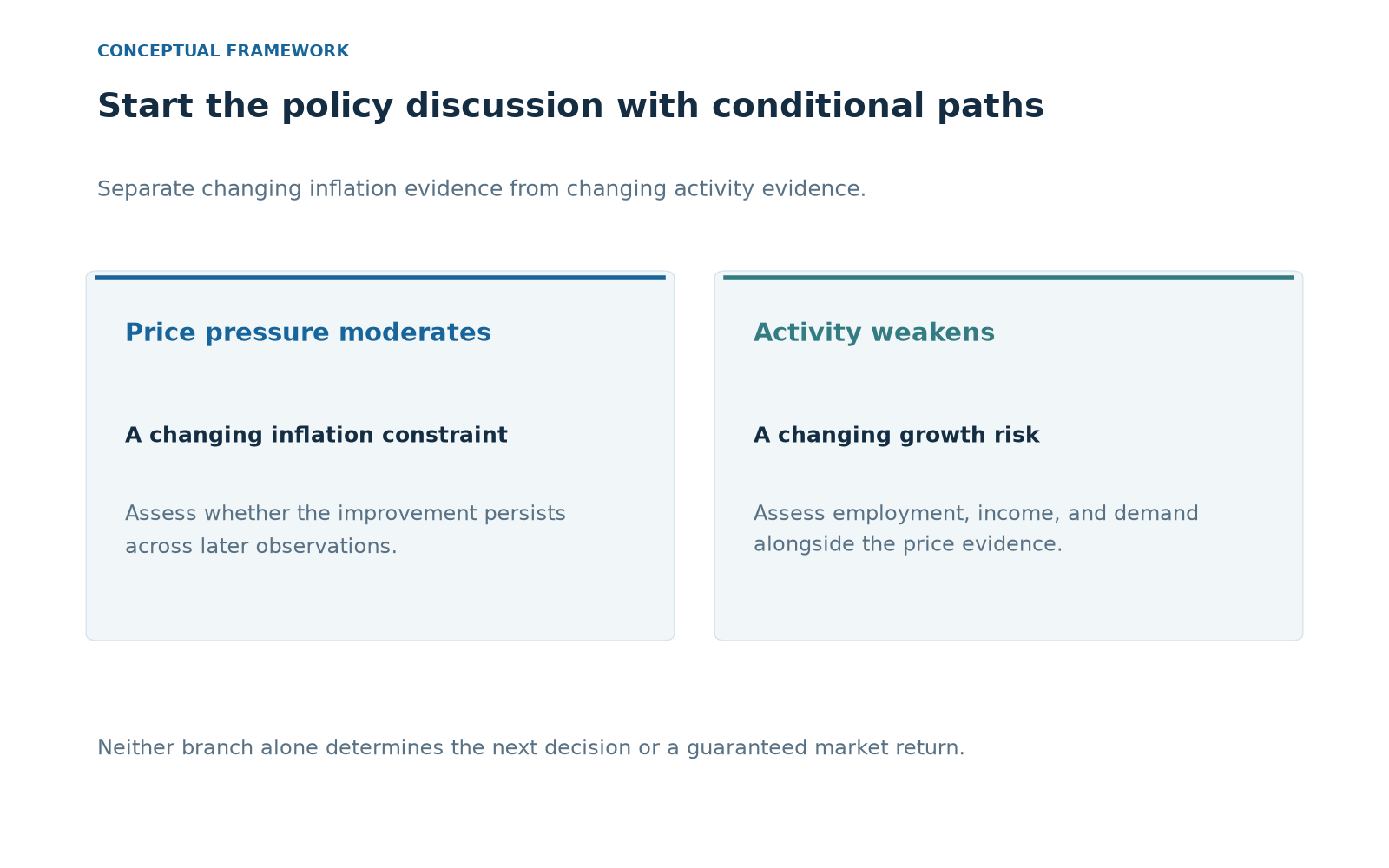
A year-end test for the next research note
Start with a working view that can fail. If stable demand and easing inflation make rate relief more useful to borrowers, one would expect evidence of continued orders, eventual repricing on eligible debt and cash receipts sufficient to fund operations. Each condition is observable in principle, but not necessarily in the same release. A decline in new claims may be consistent with the story without confirming a particular company’s sales. Conversely, an increase in a rolling average need not overturn a company-specific improvement in collections. State what would change the view: evidence of cancellations, rising financing spreads, or a longer delay between delivery and payment. A list of possible explanations is useful only when the reader can also see a way to distinguish them.
A different working view begins with weaker demand. In that case, policy easing might soften a financing burden without preventing weaker sales or lower utilization. Fixed costs then matter: a supplier can sell fewer units while still paying for the same facility. Even a business with little debt may be exposed through buyers who postpone installation or distributors who run down inventory. A fall in interest expense at the supplier would not quantify those indirect effects. To evaluate the alternative, compare the timing of customer commitments with the timing of the supplier’s own financing. A refinancing date gives a reasonably specific point at which interest expense may change. A tentative order or an unsigned budget does not give comparable certainty about revenue. The two inputs should not receive equal confidence merely because both fit in a spreadsheet.
The turn of the year offers a useful discipline for recording uncertainty. Put the measurement period, the release date and the date of the research judgment in separate places. That prevents December’s employment information from becoming evidence of January hiring and prevents the December 30 publication from becoming a December 30 rate cut. Distinguish an estimate that can be revised from a contract term that is already set. Finally, keep the original conclusion visible when later evidence arrives. If a new report changes the interpretation, explain which assumption changed instead of rewriting what was knowable at the earlier cutoff. This approach is especially useful during a holiday week, when a small number of observations can receive disproportionate attention simply because the calendar contains fewer competing headlines.
As of Sunday, January 4, the policy baseline was clear and its consequences were conditional. The minutes clarified the range of judgments behind an existing decision. The claims release supplied a lower weekly reading alongside a higher four-week average. Neither supplied a complete forecast for inflation, demand or borrowing costs. The useful question for the next edition is which transmission channel acquires independent support: repricing in existing contracts, changes in the availability of new credit, or a change in the underlying cash that borrowers earn. Until that evidence arrives, keep the mechanisms distinct, and do not turn a change of calendar into a claim that the economy has already changed direction.
Related research

Weekly Research
Modest Hiring Requires a Wider Labor-Market View
January 5–11: the December employment release provides the first labor anchor of the year.

Weekly Research
Inflation Progress Still Needs Confirmation Beneath the Headline
January 12–18: December CPI offers a useful distinction between total and underlying price changes.

Weekly Research
A Resilient Global Baseline Still Contains Uneven Risks
January 19–25: the IMF’s forecast is a starting framework, not an observed full-year outcome.