
Weekly Research
U.S. Inflation and an ECB Increase Highlight the Policy Trade-Off
- Report or archive date
- Coverage June 8–14, 2026
- Reading time
- 10 min read

Summary
June 8–14: price pressure is a cross-border issue, with different policy responses.
A dollar paid for gasoline in the United States and a euro paid in interest by a European business belong to different accounts. Yet they can originate in the same disruption. When energy becomes more expensive, a household loses purchasing power at the pump, a manufacturer faces a larger bill before its next sale, and a central bank must judge whether the disturbance will spread into prices that adjust less frequently. The week of June 8 through 14 brought evidence on two parts of that chain. The evidence has more to say about how to compare economies than about which central bank will move next.
The American release on June 10 concerned prices consumers had already paid in May. Consumer prices rose 0.5 percent from April on a seasonally adjusted basis. Prices excluding food and energy rose 0.2 percent. The figures over twelve months were 4.2 percent for the full basket and 2.9 percent for the narrower one. Energy prices rose 3.9 percent during May and accounted for more than three fifths of the monthly increase in the full index. Those details put the size and concentration of the price pressure in perspective. They do not establish the path of gasoline, shelter, or wages in June.
In Europe, the governing council announced on June 11 that it would raise its three key rates by a quarter percentage point. The new levels, effective June 17, include a deposit facility rate of 2.25 percent, a main refinancing rate of 2.40 percent, and a marginal lending rate of 2.65 percent. As of the end of this review week the announcement had occurred and the new rates had yet to take effect. The ECB decision concerns the outlook for inflation in the euro area. The American reading concerns realized inflation for a U.S. consumption basket. Putting them in chronological order on a news page does not turn the first country's price index into the second country's decision rule.
Where the energy bill lands
Consider a commercial laundry in a European city. Its largest contract provides sheets and towels to a hospital. A second plant serves hotels. Both plants purchase gas to heat water, and both have revolving bank facilities for the time between washing a batch and collecting payment. The business looks like one exposure when classified by industry. It behaves like at least two when a gas invoice arrives. The hospital pays a set price with an annual adjustment. Hotel work is repriced quarterly but varies significantly with occupancy. Neither plant can simply send yesterday's gas bill to its buyer.
Suppose the hospital plant processes 100,000 pounds a month for $1.20 per pound in the equivalent local currency. For ease of comparison keep exchange rates fixed and express all amounts in dollars. Energy costs $18,000 a month, other variable expenses are $42,000, and fixed cash operating costs are $45,000. The arithmetic leaves $15,000 of operating cash contribution before financing, taxes, and capital expenditure. A 25 percent increase in the unit price of energy adds $4,500 of expense with volumes and energy efficiency unchanged. Contribution falls to $10,500. A one-quarter increase in a single input has cut the plant's contribution by three tenths. Applying the 25 percent figure to the entire expense base would exaggerate the damage. Applying it to national consumer prices would answer an entirely different question.
The example also shows why a lender wants to see the contract. If the annual reset is four months away, four months of extra expense total $18,000 on these assumptions. If the hospital allows a temporary fuel surcharge, the cash gap might close sooner. If the surcharge is approved now but paid in ninety days, reported revenue can improve well before the bank balance does. The hospital has its own budget calendar, and its ability to switch suppliers depends on sanitation requirements and capacity at nearby plants. The commercial question is how the two sides divide the cost and when each pays, not whether higher national inflation mechanically grants one side pricing power.

An announced rate and an actual interest charge
The interest change is smaller in this example, but it can arrive when the operating business has less room. Assume a balance equivalent to $600,000, a one-for-one move of a quarter percentage point in the loan reference rate, immediate repricing, and a constant balance. Annual interest increases $1,500, or about $125 a month before day-count adjustments. Against $4,500 of extra monthly fuel expense this is a secondary first-round effect. If the business draws an additional $200,000 to finance invoices, however, interest on that incremental balance is due at the entire contractual borrowing rate. At a rate of 6 percent, the additional draw alone costs $12,000 annually. Multiplying the new borrowing only by the quarter-point change misses the bigger financing decision.
Most actual loans do not meet all four assumptions. A fixed-rate term loan might have no change in contractual interest before maturity. A floating loan might reset in September against a three-month reference rate that already reflects expectations. The borrower might pay a commitment fee on unused credit, face a leverage-linked spread, or have to post additional collateral. At the bank, wholesale funding and retail deposits can reprice on different schedules. The announced policy change is public. The amount that appears on a particular June bank statement is a contract question requiring balance, benchmark, spread, reset date, and day count.
For equity holders, the crucial question may be whether the laundry can afford a heat-recovery system before the next contract renewal. For lenders it may be whether cash covers payroll and interest if a hospital pays late. For the hospital, a failed supplier could cost more in emergency procurement than a modest price adjustment. The incentives can produce a negotiated outcome that no inflation series forecasts. An analyst can make the financial consequences legible without claiming to know the eventual agreement.
What the U.S. indexes do and do not compare
The 0.5 and 0.2 percent readings describe overlapping baskets with different weights. Subtracting them does not yield the change in food and energy prices. The full basket includes those components and the rest of consumption. The narrower basket reallocates weight across the items it retains. A component's contribution depends on its weight as well as its price movement. That explains how energy can account for a majority of one month's headline increase without accounting for a majority of a typical household's spending. Relative weights and the period under examination belong beside any statement about contribution.
Energy remains part of the household budget even when the analyst is looking for persistence using a measure that excludes it. A commuter who pays more to drive to work cannot use the core index to settle the bill. At the same time, a spike in a price that can reverse quickly says relatively little about the next annual rent negotiation. Shelter rose 0.3 percent in May. That change has a different timing mechanism from a day-to-day price posted at a fuel station. Reading both helps distinguish an immediate loss of purchasing power from the risks of a longer adjustment in service prices. It avoids the choice between dismissing the energy shock and assuming it will last indefinitely.

A tempting shortcut is to multiply one monthly reading by twelve and write that number next to the published twelve-month comparison. They are different calculations. Even a compounded scenario that repeats precisely the latest monthly change for another eleven months is an assumption about the future. The actual trailing comparison incorporates an entire sequence of past prices. Energy volatility and the timing of seasonal adjustment make the distinction especially important here. A reader can acknowledge the magnitude of May without turning twelve replicas of May into a forecast.
What to compare across borders
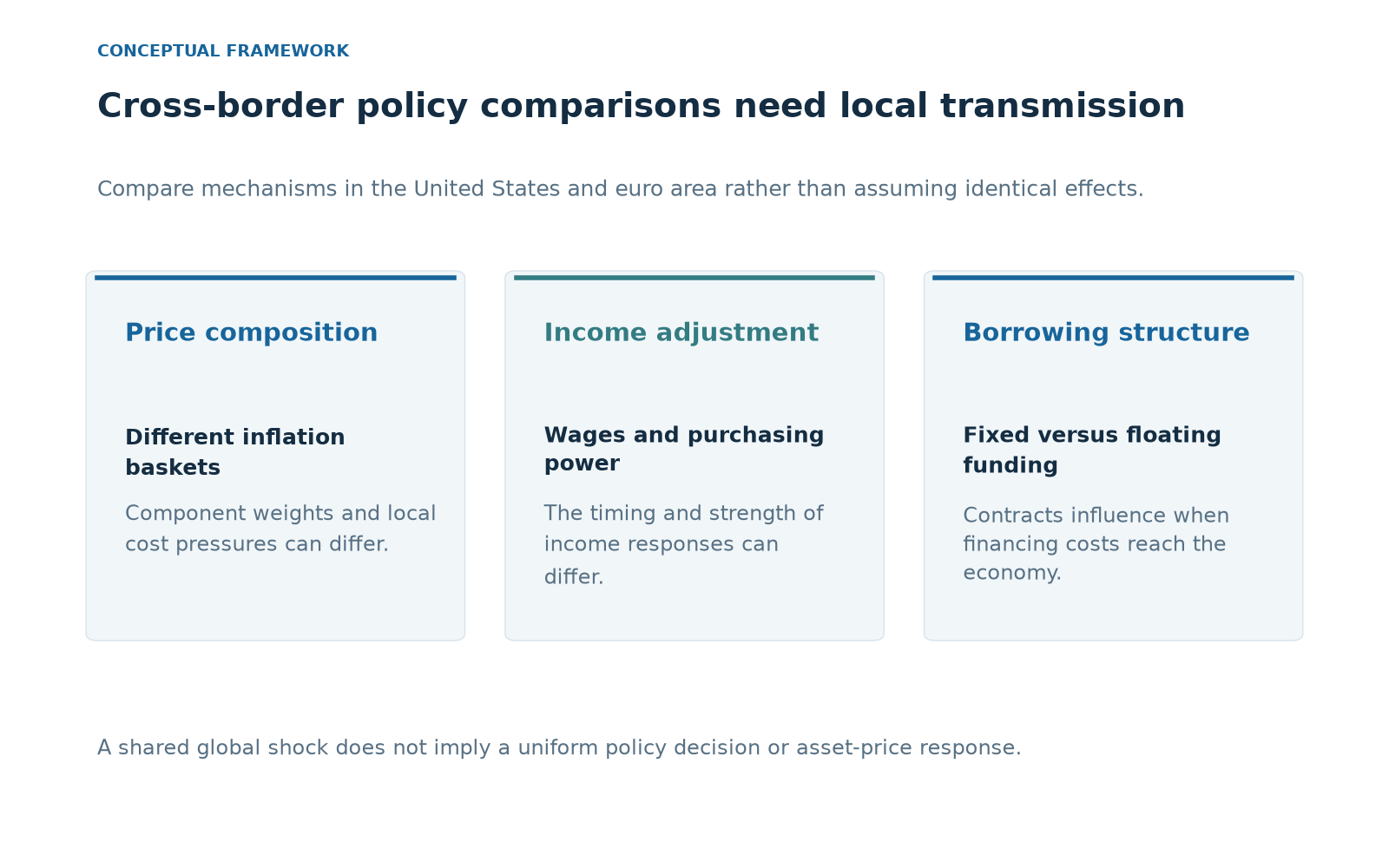
For a useful international comparison, begin with the underlying exposures and the relevant policy institution. How much energy is imported, in what currency, under what contracts, and with what taxes or subsidies? How quickly do mortgages reset, how do businesses finance working capital, and how do wages adjust? A family with a fixed mortgage and a variable fuel bill feels one shock immediately. A company with long energy contracts and floating-rate debt can feel the sequence in reverse. Relabeling both as inflation exposure hides what matters for household spending and business solvency.
Measurement deserves the same care. The U.S. consumer price index and the euro area's harmonized measure are designed for distinct populations and use different methods in some categories, including the treatment of owner-occupied housing. A difference between the two headline rates can reflect the basket, national conditions, tax policy, and dates as well as a common global force. A sound comparison would identify the series and interval on both sides, preferably compare like components, and explain the parts that cannot be lined up. The Federal Reserve also defines its longer-run inflation goal using a different U.S. price measure. Reading the May CPI is informative without suggesting it is a mechanical trigger for a target-rate decision.
There is a timing difference between statistical observations and financial prices. If markets expected a quarter-point move in the euro area, parts of the yield curve could already have incorporated it before the announcement. If the move itself was expected but the policy discussion changed views about subsequent decisions, longer yields could respond to the outlook more than to the immediate setting. An assertion about the event's actual effect would require observed prices, a time window, and a check for other news.
A practical stress test for the loan file
A small change in one assumption can reverse the interpretation of the laundry example. Suppose the plant raises its hospital price by four cents per pound after the four-month delay. At the assumed volume that brings in $4,000 extra a month, almost enough to offset the $4,500 energy increase. Contribution before financing is then $14,500 against the original $15,000. If the buyer instead diverts one tenth of its volume to a second provider, revenue and variable costs must both be recalculated. The original energy bill after the shock is 22.5 cents a pound. Other variable expenses are 42 cents. With the new price of $1.24 and 90,000 pounds, the unit contribution is 59.5 cents, leaving $53,550 before the unchanged $45,000 of fixed cash costs, or $8,550 after them. A negotiated price recovery accompanied by lost volume can leave the plant worse off than the unadjusted price at full volume.
Actual energy usage could be less flexible than this arithmetic assumes. A boiler must be hot before the first load enters; smaller loads can consume more energy per pound. An idle shift might save less labor than expected if trained staff are retained. Conversely a more efficient drying schedule could lower energy use without any price concession. For a lender, the useful request is for metered usage, pounds processed, minimum staffing, and the contract adjustment calendar. For an analyst looking at a public company, the equivalent evidence might be a separation of price and volume, a discussion of utilization, and disclosure of when energy contracts reset. Meter readings before and after a change in loads would show how much of the energy bill actually varies with volume.
Which observation could overturn the first interpretation?
If American energy prices eased and the broader basket showed little acceleration, the case for widespread second-round effects would weaken. If food, shelter, and labor-intensive services accelerated even as fuel leveled off, an energy-only explanation would lose force. In Europe, if loan pricing adjusted only gradually while businesses' energy contracts repriced immediately, the first reported deterioration in profit might owe much more to industrial inputs than to the June rate action. If loan renewals became significantly more restrictive, smaller firms might feel the financing channel even before the published average loan rate moved very far.
There is one last accounting detail worth checking before comparing a U.S. business with a euro-area peer. The energy line may be reported net of a temporary reimbursement at one company and before reimbursement at another. A reimbursement booked this month but received next quarter reduces the expense reported today while leaving the immediate funding need intact. A company that owns its building and a company paying a gross lease with utilities included can likewise report very different direct energy expenses while carrying similar economic exposure through the next rent review. The analyst can reconstruct a comparable measure by recording the gross expense, reimbursement, contractual recovery date, and actual receipt. Missing information should remain an open item in the comparison. Promoting a small apparent difference into evidence of superior cost management before checking those terms would give the numbers a precision the accounts do not support.
The same logic applies to the money available for new equipment. A business can cover today's recurring bill and still have too little cash to install a heat exchanger during the next planned closure. Lost access to that investment would prolong its energy exposure. The size of the shock today and the ability to adapt over time therefore deserve separate lines in the analysis.
In May, energy accounted for most of the sizable monthly increase in U.S. consumer prices, while the core index rose more slowly. The ECB announced a policy response for its own currency area. The commercial consequences depend on contracts, competition, credit, and time. An analyst who can say whose payment changes first, how large it is relative to the available cash margin, and what evidence would change that assessment has learned something concrete from both events. A prediction that one central bank must follow another adds little without that work.
Related research

Weekly Research
May Hiring Adds Support Without Settling Inflation
June 1–7: a positive employment report is one part of the policy balance.

Weekly Research
June’s Fed Hold Keeps Supply and Productivity in the Same Frame
June 15–21: unchanged rates coexist with a complex economic assessment.

Weekly Research
Nominal Resilience Can Conceal a Household Squeeze
May 25–31: inflation changes the meaning of a stable spending total.