
ResearchMarket Sentiment
A Good Story Can Become a Bad Price
- Report or archive date
- Archive placement July 17, 2026
- Reading time
- 13 min read

Summary
A promising industry can produce disappointing investments when the purchase price already assumes exceptional execution. An industrial technology case examines whether revenue, margins, financing, and share count support the valuation.
The product can succeed while the investment struggles
Imagine a company that sells automated inspection equipment to manufacturers. Its machines identify defects earlier, reduce wasted materials, and help plants operate more efficiently. Buyers have a practical reason to consider the product, and the potential market is substantial. The story is credible enough to deserve serious research.
That does not settle the investment question. The company must win orders, install equipment, provide support, collect cash, and earn an adequate return on the capital required to grow. Shareholders must then receive enough of that economic value to justify the price paid for their shares.
The distance between a useful product and a rewarding investment contains several tests. A persuasive narrative can skip over them because its conclusion feels intuitive: if the technology matters, the stock should rise. But importance to an industry is not the same as value captured by one company, and company value is not the same as return from any purchase price.
Translate the story into a transaction
Begin with the buyer's problem. An inspection system that reduces defects can save money, but the buyer still compares its price with installation costs, maintenance, training, downtime, and alternative approaches. A demonstration that works in a controlled setting does not prove that every plant will achieve the same savings.
The seller's economics depend on how it charges for that value. Equipment sales, software subscriptions, maintenance agreements, and usage-based fees produce different revenue patterns. A large installation can create upfront revenue and years of service obligations. A recurring contract can create more predictable billing while requiring continued investment in performance and support.
Competitive responses matter. If several suppliers can deliver similar savings, buyers may negotiate lower prices. If the product becomes essential but standardized, widespread adoption can benefit the industry more than the individual supplier's margins. The addressable market can expand while the profit earned per installation declines.
A useful research note therefore describes a concrete exchange: who pays, for what, under which terms, and why the supplier can retain an attractive share of the benefit. The narrative becomes more testable when it moves from technological possibility to an identifiable transaction.
Revenue growth can outrun profit growth
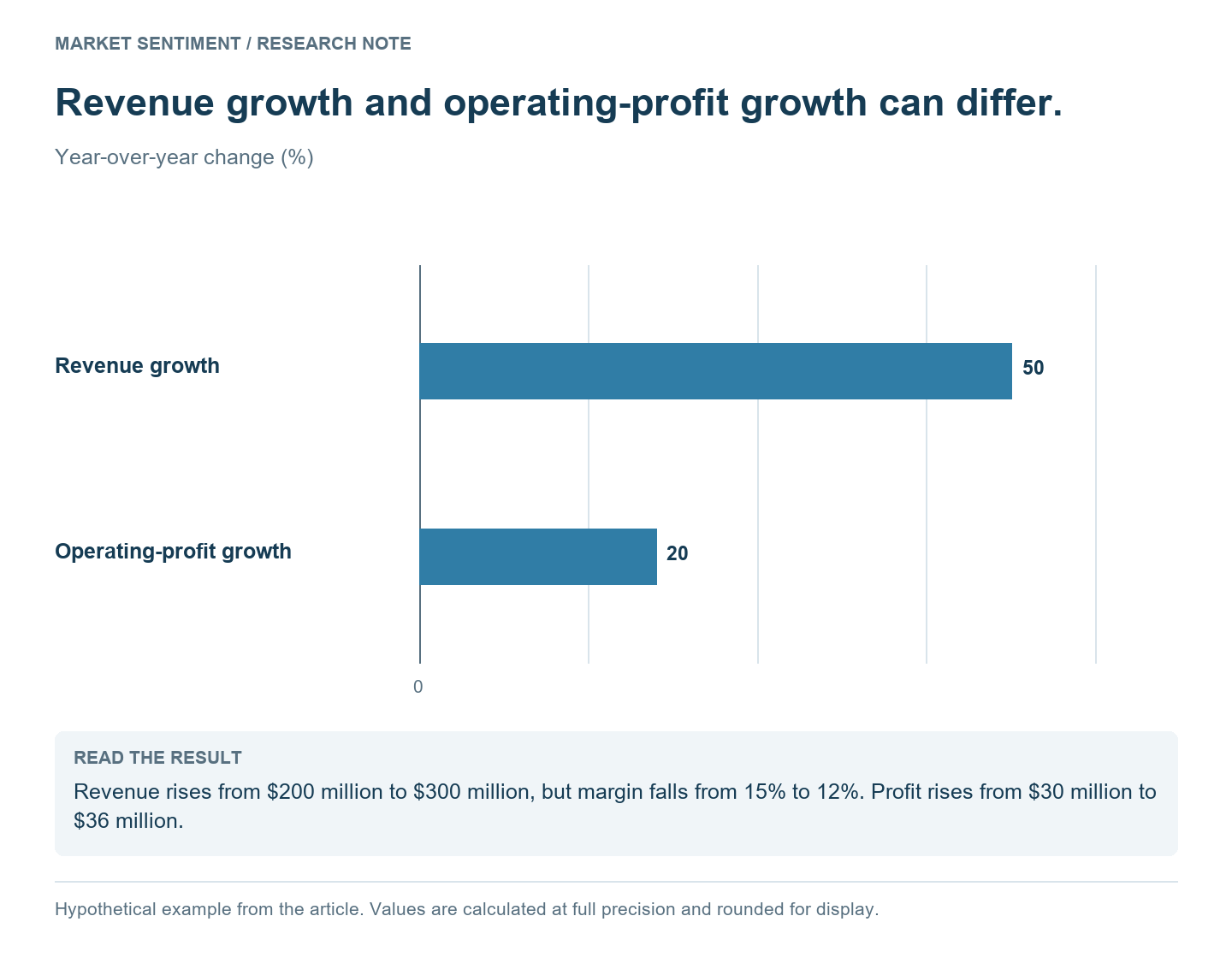
Suppose the company records annual revenue of $200 million and an operating margin of 15%. Operating profit is $30 million. In the following year, revenue grows to $300 million, a 50% increase. That sounds like a strong confirmation of the growth story.
However, assume the next year's operating margin falls to 12% because installation, support, and development costs rise. Operating profit becomes $36 million. Revenue grew 50%, but operating profit grew only 20%. The company is larger and more profitable in dollars, yet the benefit to operating earnings is much smaller than the sales headline suggests.
The margin decline is not automatically a sign of failure. Some expenses may build capabilities that support later earnings. Equally, calling every expense an investment does not prove that it will produce an adequate return. The researcher needs to distinguish temporary expansion costs from costs required each time the company wins additional business.
Ask what would have to happen for margins to recover. Would installation become easier, support needs decline, prices rise, or development spending grow more slowly than sales? Each explanation suggests evidence that can be checked. A forecast of higher margins without an operating mechanism is simply a more favorable number.
Follow the cash needed to deliver the growth
Profit is recorded under accounting rules; cash must be available when obligations come due. The inspection company may need to purchase components before receiving payment, carry demonstration equipment, extend payment terms, or add service capacity before new installations generate revenue. Growth can therefore absorb cash even while reported profit increases.
Consider a separate cash-flow bridge for one year. After-tax operating profit is $30 million. Depreciation is $8 million, capital spending is $25 million, and the increase in operating working capital is $10 million. Under the simplified unlevered cash-flow definition used here, free cash flow is $3 million: $30 million plus $8 million, minus $25 million, minus $10 million.
The small cash figure does not invalidate the business. It shows that much of the current operating return is being reinvested. To evaluate the investment, the analyst must judge what that reinvestment can earn and when the resulting cash becomes available. Assuming rapid growth and ignoring the required capital would overstate value.
Working capital deserves particular attention because it can hide inside a successful sales story. Longer receivable collection times can make reported revenue look strong while cash conversion weakens. Inventory built for expected demand may be necessary, excessive, or both at different points in the cycle. The balance sheet helps distinguish those possibilities.
A larger business does not necessarily create more value
To isolate the economics of expansion, consider two separate projects. Each requires $20 million immediately. The first is assumed to generate $1.6 million of annual after-tax cash flow forever, beginning one year from now. The second generates $3 million on the same schedule. Assume those cash flows already include all ongoing maintenance and replacement spending, with no further capital required beyond what is reflected in them.
At an assumed 10% required return, the first cash-flow stream is worth $16 million, calculated as $1.6 million divided by 10%. After subtracting the $20 million initial cost, its net present value is minus $4 million. The second stream is worth $30 million, leaving a positive net present value of $10 million.
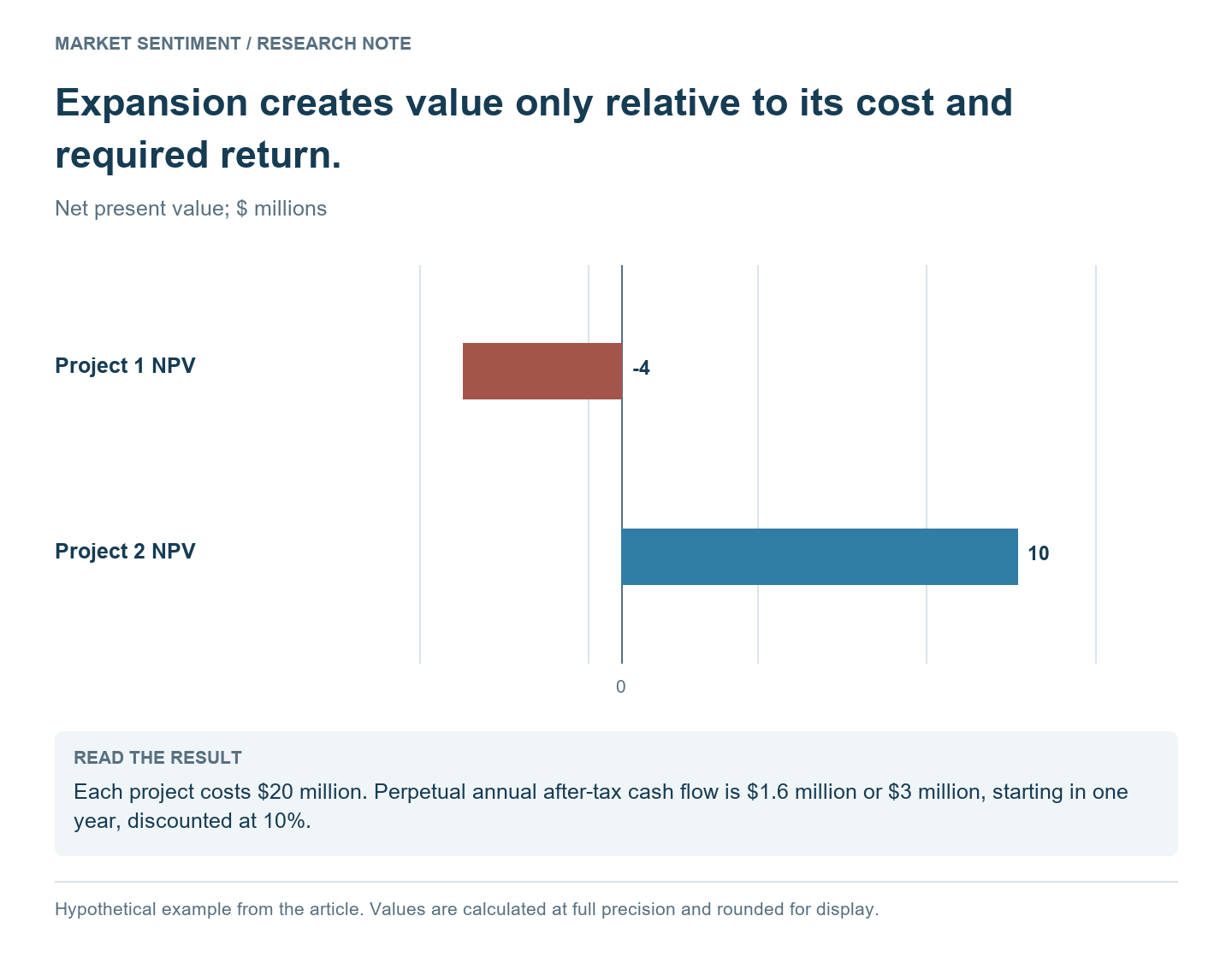
Both projects make the company's operations larger. Both generate positive annual cash. Under the specified assumptions, only the second creates value beyond the required compensation for the capital committed. Growth in activity is therefore not sufficient evidence of value creation.
The perpetual cash-flow assumption simplifies the inspection-equipment calculation. Actual projects have finite useful lives, changing maintenance requirements, taxes, uncertainty, and possible residual values. Those features belong in a real investment analysis. The simple comparison is useful because it holds scale and timing constant while changing the economic return on the new commitment.
For the equipment company, this raises a practical question: does each additional installation generate attractive cash after the capital and support it requires? A growing installed base can be economically valuable, but it can also carry obligations that absorb much of the benefit. Revenue per machine is only the start of that calculation.
The analyst should also distinguish returns on existing operations from returns on the next expansion. A company may have built an excellent business in its first market and face weaker economics in the next one. Assuming every new market will reproduce the original success can turn an accurate account of past performance into an overly generous forecast.
Growth belongs to the company; returns belong to each share
Suppose net income in the initial year is $20 million and weighted-average shares are 100 million. Earnings per share are $0.20. In the next year, net income rises to $24 million, but weighted-average shares rise to 120 million. Earnings per share remain $0.20.
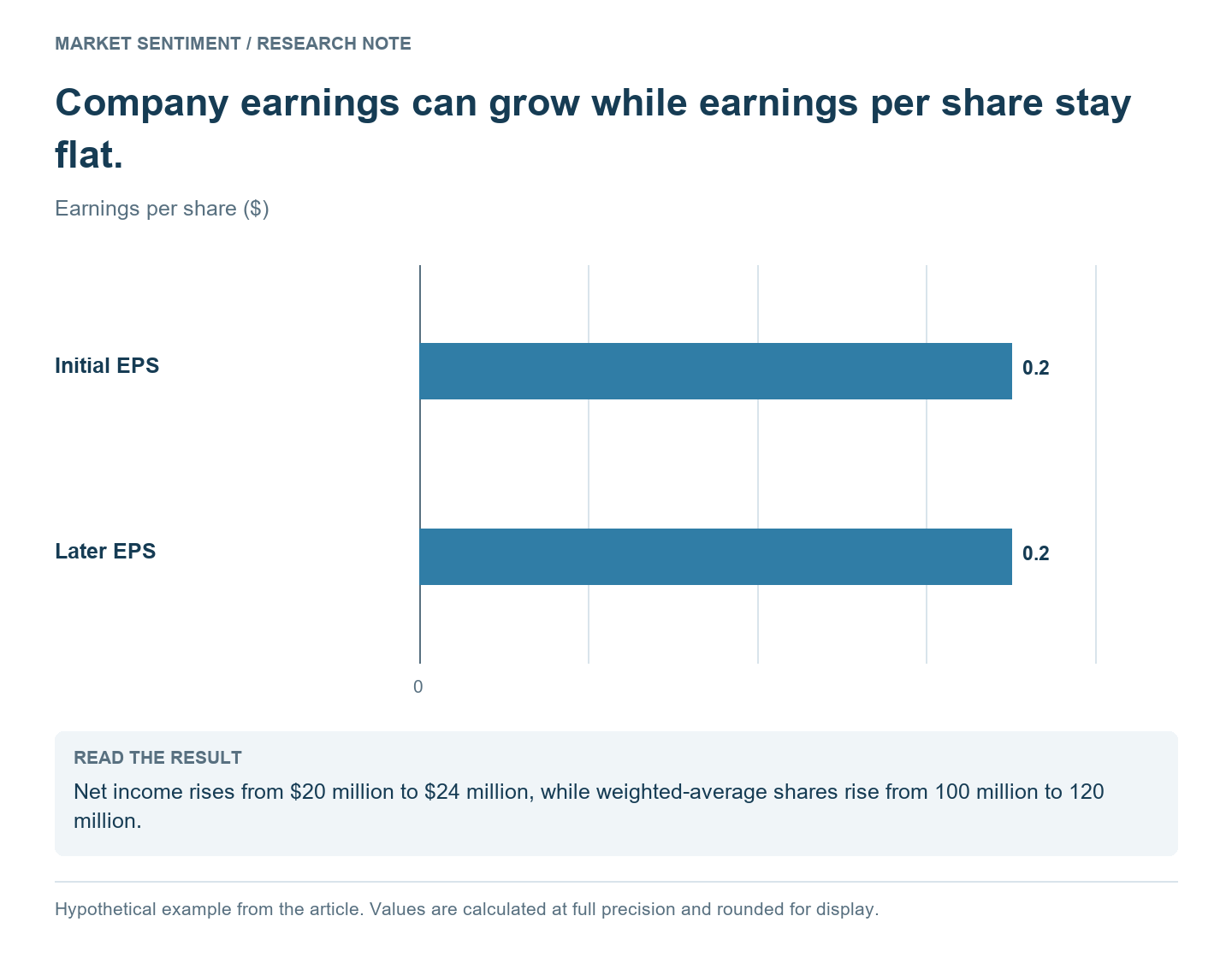
The business generated 20% more net income, while the denominator also grew 20%. A shareholder's earnings claim per share did not increase. That is why company-level growth and per-share growth need separate attention.
Issuing equity is not automatically harmful. It can fund productive investment, strengthen liquidity, or acquire valuable assets. The question is whether the value obtained for existing holders justifies the additional claims created. The ownership percentage can decline while the economic value of each remaining share rises, falls, or stays unchanged.
Share-based compensation also needs careful treatment. It can be a real cost to owners even when it does not require the same immediate cash payment as wages. A valuation should handle the expense and potential dilution consistently rather than ignoring both or counting the same burden twice.
For a growth company, the research bridge should therefore end at cash flow or earnings attributable to a share, not stop at total revenue. Funding the story is part of the story.
The purchase price can demand more than strong execution
Assume the company's initial earnings per share are $0.20 and its share price is $8. The price-to-earnings multiple is forty. That ratio describes the relationship between price and the stated earnings measure. It does not establish that forty is a fair multiple or that the company will maintain its current earnings quality.
In a separate one-year scenario, suppose earnings per share increase 40% to $0.28. If the market then values those earnings at twenty-five times, the ending price is $7. The company delivers substantial per-share growth while an investor who paid $8 experiences a 12.5% price loss, excluding distributions and costs.
The arithmetic separates operating performance from valuation change. A good business result can be insufficient when the purchase price includes an even more demanding outlook, when perceived risk increases, or when investors accept a lower multiple for other reasons. The example does not predict a particular future multiple; it shows why earnings growth alone cannot determine the investment return.
The reverse is possible too. A weak business result can coincide with a rising stock price if the outcome is less poor than expected or if the outlook beyond the reported period improves. Price responds to a changing assessment of future value, not simply to whether the latest operating number is positive.
Ask what the price requires
Reverse the preceding exercise. An investor pays $8 and considers a target return of 10% over one year, assuming no dividends or costs. The necessary ending price is $8.80. If the investor assumes an ending multiple of twenty-five, required earnings per share are $0.352.
That is 76% above the starting $0.20, not 40%. The target return, purchase price, and ending valuation together imply a demanding earnings requirement. Changing any of those assumptions changes the requirement. This is a sensitivity exercise, not a statement that the market has exactly those beliefs.
There is usually no unique set of expectations embedded in a price. Higher growth can offset a higher discount rate; stronger margins can offset more reinvestment; a longer growth period can offset a slower initial ramp. Many combinations can produce the same estimated value.
A reverse valuation is useful because it forces those combinations into view. It asks whether the business would need to achieve an ordinary, ambitious, or highly unusual set of outcomes under the analyst's assumptions. It does not read a single collective forecast directly from the stock price.
Timing changes the value of the same success
Imagine a simplified claim paying $10 exactly five years from now, with no other payments. Discounting at an assumed 10% annual rate gives a present value of approximately $6.21. If the same $10 payment is delayed to year six, the value falls to approximately $5.64 at the same rate.
Nothing about the ultimate payment changed; only its timing did. In a real growth business, a delay can also create additional operating costs, financing needs, or competitive risks. An investment case based on eventual adoption must therefore explain when adoption becomes profitable cash flow.
The discount rate matters as well. At an assumed 12%, the five-year $10 claim is worth approximately $5.67. The example isolates the sensitivity of a distant payment to the required return.
Long-term optimism can remain intact while current value falls if success arrives later or investors require more compensation for uncertainty. Describing that outcome as the market failing to understand the technology would avoid the valuation question rather than answer it.
The total market is not the company's obtainable revenue
A large market estimate can provide context, but it needs boundaries. Some potential buyers may lack the budget, production scale, technical compatibility, or economic incentive to adopt. Others may choose competing products or develop an internal solution. The relevant revenue opportunity is smaller than the universe of activity that the technology might theoretically touch.
The inspection company also cannot assume that every dollar of savings becomes its revenue. Buyers need to retain enough benefit to justify adoption. Competitors, distributors, integrators, and service providers may capture part of the economics. A market-size slide does not establish the supplier's pricing power.
Be careful about double counting. Equipment revenue and the value of the goods inspected are different layers of economic activity. Adding them together would not create a larger market for the equipment vendor. Likewise, spending by several firms along one supply chain may represent successive stages of the same final demand.
A credible growth forecast connects installations, revenue per installation, recurring services, retention, and capacity to deliver. Those operating quantities are easier to challenge than an unsupported assumption that the company will capture a round percentage of a very large market.
Attention can change the price without changing the product
A compelling story attracts discussion, and discussion can draw new investors to a company. Increased attention can improve understanding of a previously overlooked business. It can also encourage people to repeat an attractive conclusion without examining the assumptions that support it.
The research task is to identify what changed in the evidence. A new product qualification, a contract with meaningful terms, or a demonstrated improvement in cash conversion differs from a widely shared restatement of an existing plan. Both can attract attention, but they do not carry the same informational value.
Avoid treating the volume of discussion as proof of adoption. Public interest in a technology can rise faster than deployments, revenue, or profits. That gap may eventually close through stronger fundamentals, weaker expectations, or both. The number of people talking about a business does not resolve which outcome is more likely.
An analyst can acknowledge enthusiasm while maintaining a separate operating record. Track what has been delivered, what has been ordered, what remains conditional, and what has merely been proposed. This prevents a story from gaining apparent factual support each time it is repeated.
Build a disagreement that can be investigated
Suppose one analyst expects the inspection company to retain high margins because its software improves with accumulated operating experience. Another expects margins to decline because competing systems become easier to install. The disagreement is useful if it leads to evidence about performance, switching costs, support requirements, pricing, and retention.
It is less useful if the two sides simply assign different valuation multiples and call one another optimistic or pessimistic. A multiple summarizes assumptions; it does not explain them. The better discussion identifies which operating outcome would make each valuation plausible.
Separate a disagreement about the business from a disagreement about price. Two researchers can agree that adoption will grow and still disagree about whether the current price leaves an attractive expected return. They can also agree that the price is demanding while assigning different probabilities to exceptional execution.
Write down what would weaken the preferred interpretation. If the thesis requires support costs to decline, persistent cost growth is relevant evidence. If it requires buyers to renew subscriptions, weak renewal economics should matter even when new installations remain strong. A thesis that absorbs every adverse observation without changing is not sufficiently testable.
Financing can change the feasible path
The company may have a promising long-term opportunity and still face a near-term funding constraint. Equipment purchases, inventory, development, and receivables can require cash before the opportunity produces it. The availability and terms of funding determine which growth plans can actually be executed.
Debt adds payment obligations and may limit flexibility. Equity can provide a longer runway while changing ownership claims. Advance payments from buyers can help cash flow but may bring delivery commitments. Each financing choice changes the relationship between business success and shareholder outcomes.
The analysis should examine when cash is needed, what resources are available, and which spending can be delayed without undermining the product. A broad statement that the company has access to capital is less informative than a schedule of obligations and realistic funding alternatives.
A financing assumption should also be consistent with the valuation scenario. It is incoherent to assume a severe operating setback, unchanged generous funding terms, no dilution, and no strategic adjustment merely because those choices preserve a preferred valuation. Scenario analysis is useful only when the parts fit together.
Keep the conclusion conditional on the evidence
A strong article about a growth business can end with a clear set of conditions rather than a dramatic price prediction. It can explain which operating milestones support the story, which cash-flow requirements remain unresolved, and how much execution the purchase price would require under explicit assumptions.
That approach respects the difference between a promising technology and an investment at a particular valuation. It also makes future review possible. When new information arrives, the reader can see which part of the case changed instead of hearing a completely rewritten narrative that claims to have anticipated everything.
The objective is not to avoid ambitious businesses or to assume that popular investments must fail. It is to make enthusiasm accountable to unit economics, financing, per-share outcomes, and price. A story becomes an investment case when those connections are explained. A good story becomes a bad price when the cost of participating leaves too little room for outcomes that are good but less than extraordinary.
Related research
ResearchMarket Sentiment
AI Earnings News and Investor Expectations Are Separate Tests
An earnings release can demonstrate strong operating growth without answering whether the investment already priced in that growth. Reading AI-related results requires separating disclosed business performance, the expectations available before release, and the economics of the capacity being built.

ResearchMarket Sentiment
Positioning Data Arrive With a Clock Attached
A newly released position report may describe an older market. Separating the observation date, public release, revision history, and first feasible trading time prevents stale information from becoming a false account of current sentiment or an impossible historical strategy.

ResearchMarket Sentiment
Space-Industry Excitement Needs Milestones and Cash-Flow Tests
Space businesses turn engineering progress into investment value through a sequence of operational and financial steps. A milestone is useful evidence only when its scope is clear and its connection to delivery, payment, financing, and per-share value is understood.