
ResearchFixed Income
Callable Bonds Can Change the Reinvestment Problem
- Report or archive date
- Archive placement April 23, 2026
- Reading time
- 13 min read

Summary
A callable bond can return principal earlier than its final maturity, often when replacing its income has become less attractive. Evaluating that possibility requires alternative payment schedules, correctly calculated call yields, and an examination of who controls the timing of repayment.
Getting principal back early is not always an advantage
Receiving repayment before a final maturity can sound like an unqualified benefit. The money is available sooner, and exposure to the issuer ends for the redeemed amount. But a bondholder may have paid for an income stream expected to continue for years. An early redemption can terminate that stream and leave the holder seeking a replacement when comparable yields are lower.
A callable bond gives the issuer a contractual right to redeem under specified terms. That right belongs to the issuer, not the investor. The investor's ability to sell in the market is a different mechanism, with a different price and potentially different costs. Confusing the two can make an issuer option look like flexibility granted to the holder.
The key analytical question is not whether early repayment is always good or bad. It is which payment schedules are permitted, what the investor pays for them, and how each schedule affects the intended use of the money.
Write the maturity schedule first
Consider a bond with $1,000 face value, a 6% annual coupon, and five years remaining. It pays $60 at the end of each year and repays principal with the fifth coupon. Assume annual compounding, valuation immediately after a coupon date, no accrued interest, and full payment under the relevant schedule. The investor pays $1,040.
If the bond remains outstanding until final maturity, its scheduled receipts are four annual payments of $60 followed by $1,060 in year five. The total nominal receipts are $1,300, but they do not all arrive at the same time. A yield calculation must discount their individual dates rather than divide the nominal gain evenly across five years.
Solving for the annual discount rate that equates those payments with the $1,040 purchase price gives a yield to maturity of approximately 5.0742%. The result is below the 6% coupon because the investor pays more than the $1,000 principal ultimately returned. This calculation assumes the entire maturity schedule occurs.
Now add the issuer's option
Suppose the contract permits the issuer to redeem the whole bond for $1,000 at the end of year two, together with the regular second coupon. For clarity, assume this is the only optional call date before final maturity. No call occurs in year one, and no other redemption feature applies. Real contracts can contain more dates and conditions than this simplified example.
If the issuer exercises this option, the investor receives $60 at the end of year one and $1,060 at the end of year two. The remaining three $60 coupons disappear because the obligation has been redeemed. Total nominal receipts under this schedule are $1,120, arriving much earlier than the full maturity receipts.
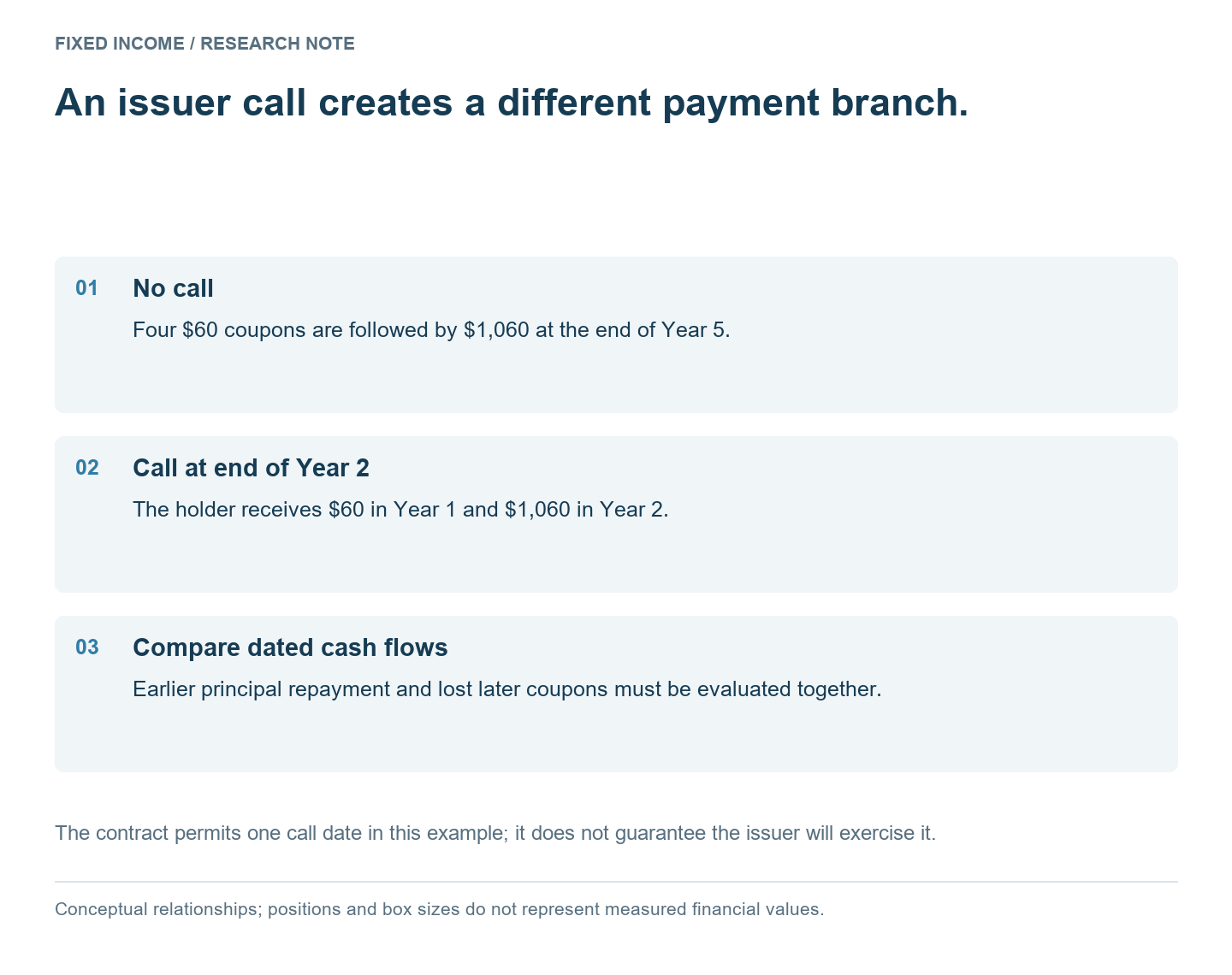
The difference between $1,300 and $1,120 is not itself the economic loss from the call. It ignores the earlier return of principal and the earnings potentially available from reinvesting it. Comparing the alternatives requires either dated cash-flow analysis or a common future endpoint with explicit reinvestment assumptions. Simply subtracting undiscounted totals would misstate the question.
Yield to call uses the call date and redemption amount
For the two-year call schedule, solve $1,040 equals $60 divided by one plus the yield, plus $1,060 divided by one plus the yield squared. The annual yield to call is approximately 3.8828%. The investor receives the 6% coupon while the bond remains outstanding, yet the return implied by the called schedule is substantially lower.
The premium purchase price explains much of the difference. The investor paid $40 above face value and receives only $1,000 of principal on redemption. When the premium is recovered through fewer coupon periods, its effect on the annualized result is larger. The quoted coupon cannot show that purchase-price and repayment-date interaction on its own.
Change the assumed call price to $1,020, keeping the call date and everything else unchanged. The final call-date payment becomes $1,080 including the coupon, and yield to call rises to approximately 4.8304%. A call premium matters, but its effect must be calculated using the actual date and amount rather than described vaguely as compensation for early repayment.
The $1,000 and $1,020 call prices are alternative contract scenarios. They are not two payments the holder can collect together or choose between. A real comparison begins by reading the actual schedule, including when each redemption price applies. The terms determine which cash-flow calculation is relevant.
Yield to worst has a limited meaning
Under the original example's two permitted schedules, the 3.8828% yield to the $1,000 call is lower than the 5.0742% yield to maturity. The lower contractual yield is the relevant yield-to-worst result for this deliberately limited setup, assuming timely payment. It identifies an unfavorable permitted redemption outcome, not the probability that the outcome will occur.
The word worst does not include every possible loss. Default, a distressed sale, fees, or a different realized reinvestment result can produce a worse experience than that contractual yield. A published yield-to-worst figure is not a guaranteed minimum annual return on the investor's account.
More complex call schedules require more calculations. The earliest date is not a universal substitute for evaluating the relevant dates and prices. A declining redemption premium, irregular coupons, or special provisions can affect which schedule produces the lowest yield. The convention used to present the figure should be understood before comparing it with another security's quoted yield.
Why lower rates can encourage a call
An issuer may benefit from replacing expensive financing with less expensive financing, provided the contract allows redemption and the transaction makes economic sense. The bondholder's attractive existing coupon can therefore become attractive to the issuer to retire. This creates a connection between the circumstances making the bond valuable to the holder and the circumstances making early repayment more likely.
The incentive depends on more than a benchmark rate. Refinancing costs, the issuer's credit spread, call premiums, access to funding, and remaining maturity all matter. A decline in government yields does not ensure that a financially weaker issuer can refinance cheaply. Nor does a favorable economic calculation override a contractual restriction on when the bond may be called.
An issuer may also redeem for reasons associated with corporate actions or specific contractual events. The analyst should distinguish the ordinary optional call being modeled from other redemption provisions. The label callable does not describe a single standardized contract, and a generic interest-rate story cannot replace the terms of a particular security.
Do not assume the first possible call will happen
The first call date establishes an opportunity under the contract, not a promise that the issuer will exercise it. A holder who builds a spending plan around receiving principal on that date can be left with an unfilled cash need if the bond remains outstanding. The final maturity and optional call date are different kinds of dates.
Similarly, an issuer's past behavior is not a binding commitment for the next decision. Funding conditions, credit quality, and corporate priorities can change. A scenario analysis can assign different possibilities, but the assumptions should remain visible. Reporting a call-date return as the expected realized return requires more evidence than showing that redemption is legally permitted.
For a cash requirement before final maturity, examine both the called and uncalled cases. In the uncalled case, selling the bond may provide cash, but the sale price is uncertain. In the called case, proceeds arrive earlier, creating a reinvestment decision. Neither branch can be removed simply because one appears more convenient for the plan.
Bring both outcomes to a common five-year endpoint
Return to the $1,000 call price and assume every receipt can be reinvested at a constant 3% annual rate after it arrives. This reinvestment rate is an explicit scenario input. Compare terminal wealth at year five so that early and late receipts are evaluated over the same total horizon.
If the bond is not called, each $60 coupon earns 3% from its receipt date until year five, and $1,000 of principal arrives at the endpoint. Ending wealth is approximately $1,318.55. The first coupon compounds for four years, the second for three, the third for two, and the fourth for one; the final coupon arrives at the endpoint and earns no additional interest within the comparison.
If the bond is called at the end of year two, the first $60 coupon still compounds for four years. The $1,060 call-date payment compounds for three years. Ending wealth is approximately $1,225.82. The difference between the two five-year outcomes is approximately $92.73 under the stated reinvestment assumption.
The calculation gives earlier principal its opportunity to earn a replacement return. It therefore provides a more coherent comparison than subtracting the original nominal payment totals. It also demonstrates why the assumed reinvestment rate matters: the called proceeds are available earlier, but they earn the replacement rate rather than the original bond's coupon.
Separate investment return from a spending plan
The common-endpoint example assumes all receipts remain invested. An investor who spends the coupons has a different account balance and a different economic use of the cash. Spending a coupon is not an investment loss, but that spent amount cannot also be counted as reinvested terminal wealth.
A plan intended to support annual expenses should show the payments that remain after a call. Once the original coupon stream stops, replacement income depends on the instruments available and the amount reinvested. The principal returned can fund spending directly, but using principal changes the remaining capital and the future income it can produce.
It can help to separate three questions: what cash is contractually received before redemption, what wealth exists at the chosen comparison date, and what spending the portfolio can support afterward. Yield to call addresses a dated cash-flow relationship. It does not answer all three questions without additional calculations.
Measure the replacement-income gap directly
Consider a separate income-use scenario in which the investor owns ten of the bonds and spends every coupon as received. The initial purchase cost is $10,400, while annual scheduled coupon cash is $600. If all ten bonds are called at $1,000 each, the returned principal is $10,000. Previously spent coupons are not available to add to the replacement investment.
Assume an appropriate replacement in this scenario pays 3% annually on the $10,000 reinvested amount. Its annual income is $300, leaving a $300 gap relative to the former coupon stream. Receiving the original face amount in full did not preserve the original income level. The rate available after redemption matters to the spending plan.
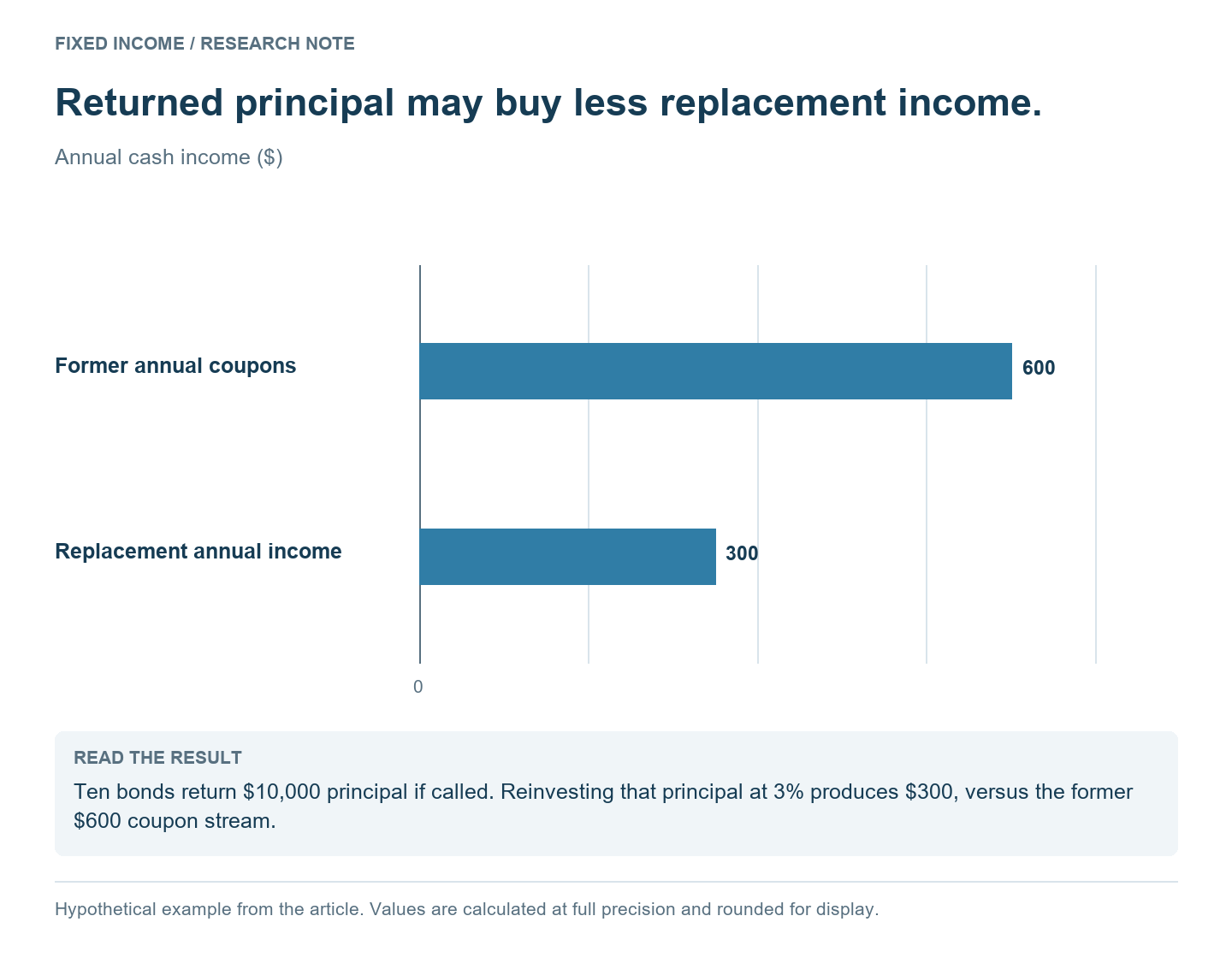
At that same assumed 3% rate, producing $600 of annual income would require $20,000 of invested principal. The calculation does not recommend finding a higher-yielding security to bridge the gap. A higher quoted yield can involve different credit, duration, liquidity, or option exposure, so replacing the old coupon by matching a percentage can quietly change the portfolio's risk.
The example also separates a purchase premium from returned capital. The investor originally paid $10,400, but the contractual principal repayment is $10,000. That difference has already affected the cash-flow yields calculated earlier. It should not be ignored in a return calculation or deducted again from principal after the $10,000 redemption has been correctly recorded.
An income forecast can therefore show two explicit rows of future receipts: the original coupons if the bond remains outstanding and the replacement receipts if a call occurs. Neither needs to be described as certain before the issuer acts. Comparing the schedules reveals the size and timing of the spending adjustment that a simple coupon-rate comparison would conceal.
The price benefit from falling rates can be limited
At a 4% annual discount yield, the five-year noncallable schedule is worth approximately $1,089.04. If repayment at the end of year two were certain under the original $1,000 call price, the shortened schedule discounted at the same 4% would be worth approximately $1,037.72. The shorter promised stream has a different value.
Each present value corresponds to a fixed payment schedule. A callable bond's market value also depends on whether and when the issuer chooses to redeem it. Valuing that choice requires assumptions about future rates, credit conditions, and the issuer's exercise behavior.
The comparison nevertheless explains the economic limitation. When falling rates increase the value of remaining high coupons, the issuer's option can prevent the holder from retaining all of that benefit. Treating the callable bond as an unchanged five-year payment schedule can overstate the upside from lower yields.
Rate increases can produce the opposite timing problem
If refinancing becomes unattractive, the issuer may leave the bond outstanding until final maturity. The holder then retains exposure for longer than an anticipated call-based plan assumed. A bond marketed with attention on an early call date can behave more like its longer final maturity when conditions move against that expectation.
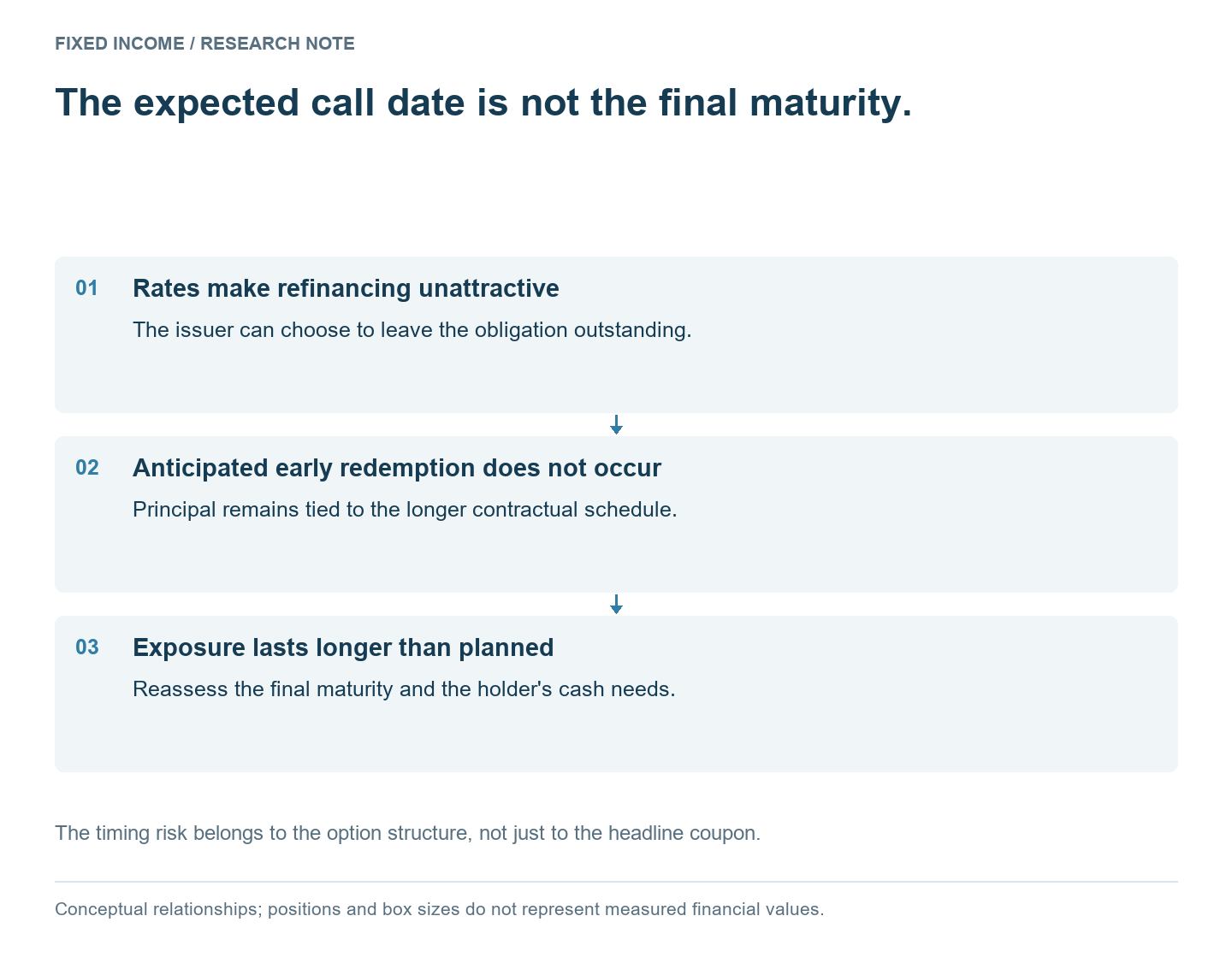
This is often described as extension risk: the expected life of the investment lengthens under conditions that may also depress its price. The investor can face limited appreciation when rates fall and a longer exposure when rates rise. The precise pattern depends on the contract and market conditions, but the asymmetry deserves explicit testing.
Duration based on a fixed assumed call date can miss that change in expected life. Measures that revalue possible cash flows under different rate scenarios are more appropriate for analyzing the option, provided their assumptions are understood. A single duration number should not be accepted without asking which cash-flow behavior the calculation allows.
Read the protection period and the type of call
A period during which an ordinary optional call is prohibited can provide temporary protection for the coupon stream. It does not necessarily eliminate every extraordinary redemption provision. The contract should identify the restrictions, exceptions, notice requirements, and prices that apply. A short description on a listing page may omit details needed for a complete cash-flow analysis.
A make-whole provision uses a specified formula rather than a simple fixed redemption amount. Its purpose and economic effect depend on the formula, reference rate, spread, and any later change to a different call arrangement. The term make-whole should not be interpreted as a guarantee of every investor's purchase price, tax outcome, or intended reinvestment return.
Notice timing matters because a bond can continue trading after a redemption announcement but before settlement of the call. An investor considering a transaction during that interval needs the announced payment date, redemption amount, and accrued-interest treatment. A yield calculation based on the original final maturity would no longer describe the announced payment schedule.
Partial redemption requires position-level attention
Some agreements allow only part of an issue to be redeemed. The amount of a particular holder's position affected can depend on the applicable allocation process. A portfolio-level assumption that every bond is called in full on the same date may therefore differ from the cash actually received by an individual holding.
For a simple position of ten bonds with $1,000 face value each, redemption of three bonds returns $3,000 of principal and leaves $7,000 outstanding, apart from coupon payments. The remaining seven bonds can continue to carry their original credit and rate exposures. Calling part of a position does not turn the entire holding into cash.
A practical record should update both sides: cash received from the redeemed amount and the terms of the remaining security position. Otherwise, an income forecast can mistakenly continue counting coupons on redeemed bonds or remove coupons from bonds that remain outstanding. The operational details matter because they determine the actual payment schedule being analyzed.
The issuer option is part of the price comparison
A callable and noncallable bond should not be compared solely by coupon or final maturity. The callable structure grants a valuable right to the issuer, while the holder bears the associated uncertainty. Compensation can appear through a different price or yield, but assessing its adequacy requires a comparison that controls for other terms and risks.
Credit quality, currency, seniority, liquidity, and taxation can differ across the apparent alternatives. A larger spread on one bond does not isolate the value of its call feature if those other characteristics also differ. A careful comparison describes the differences before deciding which part of the pricing gap is plausibly associated with the option.
Option-adjusted measures can help organize the comparison by modeling the option's value, but they remain model-dependent. Assumptions about volatility and exercise behavior can materially affect the result. A precise-looking spread is useful only when the analyst understands the model and the contractual terms behind it.
Build the review around payment branches
Begin with the no-call schedule, then write each relevant redemption schedule using the correct date, principal amount, and final coupon treatment. Calculate yields from the actual acquisition outlay rather than from face value alone. If the purpose is a future wealth comparison, bring receipts to a common endpoint under explicitly stated reinvestment assumptions.
Next test the consequences of a call occurring and not occurring. A call can remove income and create replacement risk; no call can leave the holder exposed longer than anticipated. Include any transaction costs and practical cash requirements in the scenarios rather than treating them as afterthoughts once the preferred yield has been selected.
The result should be an explanation of the tradeoff, not a verdict based on the largest displayed percentage. A higher coupon can coexist with a lower yield to call, an early repayment can coexist with lower terminal wealth, and a final maturity can remain relevant even when an early call seems likely. Understanding who controls the payment date is essential to understanding what the bondholder has actually bought.
Related research

ResearchFixed Income
Breakeven Inflation Is Not a Pure Forecast
The gap between nominal Treasury yields and inflation-protected yields contains information about inflation, but also reflects risk compensation, liquidity, and security design. Reading the gap well requires understanding both bond legs and the horizon over which the comparison is made.

ResearchFixed Income
A Bond Ladder Trades Some Timing Risk for Other Risks
Staggered maturities can spread reinvestment decisions across time and organize expected cash receipts. They do not remove credit risk, guarantee spending capacity, or prevent market-price declines. The ladder's purpose and maintenance rules matter as much as the spacing of its rungs.

ResearchFixed Income
A Policy Rate Is Not a Ten-Year Borrowing Cost
An unchanged overnight policy setting does not freeze the cost of borrowing for a decade. Long-term financing depends on expectations for future short rates, compensation for holding duration, issuer-specific risks, and the contractual structure through which a borrower obtains funding.