
ResearchCross-Asset Allocation
Cash Can Be an Asset With a Specific Job
- Report or archive date
- Archive placement February 19, 2026
- Reading time
- 13 min read

Summary
Cash is often discussed as either an idle balance or a prediction that markets will fall. A more useful assessment separates operating liquidity, planned spending, and optional investment capital. Each purpose has different requirements, opportunity costs, and reasons for changing the balance.
One balance can contain three decisions
Imagine a design cooperative with $120,000 in readily available funds. It has assigned $30,000 to scheduled payments, $50,000 to unexpected operating needs, and $40,000 to possible future investment. The account statement shows one amount, but the organization has made three economically different decisions.
The scheduled-payment money is already committed in substance. The operating reserve supports continuity if receipts arrive late or an unexpected expense appears. The investment balance remains discretionary. Describing all $120,000 as money waiting to enter the market would erase the first two purposes.
The opposite error is to describe the entire amount as an essential reserve. Doing so could protect an unexplained tactical decision from scrutiny. Each portion needs a reason, a review date, and a rule for when it can be used or reassigned.
This distinction makes the cash discussion more concrete. The central question becomes what the balance is supposed to accomplish and whether its form supports that job. The answer may differ across portions of the same account.
Operating liquidity solves a timing problem
Organizations and households can be solvent on paper while struggling to meet a payment on time. Assets may be valuable but difficult to sell quickly, and expected income may arrive after an obligation is due. Operating liquidity addresses that mismatch between resources and timing.
The relevant amount depends on the pattern of receipts and payments, their reliability, and the cost of a delay. A business with concentrated seasonal revenue has different needs from one with steady, dependable receipts. The average monthly surplus does not describe the largest gap within the month.
Payment concentration matters as well. Several expenses can arrive together even when the annual budget looks comfortable. A reserve calibrated only to average outflows may be too small for that cluster. A dated cash-flow schedule reveals the problem more clearly than a single annual income estimate.
The objective is not to predict every surprise. It is to identify the situations in which a temporary funding gap would cause disproportionate harm and to maintain a credible way to bridge them. Yield matters, but it is one consideration within that task.
Runway depends on net cash use
Consider a separate operation with $48,000 of available cash. Monthly cash payments are $12,000 and dependable monthly receipts are $4,000. Ignoring interest and changes in those flows, net cash use is $8,000 per month, giving six months of runway.
If payments rise to $16,000 while receipts remain $4,000, net use becomes $12,000 and runway falls to four months. The account balance did not change at the moment the forecast changed, but its ability to support operations did.
Now suppose $20,000 of the original $48,000 is restricted to a separate purpose and cannot fund these expenses. Available operating cash is only $28,000. At the original $8,000 monthly net use, runway is three and a half months, not six.
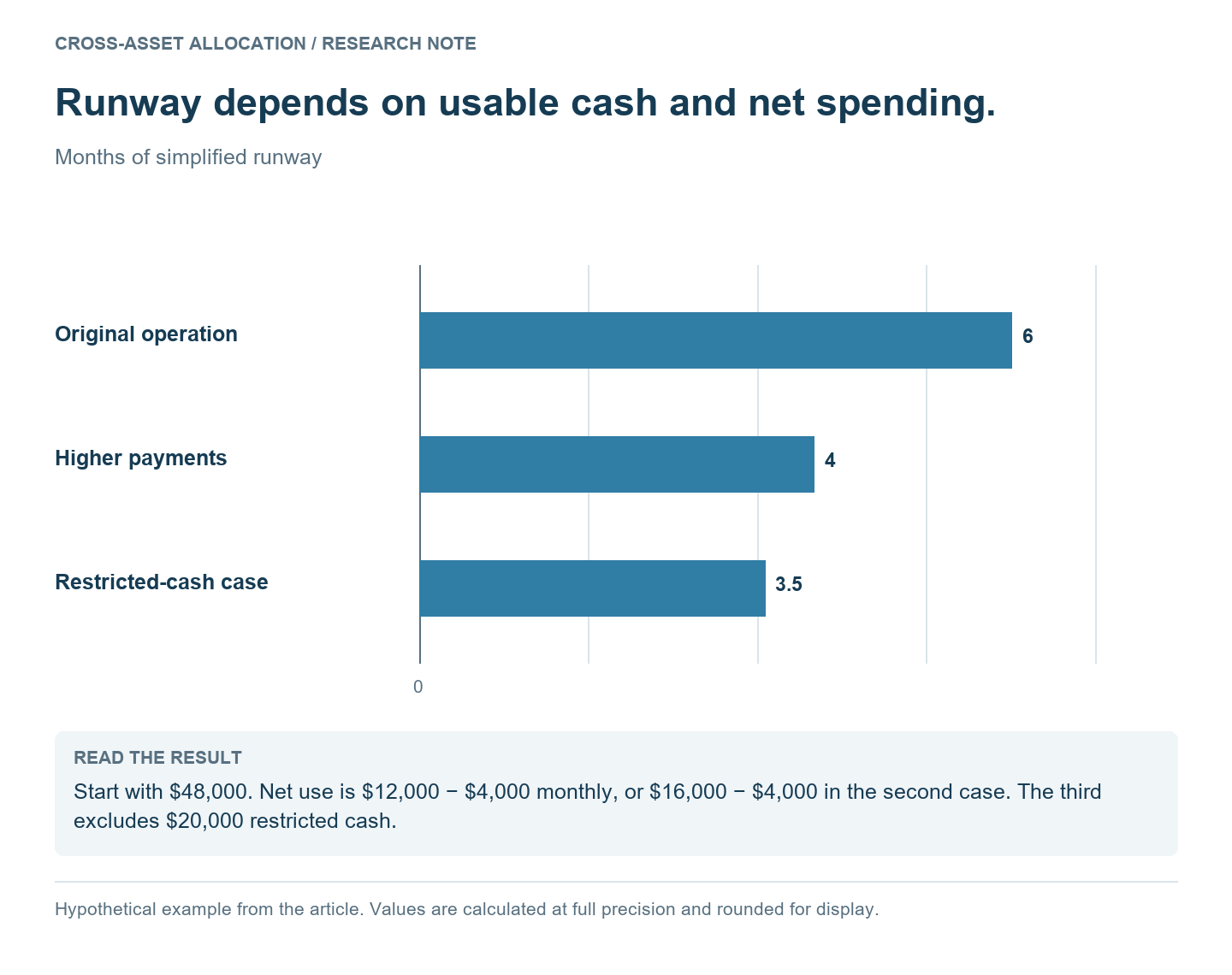
These calculations are intentionally simple. Real receipts and payments can be uneven, and restrictions can be more complicated. The lesson is to use spendable resources and net cash flows rather than treating a gross account balance or a revenue figure as a complete measure of resilience.
Planned spending needs a different benchmark
Cash assigned to a known expenditure has a recognizable success condition: the required amount must be available when the payment is due. Comparing that allocation only with the return of a stock index can misidentify its purpose.
That does not mean its implementation should be ignored. Unnecessary fees, an unsuitable maturity, or an avoidable access problem can still impair the outcome. The appropriate comparison is among instruments capable of meeting the same payment requirements under their actual terms.
The spending currency is part of those requirements. Money held in a different currency may fluctuate in value relative to the invoice even if its local-currency balance is stable. A higher foreign interest rate does not automatically compensate for that mismatch.
The planned-spending balance should change when the obligation changes. Once the payment is made, the remaining funds need a new assignment. If the project is canceled, keeping the old reserve indefinitely without review turns a deliberate decision into inertia.
Tactical cash makes a market decision
Discretionary cash held for a future investment opportunity serves another purpose. It leaves the investor able to act later, but it also postpones exposure to the investment's returns. The value of that flexibility depends on the opportunity eventually available and the decisions made along the way.
A tactical balance should therefore have more than a general intention to wait for a better price. Define what would make an opportunity attractive, how much capital could be used, and what would happen if the anticipated price never appears. Otherwise, the reason for waiting can shift with every market move.
The rule need not be a rigid numerical trigger. It can depend on valuation, business evidence, or a change in the portfolio's needs. But it should be specific enough to distinguish a new decision from a retrospective explanation of why the previous decision was always correct.
It is particularly important not to spend the operating reserve under the label of tactical flexibility. Capital can only serve one use at the moment it is deployed. A compelling investment does not remove an existing payment obligation.
A decline can still leave the purchase price higher
Suppose an investment begins at a price of 100. An investor waits for a 15% decline before buying. If the price falls immediately to 85, the desired entry price is achieved. But that is only one possible path.
If the price first rises 20% to 120 and then falls 15%, it ends at 102. The investor has bought after a sizable decline but at a price 2% above the original level. The percentage decline is measured from the later peak, not from the original opportunity.
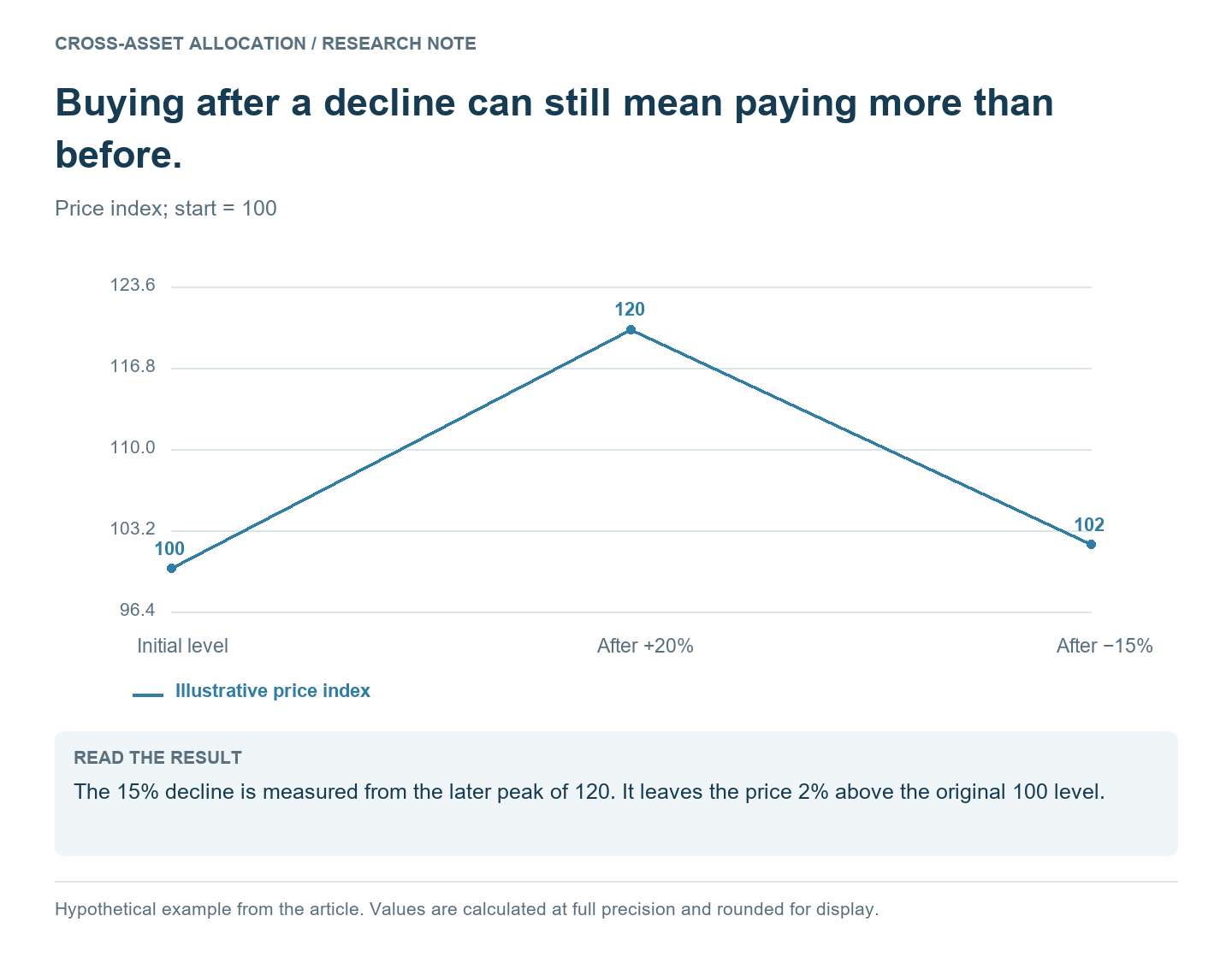
This example ignores income, interest on cash, trading costs, and taxes to isolate the price path. It does not show that waiting is always wrong. It shows why a plan based on buying the next decline must define the reference point and consider what happens before the decline.
The same logic applies in reverse. Buying immediately can expose capital to a loss that waiting would have avoided. Comparing both paths is more informative than telling a story in which one timing choice is rewarded by construction.
Measure opportunity cost against the actual alternative
The opportunity cost of cash is the result forgone on the relevant alternative, not the return of whichever asset happened to perform best afterward. A fair comparison should use a feasible alternative that could have been selected with the information available at the time.
For a one-year exercise, assume cash returns 3% and a risky investment returns 8%. A portfolio with 20% in cash and 80% in the risky investment returns 7% before costs. Investing the entire amount in the risky asset would have returned 8%, a difference of one percentage point.
Change the risky return to negative 20% while keeping the assumed cash return at 3%. The mixed portfolio returns negative 15.4%, compared with negative 20% for the all-risky alternative. The cash allocation improves that scenario by 4.6 percentage points.
The same cash weight has a cost in one scenario and a benefit in another. Whether the tradeoff is useful depends on the portfolio's purpose and constraints. The paired comparison is more honest than treating cash as permanently wasteful or permanently protective.
A quoted yield is not a long-term return promise
Cash investments can offer a yield that changes with market conditions or the instrument's terms. A yield observed today does not necessarily apply to the same balance for several future years. Reinvestment creates a new decision when an instrument matures.
Money market fund yields, for example, generally reflect the short-term instruments held by the fund and can change over time. A fixed return on a particular short-term security applies to its defined holding arrangement, not automatically to the securities purchased after it matures.
Compare like measures. A recent annualized yield, a total return over a past year, and a contractual maturity payment are different pieces of information. Fees and compounding conventions can also affect the comparison. A larger displayed percentage is not meaningful until its definition is understood.
This matters when cash is expected to finance continuing spending. A plan that assumes today's income will persist indefinitely may face a gap if reinvestment yields decline. The cash balance can remain nominally stable while the income it generates changes.
Short maturity trades price sensitivity for reinvestment exposure
A short-maturity instrument can reduce the time during which market yield changes affect its price before repayment. It can also bring forward the moment when proceeds must be reinvested at an unknown future rate. These are different aspects of the same structure.
Extending maturity to lock in a yield can reduce near-term reinvestment needs, but it may create more price sensitivity or reduce flexibility if the money is required early. The better choice depends on the timing of the obligation and the instrument's credit and access features.
A ladder of maturities can spread the reinvestment dates. It does not guarantee a particular future income stream from new purchases, nor does it make early-sale prices certain. Its main analytical benefit is a more visible schedule of cash receipts and renewal decisions.
For a reserve whose withdrawal date is genuinely uncertain, maturity matching will necessarily be imperfect. The review should recognize that uncertainty rather than treating a neat schedule as proof that every possible payment date has been covered.
Nominal stability can coexist with declining purchasing power
Assume a cash investment earns 3% over a year while the relevant spending basket rises 4%. A starting balance of $100 becomes $103, but the basket that originally cost $100 now costs $104. The cash has grown in dollars and lost purchasing power.
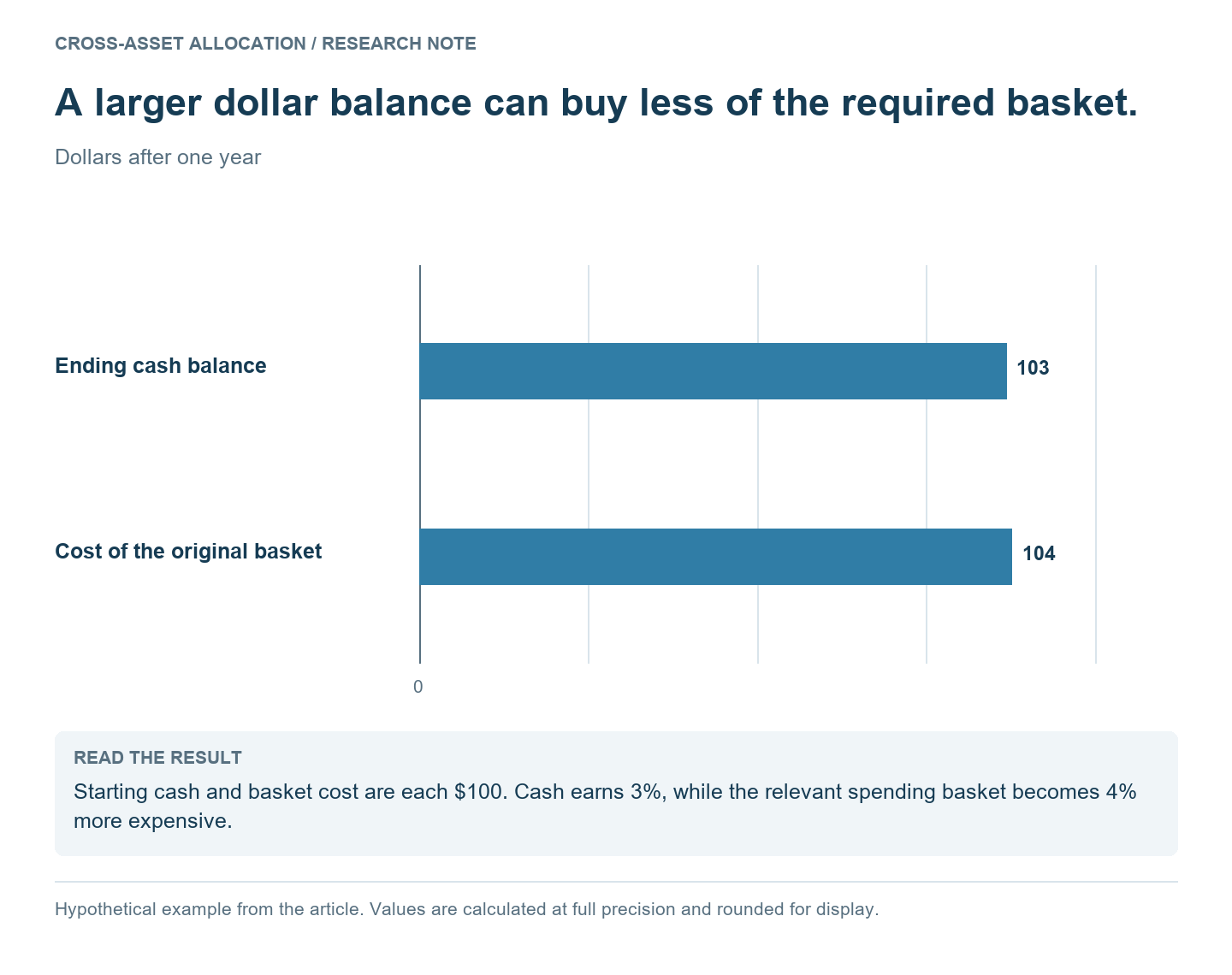
The exact real return is 1.03 divided by 1.04, minus one, or approximately negative 0.96%. Simply subtracting 4% from 3% gives a useful rough approximation, but the ratio gives the precise result under the stated assumptions.
This does not automatically make the cash allocation inappropriate. A short-term payment may be fixed in dollars, or immediate access may be worth accepting some expected purchasing-power erosion. The purpose determines how the inflation exposure should be evaluated.
For capital intended to finance activity far into the future, however, persistent erosion can become material. A stable account statement is not sufficient evidence that the long-term objective remains funded. The spending basket and the duration of the exposure need to be considered together.
Cash-like products are not interchangeable
A bank deposit, a money market mutual fund, and a Treasury bill are different instruments. Their claims, access arrangements, price behavior, and protections should be examined separately. A platform may display them near one another without making them economically identical.
In the United States, eligible deposits at an FDIC-insured bank can receive deposit insurance subject to the applicable coverage rules. Mutual fund shares are not FDIC-insured deposits, even when offered through a bank. Product identity matters more than the institution's branding.
A Treasury bill purchased below face value produces its discount return if held to the maturity payment under its terms. Selling before maturity introduces a market price and may involve practical transfer or execution arrangements. The existence of a secondary market does not mean every holding is instantly spendable through every account.
Money market funds invest in short-term instruments, but their structures and valuation conventions differ. A stable share-price objective should not be mistaken for a universal guarantee of principal. The reserve's required properties should be checked against the specific vehicle rather than inferred from the word money.
Higher interest in another currency changes the assignment
Consider a reserve measured in dollars. It converts $10,000 into 10,000 units of a foreign currency at an initial exchange rate of one dollar per unit. The foreign cash investment earns 5%, leaving 10,500 foreign-currency units after one year. That local-currency result looks straightforward.
Suppose the foreign currency is then worth $0.92 per unit. Converting the balance back produces $9,660, a dollar return of negative 3.4% before conversion costs or taxes. The positive 5% interest return did not prevent a loss relative to the dollar obligation. The combined return is 1.05 times 0.92, minus one.
This example does not forecast any currency. It identifies the additional exposure created by chasing a higher foreign yield. If the reserve's purpose is to pay a dollar invoice, the exchange-rate movement can matter more than the interest difference.
If the obligation is instead fixed in that foreign currency, the interpretation changes. Holding the relevant currency can reduce uncertainty about funding that payment, even while its dollar-reported value fluctuates. The same asset can be a mismatch for one liability and a useful match for another.
Hedging can alter the exposure, but it introduces its own pricing, maturity, and implementation decisions. A comparison that assumes the higher foreign yield can be collected while exchange risk disappears at no cost is incomplete. The cash decision must remain connected to the currency and timing of the payment it is meant to support.
Small yield differences need a dollar translation
Suppose two cash arrangements differ in annual return by 0.20 percentage points. On a constant $50,000 balance held for one year, the difference is $100 before taxes, fees, or any other differences. That calculation provides a scale for evaluating the tradeoff.
The extra income may be worthwhile if the arrangements are otherwise suitable. It may be less compelling if it requires materially worse access, additional operational complexity, or a risk that conflicts with the reserve's purpose. A percentage that looks meaningful in an advertisement can be modest in the actual budget.
Conversely, small recurring differences can become material on a much larger balance or over a long period. The point is not to dismiss them. It is to compare the incremental dollars with the full set of consequences rather than evaluating yield in isolation.
The comparison should include any minimum balance, expense, transaction cost, or condition attached to the rate. A headline rate that applies only to part of the balance or a limited period should not be multiplied across the whole reserve and year without adjustment.
Operational access is part of the asset's usefulness
A reserve can be economically liquid yet inconvenient to use for a particular payment. Redemption instructions, transfer steps, approval requirements, and the location of the receiving account can affect when the money becomes usable. Those details belong in a funding plan.
An organization may also depend on a single authorized person or a single payment channel. If either becomes unavailable, the nominal cash balance does not solve the immediate operational problem. Clear authority and a tested process can matter alongside investment selection.
Avoid assuming that every balance visible on a screen is available for withdrawal. Some funds may be pledged, restricted, pending settlement, or assigned to obligations already incurred. The operating view should reconcile the displayed amount with the amount that can actually be spent.
This is a different review from forecasting market returns. It focuses on whether the intended payment can be completed under ordinary and adverse circumstances. A modest reserve with dependable access can serve its purpose better than a larger-looking balance whose availability has not been verified.
Unused liquidity is not automatically failed capital
If a reserve is maintained for a disruption that does not occur, the lack of a withdrawal does not prove the reserve was unnecessary. Its value was the capacity to respond under a plausible adverse condition, not a requirement that the condition eventually happen.
The reserve should still be reviewed. If the underlying exposure shrinks, a backup arrangement becomes more reliable, or spending flexibility improves, the required balance may change. A reserve can be justified at one date and excessive at another.
The review should use information available when the decision was made and the conditions that now apply. Judging the original choice only by the best-performing asset afterward confuses hindsight with a fair assessment of the funding problem.
For tactical cash, the evaluation differs. A balance held to exploit market opportunities should be assessed against its stated deployment process and relevant alternatives. It should not borrow the protection rationale of an emergency reserve after an investment opportunity has been missed.
Assign a destination to incoming cash
Dividends, interest, maturities, and new contributions can cause cash to accumulate even when no one has deliberately increased the target balance. Without a destination rule, the resulting allocation can drift away from the intended plan.
The first question is whether those receipts replenish an operating or spending reserve. If those purposes are already funded, the next question is whether the money belongs in the long-term allocation or in a separately justified tactical balance. The answer should follow the mandate rather than inertia.
Using incoming cash to rebalance can sometimes reduce the need to sell other holdings. The practical benefit depends on the size of the receipts relative to the portfolio and the degree of drift. It is a mechanism to examine, not a guarantee that all rebalancing can be done without sales.
The final cash review should therefore reconcile purpose, amount, vehicle, access, and destination. Once those elements are visible, the debate becomes more useful than a slogan about being invested or uninvested. Cash can be doing necessary work, waiting for an explicitly defined opportunity, or simply accumulating without a reason. Those are three different conditions and deserve three different decisions.
Related research

ResearchCross-Asset Allocation
Stocks and Bonds Can Fall Together
Stocks and bonds are different claims, but both can lose market value when investors demand higher returns or when economic conditions impair expected payments. Working through bond prices, business margins, and equity valuation shows why diversification can moderate some shocks without providing a standing guarantee against joint losses.

ResearchCross-Asset Allocation
Correlation Is Conditional, Not Permanent
An asset's diversification role depends on what is driving returns, how the exposure is measured, and which conditions the portfolio must survive. Three market scenarios show why a historical correlation is an input to judgment rather than a permanent description of the relationship between investments.

ResearchCross-Asset Allocation
Match a Portfolio Stress Test to an Economic Mechanism
A stress test should explain how an economic disturbance reaches earnings, yields, credit spreads, and available cash. An original four-part portfolio example connects those channels to approximate valuation changes, then shows why the ability to fund a payment can matter as much as the headline loss.