
ResearchFund Flows
Creation Baskets Explain How ETF Supply Adjusts
- Report or archive date
- Archive placement September 23, 2026
- Reading time
- 13 min read

Summary
ETF shares can be created by transferring a specified package of assets into the fund. Following that package reveals how share supply changes, why a basket can differ from the full portfolio, and where trading costs and execution risks remain.
Follow the assets delivered to the fund
An ETF's exchange price is visible throughout the trading day. The process supporting its supply is less visible to most investors. Behind a creation transaction is a specified package of securities, cash, or both, delivered in exchange for a block of new ETF shares.
That package is the creation basket. It connects a transaction in ETF shares with a transaction involving the fund's assets. Understanding the connection explains why growing ETF assets do not always imply that the fund bought securities in the open market with a fresh cash deposit.
The basket also clarifies the limits of common shortcuts. It may not be a scaled-down copy of every holding. A published basket may describe an available transaction rather than one that actually occurred. The basket's estimated value can change before the transaction is finalized, and the institution assembling it faces costs that a simple premium calculation can omit.
Check the ETF’s creation-unit size, eligible assets, cash adjustments, fees, and settlement terms.
The creation unit establishes the quantity
Assume the ETF has $100 million in net assets and two million shares outstanding. Net asset value is $50 per share. Its creation unit contains 50,000 shares, so one unit corresponds to $2.5 million at that net asset value.
An authorized participant, or AP, is an institution permitted to transact directly with the ETF under its arrangements. In an in-kind creation, the AP transfers the accepted securities and any required cash component. The fund issues the specified number of shares when the transaction is completed under the applicable terms.
Assume the transaction adds exactly $2.5 million of net assets and 50,000 shares, with no price movement, costs, or other changes. The fund then has $102.5 million and 2.05 million shares. Dividing one by the other still gives $50 per share.
The fund has become larger without generating a return for existing shareholders merely by issuing shares. New shares are supported by additional assets. A creation that increased shares without corresponding value would dilute existing owners; the valuation and cash-adjustment process is intended to reconcile what enters with what is issued.
Build one complete basket
Suppose the accepted basket consists of security A worth $1.2 million, security B worth $800,000, security C worth $400,000, and $100,000 in cash. The total is $2.5 million, matching the value of the creation unit in the simplified example.
The basket's composition is 48% A, 32% B, 16% C, and 4% cash. These percentages describe the assets delivered in that transaction. They do not necessarily describe the ETF's full portfolio or the index it may seek to track.
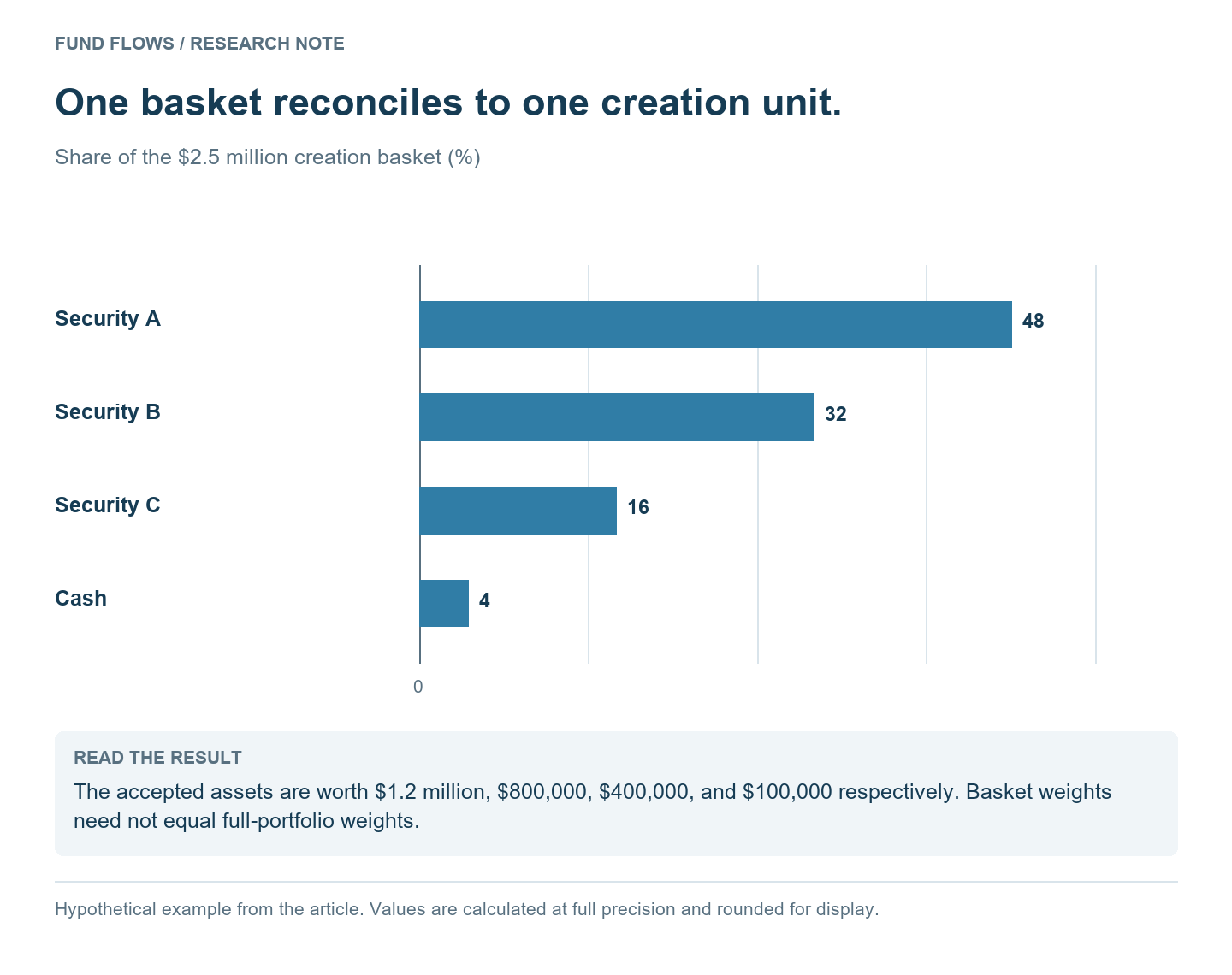
The securities could come from the AP's existing inventory, market purchases, another transaction, or a combination of sources. The transfer into the ETF does not identify how each security was obtained. Calling the entire $2.5 million an open-market purchase by the fund would therefore add an unsupported trading claim.
Once transferred and accepted, the assets belong to the fund's portfolio. The newly issued ETF shares can be held, sold, or used to satisfy existing delivery obligations. The creation record establishes the increase in outstanding ETF shares and the corresponding asset transfer, not the final identity or motivation of every investor who later owns those shares.
Compare the basket with the existing portfolio
Before the creation, assume the fund's $100 million consists of $60 million in A, $25 million in B, $10 million in C, and $5 million in cash. Its initial portfolio weights are 60%, 25%, 10%, and 5%, different from the basket weights.
After receiving the basket, the fund holds $61.2 million in A, $25.8 million in B, $10.4 million in C, and $5.1 million in cash. Total assets are $102.5 million. The A weight becomes approximately 59.71%, calculated from $61.2 million divided by $102.5 million.
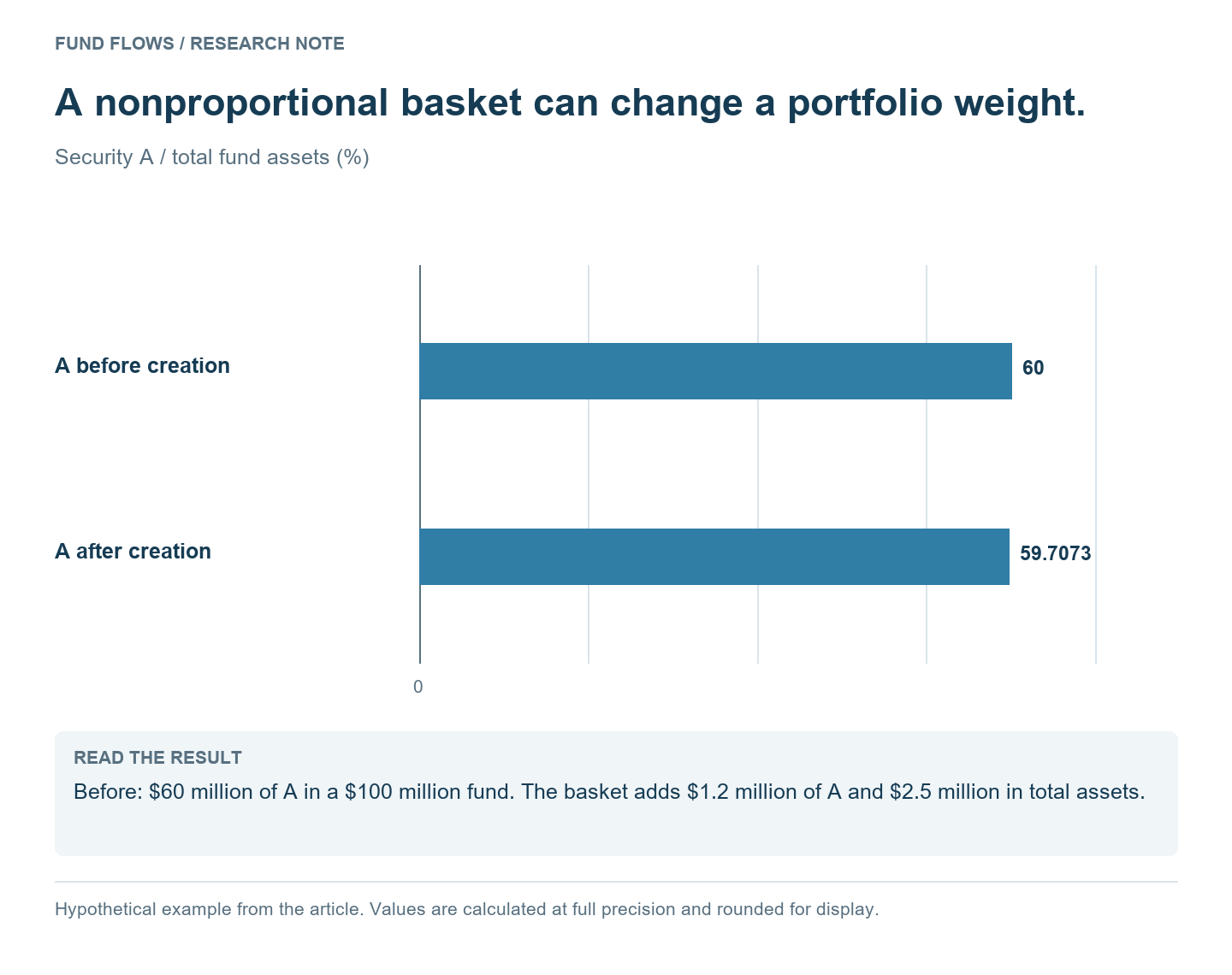
The fund received more A in dollar terms, but A's portfolio weight fell because the creation basket contained less A proportionally than the existing fund. An analyst looking only at the lower weight might mistakenly infer that A was sold. An analyst looking only at the larger dollar holding might mistakenly infer an open-market purchase by the manager.
The full reconciliation explains both observations. Securities arrived through a creation, the share count increased, and the portfolio composition shifted. No additional sale or purchase needs to be invented to make those facts fit together.
Why a basket can differ from the portfolio
The full holdings list describes what the fund owns. A creation or redemption basket describes the assets relevant to a particular primary-market transaction. Those are different records with different purposes.
For ETFs operating under the applicable US framework, custom baskets can differ from a pro rata representation of the portfolio, subject to required policies and procedures. The specific fund's arrangements determine what it will accept and how it manages the interests of existing shareholders.
There can be practical reasons to use a basket that differs from the full portfolio. Some securities may be difficult to source in small amounts. Portfolio management may require adjustments. A bond fund may hold many individual issues with varying liquidity, making a transaction in every holding impractical.
Those possibilities do not make every basket appropriate. The manager must consider the effect on the portfolio, transaction costs, valuation, and the shareholders who remain. A basket should be examined in relation to the fund's objective and holdings rather than treated as evidence that the manager can accept arbitrary assets without consequences.
Cash components complete the value reconciliation
The cash component can help reconcile the value of delivered securities with the value of ETF shares issued. It should be distinguished from a transaction fee and from any separate cash substituted for a security under the fund's terms.
Return to the basket initially valued at $2.4 million in securities plus $100,000 in cash. Suppose the final accepted valuation of those securities is $2.405 million, while the creation unit's final value is $2.510 million. The balancing cash amount would be $105,000 in this simplified calculation.
The securities increased by $5,000, while the creation unit's required value increased by $10,000. The cash component therefore rises by $5,000. Using the old $100,000 amount would leave the delivered package $5,000 short of the stated final value.
Real calculations may involve accrued income, expenses, currency movements, corporate actions, and other adjustments. The operational documents specify how those items are treated. The central principle is that the securities value and cash component must be evaluated on compatible terms before concluding that the package matches the shares being issued.
Substituting cash changes who must obtain securities
If a fund accepts cash instead of a particular security, the cash may need to be invested to establish the intended exposure. That changes the execution task. With an in-kind delivery, the security arrives directly; with a cash substitution, someone must arrange the relevant portfolio trade or otherwise manage the resulting exposure.
Cash substitution can be useful where a security is difficult to transfer or where the product's market structure favors cash handling. It does not make the underlying trading cost disappear. Spreads, market impact, currency conversion, and timing can affect the cost of turning cash into the desired holdings.
Fund arrangements may assign transaction charges to help cover costs associated with a creation or redemption. The researcher should identify which costs are included in a published fee and which remain variable. A quoted fixed fee may not capture every economic cost faced by the AP or the fund.
A cash creation and an in-kind creation can increase ETF shares by the same amount while producing different operational activity. The first may lead to securities purchases by the fund. The second may involve a transfer of securities the AP already owned. Net issuance alone cannot establish which path occurred.
The premium must cover the complete trade
Suppose an AP can obtain the accepted basket for $2.5 million and sell 50,000 ETF shares at $50.14 each. Sale proceeds are $2.507 million. The apparent difference is $7,000 before all other costs.
If the combined financing, hedging, transaction, and execution costs are $4,500, the simplified net result is $2,500. This assumes the stated prices are actually achievable for the full quantities and that the transaction completes as modeled.
Now reduce the executable ETF sale price to $50.04 while leaving the basket cost and other costs unchanged. Proceeds are $2.502 million. The gross difference is $2,000, and the net result becomes a $2,500 loss. A positive price difference relative to the basket is not sufficient by itself to establish a profitable creation.
The relevant comparison uses executable prices, consistent timestamps, and the whole transaction. A displayed midpoint may not be available for the required size. The cost of obtaining the last securities can differ from the cost of obtaining the first. Financing and hedging conditions can change while the trade is being assembled.
The AP's role differs from the market maker's role
An AP can transact directly with the fund. A market maker quotes and trades ETF shares in the secondary market. The same institution may perform both roles, but the activities are conceptually distinct and should not be assumed to coincide in every trade.
A market maker can satisfy an investor's purchase from inventory or obtain shares from another market participant. That transaction need not trigger an immediate creation. Likewise, an AP can create shares in anticipation of demand or to manage an existing inventory or delivery position.
This distinction explains why exchange trading can be large while net issuance is small. Existing ETF shares can change hands repeatedly without changing the total number outstanding. Creation and redemption activity adjusts supply at the fund boundary; ordinary secondary trades transfer ownership of existing supply.
The existence of authorized participants also does not guarantee that an institution will execute a particular arbitrage at any cost. Commercial incentives, risk limits, funding conditions, and the availability of underlying securities affect participation. The mechanism links prices and assets through actual transactions, not through a promise that every deviation will instantly disappear.
Redemption reverses the direction of transfer
In an in-kind redemption, the AP delivers ETF shares and receives the accepted redemption basket, with applicable cash adjustments. The surrendered shares are canceled. Assets and outstanding shares decline together under the transaction's valuation terms.
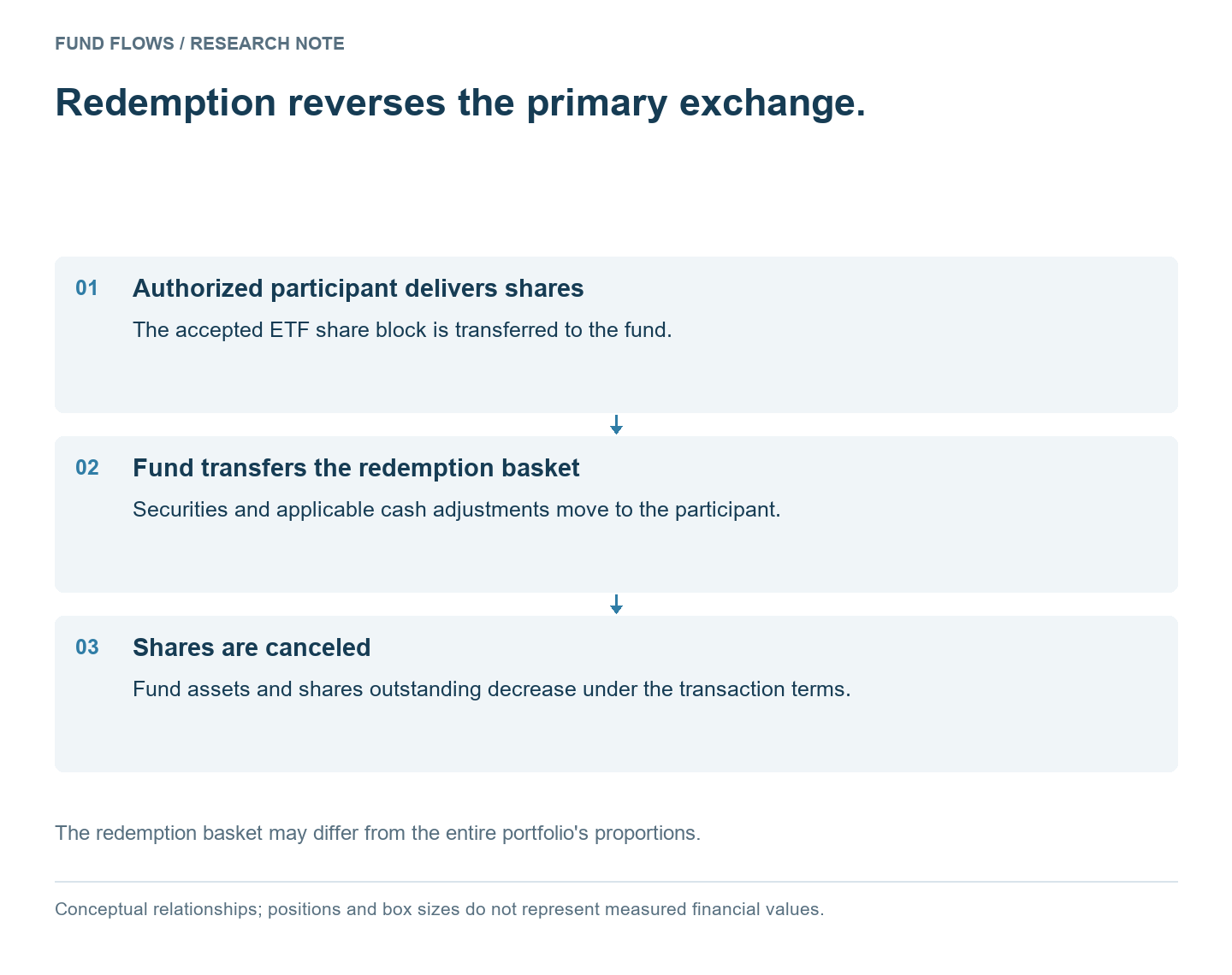
The redemption basket need not be identical to a creation basket used earlier. The composition depends on the fund's procedures and the particular transaction. A researcher should not infer the outgoing securities solely from a prior published creation file.
An in-kind redemption transfers assets out of the fund without necessarily requiring the fund itself to sell them for cash. The recipient may later sell, retain, or use those securities elsewhere. The transfer therefore changes ownership immediately, while any subsequent market sale is a separate step.
This is economically important during periods of heavy redemptions. Saying the fund avoided a cash sale describes one part of the process. It does not prove that the assets never reached the market, that the recipient faced no execution costs, or that the composition of the remaining fund was unchanged.
Basket selection affects remaining holdings
Consider a separate fund with $100 million, divided between $60 million of more readily traded securities and $40 million of less readily traded securities. These are analytical categories for the example, not regulatory classifications.
The fund meets a $10 million in-kind redemption by transferring $8 million from the more readily traded group and $2 million from the other group. Ignoring price changes and costs, it retains $52 million and $38 million, totaling $90 million.
The less readily traded group rises from 40% of assets to approximately 42.22%. The fund has met the redemption, but the composition of its remaining portfolio has changed. A proportional transfer of $6 million and $4 million would instead leave $54 million and $36 million, keeping the latter group's weight at 40%.
The example does not establish that one basket is always superior. Actual securities have multiple characteristics, and liquidity itself depends on market conditions. It shows why the outgoing basket matters to investors who remain. Net redemptions alone do not reveal the resulting portfolio's liquidity, duration, credit exposure, or concentration.
Gross activity can be substantial when net issuance is small
Assume the ETF completes four creation units and three redemption units during a period. At a constant $50 net asset value and 50,000 shares per unit, creations add 200,000 shares worth $10 million, while redemptions remove 150,000 shares worth $7.5 million.
Net issuance is 50,000 shares, or $2.5 million. Gross primary-market activity, defined here as the value of creations plus redemptions, is $17.5 million. Both measures are correct, but they describe different aspects of activity.
The net number describes the change in supply under the stated assumptions. The gross number describes how much passed through the creation and redemption process. Neither is equivalent to exchange trading volume, and the three measures should not be added together as if each captured independent new investor money.
Prices may vary in real transactions, so multiplying a period's net share change by a single closing net asset value can be an approximation. Exact dollar issuance requires the applicable transaction values and treatment of other share-count changes. Share splits, reorganizations, and data adjustments must be excluded before interpreting every change as investor flow.
Settlement adds a clock to the accounting
A basket that balances in value still has to be delivered. Securities may trade in different markets, follow different calendars, or settle at different times. Currency conversion and local holidays can complicate a transaction that appears simple when represented as one dollar amount.
The relevant questions concern when the AP must deliver assets, when ETF shares become available, and how any temporary exposure is financed or hedged. A missed delivery or an unexpected market closure can change the economics of the trade.
A published net asset value also represents a valuation at a particular time. Some underlying markets may be closed while ETF shares continue trading. Changes in the ETF price can then reflect new information not yet incorporated into the last official portfolio valuation.
The analyst should align timestamps before labeling a difference an arbitrage opportunity. A comparison between a live tradable price and a stale valuation can be informative, but it is not the same as a simultaneous executable trade in both markets. Basket analysis improves that comparison by identifying the assets and timing actually involved.
Keep the investment objective in the reconciliation
Matching dollar values is necessary, but it does not establish that the resulting portfolio still has the intended exposures. Two baskets with equal values can contain different interest-rate sensitivity, credit quality, industry concentrations, currencies, or liquidity characteristics.
For an index-tracking fund, the portfolio consequences should be considered alongside the benchmark and the manager's tracking approach. A basket that is convenient to assemble could require later portfolio trades to maintain the intended exposure. Those later trades can create costs even if the creation itself was completed in kind.
For an actively managed fund, receiving a particular basket may support a desired portfolio adjustment. That possibility still needs evidence from the actual process. The observer should not label every nonproportional basket an expression of the manager's investment conviction. Operational availability and portfolio management can both affect the accepted package.
A useful review follows the full sequence. First establish what entered the fund. Then compare the resulting holdings with the prior portfolio and the stated objective. Finally, examine whether subsequent transactions were needed and how their costs were handled. Stopping after the first transfer can miss economically relevant work performed afterward.
This sequence also prevents a misleading interpretation of cash. A cash amount in the basket may be a balancing item, payment associated with a substituted security, or part of the intended portfolio exposure. It does not automatically show that the manager is becoming defensive. The reason for the cash determines what can be inferred from it.
The completed analysis should be able to explain both value and exposure. Value reconciliation protects the arithmetic connecting assets with shares. Exposure reconciliation explains what ownership of those shares now represents. Together, they turn a basket file from a list of identifiers into an account of how the fund's supply mechanism interacts with its investment portfolio.
Read a basket file as an operational document
A holdings file, a published basket, and a completed transaction record should be kept distinct. A holdings file shows a portfolio at a stated date. A basket file can describe a package available for creation or redemption. A transaction record establishes what was actually accepted and transferred.
The researcher should confirm the effective date, creation-unit size, security identifiers, quantities, currencies, cash components, and whether the file is estimated or final. Any custom arrangements or cash substitutions must be understood before treating the file as a complete description of activity.
Reconcile the total package value with the shares issued or canceled. Explain any differences through identified adjustments rather than forcing the numbers to match through an unexplained residual. If transaction-level information is unavailable, narrow the conclusion to what the published file supports.
The strongest basket analysis follows assets across the fund boundary, checks how share supply changes, and examines what remains in the portfolio. That approach explains the mechanism supporting an ETF while preserving its practical limits. Supply adjusts through institutions delivering real assets under specific terms, and the quality of that process depends on valuation, execution, and the holdings being transferred.
Related research

ResearchFund Flows
Persistent Outflows Are a Question About Mechanics as Well as Sentiment
Repeated withdrawals deserve attention, but their meaning depends on the investors, the product, and the assets that must fund them. A useful diagnosis separates investor motivation, cash requirements, and the market effects of selling.

ResearchFund Flows
A Record Flow Is Only a Record Within a Defined Dataset
A record flow is a comparison with an observed history, not a universal statement about investor behavior. Defining the series, checking its coverage, and testing alternative measures determine whether the record is economically meaningful.

ResearchFund Flows
Following a Technology Theme Through Fund Holdings
A technology theme travels through different business models before it reaches a fund portfolio. Mapping those links, reconciling holdings, and separating purchases from price changes turns a broad narrative into an exposure that can be examined.