
ResearchFund Flows
Cross-Border Flows Need a Currency Translation Check
- Report or archive date
- Archive placement July 14, 2026
- Reading time
- 13 min read

Summary
Foreign-currency assets can grow in dollar terms without receiving new money. Separating transactions, local investment returns, and exchange-rate changes is essential before a change in reported assets is interpreted as an international allocation decision.
The reporting currency can change the apparent story
A portfolio remains worth 100 million euros, but the exchange rate changes from $1.10 to $1.20 per euro. Its reported dollar value rises from $110 million to $120 million. No subscriptions occurred, no securities were added, and the local-currency value did not change.
The $10 million increase is a translation effect. It matters to someone measuring wealth in dollars, but it is not evidence that investors supplied another $10 million to the portfolio. A dollar asset chart alone cannot distinguish that effect from new contributions or investment gains.
The same principle applies to broader international holdings. Changes in positions can arise from financial transactions, price changes, exchange-rate movements, and other adjustments. A balance measured at two dates is not automatically a record of the transactions between them.
Write down the exchange-rate convention first
An exchange rate of $1.20 per euro means one euro converts into 1.20 dollars. To translate 10 million euros, multiply by 1.20, obtaining $12 million. If the rate is quoted in the inverse direction, the arithmetic changes even though the economic relationship is the same.
For example, a rate of 150 yen per dollar means 1.5 billion yen converts into $10 million by dividing by 150. Multiplying the yen amount by 150 would be a unit error. The words per dollar or per euro are part of the data, not optional labels.
This is especially important when combining files from different providers. Some series quote local currency per dollar, while others quote dollars per local currency. A plausible-looking number can be wrong if the direction is inverted. Preserve the original convention and the converted unit in the working record.
Exchange-rate dates matter as well. A transaction-date rate, an average period rate, and an end-period rate have different uses. A calculation should identify which convention it applies before interpreting a difference as new money or a valuation gain.
Within a single date, different observation times can also matter. A local market close and a later currency fixing may incorporate different news. Using a consistent valuation convention does not eliminate that timing difference, but it makes the result reproducible and prevents an unexplained switch between price snapshots from appearing as an investor transaction.
Build the local-currency asset bridge
Consider a euro-denominated fund beginning with 100 million euros. Its existing portfolio earns 8 million euros during the period. At the very end, after that return has occurred, investors contribute a net 12 million euros. Assume no distributions, other transactions, or valuation adjustments.
Ending assets are 120 million euros: 100 million at the start, plus 8 million of investment gain, plus 12 million of net contributions. The existing portfolio's return is 8%, while total local-currency asset growth is 20%. The difference is external funding, not additional investment performance.
The timing assumption is deliberate. Because all contributions arrive at the end, they earn none of the specified period return. If money arrived earlier, some of the investment gain could belong to the new contributions, and a simple beginning-assets return calculation would need adjustment.
Reconcile the local-currency bridge before translating it. If the fund's own transaction and return records do not explain its local asset change, changing the reporting currency will not solve the discrepancy. It will add another source of movement to an already incomplete account.
Translate the bridge into dollars
Suppose the opening exchange rate is $1.10 per euro and the closing rate is $1.20. The 100 million euro opening balance is worth $110 million. The 120 million euro ending balance is worth $144 million. Dollar assets rose by $34 million, more than the local flow translated at either rate.
Because the 12 million euro contribution arrives at the end, its dollar value is $14.4 million using the specified transaction-date rate of $1.20. Before that contribution, the existing portfolio is worth 108 million euros, or $129.6 million at the closing rate.
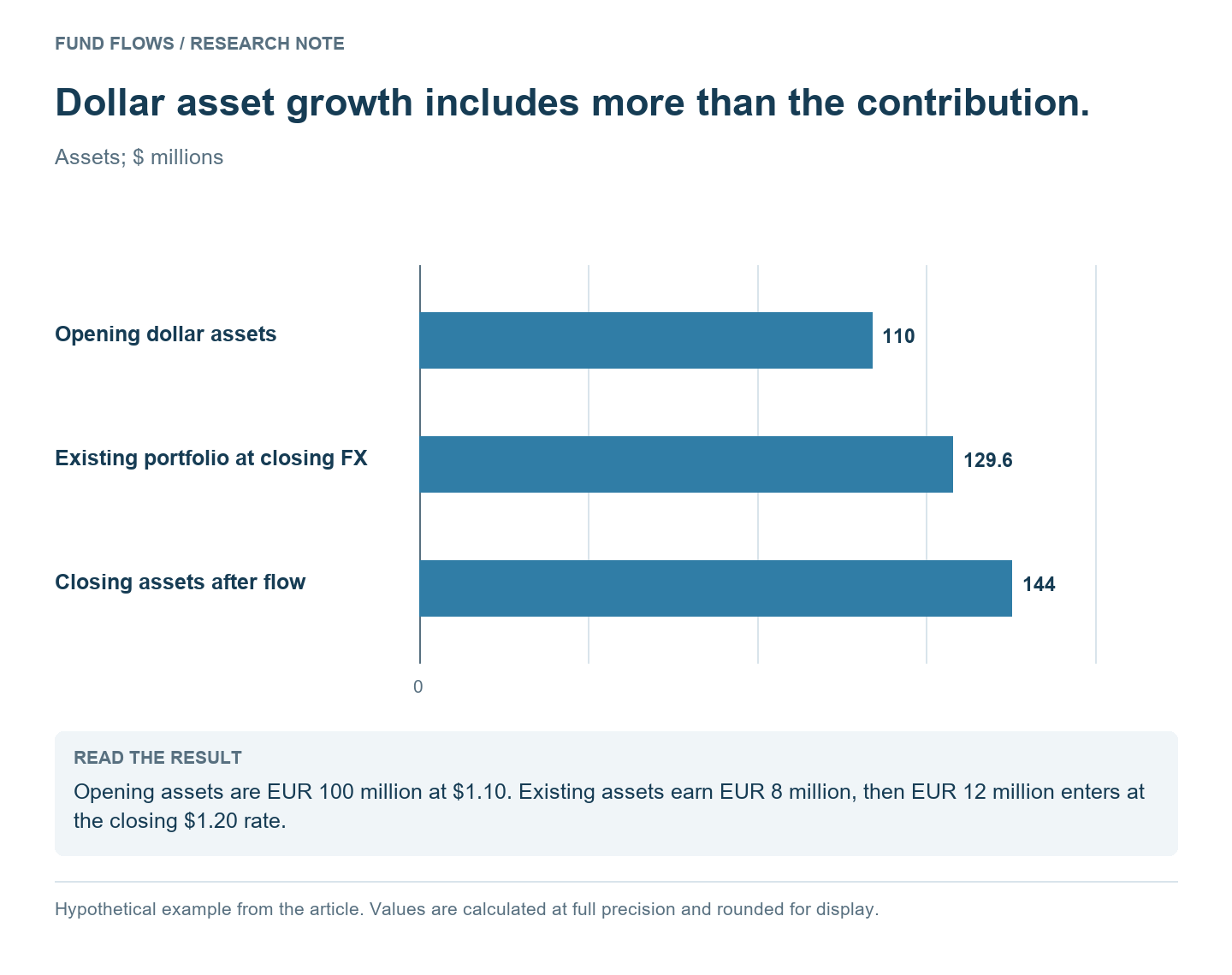
The original dollar portfolio therefore gained $19.6 million through investment performance and translation, while the external contribution added $14.4 million. Together those components explain the $34 million increase. Calling the full increase a dollar inflow would overstate the contribution by $19.6 million.
This separation is the central task. Reported assets describe the value present at the end. Transactions describe the money or assets transferred during the interval. Currency translation changes the dollar value of both holdings and transactions, but it does not turn a revaluation into a new subscription.
Separate local return, currency movement, and their interaction
One way to decompose the $19.6 million gain on the opening portfolio is to value the 8 million euro investment gain at the opening exchange rate, producing $8.8 million. The exchange-rate change on the original 100 million euros contributes another $10 million.
There is also an interaction: the 8 million euro local gain is worth an additional $0.8 million because the euro value is translated at a rate that is $0.10 higher. Adding $8.8 million, $10 million, and $0.8 million gives the required $19.6 million.
An equivalent two-part decomposition assigns $8.8 million to local performance at the opening rate and $10.8 million to currency translation on the full 108 million euro pre-contribution balance. Both decompositions reach the same total. The interaction is included in the second version's currency component.
Do not add the $0.8 million interaction again after already calculating currency effects on the 108 million euro balance. Different attribution conventions can allocate the interaction differently, but they must reconcile to the same overall change. A component label does not justify counting the same effect twice.
Investment returns combine multiplicatively across currencies
For the opening portfolio, the dollar return factor is the local return factor of 1.08 multiplied by the exchange-rate factor of 1.20 divided by 1.10. The result is approximately 1.178182, implying a dollar return of approximately 17.82%.
The local 8% return and the euro's approximately 9.09% appreciation against the dollar cannot simply be added for an exact result. Their interaction contributes the remaining difference. Adding the two percentages gives approximately 17.09%, which understates the compounded currency-adjusted return.
The dollar return calculation uses the pre-contribution ending value of $129.6 million divided by the opening $110 million. It does not use the full $144 million ending assets, because that amount includes the external contribution. Dividing $144 million by $110 million would measure asset growth rather than the investment return on the opening capital.
This distinction is useful when flows are estimated as a residual. Under the stated end-of-period timing, subtracting $110 million multiplied by the correct dollar return factor from $144 million leaves the $14.4 million dollar contribution. Using the local 8% return with dollar assets would leave a misleading residual that includes currency gains.
The flow's conversion date can change its reported amount
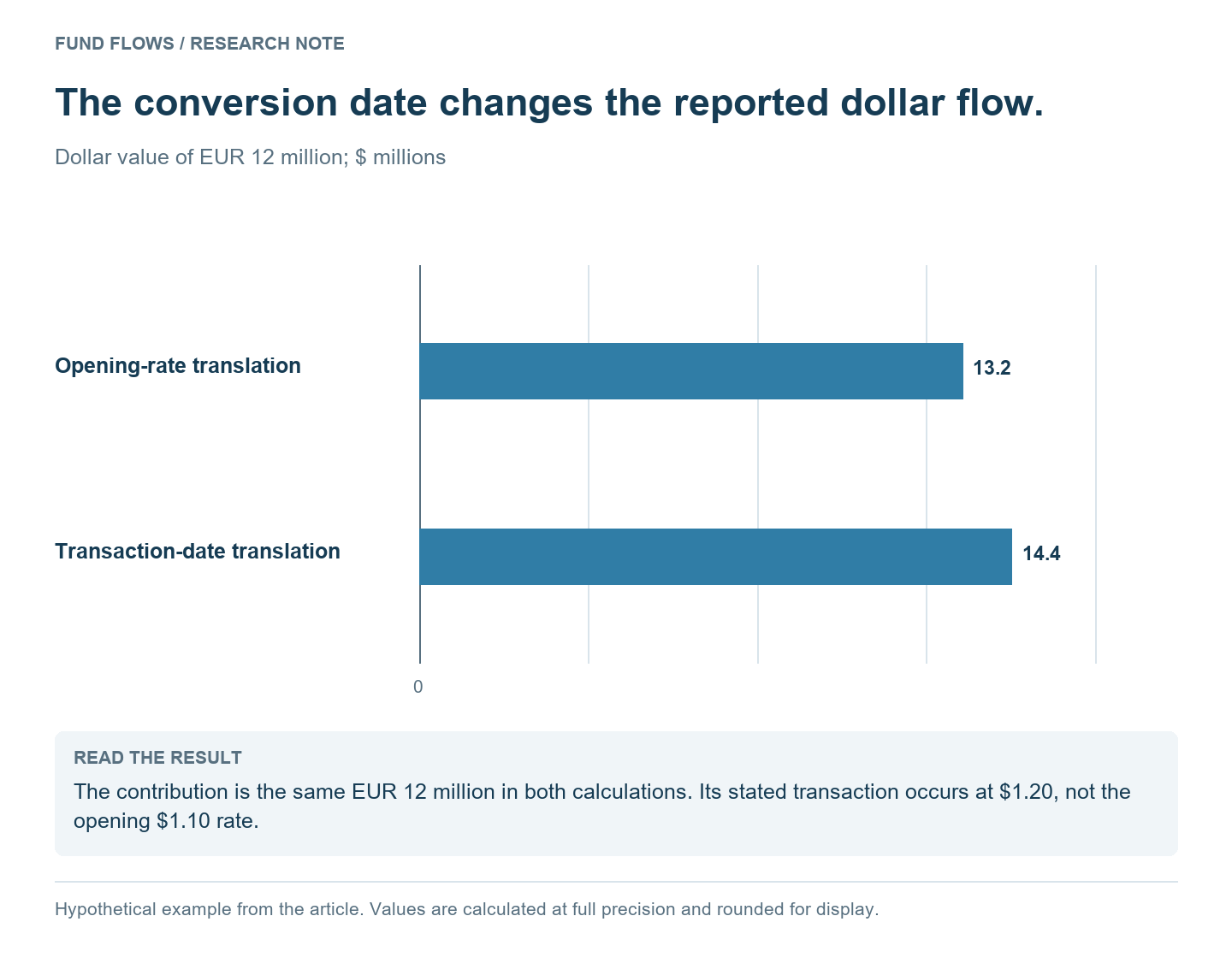
In the main example, converting the 12 million euro contribution at the opening rate would produce $13.2 million rather than the actual assumed transaction-date value of $14.4 million. The $1.2 million difference is a translation-convention difference, not evidence of an additional euro subscription.
For a separate transaction-only example, suppose two contributions of 6 million euros arrive at rates of $1.15 and $1.20 per euro. Their dollar equivalents are $6.9 million and $7.2 million, totaling $14.1 million. Translating the combined 12 million euros entirely at $1.20 would give $14.4 million, $0.3 million more.
This second example is not a replacement asset bridge for the first fund. It isolates the translation of transactions occurring at different times. A full portfolio reconciliation would also need to account for returns and currency movements after the earlier contribution arrived.
Period-average rates can be practical when transaction-level data are unavailable, but they remain a convention or approximation. If flows are concentrated on dates when exchange rates differ materially from the average, the approximation can affect comparisons. The reporting method should be consistent across the funds or countries being ranked.
Positive local flows can coexist with falling dollar assets
Consider another fund beginning with 100 million euros at $1.10 per euro, worth $110 million. Its local investments have no gain or loss, and it receives a 5 million euro contribution at the end. The closing exchange rate is $1.00 per euro.
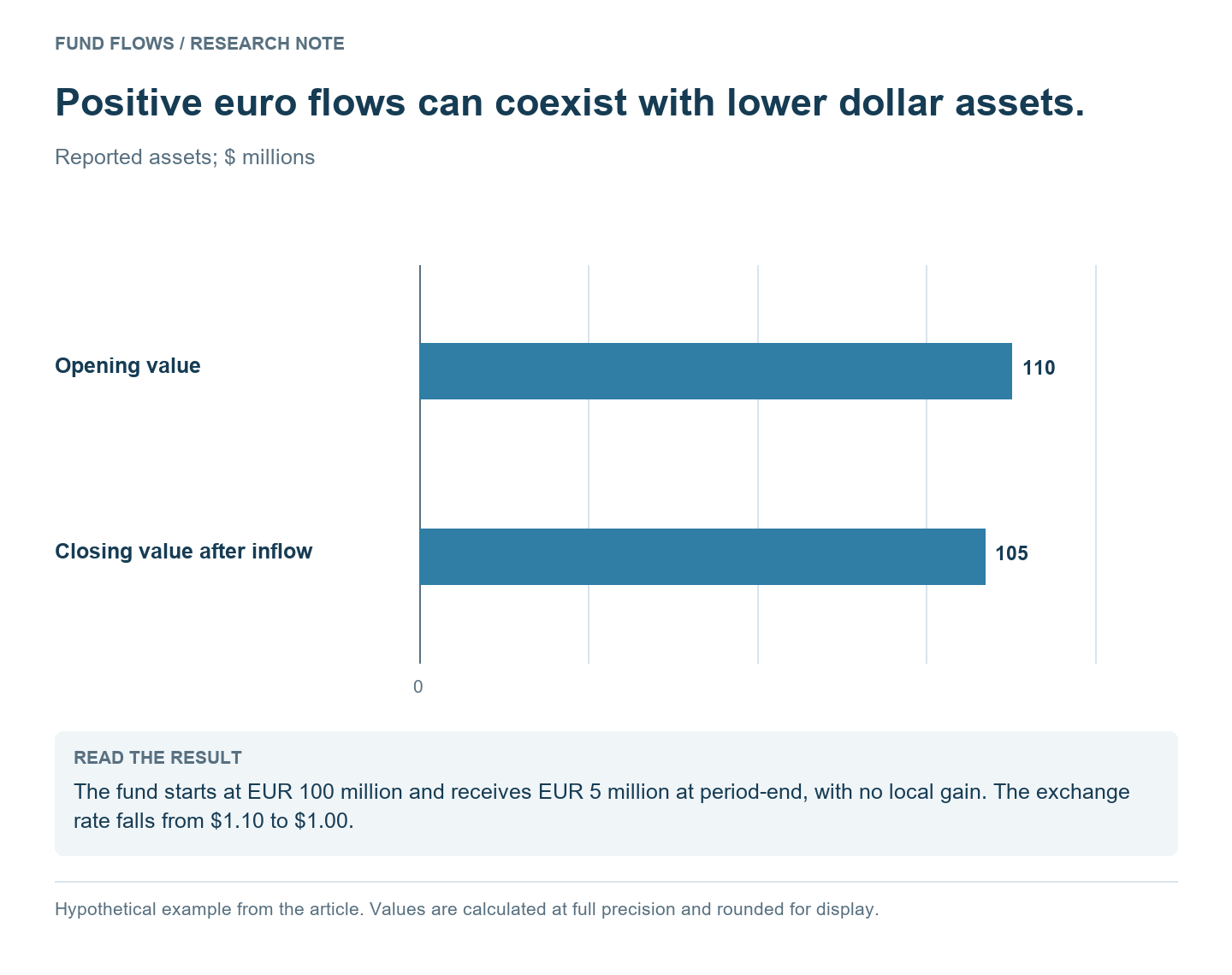
Ending assets are 105 million euros, worth $105 million. Dollar assets fell by $5 million even though investors contributed 5 million euros, worth $5 million when they arrived. The opening assets lost $10 million of dollar translation value, partly offset by the new contribution.
Describing the $5 million decline in dollar assets as an outflow would reverse the direction of the actual investor transaction. The fund received money. Its reporting-currency value declined because the exchange rate moved enough to outweigh that contribution.
The opposite pattern is equally possible: a favorable currency movement can more than offset withdrawals in the reported asset balance. Direction alone does not solve the measurement problem. Both increases and decreases need a bridge that separates transactions from valuation effects.
Combine currencies only after converting compatible amounts
Suppose three separate net flows occur at their stated conversion rates: positive 10 million euros at $1.20 per euro, positive 1.5 billion yen at 150 yen per dollar, and negative 4 million pounds at $1.25 per pound. Their dollar equivalents are positive $12 million, positive $10 million, and negative $5 million.
The combined net flow is positive $17 million. Adding the raw currency amounts before translation would have no coherent meaning because euros, yen, and pounds are different units. Each component must be converted using a compatible convention before aggregation.
The negative sign on the pound flow should be preserved through the conversion. An outflow does not become an inflow because the exchange rate is quoted differently. Keeping amount, sign, currency, rate direction, and date together reduces the chance of a spreadsheet transformation changing the economic meaning.
Even correctly translated flows may not be directly comparable if their populations or definitions differ. One series may include ETFs while another excludes them, or one may count reinvested distributions differently. Currency alignment is necessary for a dollar total, but it does not replace the other checks needed for a consistent aggregate.
Trading currency is not the same as currency exposure
An ETF can trade in dollars while holding securities with foreign-currency exposure. Changing the exchange listing or the currency used to pay for the shares does not automatically hedge the underlying investments. The trading currency describes a transaction convention; the portfolio's exposures determine how exchange-rate movements affect its value.
A dollar-denominated share class can therefore have a different meaning from a dollar-hedged share class. A hedge involves a strategy, commonly using financial instruments, intended to offset specified currency movements. Its objective, coverage, costs, and effectiveness need to be understood separately from the currency printed beside the share price.
For flow research, this prevents a labeling error. A subscription into a dollar-priced vehicle is not proof that the investor obtained only dollar economic exposure. Similarly, a foreign-currency payment for a share does not establish where all of the underlying companies conduct business or earn revenue.
The fund's base currency, share-class currency, trading currency, and underlying exposure can differ. A clear analysis identifies which one is being used in each calculation rather than allowing the word currency to stand for all four.
Hedge gains and losses are not shareholder subscriptions
If a fund uses currency hedges, changes in the hedge's value can offset some movements in the underlying holdings. Those gains or losses are part of the investment result. They are not automatically additional contributions or redemptions by the fund's shareholders.
The timing of cash settlements can complicate the picture. A hedge may generate a cash receipt while the corresponding underlying valuation loss remains unrealized, or require collateral while the portfolio has an offsetting gain elsewhere. An analysis of liquidity needs to follow those payments separately from the ultimate combined economic exposure.
It would therefore be wrong to remove the full unhedged currency effect from a hedged fund's asset change without accounting for the hedge result. It would also be wrong to classify the hedge cash receipt as new investor demand merely because cash entered an account.
The appropriate bridge includes portfolio performance, hedge performance, external transactions, distributions, and relevant other adjustments under the fund's reporting conventions. Hedging changes the investment outcome and cash timing; it does not eliminate the need to distinguish those components.
Normalized flow rates also depend on the translation convention
In the main example, the 12 million euro contribution is 12% of the 100 million euro beginning balance. In transaction-date dollars, the $14.4 million contribution is approximately 13.09% of the $110 million beginning dollar balance. Both calculations are valid under their stated definitions.
The difference does not mean more euros were contributed in the dollar version. The numerator was translated at the ending transaction rate, while the denominator was translated at the opening rate. The dollar ratio includes the change in the currency's value between those dates.
For a constant-currency comparison using the opening rate for both quantities, the flow would be $13.2 million against $110 million, again 12%. This can help compare transaction intensity without exchange-rate changes affecting the ratio. It is an analytical constant-currency measure, not the actual assumed dollar value of the end-period subscription.
The choice depends on the question. A report about dollars transferred at the transaction date should preserve the transaction-date conversion. A comparison of local subscription intensity may prefer the local-currency ratio or a consistently translated equivalent. Mixing those conventions across countries can change a ranking without any corresponding difference in local investor behavior.
Maintain full precision when recovering a residual
Using the local 8% return with the dollar balances would calculate expected pre-flow assets of $118.8 million: $110 million multiplied by 1.08. Subtracting that from the $144 million ending balance leaves $25.2 million. The result exceeds the true assumed $14.4 million dollar contribution by $10.8 million, the currency effect on the 108 million euro pre-contribution portfolio.
This is a currency mismatch, not a small rounding issue. The return series must measure the same reporting-currency outcome as the asset balances. Otherwise, the residual absorbs an investment-related change and falsely labels it shareholder activity.
Rounding can create a smaller but separate problem. If the correct dollar return is rounded to 17.82% before being applied to $110 million, expected pre-flow assets become $129.602 million. The resulting flow residual is $14.398 million, which is $2,000 below the exact $14.4 million contribution in this case.
The economic interpretation is unchanged at this scale, but the discrepancy can confuse a reader who tries to reproduce the calculation. Keep full precision in the calculation and round only the displayed result. Here, calculating 108 million euros times $1.20 directly gives the exact $129.6 million pre-flow balance under the assumptions.
These two errors require different remedies. A mismatched currency return must be replaced with a compatible return series. A rounding residual requires more precise arithmetic, not an invented transaction adjustment. Identifying the cause prevents a reconciliation from being forced into agreement through an unsupported balancing item.
Cross-border is a question about the parties, not just the currency
A transaction can be denominated in dollars and still be cross-border if it occurs between residents of different economies under the relevant statistical framework. Conversely, a foreign-currency transaction between two residents of the same economy is not automatically a cross-border investment flow.
Fund domicile, investor residence, security issuer residence, and listing location describe different parts of the chain. An inflow into a fund domiciled in one country may be financed by an investor in another and invested in companies across several others. A single country label cannot capture every relationship.
This is why fund flow totals should not be presented as national balance-of-payments flows without additional mapping. The two systems can have different boundaries, units of observation, and transaction coverage. Similar dollar totals do not establish that they measure the same capital movement.
The distinction is especially important when drawing conclusions about confidence in a country or currency. A change in a global fund's assets may reveal little about the residence of its owners. A change in foreign holdings can include valuation effects. The economic claim needs to match the specific transaction or position being measured.
Reconcile the components before interpreting the destination
Begin with a clearly defined currency and population. Separate local transactions from investment gains, translate balances and flows using appropriate dates, and account for any hedge or reclassification effects. Verify that the resulting components reproduce the observed ending assets.
If the bridge leaves a residual, investigate it rather than automatically labeling it foreign buying. Timing, distributions, mergers, coverage changes, and inconsistent exchange-rate conventions can all create unexplained differences. A residual becomes an economic finding only when its meaning is supported by the underlying records.
Cross-border fund data become more informative when the translation is visible in the analysis. A larger dollar balance may reflect new contributions, stronger local investments, a weaker reporting currency, or a combination. Separating those channels allows the article to describe actual allocation changes without inventing investor decisions from movements in the exchange rate.
Related research

ResearchFund Flows
ETF Holdings Overlap Can Hide a Concentrated Capital Flow
Different ETF names can lead back to the same companies. Looking through each fund's holdings reveals the combined exposure, while a separate flow analysis shows why assumed allocation of new money must not be confused with observed trading or corporate financing.

ResearchFund Flows
AI Headlines Do Not Reveal Where New Investment Went
Earnings growth, a rising stock price, a busy trading session, and an ETF inflow are different observations. Following the money through corporate accounts, securities markets, and fund ownership helps identify which part of an AI investment story is actually documented.

ResearchFund Flows
Fund Categories Can Change the Apparent Winner
A category can rise to the top of a flow ranking because a fund changed classification rather than because investors changed their transactions. A consistent fund universe, explicit category rules, and a record of classification dates help separate market activity from changes in the reporting map.