
ResearchCross-Asset Allocation
Inflation Protection Depends on the Liability You Are Protecting
- Report or archive date
- Archive placement June 10, 2026
- Reading time
- 13 min read

Summary
An investment can respond to a broad inflation index while still leaving a particular spending plan underfunded. Matching the obligation requires attention to its basket, timing, currency, and flexibility. Original budget and bond examples distinguish contractual inflation linkage from market-price stability and business pricing power.
Protect the payment before choosing the label
Three obligations can all be described as exposed to inflation while requiring different responses. One is a fixed dollar invoice due next month. Another is an annual payment contractually linked to a consumer price index. A third is the future cost of replacing specialized equipment whose price can move independently of that index.
The fixed invoice has already established its nominal amount. The indexed payment changes according to a defined formula. The equipment purchase depends on a particular market, product specification, and delivery date. Treating all three as the same inflation problem can lead to an instrument that matches none of them well.
An allocation review should therefore begin with the liability: what must be purchased or paid, in which currency, at what time, and under what contractual terms. Only then can an investment's inflation sensitivity be judged against the actual need.
The aim is not to find one asset that always rises when an inflation statistic rises. It is to improve the portfolio's ability to deliver the required purchasing power under relevant conditions. That objective is more specific and more demanding than selecting a familiar inflation-sensitive category.
A price index represents a defined basket
A broad consumer price index summarizes price changes across a specified population and expenditure pattern. A particular household, organization, or project can have different spending weights. Even if every individual price is measured accurately, the relevant aggregate change can differ.
The difference is not necessarily evidence that the published index is wrong. It can reflect a different question. A research organization with substantial payroll and specialized equipment expenses is not purchasing the same basket as the average consumer household.
For a funding plan, identify the major expense categories and their approximate shares before selecting an inflation assumption. The exercise need not claim to create an official index. It can simply make the budget's sensitivities visible and prevent an unrelated average from being used without thought.
The basket should also separate price changes from changes in quantity or quality. A larger office, more staff, or upgraded equipment can raise spending even if the prices of comparable items do not change. Those are real funding needs, but they are not all inflation.
Build a spending basket
Suppose an annual budget is $50,000. It assigns 40% to housing-related costs, 20% to food, 20% to health-related expenses, 10% to energy, and 10% to other items.
Assume the respective category prices rise 3%, 4%, 6%, 25%, and 2%, with quantities unchanged. The contributions to the total increase are 1.2, 0.8, 1.2, 2.5, and 0.2 percentage points. Together they produce a 5.9% increase.
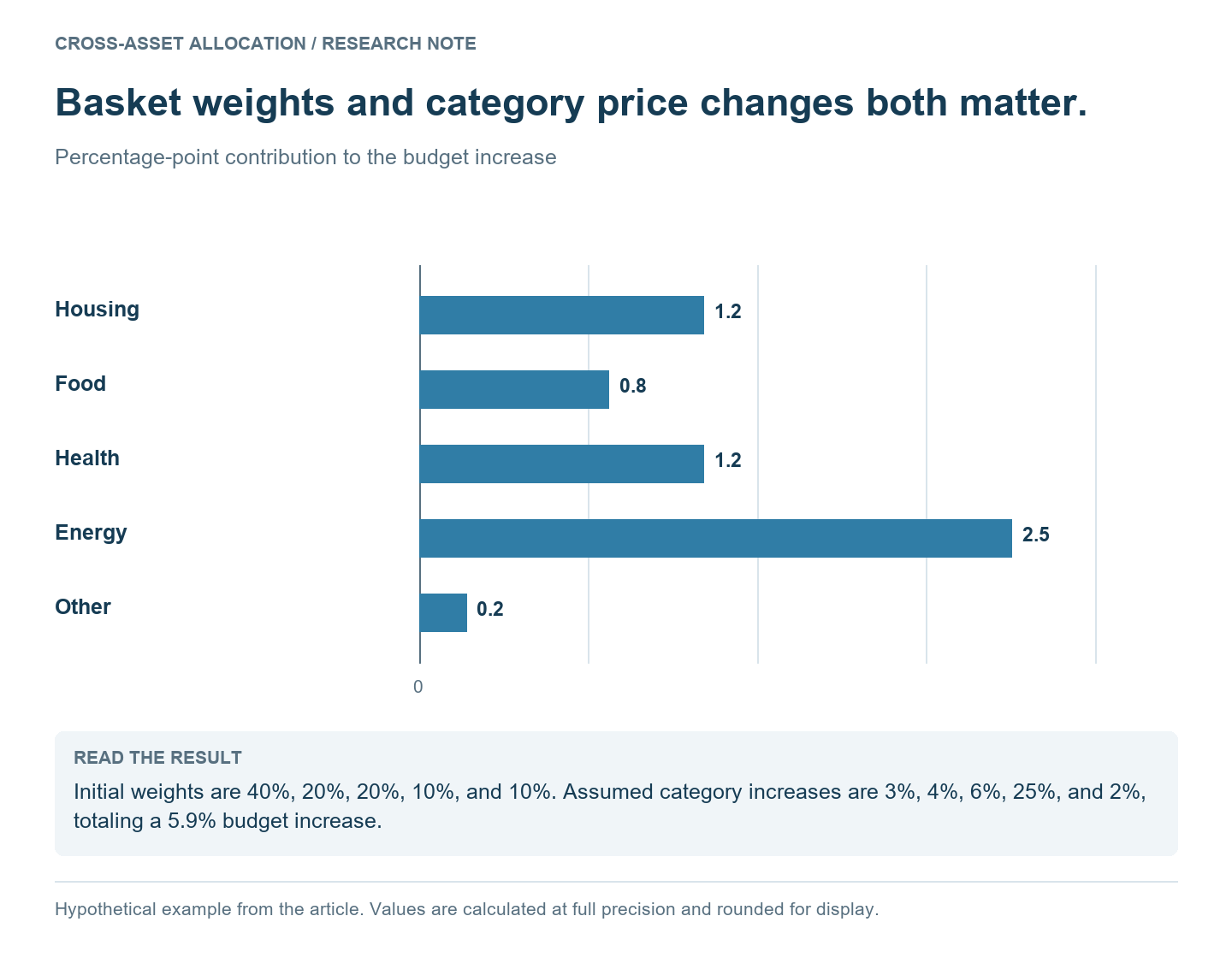
The same basket would now cost $52,950. Energy has only a 10% initial weight but contributes 2.5 percentage points because its assumed price change is large. The result depends on both the weights and the category changes.
This is a fixed-basket calculation. Actual behavior might change when prices rise, and official indexes can use more detailed methods. The example's role is to demonstrate why a broad inflation figure cannot be assumed to match every spending plan exactly.
Measure the mismatch instead of hiding it
Assume, separately, that a broad inflation index rises 3%. An abstract $50,000 payment claim linked exactly to that index would increase to $51,500. This is a simplified contractual amount, not the market return of an actual inflation-linked bond or fund.
Against the budget's $52,950 cost, the indexed amount leaves a $1,450 shortfall. It covers approximately 97.26% of the required spending. The claim did exactly what its assumed contract required, yet it did not fully match the particular liability.
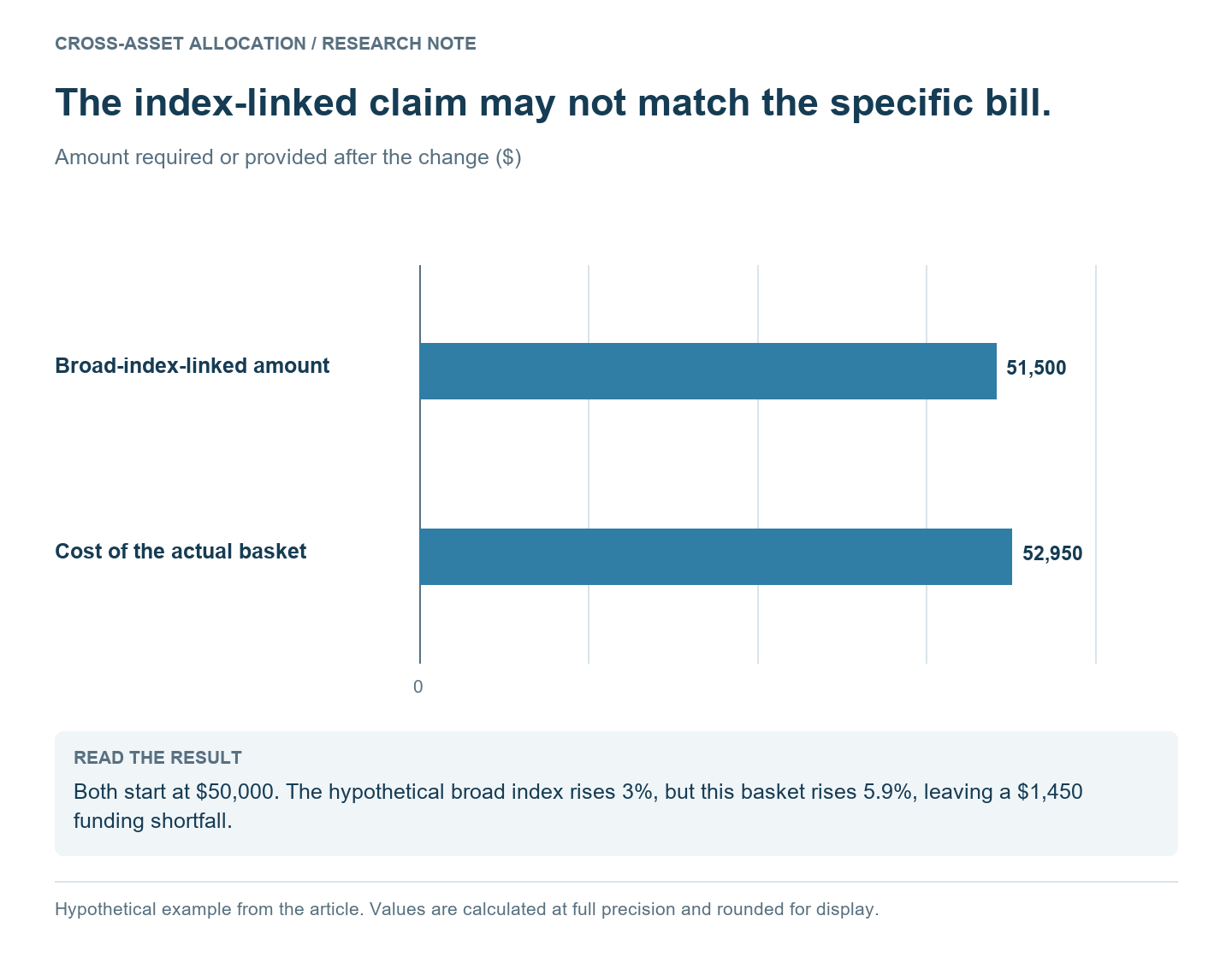
That difference is a form of basis risk: the protection and the obligation respond to different underlying measures. It can matter even when the investment's index linkage is dependable. A reliable relationship to the wrong basket is still an imperfect match.
The appropriate response may involve a funding margin, more specific cost analysis, or flexibility in the spending plan. It should not begin by assuming that an asset described as inflation-protected guarantees the purchasing power of every possible expense.
Contractual linkage has precise terms
An indexed obligation or investment specifies which index applies, the reference dates, how adjustments are calculated, and whether any caps or floors apply. The timing can differ from the date on which a particular expense is incurred.
Those details determine the protection. A payment that adjusts annually can lag a sudden increase in current expenses. A cap can limit the adjustment during a large price move. A floor can create a different response when prices fall. The label alone does not reveal those features.
The currency must also match the question. An instrument linked to inflation in one currency can still expose the holder to exchange-rate changes relative to spending in another. Local purchasing-power protection and foreign-currency value stability are distinct objectives.
A practical comparison should place the liability terms and the investment terms side by side. Identify which changes are matched directly and which remain uncertain. This makes the residual exposure easier to evaluate than a general statement that the portfolio contains inflation hedges.
Understand what TIPS adjust
U.S. Treasury Inflation-Protected Securities adjust principal using their specified consumer-price index mechanism. Their fixed coupon rate is applied to the adjusted principal, and interest is paid semiannually. The dollar coupon can therefore change even though the coupon rate does not.
For a coupon example, use $1,000 of original principal and a 2% annual coupon rate. If the applicable adjusted principal at a payment date is $1,030, the semiannual coupon is $10.30: one-half of 2% multiplied by $1,030.
If the adjusted principal at another payment date were $980, the corresponding coupon would be $9.80. These principal amounts are assumed index adjustments, not statements about a current security or a particular annual inflation reading.
The distinction between rate and amount is important. A fixed coupon rate does not mean a fixed dollar coupon on an indexed principal. Conversely, a larger coupon payment does not by itself describe the security's total market return over the period.
The maturity floor is not the purchase price
At maturity, TIPS repay the greater of the inflation-adjusted principal and the original principal under their terms. That floor concerns the original principal amount. It should not be interpreted as protection of every price paid by a later purchaser.
Suppose, an investor pays $1,100 for a claim with $1,000 of original principal, ignoring accrued interest for this example. The original-principal floor remains $1,000, not $1,100. The purchase premium has not become part of the floor.
This does not calculate the investment's full return, which would also include coupon payments, the actual principal adjustment, timing, and costs. It isolates a common misunderstanding about what is protected. A contract can provide a meaningful floor without guaranteeing recovery of a particular market purchase price.
The same distinction cautions against treating a fund holding inflation-linked bonds as though the fund investor had a single bond maturing at the investor's chosen withdrawal date. The holdings and the portfolio's market value can change before that date.
Real yields can move market values
Inflation linkage concerns the units in which future payments are defined. The current market value of those payments can still change when the real return investors require changes. Protection of a future indexed payment is not the same as a stable price today.
Consider a simplified certain payment of 100 purchasing-power units due in five years, with no intermediate payments. At a 1% real discount rate, its present value is approximately 95.15 real units. At a 2% real discount rate, the value is approximately 90.57.
The immediate value decline is about 4.81%, calculated from unrounded values. The promised real payment remains 100 units. This is a generic real-cash-flow example, not a price forecast for a particular TIPS issue or a calculation incorporating its maturity floor.
The example explains how a real-rate increase can pressure an inflation-linked investment's market value. Its contractual index adjustment and its market repricing can operate at the same time. Evaluating the investment requires the holding horizon and the intended payment purpose.
Expected inflation is already part of pricing
An investor purchasing an inflation-linked security is not necessarily obtaining future inflation adjustments without paying for their expected value. The price and real yield reflect market conditions at purchase. A nominal bond's yield also incorporates expectations and compensation for relevant risks.
The yield difference between comparable nominal and inflation-linked government securities is often called inflation compensation or breakeven inflation. It can be informative, but it is not a pure measurement of the inflation that will occur. Risk premiums and liquidity differences can affect it.
The choice between the two securities therefore depends on more than the observation that prices are currently rising. Starting valuations, the liability being funded, and the consequences of different inflation outcomes all matter. A currently high inflation reading does not automatically establish which instrument will earn the higher future return.
For a liability-matching purpose, the direct linkage can still be valuable even when it is not a speculative bet on inflation exceeding expectations. The usefulness of the match and the forecast of relative investment performance are separate questions.
Time can magnify a small assumption difference
Suppose a program costs $50,000 today and the same quantity of activity is required five years from now. Under a constant 3% annual cost increase, the future amount is approximately $57,963.70. Under 5% annual cost growth, it is approximately $63,814.08.
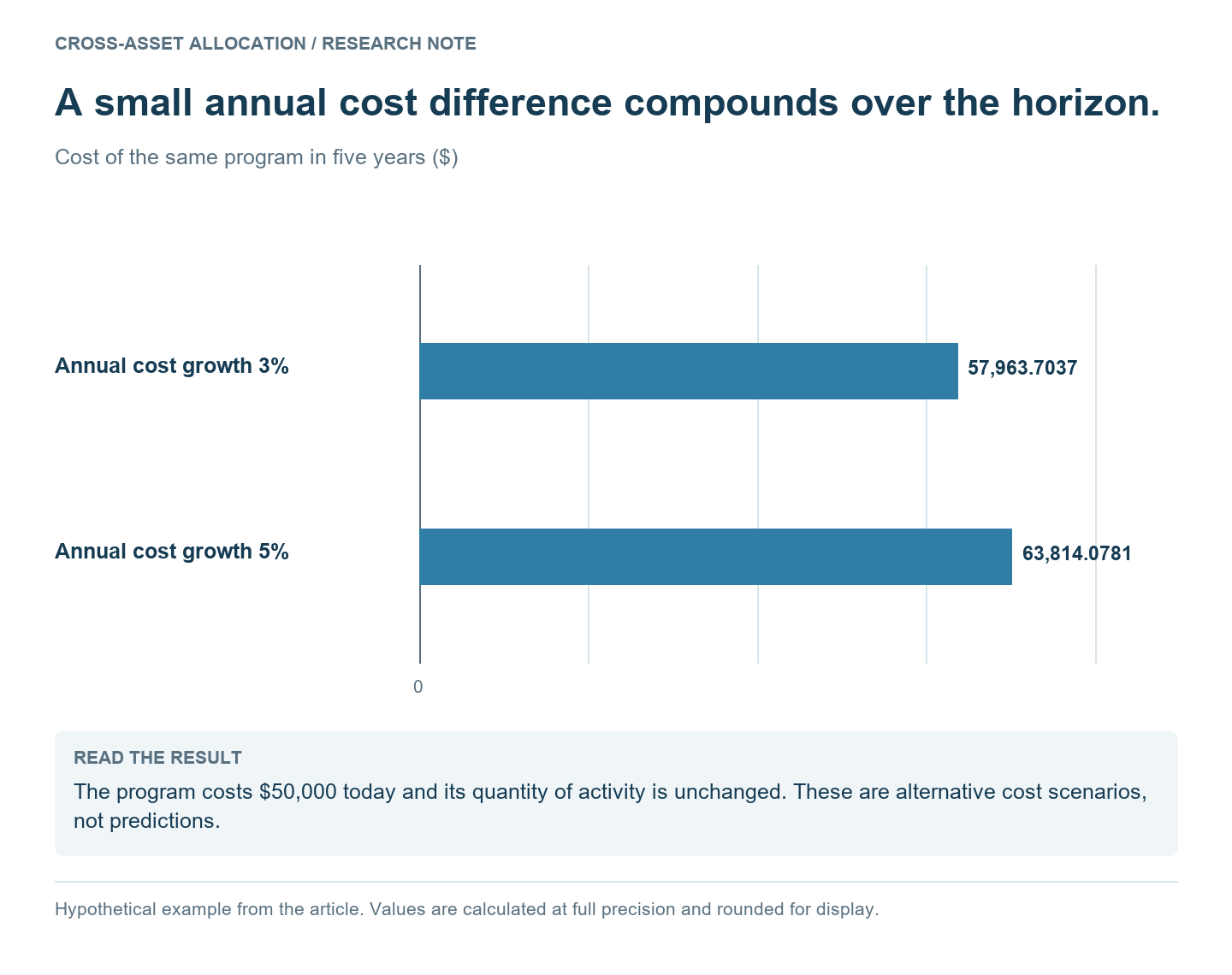
The difference is approximately $5,850.37 when calculated using full precision before rounding. Neither path is a forecast. The comparison shows how a modest annual assumption difference compounds into a meaningful funding difference over several years.
A plan that is adequate under the lower path may be inadequate under the higher one even if the investment account performs exactly as expected. The shortfall can come from the liability side rather than from disappointing asset returns.
This is why the funding review should update both sides of the balance. Reassessing only the portfolio while leaving an old spending-cost assumption untouched can create a misleading impression of progress toward the goal.
Business pricing power is a contingent relationship
Equity ownership can provide exposure to businesses whose revenues rise with prices, but that is not the same as a contractual inflation adjustment. The result depends on demand, competition, costs, financing, and the amount of reinvestment required to maintain the business.
A company may raise selling prices while its input costs rise faster. It may preserve margins but lose volume. It may report higher nominal earnings while needing more working capital or replacement spending. Each outcome has a different implication for cash available to owners.
The starting share price also matters. A business with strong pricing power can still be an unattractive investment at a valuation that already assumes exceptionally favorable results. The equity's response to inflation cannot be inferred from the operating description alone.
For portfolio purposes, treat pricing power as a business hypothesis to investigate. Examine contracts, margins, volumes, cash conversion, and capital needs. It can contribute to resilience, but it should not be assigned the certainty of an indexed payment formula.
Property income can adjust on a different clock
Real estate is another category frequently associated with inflation protection. Its income may rise through rent reviews, new leases, or changes in market demand. The timing and extent of that adjustment depend on the actual agreements and local conditions.
Expenses and financing can change on a different schedule. Maintenance, insurance, utilities, and borrowing costs may increase before rent adjusts. A property can have rising nominal revenue and weaker net cash flow if those other changes dominate.
Its market value also depends on the return buyers require. Higher income does not guarantee a higher valuation when discount rates or financing conditions change. Direct property and listed real estate securities can introduce different liquidity and leverage features as well.
The useful analysis follows the property's cash-flow terms and funding structure. The physical nature of the asset is relevant, but it does not create an automatic match to every inflation-linked spending obligation.
Commodity exposure matches some prices better than others
A commodity-related investment can respond to a particular supply-and-demand shock, but a broad spending basket contains much more than raw materials. A large energy-price increase may coincide with modest changes in other expenses, and commodity prices can later reverse.
The investment vehicle adds another layer. Producer shares include operating and financing risks. Futures-based strategies depend on contract selection, maturity changes, collateral, and expenses. Their returns need not equal the change in a spot-price series.
A hedge intended for a specific energy-intensive expense should be evaluated against the product, quantity, timing, and currency of that expense. A general commodity holding may provide only a partial or unstable relationship.
This does not make commodity exposure inherently unsuitable. It makes the purpose of the exposure important. The portfolio should identify which liability or scenario the holding is intended to address and what new risks it introduces in exchange.
Cash protects a different part of the problem
Suitable cash instruments can provide access to nominal funds for near-term payments. That can be valuable even when their after-cost return does not fully offset inflation. Liquidity and purchasing-power preservation are related objectives, but they are not identical.
Moving all long-term capital into cash to avoid market fluctuations can leave the funding plan exposed to continuing cost increases. Moving all payment reserves into volatile inflation-sensitive assets can create the opposite mismatch: a nominal funding gap at the moment the payment is due.
The allocation can separate immediate obligations from longer-term purchasing-power needs, while still reviewing the whole plan. That separation should follow the actual schedule and flexibility of spending rather than a universal rule about how much cash every portfolio requires.
The tradeoff is easier to assess when the purpose is explicit. A cash reserve can be successful at funding a fixed invoice even if another asset earns more. It can be unsuccessful at supporting a distant real spending goal if the balance fails to grow with the relevant costs.
Income outside the portfolio changes the liability
The amount that must be funded from investments is spending minus dependable outside resources, not necessarily the full spending budget. Whether those resources adjust with inflation can change the portfolio's required role.
For a one-year example, begin with $50,000 of spending and $50,000 of outside income. If the spending basket rises 5.9% while income rises 4%, spending becomes $52,950 and income $52,000. A $950 gap appears even though income increased.
If the income adjustment is uncertain or delayed, the gap may differ. A contractual adjustment, an employer's discretionary increase, and a forecast of higher business income should not be treated as equally dependable. Their timing and conditions belong in the analysis.
This perspective can prevent unnecessary hedging of the entire budget or, conversely, an understatement of the need. The portfolio should be assessed against the residual obligation after realistic outside resources, with sensitivity to those resources failing to keep pace.
Flexibility is an economic resource with consequences
Some spending can be postponed, substituted, or reduced when costs rise. Other spending is essential or contractually fixed. Identifying that distinction can improve the funding plan, but flexibility should not be assumed without considering what would be given up.
Replacing an item with a cheaper alternative may preserve the budget while changing quality or service. Delaying equipment can preserve cash while increasing maintenance needs or reducing capacity. Those consequences matter to the objective even if the portfolio balance looks healthier.
A good scenario therefore states both the financial adjustment and its practical effect. The goal is to understand the choices available under pressure, not to make every funding gap disappear by assuming painless spending cuts.
The same discipline applies to adding contributions. A plan can become more resilient if additional resources are genuinely available, but an uncertain future contribution should not be treated as a guaranteed response to higher costs.
Judge protection against the actual liability
The final review should identify the spending basket, payment dates, currency, index terms if any, and the resources intended to fund it. It should then show where the asset and liability move together and where they can diverge.
Use scenarios that change the important variables separately and in coherent combinations. A higher broad index, a specific input-price shock, a real-yield increase, and a delayed income adjustment are different tests. One favorable relationship does not establish protection against all of them.
Measure the resulting funding position rather than only the investment return. An asset can rise while the liability rises faster, leaving the plan less well funded. An asset can fluctuate in market value while still matching a future contractual payment under the relevant assumptions.
For a specific future purchase, update the cost estimate when reliable quotations or revised specifications become available. A broad index remains useful context, but it should not override direct evidence that the particular item now requires a different amount or a different delivery schedule.
Inflation protection becomes a useful investment concept when it is attached to a defined obligation. Without that connection, the label can conceal differences in basket, timing, price, and risk. With it, the portfolio discussion can focus on the purchasing power that actually needs to be delivered.
Related research

ResearchCross-Asset Allocation
Sequence Risk Changes the Meaning of an Average Return
The same investment returns can produce different funding outcomes when money enters or leaves along the way. A three-year example traces fixed withdrawals, contributions, percentage-based spending, and a cash reserve, showing why the timing and flexibility of payments belong in allocation decisions.

ResearchCross-Asset Allocation
Look Through Funds Before Counting Asset Classes
Several funds can give a portfolio repeated exposure to the same issuer or economic driver. A holdings example traces direct and indirect ownership, tests a company-specific loss, and extends the analysis across debt, nested funds, currencies, and derivatives without confusing market-value weights with complete risk measures.

ResearchCross-Asset Allocation
Calendar Rebalancing and Threshold Rebalancing Solve Different Problems
A rebalancing rule determines when portfolio drift becomes a trade. Comparing two rules on the same return paths reveals differences in exposure, transaction volume, and outcomes. The most useful choice begins with the risk the rule is meant to control, not the return it happened to produce in one example.