
ResearchMarket Sentiment
Reading Risk Headlines Without Ignoring the Transmission
- Report or archive date
- Archive placement March 30, 2026
- Reading time
- 13 min read
Summary
A geopolitical headline becomes financially meaningful through specific changes in costs, deliveries, cash requirements, and expected returns. Following those connections helps distinguish a dramatic event from the exposure that matters to a particular business or portfolio.
Move from the headline to the obligation
The Middle East conflict had disrupted energy infrastructure and transport routes by late March 2026. The economic consequences extended beyond directly affected locations, but they did not reach every business through the same channel. A manufacturer buying fuel, a company waiting for imported components, and a producer trying to export faced different financial questions.
The useful starting point is a business obligation. What must the company buy, deliver, finance, or repay? Which part of that obligation is affected by the event? How quickly does the change reach revenue, expenses, or cash? These questions translate a broad risk headline into an exposure that can be investigated.
The magnitude of the event does not by itself determine the magnitude of a particular investment loss. Contracts, inventories, financing, pricing power, and the expectations already reflected in a security's price can alter the transmission. Some of those details may be unavailable when the headline first appears.
The first question is where the cost enters
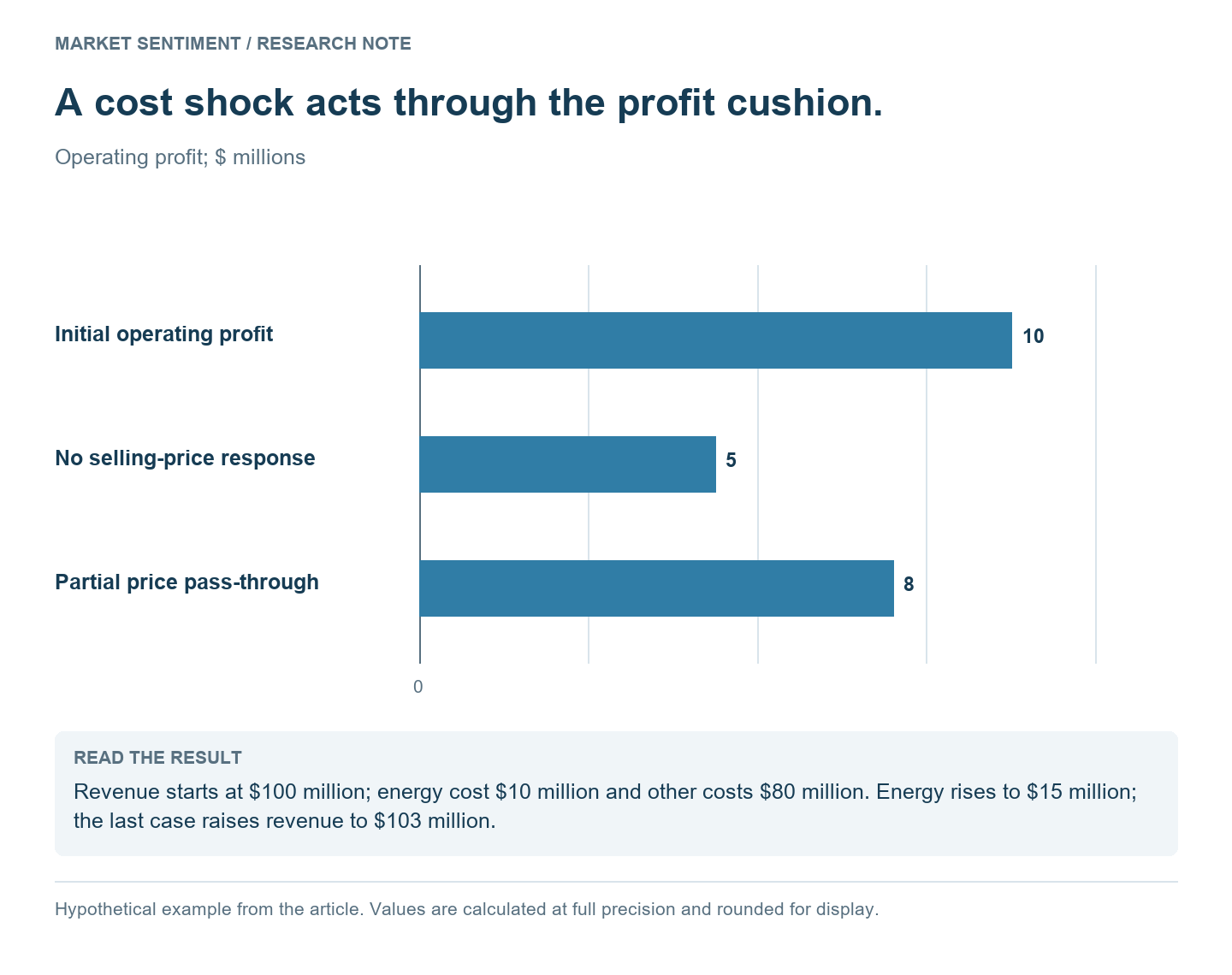
Consider a manufacturer with $100 million in revenue, $10 million in energy costs, and $80 million in other operating costs. Its simplified operating profit is $10 million, giving it a 10% operating margin. Ignore interest, taxes, and other accounting items for the exercise.
Suppose the energy bill rises 50% while output, selling prices, and all other costs remain unchanged. Energy spending becomes $15 million, total operating costs become $95 million, and operating profit falls to $5 million. A 50% increase in one cost category has cut operating profit in half because the original profit cushion was relatively small.
The manufacturer may have contracted prices, a hedge, an ability to substitute inputs, or flexibility to reduce consumption. Those factors could change the timing or size of the effect.
The research should identify the relevant cost share and the terms under which the cost resets. A spot commodity price can move immediately while a company's purchased energy cost adjusts later. Treating the spot move as an identical change in the entire expense line can substantially overstate or misdate the impact.
Passing on a cost is a commercial question
Continue the manufacturer case after costs rise to $95 million. Suppose the company raises revenue to $103 million through higher selling prices while maintaining the same sales volume. Operating profit becomes $8 million, and the operating margin is approximately 7.77%.
The price increase recovers part of the lost profit, but it does not restore the original $10 million. It also rests on the assumption that volume is unchanged. Buyers may reduce orders, seek substitutes, or renegotiate contracts. Competitors may face different costs or have different incentives to raise prices.
The ability to pass through costs therefore depends on the product, contract terms, competitive conditions, and the buyer's alternatives. A statement that a company has pricing power should be supported by evidence about those conditions, not inferred solely from a strong brand or a past period of growth.
Timing matters as well. A company may be able to reset prices only at scheduled intervals. It can absorb a cost increase for a period before higher revenue arrives. The full analysis should distinguish the eventual margin from the cash and earnings pressure during the adjustment.
A delivery delay can create a financing need
A business can face pressure even when the unit cost of its inputs is unchanged. Consider a separate company purchasing $4 million of imported components each month and paying when they are shipped. Suppose a route disruption adds one month to the transit time while the company maintains the same rate of purchases and production.
Under these simplified assumptions, an additional $4 million becomes tied up in goods in transit. The amount is a working-capital requirement. It is not automatically an additional $4 million operating expense, because the company still owns the components and expects to use or sell them through its business process.
If the extra working capital is financed at an annual rate of 6% for three months, the simple financing cost is $60,000. The calculation assumes the full additional amount is outstanding for that period and excludes fees and other effects.
The company could face further consequences if components arrive too late to maintain production. Lost output, expedited shipping, or penalties could add costs. Those effects need separate assumptions and evidence. Combining them casually with the working-capital amount would confuse a balance-sheet requirement with an expense and could count the same problem more than once.
Transport cost and transit time are separate exposures
Suppose another shipment involves 100 containers. Freight rises from $2,000 to $3,500 per container. The shipment's freight cost increases from $200,000 to $350,000, an additional $150,000. This case concerns transport pricing rather than the cost of financing goods in transit.
The freight bill can rise without a proportional increase in delivery time, and delivery time can rise without the same change in freight. Insurance, port handling, storage, and alternative routing can create additional items. The analyst should identify which costs are actually covered by the quoted rate.
A business might absorb the higher cost, pass it to a buyer, change the route, or delay shipment. The appropriate response depends on the value and urgency of the goods, contractual obligations, and available alternatives. The headline freight rate does not reveal which choice the company can make.
For investment analysis, connect the shipment to the business's scale. A one-time cost for a small portion of revenue has a different significance from a recurring increase across a core supply chain. Frequency and duration determine whether the effect is a temporary disruption or a material change in operating economics.
A higher selling price does not guarantee higher producer revenue
It is tempting to assume that every producer benefits from higher commodity prices. The ability to produce, transport, and sell the commodity matters just as much as the quoted price.
Consider a producer initially selling 100,000 units at $100 each, generating $10 million of revenue. Suppose the realized price rises to $130, but disruptions reduce the quantity sold to 80,000 units. Revenue becomes $10.4 million, only 4% above the original level despite a 30% price increase.
The example does not calculate profit. Costs, damaged assets, logistics, financing, and contractual commitments could alter the result further. It demonstrates why a favorable price movement cannot be translated directly into the same percentage increase in revenue or earnings.
The researcher should distinguish quoted prices from realized prices and production from completed sales. A company may have fixed-price contracts or inventory waiting for transport. A producer with access to an alternative route can face a different outcome from one whose exports are constrained. The actual commercial pathway determines the exposure.
Contracts determine who initially bears the shock
A cost increase can be allocated differently under different agreements. A fixed-price seller may absorb an input-cost increase until the contract resets. A contract with an adjustment mechanism may transfer some cost to the buyer. An agreement may also contain limits, delays, or conditions that affect the transfer.
The financial analysis should identify the relevant contract features rather than assume that the economic burden follows the most obvious company in the chain. The party receiving the first invoice may not be the party that ultimately bears the cost.
Hedges can alter cash outcomes, but they should be examined in relation to the actual exposure. The hedge may cover only part of the quantity, a different price benchmark, or a different period. It may also involve collateral or settlement requirements. Saying that a business is hedged does not establish that every consequence of the shock has disappeared.
The useful question is what remains after the contractual protections are applied. That residual could include volume risk, timing risk, basis differences, or an exposure beyond the hedge's horizon. A complete account follows both the protection and the remaining obligation.
Financing can amplify an operating problem
A company experiencing higher costs or delayed receipts may need additional liquidity. If financing becomes more expensive or less available at the same time, the operating shock can be amplified by a funding constraint.
The analysis should map the cash schedule. When must suppliers be paid? When will buyers pay? Which debt matures, and which facilities are committed and accessible under the relevant conditions? A reported cash balance is only one part of that schedule.
The terms of financing matter as much as the amount. Floating-rate debt can reset differently from fixed-rate debt. A company refinancing soon faces a different exposure from one with a longer maturity schedule. Collateral requirements and covenant conditions can also affect flexibility.
Those distinctions prevent a broad statement about higher interest rates from becoming an identical earnings forecast for every borrower. The transmission runs through particular instruments and dates. A geopolitical event can increase uncertainty while the immediate financial effect remains limited for a well-funded business with protected costs and no near-term refinancing need.
The duration of the disruption changes the analysis
A brief interruption and a prolonged disruption can begin with the same headline. Their financial consequences differ because inventories, reserves, alternative suppliers, and contractual protections operate over time.
For the manufacturer, a temporary increase in the energy bill may reduce profit for a limited period. A persistent increase can affect pricing decisions, investment, and the competitiveness of the product. For the component buyer, a short delay may require working capital; a longer interruption may threaten production continuity.
The scenario should therefore specify duration rather than use a single undated cost shock. It should also distinguish the time needed for the event to end from the time needed for the business to recover. Transport backlogs, repairs, and inventory rebuilding can continue after the initial disruption eases.
Avoid assigning probabilities without a defensible basis. Scenarios can be useful as conditional calculations: if the interruption lasts for a stated period, these obligations and resources become important. The value comes from making the dependencies visible, not from presenting precise odds that the available evidence cannot support.
An inventory buffer buys time
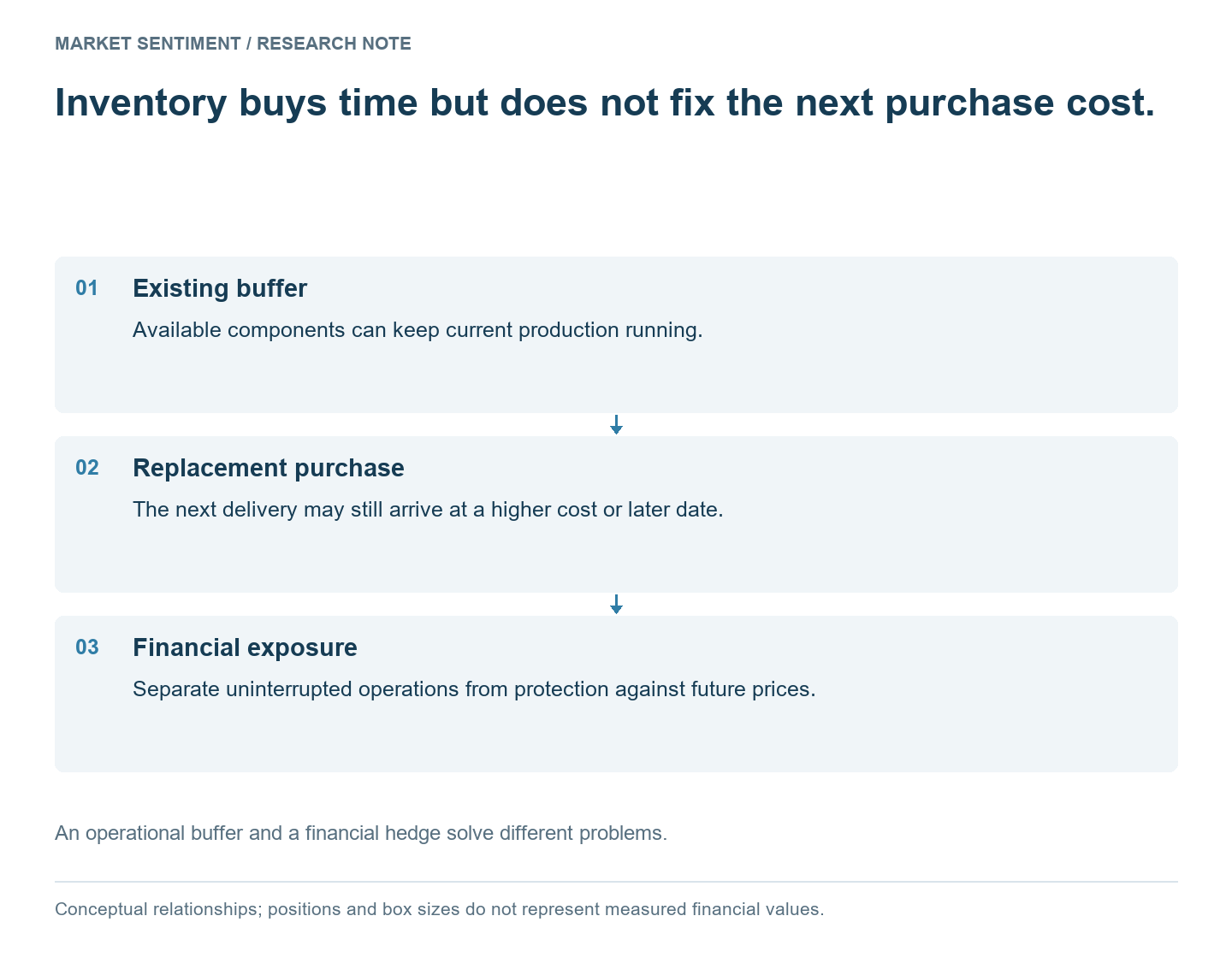
Existing inventory can help a company maintain production while deliveries are disrupted. That operational protection should be distinguished from protection against future replacement costs. A business may be able to keep operating while still facing a more expensive next purchase.
The analyst should examine which materials are available, where they are located, and whether they can actually be used in the affected production process. A large total inventory balance does not prove that a particular critical component is available. Some goods may be unfinished, committed to another order, or inaccessible during the disruption.
Inventory can also absorb cash. Holding more goods may reduce the chance of interruption while increasing financing and storage requirements. The appropriate level depends on the cost of a shortage, delivery uncertainty, and the business's ability to fund the buffer. More inventory is not automatically a costless improvement in resilience.
As the buffer is consumed, the exposure changes. A company that appears insulated initially may become more affected if the interruption persists. Conversely, a company that secures an alternative supplier may reduce its operational risk even while paying a higher unit price. The research should track those developments over time rather than classify a business as permanently protected or permanently vulnerable.
Accounting results can also arrive on a different schedule from market prices and cash payments. The cost recognized in a reporting period depends on the company's inventory and accounting circumstances. A higher commodity quote today does not necessarily enter the entire current expense line immediately.
The practical question is how much time the available resources provide and what happens when they are exhausted or replaced. That connects the inventory observation to the earlier scenarios for costs, deliveries, and financing. A buffer changes the path through the shock; it does not remove the need to understand the obligation on the other side.
Policy responses can redistribute the burden
Governments and central banks may respond to a shock through fiscal, regulatory, or monetary measures. The effects depend on the design, financing, timing, and scope of the response. A general expectation of support is not the same as an enacted measure available to a particular business.
A subsidy or price intervention can reduce an immediate cost for one group while shifting a burden elsewhere. Relief can be temporary, targeted, or conditional. The research should identify who qualifies and how the policy affects the relevant cash flows before incorporating it into a model.
Monetary policy faces its own trade-offs when a shock raises costs while weakening activity. The direction of the eventual response cannot be inferred from one commodity-price movement alone. Inflation expectations, underlying demand, and the wider economic outlook can matter.
For a dated article, separate measures already announced from possible future responses. A scenario may include an assumed policy action, but the assumption must remain explicit. Later policy developments should not be inserted into an earlier analysis as though they were already known.
Markets compare the news with prior expectations
A severe event can produce a smaller price response than expected if investors had already priced a similar outcome. A less severe event can produce a large response if it differs sharply from prior assumptions. The market reaction depends on the information change, not just the absolute seriousness of the headline.
The analyst should distinguish the event from the surprise. What did investors appear to expect beforehand? Which part of the announcement changed that view? Evidence may come from prior guidance, market pricing, or contemporaneous forecasts, but none should be invented after the outcome.
The response can also include a change in required returns. Investors may demand more compensation for holding uncertain cash flows even before earnings forecasts are revised. A falling share price can therefore reflect both a business impact and a valuation adjustment.
The article should not assign an exact share of a market move to each channel without an appropriate method. A clear explanation of plausible transmission, supported by the observed timing and exposures, is more useful than a precise-looking attribution that the evidence cannot identify.
Separate a business exposure from a portfolio conclusion
Even when a company's exposure is understood, the effect on a portfolio depends on position size, other holdings, financing, and any hedges. A portfolio can contain both buyers and sellers of the affected input, but those positions do not automatically offset each other.
The timing and scale of the exposures may differ. A producer's benefit from higher prices can be limited by export constraints, while an industrial buyer's cost increases immediately. A currency movement can alter the reported value of both positions. A simple sector label cannot establish the net result.
The research should map the largest relevant holdings and the mechanisms affecting them. It should also look for shared funding or logistics dependencies that are not obvious from industry classifications. Different company names can still rely on the same route, supplier, or financing condition.
This process produces a portfolio-specific question: which combinations of outcomes would impair the intended objective? It avoids turning a broad geopolitical observation into an automatic recommendation to buy one asset class or sell another.
Use a small set of observations to update the mechanism
Monitoring becomes more useful when each observation has a role in the analysis. For the cost channel, relevant evidence might include realized input prices and contract resets. For the delivery channel, it might include transit times, shipment availability, and inventory conditions. For funding, it might include refinancing terms and accessible liquidity.
The observations should match the business being studied. A global average freight measure may be a poor proxy for a company's particular route. A benchmark energy price may differ from the delivered cost paid under a local contract. The analyst should explain the link and its limitations.
An update should state what changed in the mechanism. A route reopening could reduce one uncertainty while leaving a backlog. A lower spot price could ease prospective costs while earlier purchases continue affecting current margins. Improved financing access could help a company absorb an operating shock without removing the underlying cost increase.
The goal is to avoid repeatedly restating the headline. Each update should revise a specific assumption or identify a new fact about the transmission. That makes the article cumulative rather than a sequence of emotional reactions to the same event.
Keep evidence and interpretation separate
A verified disruption establishes that an event occurred. It does not establish every consequence asserted in commentary. A company disclosure about costs or deliveries provides more specific evidence, while a calculation shows how an assumed change could affect a financial result.
Those layers should remain visible in the writing. The manufacturer, shipment, and producer cases here are analytical exercises. Their arithmetic is exact under their assumptions, but the assumptions would need evidence before the results could describe a real company.
The conclusion should identify which effects are documented, which are plausible mechanisms, and which remain uncertain. It should also explain what evidence would weaken the proposed interpretation. A company with protected costs, available inventory, and stable funding may be less exposed than a broad industry headline suggests.
Reading risk headlines well means following the obligations that connect the event to economic outcomes. Costs, timing, contracts, and financing give the analysis substance. Sentiment matters, but the reader gains more from understanding how a disruption reaches a business or portfolio than from being told that markets are worried.
Related research

ResearchMarket Sentiment
A Sharp Down Day Can Tell Several Stories
A large price decline can reflect revised business expectations, higher required returns, limited market depth, or investors meeting constraints. The research task is to identify the evidence for each channel and distinguish an initiating shock from the forces that amplify it.

ResearchMarket Sentiment
Forecast Dispersion Can Matter More Than the Average Forecast
A consensus can remain unchanged while the arguments behind it move apart. Reading the distribution of forecasts helps reveal competing assumptions, but disagreement among forecasters is not the same as uncertainty within each forecast.

ResearchMarket Sentiment
Why a Crowded Trade Can Keep Working
Crowding can make a position vulnerable to a shared exit without determining when that exit occurs. Understanding the investors, financing, and available market depth is more useful than treating popularity as a mechanical reversal signal.