
ResearchMarket Sentiment
Surprise Depends on the Expectation That Came Before It
- Report or archive date
- Archive placement September 16, 2026
- Reading time
- 13 min read

Summary
A policy decision is not surprising merely because it changes an interest rate. Surprise is a comparison with a prior expectation, and the immediate decision, the future policy path, and uncertainty about that path can change in different ways.
The decision is observable; the prior belief needs evidence
On September 16, the Federal Reserve raised its target range by 0.25 percentage point to 3.75%–4.00%. The decision was approved unanimously. Those facts establish the action taken. They do not establish how much of the action investors anticipated, which probability they assigned to it, or how financial markets reacted.
Calling the decision a surprise requires a benchmark from before the announcement. That benchmark might come from a survey, a carefully interpreted market price, or a documented forecast. Without it, the word surprise can become a description of the writer's reaction rather than a measured feature of the event.
The distinction matters because a rate increase can be largely anticipated, while an unchanged rate can arrive with unexpected information about future policy. Markets respond to changes in the outlook and compensation for risk, not simply to whether the current rate moved up or down.
One decision can be more surprising under one prior than another
Imagine a policy meeting with only two possible immediate outcomes: no change or a 25-basis-point increase. One basis point is 0.01 percentage point, so twenty-five basis points equal a quarter of a percentage point.
Under Prior A, an observer assigns an 80% probability to the increase and 20% to no change. The expected rate change is twenty basis points: 0.80 multiplied by twenty-five. If the increase occurs, the realized change exceeds the expected change by five basis points.
Under Prior B, the probabilities are reversed. The expected change is five basis points. The same twenty-five-basis-point increase exceeds that expectation by twenty basis points. The actual policy action is identical in the two cases; the measured surprise differs because the prior differs.
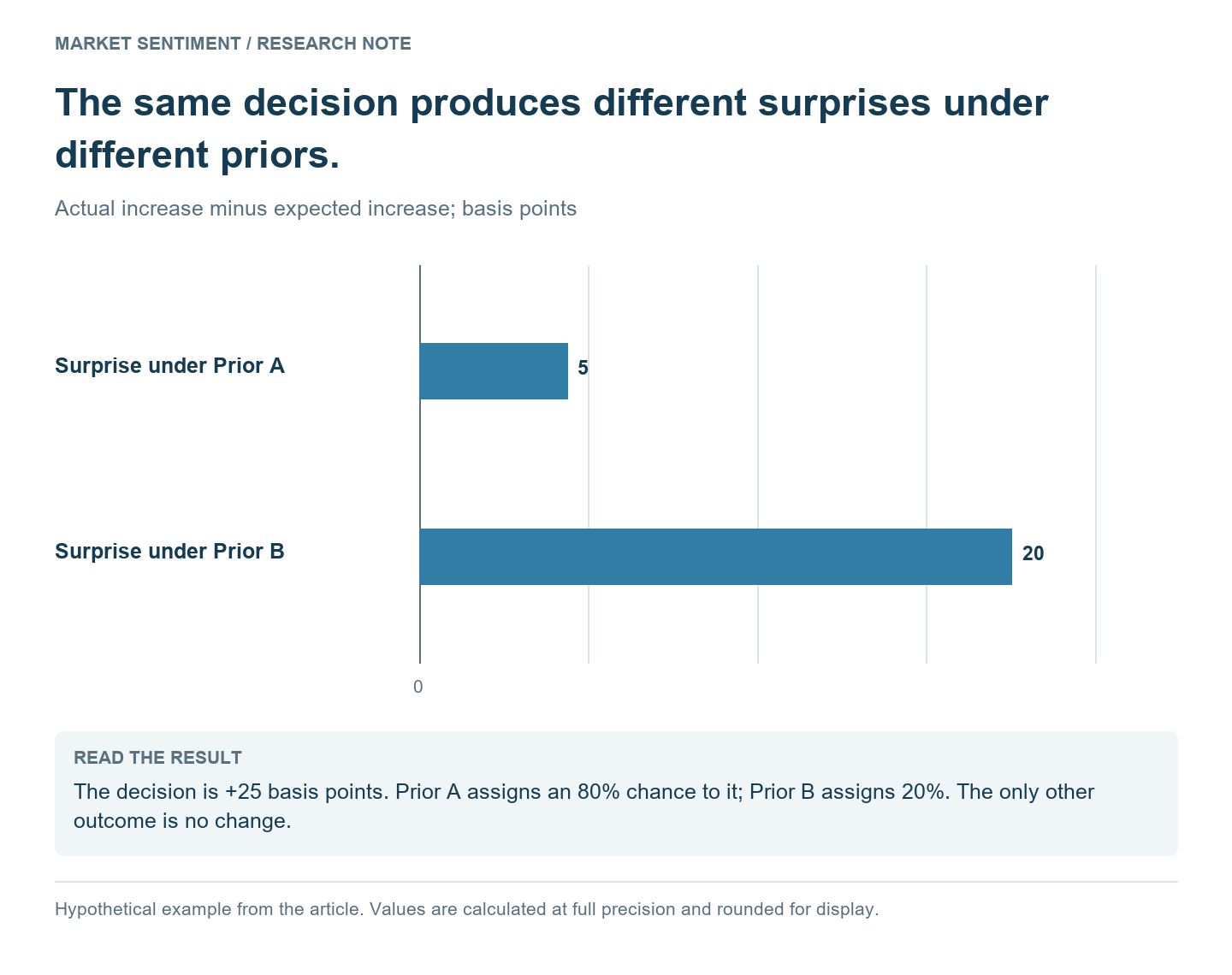
To measure a policy surprise, compare the decision with the full distribution of outcomes that investors expected before the announcement. Even if the most likely outcome occurs, its impact can differ depending on how much probability investors had assigned to the alternatives.
An expected change is not necessarily a possible decision
The twenty-basis-point expectation in Prior A does not mean policymakers are expected to choose a twenty-basis-point step. It is the probability-weighted average of zero and twenty-five. An average can lie between the discrete outcomes being considered.
That distinction becomes important when interpreting a market-implied rate. A value between two potential policy settings may be consistent with a mixture of outcomes under the model's assumptions. It is not evidence that the committee plans to select the exact intermediate number.
The calculation also depends on the assumed set of possibilities. If an analyst includes only a hold and a quarter-point increase, the inferred probabilities will be conditional on excluding larger moves, cuts, or other outcomes. A price that appears inconsistent with the two-outcome model may indicate that its outcome set is too narrow.
The useful presentation states both the possible outcomes and the assumptions used to translate a price or forecast into probabilities. A precise percentage without those conditions can look more informative than it really is.
The same mean can conceal very different uncertainty
Consider an observer assigning 40% probability to a 25-basis-point cut, 20% to no change, and 40% to a 25-basis-point increase. The expected change is zero. Another observer assigns 100% probability to no change. That observer's expected change is also zero.
If the committee leaves the rate unchanged, the difference between the realized change and the mean expectation is zero for both observers. Yet the event had a 20% probability under the first distribution and a 100% probability under the second. A surprise measure based only on the mean does not capture every aspect of how unexpected an outcome was.
The first observer's distribution has variance of 500 squared basis points and a standard deviation of approximately 22.36 basis points. The second has no uncertainty in this simplified model.
For market research, this distinction helps separate a change in the expected rate from a change in uncertainty around it. An announcement can leave the average outlook similar while resolving a wide range of possibilities. The implications for different assets can depend on both changes.
The immediate rate and the future path are separate messages
Suppose two announcements both raise the current rate by twenty-five basis points. In one scenario, the communication leads an observer to expect no further increases. In the other, it leads that observer to expect two additional quarter-point increases before rates stabilize.
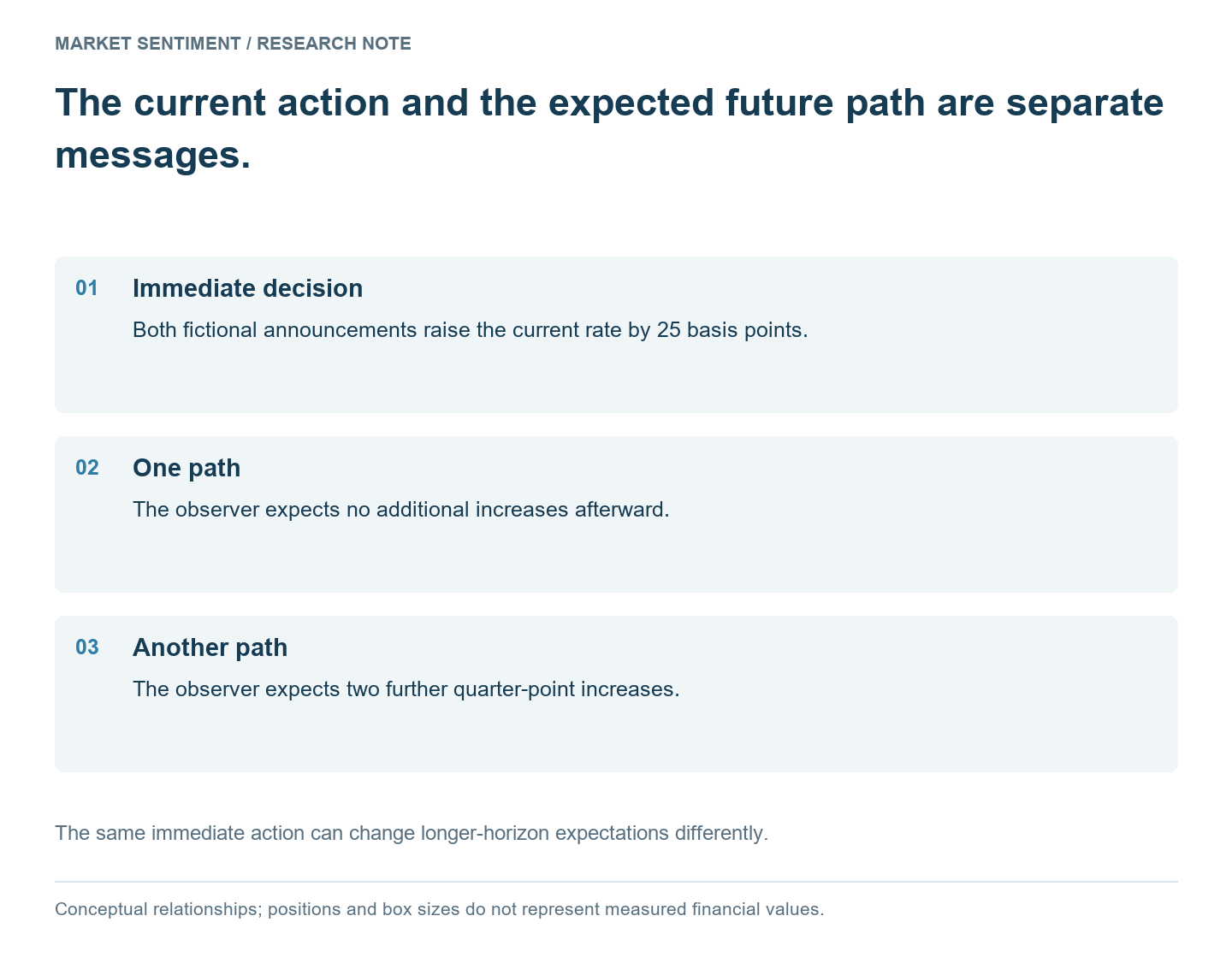
The immediate action is the same, but the assumed eventual policy level differs by fifty basis points. Assets exposed to rates over longer periods may therefore respond differently even when the current-meeting decision was fully anticipated.
The future path includes timing and duration as well as a final level. Reaching a given rate sooner can affect financing costs differently from reaching it later. Remaining at that rate longer can matter even if the projected peak does not change. A single label such as hawkish or dovish can conceal these dimensions.
An analyst should identify which horizon changed. Was the news about the current decision, the next few meetings, or the longer-run setting? Without that distinction, a commentary may attribute a longer-maturity yield move to the announced rate change when the relevant information concerned a different part of the path.
Later decisions depend on which path has already occurred
A sequence of meetings requires conditional probabilities, not just a list of independent guesses. Consider a separate two-meeting tree. At the first meeting, assume a 60% chance of a hold and a 40% chance of a quarter-point increase. If the first meeting holds, assume a 30% chance of an increase at the second. If the first meeting increases, assume a 70% chance of another increase at the second.
The four complete paths have probabilities of 42% for two holds, 18% for a hold followed by an increase, 12% for an increase followed by a hold, and 28% for two increases. They sum to 100%. The probability of an increase at the second meeting, before observing the first, is 46%: the 18% and 28% paths combined.
Once the first meeting's increase is observed, the relevant second-meeting probability under this unchanged model is 70%, not 46%. The earlier 46% included paths whose first step was a hold. Conditioning on the observed first step removes those paths.
The possible cumulative changes across both meetings are zero, twenty-five, and fifty basis points, with probabilities of 42%, 30%, and 28%. Their expected cumulative change is 21.5 basis points. That number summarizes the tree before the first decision; it is not a prediction that a committee will choose a 21.5-basis-point action.
New information can change the branches of the decision tree as well as their probabilities. The outlook for a later meeting depends on what happens at earlier ones. When comparing estimates made on different dates, check whether the information available at the time changed, the model changed, or both.
Policy communication can change the economic interpretation
A central bank communicates an assessment of inflation, employment, activity, and risks as well as a decision about its instrument. Investors may update their view of the economy when they interpret that assessment. The same rate increase can therefore carry different information under different circumstances.
For example, an increase associated with stronger perceived demand is not identical to an increase associated with a persistent supply-driven inflation problem. The implications for company revenue, margins, and financing can differ even if the immediate rate step matches.
These channels complicate causal claims. A change in market prices around an announcement can reflect information about policy, information about economic conditions, changes in uncertainty, or several of those together. An observed move is not automatically a clean experiment isolating one channel.
High-frequency studies use narrow windows and explicit methods to improve identification, but the method and assumptions still matter. A general article should not claim to have identified a pure policy shock simply because it compares prices before and after a press release.
Futures prices require a contract-level reading
Interest-rate futures can provide information about the expected policy environment, but their settlement rules determine what they measure. A contract tied to a monthly average effective rate is not a direct quote of the target range after one meeting. The observation includes days before and after any change.
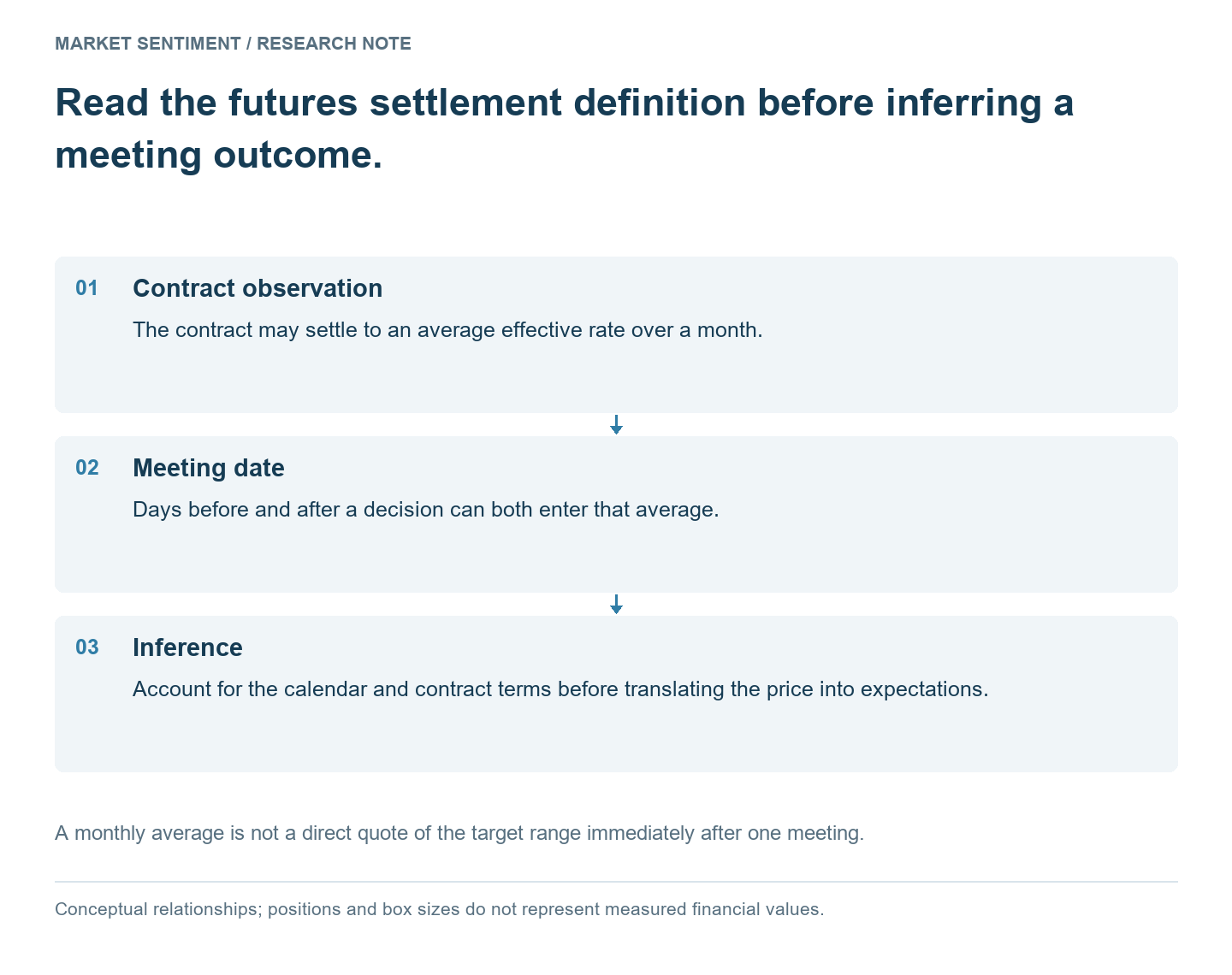
Consider a thirty-day month. Assume the effective rate is 4.00% for the first twenty days and 4.25% for the remaining ten. The simple daily average is approximately 4.0833%, not 4.25%. The quarter-point increase affects only one-third of the month in this example.
Relative to a month entirely at 4.00%, the average rises by approximately 8.33 basis points. Interpreting that change as the full post-meeting rate increase would understate the assumed policy step. Under these simple conditions, multiplying the monthly-average change by three recovers twenty-five basis points.
Real calculations require the actual calendar, settlement convention, effective-rate behavior, and any other expected changes during the contract period. The relationship between the effective rate and the target range also needs attention. A shortcut that ignores these details can produce a confident but incorrect probability estimate.
The target range itself contains two endpoints. Its midpoint is a convenient summary, not a statement that every overnight transaction occurs there. A comparison should specify whether it uses an endpoint, a midpoint, an effective overnight rate, or a different reference rate before calculating any change.
Market-implied probabilities are not unqualified forecasts
Prices reflect both expectations and compensation for bearing risk, along with market structure and liquidity effects. Translating a derivative price into a real-world probability requires assumptions about those components. A probability inferred under risk-neutral pricing is not automatically the same as the probability an observer would assign to the event occurring.
For a short horizon, some adjustments may be small in a particular setting, but that should be evaluated rather than assumed universally. Different instruments can also reference different rates or settlement periods. Their apparent disagreement may arise from contract details rather than incompatible policy beliefs.
Survey probabilities provide another perspective, but surveys have their own limits: sample selection, fieldwork dates, definitions, and the distinction between individual forecasts and a pooled distribution. Agreement between a survey and market pricing can be informative without making either measure certain.
A useful analysis states the source of the prior expectation and how it was constructed. It avoids presenting a model output as a directly observed fact about the collective beliefs of every investor.
Discounting shows why the horizon matters
To isolate rate sensitivity, imagine a default-free claim paying $100 in one year. At a 4.00% annual discount rate, its value is approximately $96.15. At 4.50%, its value is approximately $95.69, a decline of about 0.48%.
A separate claim paying $100 in five years is worth approximately $82.19 at a flat 4.00% annual rate and $80.25 at a flat 4.50% rate. Its price decline is approximately 2.37%. The longer payment horizon produces greater sensitivity in this simplified comparison.
These are changes in assumed discount rates for zero-coupon claims. They are not forecasts that a policy increase will move every market yield by the same amount. Actual yields depend on expectations across time, term premiums, liquidity, and other features of the instrument.
For corporate securities, expected cash flows and credit conditions can change at the same time as discount rates. A policy announcement that affects both financing and demand cannot be reduced to the zero-coupon calculation. The example isolates one channel so that it is not confused with the full outcome.
An anticipated action can still change actual cash payments
Being anticipated does not make a policy action economically irrelevant. Prices may adjust before the announcement, while contractual cash payments change later according to their own terms. A small information surprise and a meaningful financing effect can therefore coexist.
Consider a floating-rate loan with a constant $100,000 balance. If its applicable borrowing rate rises by twenty-five basis points for a full year, simple annual interest increases by $250. If the higher rate applies for only six months, the incremental interest is $125 under the same simple-interest assumptions.
Those calculations assume that the loan's own rate changes by the stated amount. They do not assume automatic one-for-one transmission from the policy target to every borrowing contract. The loan's reference rate, reset date, spread, caps, and other terms determine the actual effect.
An existing fixed-rate obligation can have unchanged scheduled payments even as its market value changes. A borrower refinancing later may face a different rate, while an investor selling the existing obligation may realize a price change sooner. Cash-flow exposure and mark-to-market exposure operate on different clocks.
This distinction keeps the concept of surprise in its proper place. Surprise helps explain the new information arriving at an announcement. The economic effect of the policy path also depends on how contracts and spending decisions adjust over time. A fully anticipated change can still matter to those payments and decisions.
Unanimity is a voting result, not a probability model
The September decision was unanimous, but the vote count does not reveal the probability of the next decision. Participants can agree on today's action while holding different views about the future or about the conditions that would justify a change.
A vote is also not a direct measure of the intensity of each participant's conviction. It records the formal outcome under the committee's process. Inferring a precise future-rate probability from the number of votes would add information the tally does not contain.
The same caution applies to projections. Individual policy projections reflect conditional assessments, and their summary is not necessarily a binding committee plan. The assumptions about growth, inflation, and risks matter alongside the rate figures.
For sentiment analysis, distinguish the observed decision from an interpretation of the reaction function: how future information might affect later decisions. The latter is a research judgment that should be explained and revised when evidence changes, not treated as a mechanical extension of the current vote.
Choose the comparison window before observing the result
An event analysis needs a defined period before and after the announcement. A narrow window can reduce interference from unrelated news, but it may capture only part of the communication. A wider window can include the press conference, further interpretation, and additional events.
Using the most dramatic intraday high or low after seeing the chart exaggerates the clarity of the response. It selects the outcome rather than applying a consistent measurement rule. A reproducible study states the window and price convention in advance.
The release time must also align with the market being studied. Some cash markets may be closed, while related futures or foreign-exchange markets remain active. The first feasible transaction and the available liquidity can differ across instruments.
A descriptive note can report several windows if they serve a clear purpose, but it should not mix them to produce a preferred conclusion. The immediate reaction and the next-session result are separate observations that may tell different stories about how information was absorbed.
Do not turn one asset into a universal decoder
If a bond yield rises, that alone does not identify whether expected short rates, a term premium, or another component changed. If a currency rises, the result may reflect relative policy, risk appetite, or developments in the other currency. If stocks fall, both cash-flow expectations and discount rates may matter.
Cross-asset evidence can help compare competing explanations, but it rarely provides a unique answer without a model. A pattern consistent with one mechanism may also be consistent with another. The analyst should specify which additional evidence would distinguish them.
Different parts of the same market can react differently. Short-maturity yields may respond more directly to near-term policy expectations, while longer maturities incorporate additional horizons and premiums. Companies with different financing and demand exposures may respond differently to the same macroeconomic information.
The objective is to trace the transmission from the announcement to the relevant asset, not to memorize a rule that increases are bad and decreases are good. The prior expectation and the economic reason for the action change the interpretation.
Preserve the prior so that surprise remains measurable
A research record should store the forecast or probability distribution that existed before the event, including its timestamp and definition. After the event, compare the outcome with that record. Do not replace the prior with a revised forecast and then describe the event as having been obvious.
If the prior was a scenario rather than a probability estimate, say so. A scenario can identify a plausible outcome without assigning it a precise likelihood. If no reliable pre-event benchmark is available, the report can still describe the action and its possible implications while leaving the surprise unmeasured.
This discipline also makes mistakes useful. An unexpected decision can reveal a gap in the interpretation of inflation, employment, or the policy response. The review should identify which assumption failed rather than simply changing the story to match the result.
The September rate increase is a verified action. Its degree of surprise is a separate empirical question. Keeping those two statements distinct allows the reader to understand both the policy event and the limits of any claim about what markets should have done afterward.
Related research

ResearchMarket Sentiment
Why Excellent Results Can Still Disappoint a Market
An excellent operating result and an attractive investment return are different achievements. Expectations, the outlook beyond the reported quarter, the price already paid, and the distribution of possible outcomes explain why strong results do not produce a mechanically positive market response.

ResearchMarket Sentiment
One Labor Release Should Not Become a Complete Market Narrative
A labor report contains several measures of jobs, people, hours, and pay. Reading them together helps distinguish competing economic explanations without turning one monthly estimate into a complete forecast of growth, inflation, policy, or asset returns.

ResearchMarket Sentiment
Space-Industry Excitement Needs Milestones and Cash-Flow Tests
Space businesses turn engineering progress into investment value through a sequence of operational and financial steps. A milestone is useful evidence only when its scope is clear and its connection to delivery, payment, financing, and per-share value is understood.