
ResearchGlobal Macro
The Space Economy Is a Supply Chain Before It Is a Theme
- Report or archive date
- Archive placement August 11, 2026
- Reading time
- 13 min read
Summary
Launch vehicles are the most visible part of the space economy, but commercial results depend on components, spacecraft, ground systems, contracts, and financing. Following the chain separates growing demand from completed delivery and sustainable cash generation.
Start with the service someone needs
A ship needs a reliable communications link, an agricultural business needs usable observations, and a public agency needs equipment that performs a defined mission. These needs create demand for space-related systems. The launch is an essential enabling event, but the economic purpose is usually the service delivered afterward. A successful launch and a profitable business are connected milestones, not synonyms.
Rocket Lab's August 10, 2026 release reported second-quarter revenue of $234 million and backlog of $2.36 billion. Those company-reported figures illustrate the distinction between activity already recognized as revenue and a stock of future contracted work. They do not establish the timing, margin, or cash conversion of every future delivery, and they do not by themselves establish a share-price reaction.
The broader theme contains businesses with very different economics. A component manufacturer may earn revenue when hardware is delivered. A launch provider depends on mission scheduling and execution. A constellation operator invests before selling recurring services. An applications business may buy data or connectivity without owning a spacecraft. Treating all of them as one exposure conceals the stages at which value and risk arise.
The useful starting question is therefore specific: what is being sold, to whom, and what must happen before payment becomes available? That question leads from an attractive industry narrative to a sequence of contracts, physical dependencies, operating costs, and financing needs that can actually be evaluated.
Map the chain from components to applications
Spacecraft rely on structures, power systems, propulsion, communications equipment, sensors, thermal management, and electronics. Those systems must work together under demanding operating conditions. A supplier of one specialized part can occupy a valuable position without operating a launch vehicle or selling a service directly to the final user. Its economics depend on qualification, production consistency, and the number of relevant programs.
Launch services move the payload to a specified destination, but deployment is followed by testing and commissioning. Ground infrastructure supports communication, control, processing, and delivery of the resulting service. Software and user equipment connect the space segment to practical applications. A weakness in any essential link can limit the usefulness of the system as a whole.
This chain helps distinguish direct demand from indirect exposure. A supplier with a signed production contract has different visibility from a business hoping that a future constellation will eventually require its product. Announced spending elsewhere in the industry should not be assigned automatically to every company associated with the theme.
The chain also reveals where economic activity occurs. A domestically assembled spacecraft can contain imported components, while a foreign-operated constellation can buy local ground services. Adding every supplier's revenue to the operator's revenue would count intermediate transactions repeatedly. Assessing the contribution to an economy requires attention to value added, location, and the boundary of the activity being measured.
Backlog is a schedule of obligations, not cash in the bank
Backlog generally represents contracted work that has not yet been recognized as revenue under the company's definition. Its usefulness depends on contract terms, timing, cancellations, funding, and execution. Definitions can differ across companies. A comparison should read the relevant definition rather than assuming that every reported backlog figure has identical certainty or coverage.
Consider a supplier beginning the year with $300 million of backlog. It adds $180 million of new orders, recognizes $120 million of revenue from backlog, and removes $30 million of canceled work. Ignoring acquisitions, exchange effects, and other adjustments, closing backlog is $330 million. The stock has increased 10%, even though gross new orders were much larger than that increase.
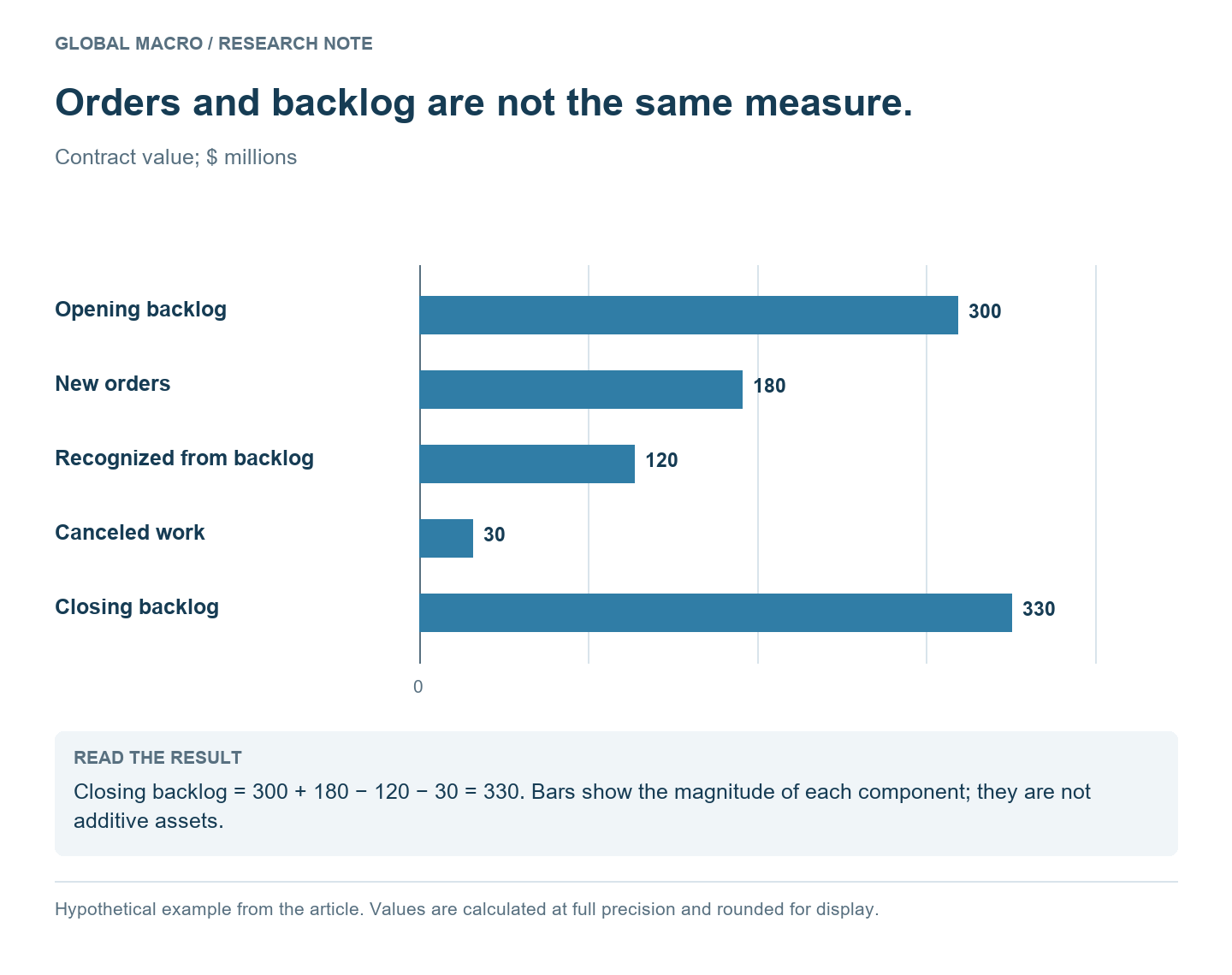
The ratio of new orders to recognized revenue is 1.5 in this example. That ratio can indicate replenishment of the order book, but it does not reveal when the remaining work will be delivered or how profitable it will be. A long-duration order and a near-term delivery can have the same nominal contract value while creating very different financing requirements.
Some contracts include options or stages that depend on additional decisions. An option to buy more units should not be treated as equivalent to an unconditional order unless the reported definition explicitly includes it and the analysis explains the distinction. The purpose is to understand what has been committed, what remains conditional, and what could change before delivery.
Recognized revenue and collected cash follow different clocks
A business can report revenue before collecting the related cash, or receive an advance before recognizing revenue. The timing depends on the contract and accounting criteria. Neither sequence is inherently suspicious. It becomes important when growth requires spending on materials and labor before milestone payments arrive, creating a working-capital demand.
Imagine a project with $40 million of revenue recognized during a period and $32 million of associated costs, all expensed in that period. The project shows an $8 million gross profit under those assumptions. If only $30 million is collected and all $32 million of costs are paid, the corresponding project cash flow is negative $2 million before other expenses and financing.
The difference does not mean the profit is fabricated. It means $10 million of recognized revenue has not yet been collected. If collection occurs later as agreed, cash catches up. If acceptance is delayed or a dispute arises, the financing need lasts longer. The analysis should follow receivables, contract assets, advances, and payment milestones alongside the income statement.
An advance payment can improve near-term liquidity while creating a future delivery obligation. Spending the cash does not eliminate that obligation. A growing business supported by advances still needs to demonstrate that its remaining resources and future receipts can cover the work promised. Cash received and economic profit should not be treated as interchangeable measures of progress.
Launch cadence changes the cost structure
A launch business has costs associated with each mission and costs that support the organization across missions. Engineering, facilities, production capability, and readiness can create substantial fixed or semi-fixed expense. Spreading those costs over more successful missions can improve unit economics, but only if additional launches do not bring proportionate increases in other costs or persistent delays.
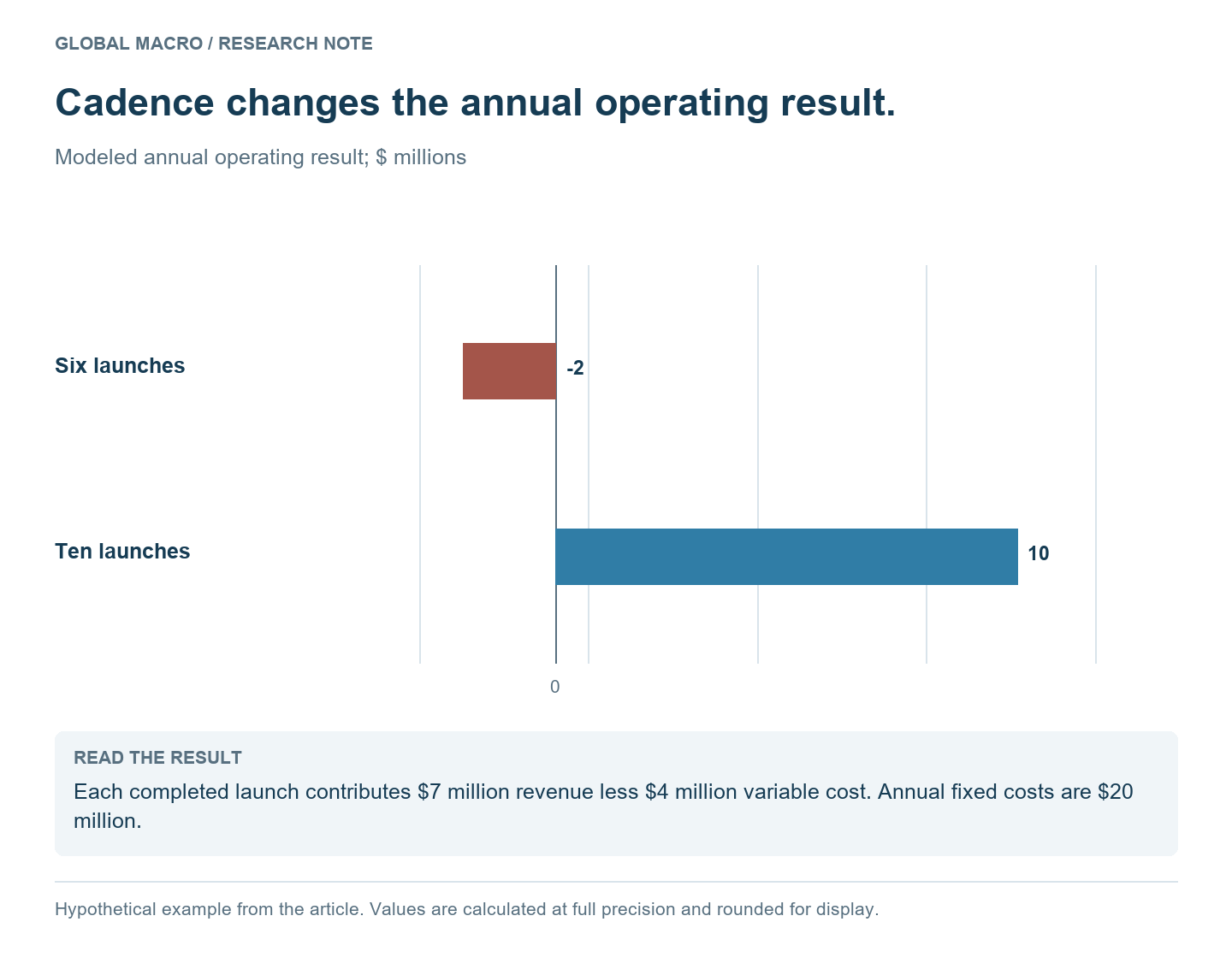
Use an annual model with $20 million of fixed operating costs, $4 million of variable cost per launch, and $7 million of revenue per launch. Each mission contributes $3 million toward fixed costs before the model reaches operating break-even. Dividing $20 million by $3 million gives about 6.67 launches, so at least seven completed launches are needed to cover the modeled annual costs.
At six launches, revenue is $42 million and modeled costs are $44 million, producing a $2 million loss. At ten launches, revenue is $70 million and costs are $60 million, producing a $10 million operating surplus. They show why cadence can matter as much as the price of an individual mission.
The model becomes more complicated if launch prices vary, missions require different configurations, or development spending rises with expansion. A company can increase launch count while still consuming cash. Evaluation should distinguish the economics of the current operating system from spending on a future vehicle or capability whose benefits have not yet arrived.
Schedule dependencies can turn a delay into a funding problem
A mission depends on more than the launch vehicle. The payload must be ready, integration completed, the relevant operational approvals obtained, and the launch site and mission conditions suitable. A delay in one dependency can move revenue and cash collection while many expenses continue. The commercial effect depends on who bears the cost under the contract.
A payload supplier can finish hardware on time yet wait for another party's schedule. A launch provider can have an available vehicle but no ready payload. A constellation operator can have financing and demand but lack commissioned spacecraft. The same delay can therefore affect several firms through different accounting and cash-flow channels.
Diversification across missions and programs can reduce dependence on one schedule, but it does not eliminate common constraints. Shared suppliers, facilities, or equipment can create correlated delays. An order book that appears diverse by end user may still rely on the same critical production process or launch infrastructure.
The useful stress test asks what happens if key receipts arrive later while spending continues. Identify contractual flexibility, available liquidity, inventory that can be redeployed, and costs that can actually be paused. A forecast assuming every milestone occurs on its earliest possible date leaves little room for ordinary execution uncertainty.
Reliability affects more than a single mission
An unsuccessful mission can involve the loss of hardware, postponed service, investigation, rework, and changes in future scheduling. Insurance may cover specified losses, but coverage, exclusions, deductibles, and timing matter. The existence of insurance does not mean the full commercial consequence disappears, especially when the lost time affects revenue or future commitments.
Each of ten missions has a 98% chance of success, and their outcomes are independent. The probability that all ten succeed is 0.98 to the tenth power, about 81.71%. Subtract that from 100% to get the chance of at least one failure, about 18.29%.
Independence is a strong assumption. A common design issue, manufacturing problem, or operating condition can affect multiple missions, making outcomes correlated. Conversely, learning and redesign can change the probability over time. A real assessment cannot take a convenient constant probability and treat it as a permanent property of the business.
Reliability also has economic value beyond avoiding loss. Predictable schedules and performance can reduce the financing and contingency costs borne by users. That value may support demand or pricing, but it needs evidence from actual operations and contract choices. A successful demonstration is an important milestone, not a complete operating history.
Deployment cost should be divided by useful service capacity
A low launch price per kilogram can be informative, but it does not capture the full cost of a functioning service. The relevant denominator may be deployed spacecraft, usable coverage, delivered data, or reliable service capacity. Orbit, payload integration, commissioning, ground infrastructure, and replacement needs affect the total economic result.
Imagine a deployment of ten satellites costing $6 million each, plus a $40 million launch and integration package. Total initial deployment cost is $100 million. If all ten provide the planned service, average deployment cost is $10 million per functioning satellite. If only eight ultimately provide that service, the same expenditure corresponds to $12.5 million per functioning satellite, before any recovery or replacement.
This example deliberately holds many details constant. In practice, the remaining spacecraft might provide partial coverage, a failed unit might be recoverable, or additional launches might restore capacity. The economic question is the cost of achieving the intended service, not simply the cost of sending mass upward.
Comparisons should therefore match mission requirements. A cheaper deployment that cannot meet latency, coverage, reliability, or payload needs is not necessarily a substitute for a more expensive one. The service specification explains which cost metric matters and prevents a headline engineering ratio from becoming an unsupported investment conclusion.
Recurring service revenue still requires recurring investment
A constellation operator may sell connectivity or data on a recurring basis, creating an appealing revenue profile. The physical system nevertheless requires maintenance, ground operations, software, and eventual replacement. Spacecraft have finite useful lives, and the replacement cycle can be a continuing capital requirement rather than an optional expansion project.
Suppose a steady-state system contains 120 satellites with an assumed five-year service life and an evenly distributed age profile. Maintaining the same number would require roughly 24 replacements annually, before unexpected failures or growth. This simplified calculation is 120 divided by five. A young constellation launched in a short period would have a different, potentially more concentrated replacement schedule.
A cash-flow forecast that treats the original deployment as the only capital expenditure can overstate sustainable cash generation. The appropriate replacement assumption depends on actual asset lives, performance, launch costs, and technology changes. Longer life can improve economics, but should not be assumed merely because it makes a valuation attractive.
Growth and maintenance spending should also be distinguished. Adding coverage or capacity may support new revenue; replacing worn-out assets may be necessary to preserve existing service. Both consume cash, but they answer different questions about the business. The distinction helps identify how much reported operating cash flow is available after sustaining the current system.
Public procurement changes the nature of demand
Public agencies can be significant buyers of space-related capabilities. Their needs may support long-duration programs, but award structures, budget decisions, technical requirements, and acceptance processes influence the timing of revenue. A large announced program does not necessarily become a single supplier's funded order on the announcement date.
Contracts can allocate development and execution risk differently. A fixed-price arrangement exposes the supplier to cost overruns within its obligations, while other arrangements may share specified costs or risks differently. The analysis should describe the actual agreement rather than assume that government-related revenue is automatically predictable or high margin.
Concentration matters too. A supplier dependent on one agency, program, or prime contractor can face a substantial change if priorities shift or a milestone is delayed. Several contract line items may still represent one underlying funding source. Counting contracts without examining their economic dependence can overstate diversification.
At the same time, demanding qualification processes and a record of reliable delivery can create barriers to entry. Those advantages need to be balanced against the investment required to obtain and maintain them. A strong position in a specialized market can be valuable, but it does not remove procurement, execution, or funding risk.
Financing can determine who reaches the next milestone
Development-heavy businesses may need outside capital before operations generate enough cash to fund themselves. The relevant question is not only the cash balance, but the expected spending path, committed obligations, and timing of receipts. A runway estimate based on the latest quarter can be misleading if a major development or production phase is about to begin.
Consider a company with $180 million of cash, a planned minimum operating reserve of $30 million, and net cash use of $10 million per month. On those assumptions, cash above the reserve covers fifteen months. That calculation excludes future financing and assumes a constant burn rate. A delayed receipt or a higher development bill would shorten the period.
Raising equity can extend runway but changes ownership. Borrowing can preserve the share count while adding repayment and interest obligations. Advances can support working capital while committing future delivery. None is universally preferable; the terms, business risk, and use of the proceeds determine the tradeoff.
For a reader evaluating the theme, this creates a distinction between technical progress and financial endurance. A company can make meaningful engineering progress while remaining dependent on favorable funding conditions. The research should explain both, without treating a financing announcement as proof of commercial success or a cash outflow as proof that the underlying project has no value.
Owning more of the chain changes both control and risk
A company may bring component production, launch services, or downstream operations inside the same organization. Greater integration can improve coordination and reduce dependence on external schedules. It can also require more capital, management attention, and technical capabilities. Owning an adjacent business does not automatically make every link more efficient.
The commercial tradeoff depends on utilization. An internal production facility can provide security of supply but may be expensive if the parent cannot keep it busy. Selling to outside buyers can improve utilization, although those buyers may view the integrated company as a competitor. A specialist serving several programs faces a different balance between scale and dependence.
Acquisitions also complicate growth comparisons. Revenue can increase because the reporting company now includes another business, even if the underlying operations have not grown at the same rate. A useful comparison separates acquired revenue from growth within the previously owned operations where disclosure permits. The same distinction applies to backlog and cash generation.
Internal transactions require care too. A launch sold by one division to another is not additional external revenue for the consolidated group. The relevant economic result is the service ultimately delivered outside the group, together with the costs incurred across the full chain. Segment reports can illuminate performance, but their totals need to be interpreted under the company's consolidation rules.
Integration should therefore be evaluated as a strategy with specific benefits and costs. Evidence might include shorter production cycles, more reliable delivery, lower total costs, or improved access to users. A larger organizational footprint is not itself proof that those benefits have been achieved. The combined business must still convert its technical capabilities into services that buyers value and cash flows that support continued operation.
Turn the theme into a sequence of evidence
A practical assessment begins with the final service and works backward. Identify the paying user, service requirements, necessary spacecraft and ground systems, critical suppliers, deployment plan, and funding. Then follow the forward path from order to production, launch, commissioning, service delivery, and cash collection. Each stage should have a concrete milestone and a clear remaining dependency.
The reported revenue and backlog figures provide useful observations at particular points in that chain. They should be supplemented by margins, cash conversion, schedule performance, concentration, and replacement needs. No single measure resolves every question. The strongest account explains which part of the business has become more certain and which part still depends on execution.
That approach keeps the space economy grounded in ordinary commercial questions without ignoring its technical demands. The industry may create valuable new capabilities, but economic returns emerge through specific services, contracts, and assets. Following those connections gives readers a way to assess progress as it occurs, rather than relying on the excitement of the theme itself.
Related research

ResearchGlobal Macro
Why Services Inflation Can Outlast a Goods Price Shock
Services combine local capacity, labor, leases, and contracts that adjust on different schedules. Following those schedules explains why cheaper goods or energy may not immediately produce slower increases in rents, repairs, travel, and other services.

ResearchGlobal Macro
From Cloud Demand to Economy-Wide Productivity
Cloud revenue can reveal strong demand for computing services without establishing the productivity gains of the organizations buying them. The path from spending to economic output runs through deployment, workflow changes, quality control, and competition.

ResearchGlobal Macro
AI Investment Has a Physical Supply Chain
An AI computing system becomes productive only when processors, memory, packaging, networks, power, cooling, and software work together. Mapping those dependencies reveals why strong chip demand can coexist with deployment delays and uncertain returns elsewhere in the chain.