
ResearchGlobal Macro
Why the Same Energy Shock Hits Countries Differently
- Report or archive date
- Archive placement March 31, 2026
- Reading time
- 13 min read
Summary
An international energy-price increase is not one uniform economic event. Its effect depends on what a country imports and exports, how purchases are invoiced, how energy reaches domestic users, and who absorbs the cost. A useful comparison follows those exposures before assigning countries to a simple list of winners and losers.
The international price is only the starting point
The energy and transport disruption associated with the Middle East conflict in March created pressures that extended beyond the countries directly affected. The economic consequences depended on access to physical supply, shipping routes, import dependence, and the financial capacity to absorb a larger bill. An exporter unable to deliver its product could experience a very different outcome from an exporter with an unaffected route.
For research, that distinction is essential. A country can produce energy and still import particular fuels or refined products. It can have ample resources but insufficient transport or processing capacity. It can report a favorable trade balance while some households and industries face substantially higher costs.
The right starting question is therefore specific: which energy product, purchased or sold by whom, through which route, in which currency, under what contract? The answer reveals how an international shock becomes a domestic cash-flow change. It also prevents a broad commodity label from replacing the actual economic structure.
Three economies
Consider three economies, Harbor, Plateau, and Delta. Harbor imports most of the energy used by its transport and manufacturing sectors. Plateau exports fuel, but its export route is vulnerable to disruption. Delta produces some domestic energy, imports other fuels, and has substantial electricity generation from sources whose operating costs respond differently to international fuel prices.
An increase in the international fuel price initially appears unfavorable for Harbor and favorable for Plateau. Delta's position is less obvious. That first impression is useful as a hypothesis, but it is not a completed analysis. Harbor may have contracts and reserves that delay the cost increase. Plateau may be unable to export its usual volume. Delta's domestic power-pricing rules may transmit international fuel costs even to users supplied partly by other sources.
Each economy also contains different households and businesses. A fuel-intensive exporter can experience higher costs while a domestic energy producer benefits. Government revenue may increase while household purchasing power weakens. Country-level aggregates combine these effects rather than eliminate them.
Following the three economies through trade, currency, industry, and public finances shows how to replace a broad classification with a more useful comparison.
Gross imports and net imports answer different questions
Suppose Harbor imports 120 units of energy products and exports 20 units of other energy products. Its net import position is 100 units in this simplified example. The net position helps describe the overall income transfer associated with a price change, but it can conceal differences in product quality, timing, and infrastructure.
The imported and exported products may not be interchangeable. A refinery can require a particular crude grade while the country exports another. A country can export crude oil and import refined fuel because domestic refining capacity is limited. Electricity may be available in one region but difficult to transport to another.
For a physical-supply analysis, gross dependence and bottlenecks can therefore matter even when the net trade position looks manageable. For a national-income analysis, the relative change in export and import prices matters. For a financing analysis, the timing of receipts and payments matters. These are separate questions requiring different views of the same trade system.
An analyst should avoid netting away a practical vulnerability. A country cannot necessarily use an export receipt received next quarter to solve a fuel shortage today. Nor can it substitute an unsuitable domestic product for the input a factory requires without cost or delay. The balance of trade is an accounting summary, not a map of every usable supply route.
Currency movements can amplify the import bill
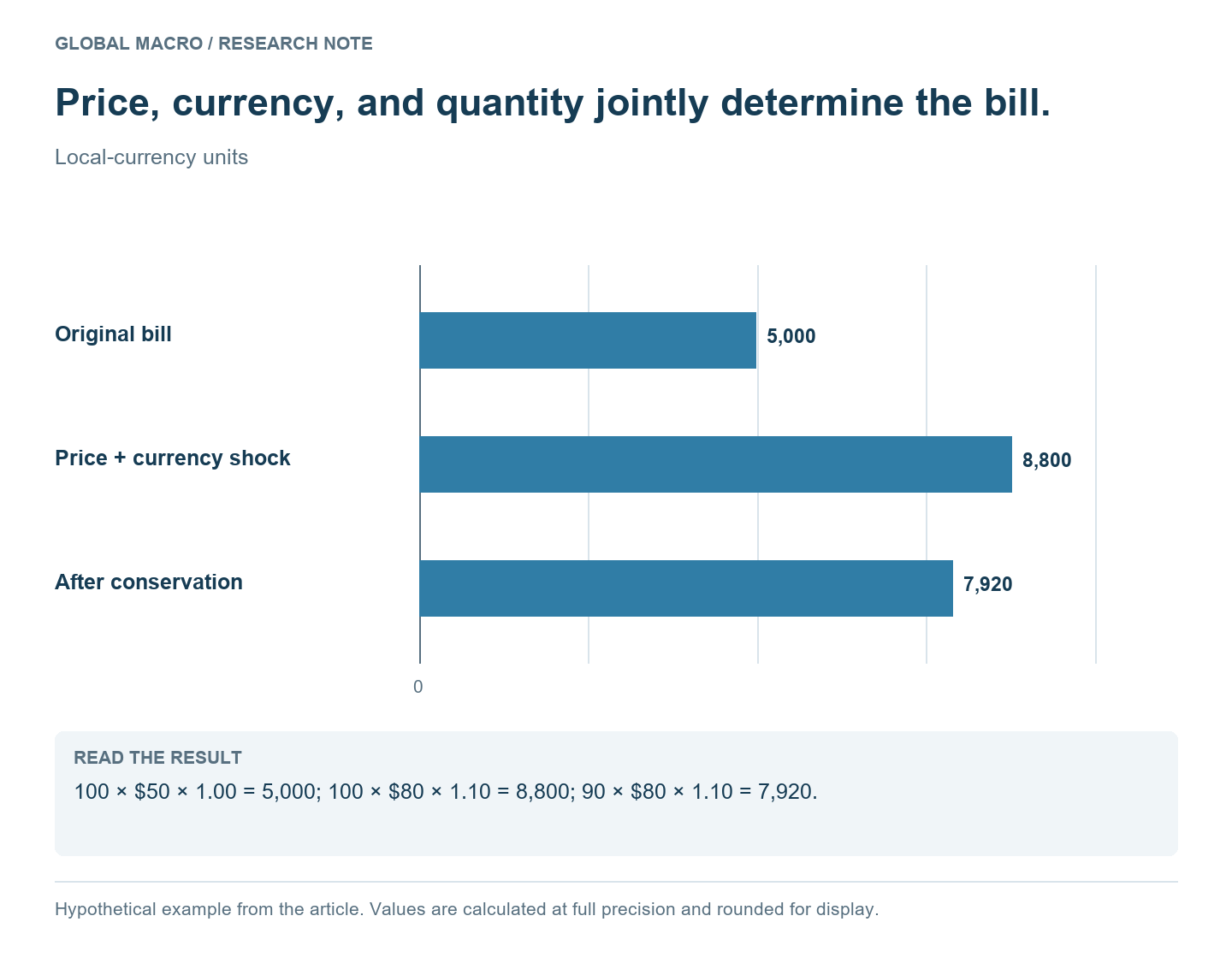
Suppose Harbor buys 100 units of an imported fuel at $50 each. Its dollar bill is $5,000. If the exchange rate is one local currency unit per dollar, the domestic-currency bill is also 5,000 units.
Now let the international price rise to $80 while the currency weakens to 1.10 local units per dollar. With the quantity unchanged, the dollar bill rises to $8,000 and the domestic-currency bill becomes 8,800. Relative to the original 5,000, the increase is 76%.
The international price rose 60%, and the local-currency price of a dollar rose 10%. The combined effect is multiplicative: 1.60 × 1.10 − 1 = 76%. Adding the two changes would produce 70% and understate the bill in this example.
That arithmetic does not imply that every importer immediately pays 76% more. Existing contracts, hedging, taxes, inventory, and regulated prices can alter the timing and distribution. It does show why a dollar commodity chart is insufficient for comparing domestic pressure across countries. The exchange rate and the currency denomination of the obligation are part of the exposure.
Quantities can adjust, but often with a lag
Higher prices can encourage conservation, substitution, and lower production of energy-intensive goods. The speed of those adjustments depends on equipment, infrastructure, contracts, and the nature of demand. A household can reduce some discretionary travel quickly but cannot instantly replace its heating system or move closer to work.
Suppose Harbor reduces fuel purchases from 100 units to 90 after the price and currency changes. At $80 per unit and 1.10 local units per dollar, the domestic-currency bill becomes 7,920. Conservation reduces the bill relative to 8,800, but spending remains 58.4% above the original 5,000.
The lower quantity also has an economic interpretation. Some reduction may come from efficiency improvements with little loss of useful activity. Some may come from postponed travel or lower factory output. Treating every decline in energy consumption as equally beneficial would miss the difference between efficiency and curtailed production.
Over a longer horizon, new equipment or infrastructure can expand the available choices. Those investments require financing and time. A short-run vulnerability can therefore coexist with a credible longer-run adjustment, but the future adjustment should not be presented as if it already protects current cash flow.
An exporter needs volume as well as price
Plateau initially exports 100 units at $50, generating $5,000 of gross export revenue. If the international price rises to $80 and export volume remains at 100, gross revenue becomes $8,000. That is the straightforward benefit often associated with an energy exporter.
Now suppose a disrupted route reduces the volume it can deliver to 60 units. At $80, gross revenue is $4,800, below the original $5,000. The higher price does not compensate for the lost volume. At 70 units, revenue would be $5,600, above the original amount but far below the unaffected-volume case.
These are gross revenues, not profits or government receipts. Production costs, freight, insurance, ownership, taxes, royalties, and contractual arrangements determine how much income reaches domestic businesses and public finances. A quoted commodity price cannot answer those questions by itself.
The example explains why production status and export access must be separated. Having resources underground is different from producing them. Producing them is different from delivering them to a buyer. Delivering them is different from receiving payment on time. Each step can constrain the apparent benefit of a higher international price.
The electricity system can alter the transmission
Delta's electricity supply comes from several sources. Some generators depend directly on imported fuel, while others have different operating-cost structures. The average generation mix is relevant, but it is not enough to determine the prices paid by every user.
Electricity pricing depends on market design, contracts, network charges, regulation, and the generating units needed to meet demand at a particular time. A system with substantial low-fuel-cost generation can still face periods when expensive fuel-dependent capacity is needed at the margin. Existing contracts may shield some users while others face a faster adjustment.
Physical constraints also matter. Generation in one location may not relieve a shortage elsewhere if transmission is limited. Storage can shift supply across time but has finite capacity and operating constraints. An annual energy balance can therefore look comfortable while particular hours or regions remain vulnerable.
For industrial research, examine the actual supply arrangement facing the facility. A long-term power contract, on-site generation, exposure to spot prices, and regulated tariffs produce different cash-flow profiles. Country averages provide context; the relevant contract and infrastructure determine the immediate business exposure.
Industrial structure determines how far the shock spreads
Energy enters production directly through fuel and electricity and indirectly through transport and materials. A country concentrated in energy-intensive manufacturing can experience a different cost increase from one concentrated in less energy-intensive services. But broad sector labels still conceal substantial variation within each industry.
Consider a producer with $100 of revenue, $15 of energy costs, $55 of other variable costs, and $20 of fixed costs. Operating profit is $10. If energy costs rise 40% and the firm cannot change prices, quantities, or other costs, energy expense becomes $21 and operating profit falls to $4.
A second business has the same revenue and initial profit but only $3 of energy costs, with other costs totaling $87. The same 40% energy-cost increase raises its expense by $1.20 and reduces profit to $8.80. Both businesses face the same percentage increase in energy, but the effect on profit differs because the original cost shares differ.
These examples hold many factors fixed. In practice, businesses can adjust output, negotiate contracts, improve efficiency, or pass costs through. The initial cost structure nevertheless identifies where the pressure begins. It also helps explain why the same national energy shock can change the composition of production rather than simply reduce every industry's activity by the same proportion.
Household exposure depends on spending patterns
Households differ in the share of income devoted to energy and other necessities. Heating needs, commuting distance, housing efficiency, and access to public transportation affect the practical burden. A uniform price increase can therefore produce unequal changes in disposable resources.
Suppose two households each have $3,000 of monthly take-home income. One spends $150 directly on energy and fuel, while the other spends $300. A 40% increase raises those bills by $60 and $120 respectively, assuming unchanged quantities. The direct burden is 2% of income for the first household and 4% for the second.
Indirect effects can add to the pressure through food production, transport, and other services. At the same time, some households may receive higher income from energy-related employment or business ownership. A complete distributional analysis considers both spending and income exposure.

This is why aggregate national gains do not guarantee broadly improved household welfare. An exporting country can receive more foreign income while many residents pay higher domestic prices. The way that income is distributed through wages, profits, taxes, and public spending determines who benefits and who remains exposed.
Price controls and subsidies move the cost
A government can prevent part of an international price increase from appearing immediately in a regulated domestic price. That may protect households or businesses in the short term, but the underlying cost still has to be absorbed somewhere in the system.
Suppose imported fuel costs 80 units per standardized quantity, while the permitted domestic selling price is 60. Ignoring other costs for the example, the gap is 20 per quantity sold. At 1 million quantities, covering the gap requires 20 million units of funding. If consumption or the import price changes, the funding requirement changes as well.
The burden may fall on the budget, a state-owned supplier, private distributors, or a combination. If compensation is delayed, a supplier's liquidity can deteriorate. If the gap is financed by borrowing, future debt service becomes part of the cost. If supply is not adequately funded, shortages or rationing can emerge.
The policy can still serve a legitimate distributional purpose, especially when targeted at vulnerable households. The research question is how it is financed, whom it reaches, how long it lasts, and what incentives it creates. A low posted price should not be mistaken for the disappearance of the economic shock.
Buffers change the available response
Foreign-currency liquidity, fiscal capacity, domestic financial markets, and usable inventories can help an economy absorb a temporary shock. Their relevance depends on the obligations they must cover and whether they are accessible when needed. A large headline asset figure is less informative if the assets are committed, illiquid, or held by an institution unable to deploy them for the particular problem.
For Harbor, a higher import bill may coincide with more expensive external borrowing. If existing obligations also require foreign currency, the financing pressure can extend beyond the fuel purchase itself. The maturity schedule and the stability of export receipts then become central to the analysis.
For Plateau, a revenue windfall may create room to save, reduce debt, or support spending. Committing all temporary revenue to permanent expenditure can make the budget vulnerable when prices normalize. Conversely, an exporter whose deliveries are interrupted may need its buffers even while international prices remain high.
For Delta, investment in efficiency or supply diversification may reduce future vulnerability but create a near-term financing need. The distinction between immediate relief and durable adaptation should remain explicit. Buffers buy time and choices; they do not make every response equally effective.
Hedging changes timing rather than creating free protection
An energy buyer may use financial contracts or fixed-price supply agreements to reduce uncertainty about future costs. The economic result depends on the quantity, product, currency, and period covered. A hedge can protect one exposure while leaving another unresolved.
Suppose an importer has fixed the price of half its expected purchases at $50 and buys the other half at a new $80 spot price. For 100 units split evenly, the average commodity cost is $65 and the total is $6,500 before other costs. That is lower than buying all 100 units at $80, but higher than the original $5,000 bill.
If actual purchases differ from the hedged quantity, the protection may be imperfect. If the financial contract references a different fuel or delivery point, the price relationship can change. Collateral requirements can also create cash needs before the final economic benefit is realized.
The correct conclusion is therefore specific: the arrangement reduces a defined part of the exposure under stated conditions. It does not establish that the business is unaffected by the shock. Public disclosures about hedging should be read alongside purchase volumes, contract maturity, and liquidity requirements.
The terms of trade connect production to foreign purchasing power
An economy can produce the same quantity of exports and still be able to buy fewer imports. The relevant comparison is between the prices received for exports and the prices paid for imports, often described as the terms of trade. An energy importer is vulnerable when the price of its essential imports rises faster than the price of what it sells abroad.
Consider a simplified economy exporting 100 units of a product at $10 each. Its $1,000 of export earnings can purchase 100 units of an imported product also priced at $10. Now suppose the export price rises to $10.50 while the import price rises to $13. With export volume unchanged, receipts become $1,050, enough to purchase approximately 80.77 import units.
The export business receives more dollars, yet the foreign purchasing power generated by its unchanged production falls. The price ratio changes by 1.05 ÷ 1.30 − 1, or approximately −19.23%. This example assumes common currency pricing and excludes financing, transfers, and other trade. It isolates the effect of relative prices rather than describing a complete balance of payments.
The distinction helps explain why real domestic production and real national purchasing power can move differently. A country's factories may initially produce the same quantities while the goods and services obtainable from their foreign earnings become more expensive. The income pressure can then influence consumption, saving, investment, and the exchange rate.
The adjustment can occur through several channels. The country may reduce import volumes, draw on foreign assets, borrow, sell additional exports, or change the composition of spending. Those responses have different implications. Borrowing can smooth a temporary shock, but it creates future obligations. Reducing imported capital equipment can ease the current bill while delaying productive investment. Increasing exports may require capacity that is not immediately available.
An exporter facing an improvement in the terms of trade has choices as well. It can save part of the additional purchasing power or spend it domestically. The availability of local capacity affects whether increased spending expands output or raises domestic prices. A favorable external price shift is therefore an opportunity whose outcome depends partly on how the income is used.
For comparative research, this is a reason to examine both quantities and relative prices. Nominal export receipts, real output, the trade balance, and the purchasing power of national income describe different aspects of the adjustment. Reading them together is more informative than assuming that a higher dollar revenue figure necessarily means a proportionate improvement in domestic welfare.
Compare countries using a common set of questions
A useful comparison starts with physical dependence, then adds financial transmission. Record the products imported and exported, available routes, contract timing, currency denomination, domestic pricing arrangements, and the sectors most exposed. Include the timing of debt and import payments rather than relying only on annual totals.
Next, identify the distribution of the burden. Which households face the largest essential-spending increase? Which industries have high energy shares and limited pricing power? Which institutions absorb a regulated-price gap? Which producers can actually deliver into the higher-price market?
Finally, examine the adjustment horizon. Inventory can help for a short period, hedges expire, infrastructure takes time, and fiscal support requires funding. A scenario should specify whether the shock lasts weeks, quarters, or longer. Extending a short disruption indefinitely can exaggerate damage; assuming rapid normalization without evidence can understate it.
The international price is a common signal, but the domestic transmission is specific. Following volumes, currencies, contracts, industry structure, and financial buffers produces a clearer account of why an energy shock changes some countries' opportunities while placing others under severe pressure.
Related research

ResearchGlobal Macro
Demand Shocks and Supply Shocks Need Different Diagnoses
Two economies can report the same inflation rate while moving toward very different outcomes. Stronger spending can push prices up while production expands. A disruption to supply can push prices up while production contracts. The distinction changes how to interpret profits, household income, financing conditions, and the difficult choices facing economic policy.

ResearchGlobal Macro
Reading a Forecast Revision Without Inventing Certainty
A forecast revision records a change in an assessment. It is not a measurement of how much economic damage has already occurred, and it does not reveal the contribution of every possible cause. A careful comparison preserves the forecast vintage, separates rates from levels, and explains the assumptions that changed.

ResearchGlobal Macro
When Wage Growth Becomes Purchasing Power
A higher hourly wage becomes greater purchasing power only after hours, employment, deductions, and prices have been considered. Following that chain explains why a favorable wage headline can coexist with a strained household budget—and why stronger real income can sometimes develop even while nominal wage growth slows.