
Weekly Research
A Policy Pause Makes Balance-Sheet Differences More Visible
- Report or archive date
- Coverage February 2–8, 2026
- Reading time
- 10 min read

Summary
February 2–8: the January decision remains the latest policy anchor in this review.
Put two warehouses on the same street. Their tenants sell similar goods, their operating profits are equal, and both buildings are mortgaged. One mortgage matures in eight years. The other comes due in eight weeks. A visitor walking past the loading docks would see little difference between the businesses. The treasurer at the second building would see almost nothing else. During the week ending February 8, the January Federal Reserve decision still supplied the latest policy range of 3.50 to 3.75 percent. With the central-bank setting familiar, this was a good week to look at the parts of financing that a policy rate leaves undetermined.
A balance sheet has amounts and dates. Earnings give a first indication of a company's ability to service debt. The debt schedule tells us when that ability will be tested in cash, by whom, and on what terms. Focusing exclusively on net debt or interest coverage can hide concentrations in those dates. The solvency question and the timing question can lead to different findings even for companies whose annual productivity is identical.
Draw a line at the maturity date
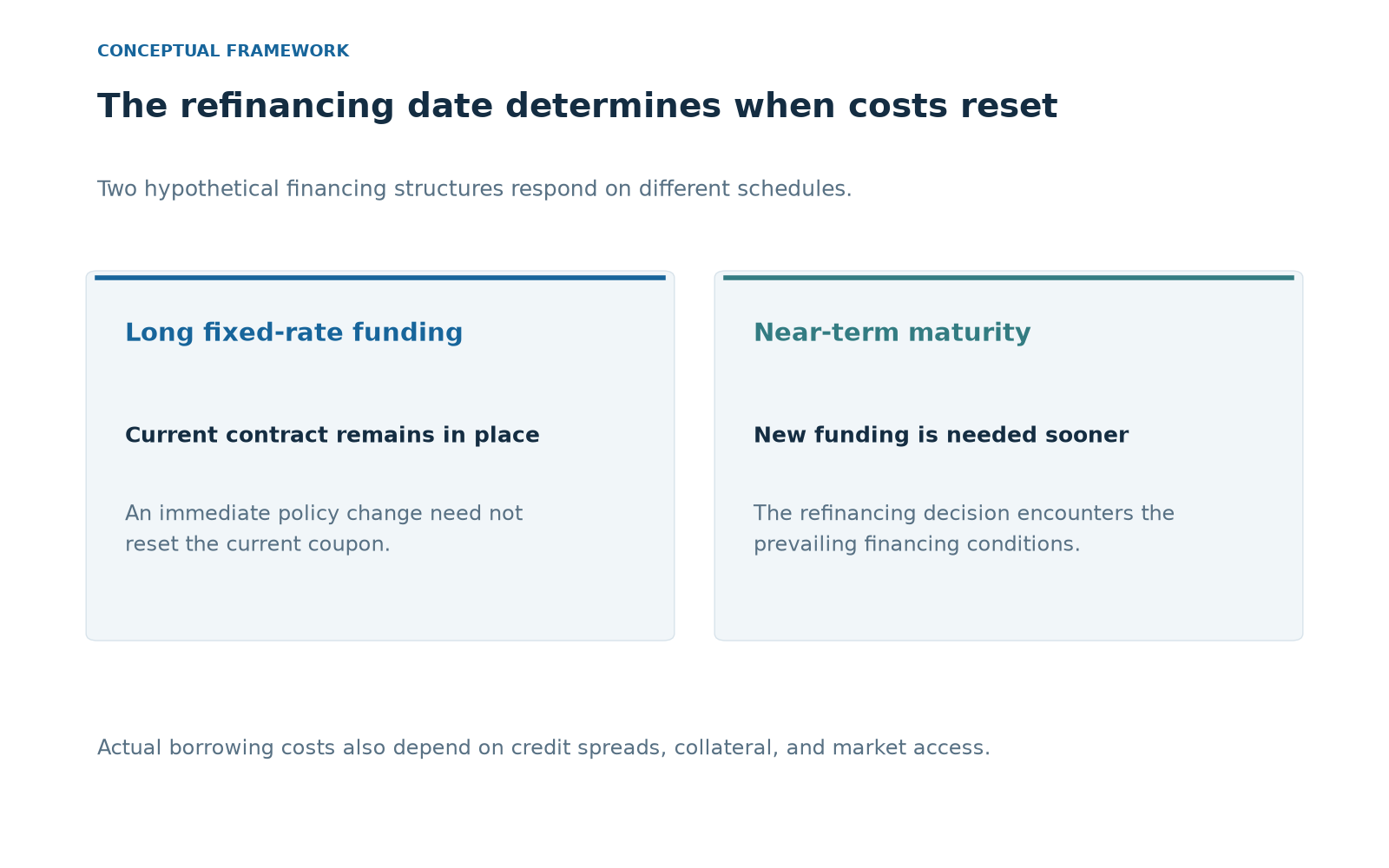
Consider two warehouse owners, North and South. Each holds property worth an assumed $15 million, owes $8 million, has $500,000 in unrestricted cash, and earns $1.2 million of annual net operating income. Both loans currently charge 4 percent interest with no scheduled amortization before maturity. Annual interest is $320,000, leaving $880,000 of operating income before capital expenditures, taxes, and other financing needs. On these simple measures the owners look alike. North's fixed loan can remain outstanding for eight years. South must repay or refinance in eight weeks.
A bank offering to refinance South at 6 percent would raise its annual interest bill to $480,000 on an $8 million balance. The difference is $160,000, equal to more than thirteen percent of annual operating income. It would be a mistake to apply that full annual amount to the current quarter when only part of the quarter follows the refinancing. It would be a bigger mistake to assume a new lender will advance the entire $8 million. Interest expense is the first question only if principal can actually be rolled over.
Suppose a lender caps the new mortgage at half of an appraised $14 million property value. The maximum new loan is $7 million. South has to cover the remaining $1 million at closing. Even deploying every dollar of its cash leaves a $500,000 gap before fees or operating reserves. At that smaller principal balance, the 6 percent coupon would generate $420,000 of annual interest. A spreadsheet showing only the annual coverage ratio could make the refinancing look relatively comfortable, while leaving the immediate funding gap invisible. A treasurer must meet a dollar amount on a particular day before benefiting from the smaller balance afterward.
The bank could require a lower advance for reasons unrelated to the latest central-bank decision. A major tenant might be approaching the end of its lease. The property's appraisal might use different rent or vacancy assumptions. The lender might already hold considerable exposure to the neighborhood. Evaluating whether any of these factors applies requires the appraisal, tenant roll, lease dates, loan policy, and a credible replacement funding proposal. Explaining every difference as a response to the policy rate would skip over the actual underwriting decision.
Ask which cash is usable on closing day
Cash in consolidated financial statements can include balances held at different entities, for different purposes, or in different currencies. Some money may have to remain with a property to satisfy its operating covenants. Other cash may be pledged against a separate obligation. A company that can show a large gross balance on a quarter-end statement may have less available for a particular maturity than a casual reader expects. Conversely, an undrawn committed facility can be a legitimate additional resource if the borrower can meet its conditions and draw in time.
Return to South. Of its $500,000 cash balance, assume $150,000 must stay available under a lease-related reserve arrangement. Assume another $100,000 is needed to cover ordinary expenses while rents are collected. Only $250,000 is then readily available for the $1 million gap under the stated scenario. South requires another $750,000 before fees. Calling all $500,000 both a source of refinancing funds and a cushion for ongoing operations would spend the same money twice. A good liquidity schedule shows the purpose of each balance and the date it becomes unrestricted.
The lender's term sheet might include an origination fee of one percent of the new $7 million loan. If it is payable in cash, add $70,000 to the closing requirement. If it is deducted from proceeds, South receives only $6.93 million from a $7 million face amount, with the same immediate effect on required cash. If it is financed as part of a larger approved loan, both principal and later interest may change. Each description can appear under the same number on a marketing presentation. The cash schedule should reflect the signed structure rather than a shorthand description of the rate.
A term sheet is not a cash balance
A refinancing process passes through stages. An indicative discussion can establish whether a lender is interested. A term sheet can narrow the range of likely terms. A signed commitment may still contain conditions that must be met before money is released. A final closing transfers cash or replaces the old obligation. The research question is what could still prevent movement from one stage to the next and how much time remains to resolve it. Treating each stage as equivalent to money already in the bank can conceal the most consequential uncertainty in the analysis.
Consider two paths to the additional $750,000 before fees. South might arrange an equity contribution from its owner or obtain a loan secured by another asset. Equity may reduce financial leverage at the property, but only if the owner can supply funds by closing. A second loan might complete the transaction while raising debt service and encumbering an asset that formerly backed another part of the business. If a shareholder borrows personally to inject equity, the property's accounts may improve while the household or parent company becomes more exposed. The funding decision looks different at different levels of consolidation.
A sale is another possible source, with its own timing. A buyer's preliminary offer on a parking parcel is quite different from an executed, unconditional sale with funds due before the mortgage maturity. An urgent sale can also realize less than an appraisal prepared under ordinary marketing conditions. An investor who treats book value as cash available next Friday is making an assumption about price, legal closing, and settlement simultaneously. Listing those assumptions explicitly makes the proposed solution testable.

Interpreting the ratio after the loan closes
Suppose South secures the missing funds and refinances the $7 million at 6 percent. Annual interest is $420,000. Using $1.2 million of operating income gives interest coverage of approximately 2.86 times. Now suppose the new mortgage requires $200,000 in scheduled annual principal payments. Debt service becomes $620,000, and operating income divided by that amount is about 1.94 times. The first ratio answers how much the property earns relative to interest. The second includes contractual principal service. A presentation that alternates between these definitions can suggest an improvement that exists only in the label.
Take the example one step closer to actual cash. The building needs $180,000 of roof work during the next year. Operating income less roof work leaves $1.02 million before financing. Deduct $620,000 of debt service and $400,000 remains for other items under these assumptions. Stating that result does not establish the legal covenant calculation. A covenant may define income and permitted deductions differently. It does show why a reader examining recurring capacity needs information about maintenance as well as interest. Deferring roof work might lift cash this year and damage the stability of future leases.
Stress the tenant side separately. If annual net operating income falls to $900,000, the same debt service consumes nearly 69 percent of it. After the assumed roof work, only $100,000 is left before other cash requirements. No rate increase is necessary to create that squeeze. Lower rental receipts and a fixed financing commitment are sufficient. Conversely, a successful lease renewal could improve coverage without a decline in interest rates. A refinancing model that varies the interest rate while treating the property as economically inert omits a large part of the risk.
What the neighboring property tells us
North has more time before maturity. That time has value. It can plan lease renewals, build reserves, or seek a new financing arrangement without an immediate deadline. But eight years of fixed-rate funding does not protect it from tenant departures, property damage, insurance increases, or the economic effect of a mortgage that exceeds the value of the building. A researcher should resist turning a well-spaced maturity schedule into a general certificate of safety. It changes which problem has to be solved first.
The holders of North's debt and North's equity also experience the situation differently. A lender who wants to sell a fixed-rate loan may receive less than face value when comparable new loans carry higher yields. North can still pay the existing coupon. The lender's mark and the borrower's payment are different views of the same contract. For a portfolio containing both property equity and mortgage credit, a rise in financing stress may affect both positions through the same tenants and collateral. Owning different securities does not necessarily create independent economic exposures.

A useful relative comparison would hold the assumed property cash flows fixed and first vary only the maturity date. Then hold the maturity fixed and vary projected rent, required principal repayment, and the value a lender assigns to collateral. This order helps identify whether an apparent difference between owners rests chiefly on timing, asset quality, or financing structure. It also gives a person reviewing the model a place to register disagreement. An analyst can accept the interest arithmetic and still reasonably question the appraisal or the ability to retain a large tenant.
A short calendar for a long-lived asset
Build a closing calendar backward from the repayment date. Enter the last day the old lender must receive cleared funds, the expected closing, the deadline for evidence of insurance, the appraisal delivery, and the dates on which the owner can call for capital. Then place the minimum cash balance beside each week. If several documents must arrive on the same Friday, a delay in one can propagate through the schedule even if its dollar value is small. Calendar risk becomes visible when obligations are put in sequence rather than summarized as a list of balances.
For an owner monitoring several properties, put all their maturity calendars side by side. Two individually manageable $500,000 equity needs become a $1 million call if they arrive together. If both plans presume sale of the same unencumbered parcel or availability of the same credit line, the resources are correlated as well. Central treasury can sometimes solve the problem by staggering closings or arranging additional committed funding. That solution depends on identifying the overlap early enough. A portfolio-wide total calculated only at year-end can miss the week when every property needs cash.
A calendar also reveals which information is worth paying for early. Suppose the largest uncertainty is whether the lender will accept the $14 million appraisal or insist on $13 million. At the assumed fifty-percent advance rate, the difference is $500,000 of loan proceeds. An updated appraisal delivered six weeks before maturity gives the owner time to arrange half a million dollars. The same information arriving the day before repayment has a sharply different practical value. The expense of obtaining and reviewing an appraisal is visible in this quarter's accounts. The value of avoiding a last-minute financing negotiation may never appear as a separate line item.
There is a useful discipline for the last financing meeting. Ask one participant to present the plan on the assumption that the new mortgage closes on time, another to present it on the assumption of a thirty-day delay, and a third to identify obligations common to both paths. A temporary bridge priced for thirty days could be expensive on an annualized basis and still protect more value than an urgent property sale. Its own fees and repayment terms must enter the comparison. Equally, a costly bridge might merely purchase time if the underlying funding gap has no credible solution. The test is what can actually be completed during those thirty days. Naming the document to be signed, the funds to be received, and the party responsible turns an optimistic extension into a proposition the board can monitor.
The policy pause gave no special instruction to North or South. Its value for this week's analysis was to hold one broad input steady while exposing substantial differences underneath. North can keep paying under an existing contract and use time to improve its options. South needs executable funding on terms its collateral and cash flow can support. The most revealing document for either investor is a dated schedule tying a named source of cash to each contractual use. When that schedule balances under reasonable stress, an earnings forecast has something solid to stand on. When it does not, a familiar policy rate offers little comfort.
Related research

Weekly Research
The January Hold Keeps Both Sides of the Mandate in View
January 26–February 1: an unchanged policy rate does not mean an unchanged balance of risks.

Weekly Research
January Data Offer a Mixed but More Detailed Picture
February 9–15: employment and inflation releases need to be read together.

Weekly Research
A Resilient Global Baseline Still Contains Uneven Risks
January 19–25: the IMF’s forecast is a starting framework, not an observed full-year outcome.