
Weekly Research
The January Hold Keeps Both Sides of the Mandate in View
- Report or archive date
- Coverage January 26–February 1, 2026
- Reading time
- 10 min read
Summary
January 26–February 1: an unchanged policy rate does not mean an unchanged balance of risks.
The Federal Reserve issued one rate decision on January 28. Businesses received it through thousands of different loan agreements. A family making a fixed mortgage payment due Friday, a builder drawing on a floating-rate credit line Monday, and a retiree rolling a maturing deposit could all encounter different borrowing or saving terms in the days around the meeting. Understanding that apparent contradiction requires separating the rate policymakers set as a target from the prices that households and businesses actually face.
The committee kept its target range for the federal funds rate at 3.50 to 3.75 percent. Two voting participants preferred a quarter-point reduction. The statement described solid economic activity, low job gains, some stabilization in unemployment, and inflation still somewhat elevated. Those observations belong together. Replacing them with a single word such as “strong” discards the tension that made the meeting worth studying. The important question for the week ending February 1 is what evidence would cause the relative importance of the employment and price risks to change.
Follow the payment reset
Start with a $4 million floating-rate business loan. Its contract resets every three months to a specified reference rate plus two percentage points, with no floor or cap. At a reference rate of 3.6 percent the annualized borrowing rate is 5.6 percent. Assuming the balance stays drawn and setting day-count details aside, annualized interest is $224,000. A quarter-point reduction in the reference rate at the next reset would reduce annualized interest by $10,000. The reduction attributable to a single quarter would be about $2,500 under a simple quarter-year calculation. Dividing by the right period keeps a headline annual saving from appearing four times larger in the next quarterly income statement.
January 28 brought no such cut to the policy range. Even a future cut would require one more step before the example's borrowing rate moved. The contract names a reference rate and a reset date. A company may pay a different rate until that date, and the reference may already reflect expectations about future policy. A lender can also charge a higher spread when a loan expires and a new one is negotiated. Headlines about monetary policy reach the business only after passing through those contractual terms.
A consumer with a fixed-rate mortgage faces a different calculation. The scheduled principal and interest on the existing debt do not reset because the central bank meets. Refinancing would require a new loan, eligibility, and consideration of closing costs and the remaining time the borrower expects to keep it. A family looking to purchase a first home has no outstanding coupon to protect. It faces the terms available now and may change its budget even if an existing homeowner on the same street feels little immediate difference. “Mortgage holders” is too broad a label for a research claim about spending sensitivity.
Why a vote can be informative without being a forecast
A recorded vote establishes what the participants preferred at that meeting. It does not show the rate each participant would prefer after an unforeseen change in inflation, employment, or financial conditions. Nor does it imply that every participant supporting the outcome had the same reasons. One might have viewed demand as sufficiently robust to wait. Another might have put greater weight on the cost of acting before the data became clearer. Without additional public evidence those motives remain hypotheses. The fact that two voters favored a cut is already informative without assigning them arguments they did not make in the statement.

An analogy applies to a firm's inventory committee. Eight managers may agree to keep inventories steady while disagreeing about why. Some expect demand to rise but worry that deliveries will be late. Others expect soft demand but want a reserve against uncertainty. Observing the final vote tells a supplier the current order decision. It does not reveal how the group would respond to a cancelled shipment or a large new sale. A forecast that treats the votes as permanent types of people loses the conditional character of the decision.
Instead of counting votes as if they were probabilities, write a pair of questions. What observation would make low job gains more consequential for future production, and what observation would make elevated inflation more persistent? For the first, look beyond the initial hiring number to hours, income, and the breadth of weakness. For the second, ask whether recurring price changes are widening and whether businesses can put them through without losing volume. The same observation could matter for both questions. Shorter hours can dampen household demand, while renewed wage pressure concentrated in a few occupations might say little about the general price level.
Compare the cost of getting the decision wrong
A central bank responding to incomplete measurements faces costs on either side of its decision. Easing quickly could support borrowing and activity if demand were already weakening more than the data showed. If price pressure instead remained broad, easier financial conditions could complicate the task of bringing inflation down. Waiting could supply more information and avoid easing too soon, while placing more strain on borrowers whose income or financing was already deteriorating. A weekly review can describe those trade-offs without putting a spurious numerical probability on either outcome.
Consider a local equipment dealer deciding whether to renew a customer's revolving credit terms. The customer is paying on time but has placed fewer orders. Extending credit at once may preserve a valuable relationship if the slowdown is seasonal. If the customer is losing business permanently, more exposure could deepen a loss. Cutting the line too soon could itself create a cash shortage. The dealer asks for receipts, receivables aging, and the order calendar because the information can distinguish the stories. Much of what looks like inertia in a decision can in fact be the value attached to waiting for a discriminating observation.
The analogy has a limit. A central bank weighs economy-wide employment and price stability, and its decisions affect financing conditions through multiple channels. A dealer is protecting its own balance sheet. The comparison helps only with the structure of uncertainty. An assessment should distinguish what action would be appropriate under each scenario from what evidence supports that scenario today. Jumping from a plausible risk to a confident claim about the next policy move skips the central step.
Work backward from the bond's cash flows
The behavior of longer-term yields around a meeting cannot be inferred solely from whether the policy rate changed. Investors had expectations before the announcement. A decision can confirm those expectations while the accompanying assessment changes views of later policy, inflation, or the compensation required for holding long bonds. Proving that a yield moved for one of those reasons takes additional observations. The January decision itself provides neither the size nor the direction of any particular market move.

A simple zero-coupon bond makes the distinction concrete. Imagine receiving exactly $1,000 five years from now from a borrower assumed to pay in full. Under annual compounding, at a 4 percent yield the price is about $821.93. At 4.25 percent it is about $812.12. The cash promised at maturity is still $1,000. The lower price, roughly $9.81 less using those rounded figures, reflects the higher discount rate across a five-year horizon. No holder receives the policy target range as the coupon on this instrument. Repeat the calculation at a different maturity while keeping the same two yields. The change in maturity alters how long the higher discount rate applies.
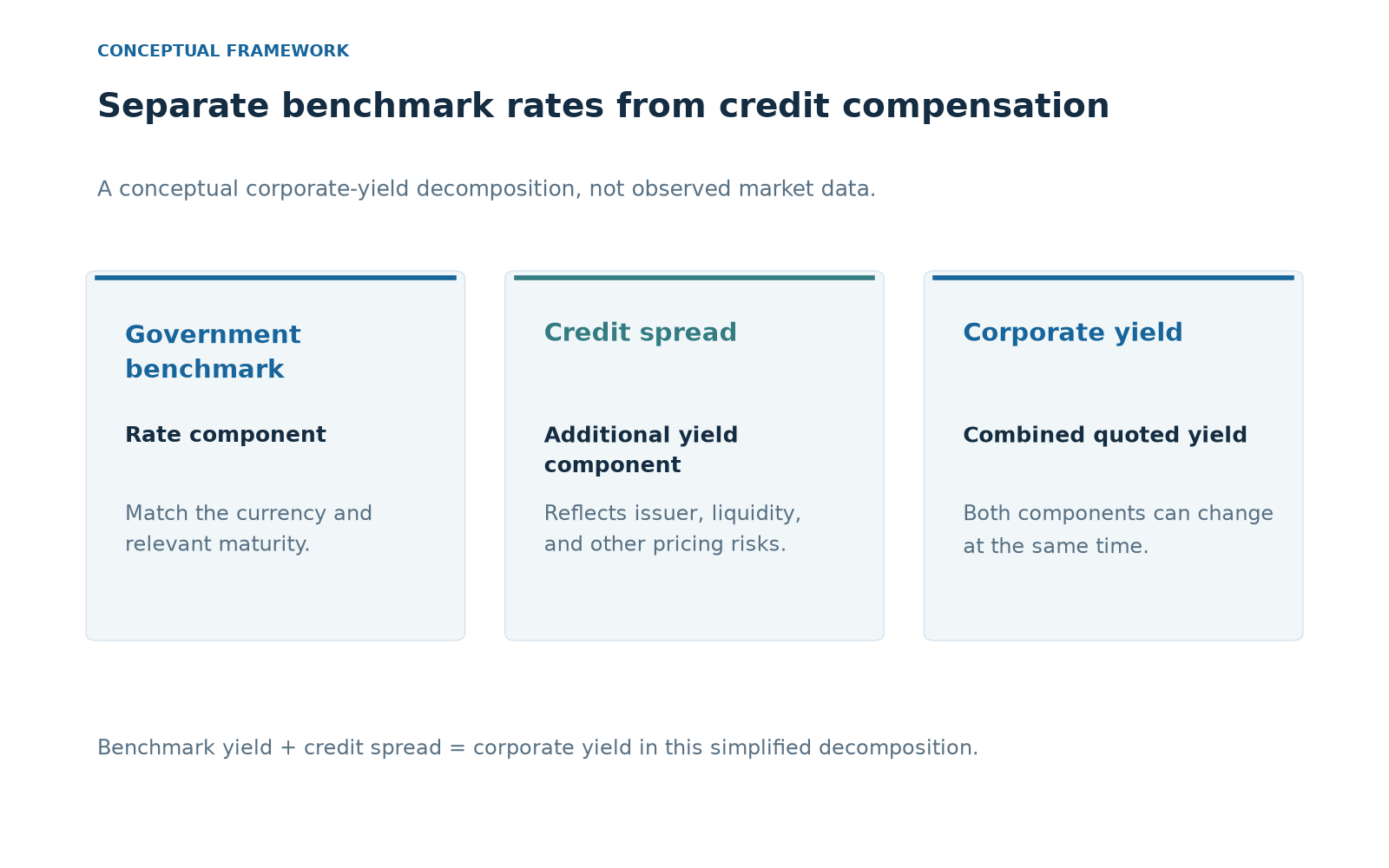
A corporate bond adds another moving part. Its yield can rise because investors demand more compensation for credit risk even when expected short-term rates fall. A holder considering a sale needs the market price under those conditions. A company that issued a conventional fixed coupon continues to make the contractual payment while the borrower remains current. The same economic surprise can therefore affect a holder's mark-to-market return immediately and the issuer's cash interest expense only much later, when it seeks new money. Confusing those perspectives makes the connection between monetary policy and corporate earnings look faster than it is.
Put the meeting on a deposit calendar
Interest income has a reset schedule as surely as interest expense does. A nonprofit may fund a summer program partly from the interest on an operating reserve. If it has already placed $2 million in a six-month certificate at an annual simple rate of 4 percent, the expected interest for that half-year is $40,000, subject to the certificate's terms. A different rate available on a newly opened deposit does not change that contracted amount. It changes the options on the maturity date, when the nonprofit must choose a new term or use the cash. Treating today's deposit quote as if it applied retrospectively would misstate funds available for the program.
Break the reserve into two equal pieces. Suppose $1 million remains contracted at 4 percent for the next half-year and $1 million can be renewed for that period at 3.5 percent. Expected simple interest becomes $20,000 on the first piece and $17,500 on the second. Relative to earning 4 percent on the entire reserve, the difference is $2,500 over six months. Announcing a $10,000 budget hole by applying a half-point annual decline to all $2 million would get both the affected balance and the period wrong. Ordinary organizations experience the timing of monetary transmission through precisely these details.
The planning response depends on the timing of disbursements too. A reserve that must pay staff in March cannot necessarily be committed for six months simply because a longer deposit offers a more appealing rate. Cash that guarantees payroll has a job independent of the income it earns. An analyst reviewing a bank or an asset manager would ask a related question from the other side of the desk. When can depositors move, what rates are they already earning, and how much do they value immediate access? Those facts help determine how fast a change in market conditions reaches the institution's funding expense. A bank facing deposit maturities clustered in one quarter can experience a much faster change than a similar bank whose deposits mature gradually across the year.
What would reach ordinary business decisions first?
Look for the decisions a business can actually change this quarter. A retailer may adjust promotional financing for customers or shorten its purchasing commitments. A builder can change the timing of its next land purchase more easily than it can change the financing of a finished house already under contract. A profitable company holding ample cash may leave its production schedule untouched but negotiate more assertively with a supplier that needs a faster payment. Monetary conditions can change the bargaining relationship between two companies even when one company's direct interest expense hardly moves.
Calculate the value of early payment from the buyer’s side. A supplier offers a 1 percent discount on a $100,000 invoice for payment today instead of thirty days from now. The buyer pays $99,000 now to avoid paying $100,000 later. At an assumed annual cash opportunity cost of 5 percent using a 365-day year, the cost of using $99,000 thirty days early is about $407. The discount saves $1,000, leaving a gross economic advantage of about $593 before operational costs or risks. A company short of liquidity may still decline. One with abundant cash may accept even if it has a cautious sales outlook.
Why include an invoice in a policy review? Because descriptive labels about easy or tight money have to reach someone through a real transaction. The buyer with cash can earn a return by paying early. The supplier deliberately forgoes $1,000 to accelerate receipts. Their willingness to do that depends on their individual alternatives, which may differ greatly from an overnight policy target. A treasurer willing to explain how often customers accept such discounts may provide more insight into immediate financing strain than a broad statement about management's confidence.
A useful record of an unchanged meeting
The starting point for February should keep an unchanged decision separate from an unchanged outlook. Write down the target range, date, vote, and the committee's stated economic assessment. Then identify the borrowing contracts and spending decisions most exposed to employment weakness or persistent prices. This procedure leaves room for a subsequent report to change one's mind without creating the false appearance that January's decision itself had been misread.
For example, suppose the next evidence were weaker household income with little additional price pressure. A researcher concerned about near-term demand would have a reason to revisit discretionary sales and credit performance. If instead selling prices rose across more categories while volumes stayed firm, the research questions would shift toward margins, wage contracts, and the durability of pricing power. If the data were mixed, as daily business evidence often is, a researcher could retain uncertainty while putting a greater burden of proof on the most fragile assumptions. No single position in an investment account follows automatically from any of these statements.
January's hold had a definite meaning on the day it was made. It kept the policy range in place and recorded a division over whether a modest cut was preferable. Beyond that, rates, financial claims, and company decisions follow their own calendars. The questions that matter reach down to the date a loan resets, the price paid for a bond, and the day an invoice comes due. Working from those dates gives a research review a way to distinguish an actual change in a household or business budget from a story told about the last meeting.
Related research

Weekly Research
A Resilient Global Baseline Still Contains Uneven Risks
January 19–25: the IMF’s forecast is a starting framework, not an observed full-year outcome.

Weekly Research
A Policy Pause Makes Balance-Sheet Differences More Visible
February 2–8: the January decision remains the latest policy anchor in this review.

Weekly Research
Inflation Progress Still Needs Confirmation Beneath the Headline
January 12–18: December CPI offers a useful distinction between total and underlying price changes.