
Monthly Research
August 2026: Moderate Inflation, Ambiguous Labor Signals
- Report or archive date
- Coverage August 1–31, 2026
- Reading time
- 14 min read

Summary
The late-summer evidence favors a closer look at assumptions rather than a broad market verdict.
An industry exhibition sells booth space months before the doors open, tickets weeks before the event, and food on the day delegates arrive. A sponsor paying in advance, a delegate booking a refundable ticket, and an exhibitor reserving space without a deposit all appear to express confidence. They do not represent the same claim on cash. The organizer planning next year's event has to learn which signals are firm and which can disappear. That is also a practical way to read August's economic evidence. A relatively moderate U.S. inflation report and a mixed labor release improved some assumptions while making others more uncertain. Neither supplied a single verdict about the next commitment worth signing.
The information arriving in August primarily concerned July. Initial nonfarm payroll employment declined by 23,000, yet the unemployment rate edged down to 4.1 percent. Revisions reduced the estimated payroll gains in May and June. July headline CPI rose 0.1 percent from June and 3.4 percent over twelve months. Core CPI rose 0.2 percent on the month and 2.5 percent over the year. The Federal Reserve's most recent scheduled decision, on July 29, had kept the target range at 3.50 to 3.75 percent, with three dissenters favoring an increase. The August employment and CPI reports were not available by August 31. Describing August as a month of moderate incoming price data is accurate; reporting an August price outcome here would not be.
Why a falling payroll count and unemployment rate can coexist
The payroll survey counts jobs at establishments. The household survey counts people and classifies their participation, employment, and unemployment. Somebody with two payroll jobs can count twice in the first measure and once among employed people in the second. A self-employed exhibition designer can work without appearing as an ordinary nonfarm payroll employee. An unemployed person who no longer meets the active search or availability criteria can leave the unemployment numerator and the labor force denominator without finding a job. The surveys also differ in sampling and can be revised or move noisily. A small difference in the signs of monthly changes is not evidence that the measures contradict each other.
July participation was 61.4 percent and the employment-population ratio 58.9 percent. Participation had fallen 0.7 percentage point since January and the employed share 0.5 point. About 4.8 million people were working part time for economic reasons. A lower unemployment rate can coexist with reduced participation or insufficient hours. The practical implication for household demand is that the presence of a job does not tell us the number of paid shifts or the disposable income left after housing and other commitments. An event organizer selling optional tickets cares about the income, availability, and travel budget of prospective delegates, not just whether they are classified as employed.
The initial negative payroll figure was also less informative in isolation than the revision to recent history. In the release available in August, May was revised down to 63,000 and June to 20,000. Together those revisions removed 103,000 from the previously reported changes for the two months. May, June, and July now totaled a gain of 60,000, or 20,000 a month on average. The three-month measure smooths the July sign but depends on the vintage being used. Reading subsequently revised figures back into an August investment decision would give the analyst information unavailable at the time. The release said little change characterized several measures; it did not establish that the economy had stopped hiring or that all industries were weak.
Which payrolls matter to the buyer?
Local government education lost 50,000 jobs in July on a seasonally adjusted basis. Retail lost 19,000 and financial activities lost 14,000, while health care continued to trend up with 22,000 more jobs. Conditions facing an exhibition serving medical equipment suppliers could therefore differ considerably from those facing a meeting of regional retail managers. Even the industry weights are not enough. A medical equipment exhibitor may expand because a new product obtained approval, or reduce marketing because it has already signed long-term supply contracts. The link from a sector employment figure to a company's discretionary travel budget has to be demonstrated, not assumed.
Average hourly earnings for private nonfarm employees were $37.62 and the average workweek 34.3 hours. The reported twelve-month earnings gain was 3.2 percent. For a company buying conference tickets, the relevant price of attendance includes time away from the office as well as the ticket, hotel, transport, and food. If headcount is tight, the opportunity cost of a key supervisor's absence can rise even when headline travel prices ease. If remote participation is a suitable substitute, a modest reduction in demand can shift attendance format without canceling the business relationship. A payroll release and a price release can influence the same decision through different channels and with different signs.
There is also a difference between bookings and commitments. A participant registering interest at a zero-cost webinar can be counted as a lead. A company issuing a nonrefundable travel authorization has made a stronger financial commitment. An exhibitor paying a deposit for a specific stand is stronger still, provided it lacks an easy cancellation right. Research about discretionary business activity should not treat all three as sales. An August survey of confidence can be informative, but reconciling it with paid orders, cancellation deadlines, and repeat transactions supplies evidence about whether sentiment is translating into cash.

Moderate headline inflation was not uniform relief
July's small headline increase followed June's 0.4 percent monthly decline. Energy fell 1.5 percent in July after a 5.7 percent decline in June. Gasoline fell in July, but electricity and utility gas rose. Shelter rose 0.1 percent and accounted for roughly two thirds of the small net headline increase. When some components rise and others fall, the contribution of a category to the net change can be large even if its own movement is small. Contribution to a monthly result must not be confused with share of household expenditure. Food bought for home use fell slightly while food away from home became more expensive, illustrating the difference between goods and a service-inclusive purchase.
The event organizer cannot simply apply the 0.1 percent headline rate to next year's cost budget. Its venue may have a contracted step-up; catering prices may reset according to a food and labor formula; security may be paid at an hourly rate plus a minimum shift; and audiovisual equipment can be rented under a fixed multi-event agreement. Attendees buying airline travel and hotel stays encounter locally and seasonally specific prices. A national measure supplies context about the economic environment. It does not specify the marginal cost of one more delegate or the fixed cost of reserving the exhibition hall.
A better budget separates the cost committed once the event is announced from the costs varying with actual attendance. Suppose the organizer can cancel the venue up to six months ahead at a modest penalty. After that date a much larger deposit becomes nonrefundable. Inflation and hiring releases arriving before the deadline can change whether it is valuable to reserve a smaller hall. The same releases after the contract becomes binding matter more for pricing, catering, and cash reserves than for the venue cost. The option to adapt has a date. A month-end economic review has greater practical value when matched to the next genuine decision window.
Build a conference income statement from commitments
Consider the accounts for a three-day trade exhibition. It expects 120 exhibitors paying $8,000 each, 2,000 delegates paying a net $250, and sponsorship of $240,000. Expected revenue is $960,000 from booths, $500,000 from delegates, and $240,000 from sponsors, totaling $1.70 million. Fixed venue, insurance, administration, security commitments, and production cost are assumed to be $1.10 million. Incremental catering and materials cost $100 per delegate, or $200,000 at the forecast volume. The operating contribution is $400,000 before interest, taxes, and other excluded expenses.
If delegate attendance falls 20 percent to 1,600 while signed exhibitor and sponsorship receipts remain intact, delegate revenue declines $100,000 but variable costs decline $40,000. Operating contribution falls by $60,000 to $340,000. The delegate loss is significant, but booth and sponsor income provide initial protection. If instead 20 exhibitors also cancel and receive full refunds, another $160,000 of revenue disappears if fixed production costs cannot be reduced materially. Contribution falls to $180,000. The same headline attendance reduction has different economics depending on who else has a right to leave.
Now assume the catering contract has a minimum charge for 1,800 delegates. At actual attendance of 1,600 the organizer still pays $180,000 rather than $160,000 for that variable-looking line. The combined stressed result falls from $180,000 to $160,000. A weaker labor market does not have to reduce every revenue stream to create financial strain; it can create a mismatch between cancelable sales and committed expenses. An analyst should read the minimum headcount date, cancellation fees, nonrefundable deposits, and whether the caterer adjusts staffing and food orders at different times. Modeling every cost as flexible in the same proportion as attendance overstates resilience.
A price increase is not an automatic solution. At 1,600 attending delegates, an extra $25 per ticket brings $40,000 if nobody changes plans and the price is collectible on every ticket. If the increase causes 200 more delegates to stay away, losing 200 original net tickets costs $50,000 in revenue before considering any remaining variable cost savings. With a catering minimum already binding, the organizer might save very little on those lost delegates. The rise may still be worthwhile for a late-registration tier where demand is less price sensitive. The relevant test concerns the affected group, the effective price after discounts, and the commitments already made.
Cash arrives in a different order from profit
Suppose exhibitors normally pay half their booth charges up front and the balance thirty days before the event. At 120 exhibitors the initial deposit pool is $480,000. It is visible cash but can carry a refund obligation or belong to services not yet delivered. If the hall requires a $500,000 deposit at the same stage, customer cash alone falls $20,000 short even before paying insurance or staff. A profitable expected event may require a working-capital facility from the outset. Conversely, collecting deposits early can make current operating cash look strong while leaving a future responsibility to deliver the event or refund participants.
The sponsor's $240,000 may be conditional on meeting a minimum attendance level or delivering an agreed list of benefits. If sponsorship falls by $60,000 below 1,700 participants, the earlier case with 1,600 delegates, 20 fewer exhibitors, and the catering minimum would leave $100,000 instead of $160,000. The attendance downside is therefore not linear. A modest additional decline near the threshold can materially change economics. Before committing to discretionary production upgrades, the board should obtain the written sponsor terms and define attendance precisely. Registered users, paid attendees, people who actually scan into the hall, and distinct organizations are different measures.
A combined stress can affect cash before it affects reported profit. Suppose the venue refuses to refund its deposit, exhibitors request their refunds within ten days, and a sponsor can delay final payment until after attendance is audited. The ultimate accounting contribution can be positive while cash briefly turns negative. A bank credit line can protect the interval only if it is committed, drawable, and sized for the actual timing. An organizer whose bank also finances exhibitors in the same industry may face tighter credit precisely when multiple participants cancel. Identify concentration not just in assets and revenues, but in the reliability of backup funding under the same adverse event.
The Treasury curve and the price of the asset
From July 31 to August 31 the two-year Treasury par yield moved from 4.28 to 4.34 percent, a six-basis-point increase. The ten-year was 4.75 percent at both endpoints, while the thirty-year eased from 5.27 to 5.25 percent. A moderate inflation reading did not produce a uniform decline in government rates over the entire month. Endpoint observations conceal movement within the period and do not isolate the effect of labor or price news. They describe nominal reference rates in dollars, not a trade-show operator's all-in borrowing cost or the return on a bond portfolio with particular coupons and holdings.
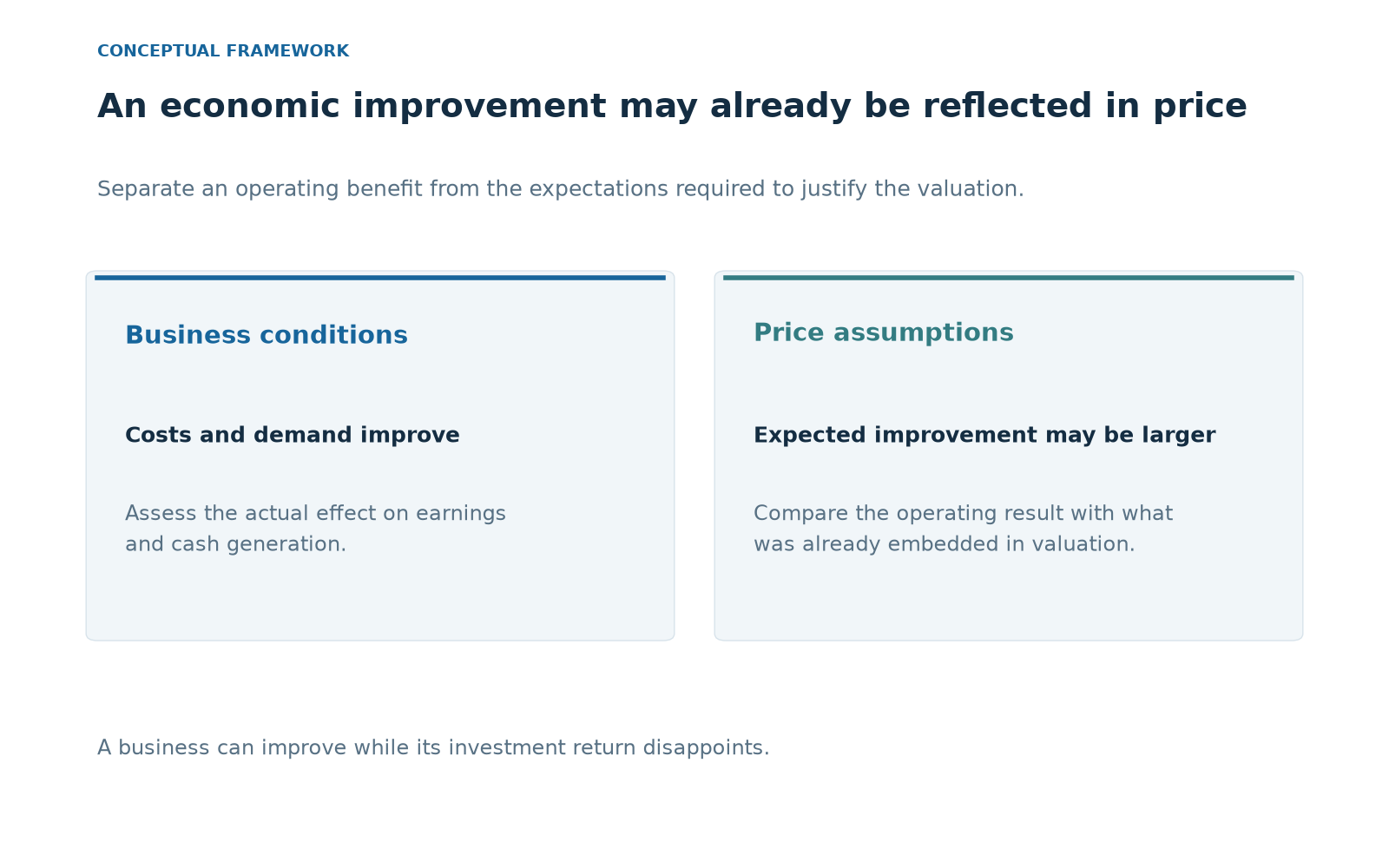
For an actual investor in the organizer, discount rates and operating cash need separate treatment. If the operation really produces $400,000 each year after all necessary reinvestment, its value depends on how many years the franchise can retain delegates and sponsors and what return investors require. If $400,000 is merely a good year's operating contribution before maintaining the brand, replacing equipment, or paying tax, capitalizing it as sustainable free cash will overstate value. An expensive purchase price can leave shareholders with a modest return even if the company benefits from improved activity. Favorable macro evidence and attractive valuation are separate findings.
Debt holders also care about cash available before interest and principal are due, property available as collateral, and the ability to recover in a cancelled-event year. A lender financing only short-term receivables under a well-documented sponsor contract faces a different risk from a lender advancing money against next year's speculative registrations. The term, amount, and legal seniority can matter more than a small movement in the Treasury curve. The same company can issue two securities with very different sensitivity to a labor market slowdown. A sound month-end allocation review identifies the actual claim involved.
What evidence would change the August view?
For the economy, employment growth broadening across industries, rising participation and hours, and fewer involuntary part-time workers would strengthen a demand interpretation. Further weakness in jobs coupled with less real income growth would point to caution, subject to revisions. A sustained slowing in a wide range of prices would make July's moderate reading more persuasive. Renewed energy pressure or rising service costs could create a less comfortable mix. The relative importance of these outcomes for monetary policy depends on future information; neither the July vote nor the August releases guaranteed the next decision.

For the exhibition, the evidence can be more immediate. Compare the share of exhibitors paying a nonrefundable deposit with the same point before last year's event. Compare net ticket proceeds by registration tier and watch how many attendees require refunds or convert to virtual participation. Examine the top sponsors' payment and performance conditions. Track venue deposits and minimum service dates against available cash. A stable headline count can hide weakening commitment if more registrations are complimentary or freely cancelable. Conversely, fewer named registrations with a higher share already paid can strengthen the immediate cash position while leaving long-run audience growth uncertain.
A particular diagnostic is the speed at which an inquiry becomes a paid booking. Suppose last year 100 inquiries produced 50 deposits by the end of August and this year 120 inquiries produce 48. Leads grew 20 percent while paid commitments fell 4 percent. The observed conversion share declined from 50 to 40 percent. That pattern could reflect weaker budgets, a change in marketing channels, a longer internal approval process, or later event dates. The organizer should compare like cohorts and allow equal time to convert before concluding that demand has weakened. The same distinction between a preliminary observation and a mature one is familiar from the labor revisions.
Another uncertainty lies in how the event defines success for the following year. A late sponsor payment may be a temporary cash problem if the sponsor renews and the contractual fee is eventually collected. A sponsor paying promptly this year but declining to return may present a more serious long-term issue. Interviewing exhibitors about qualified leads and checking the fraction willing to renew at the ordinary price can reveal more than surveying general satisfaction. A well-attended event that attracts participants outside buyers' target industries can be less valuable to exhibitors than a smaller gathering with the right audience. Headcount can improve while the underlying product loses relevance.
There is a financial equivalent to the distinction. A decline in seasonally adjusted payrolls can coexist with gains in industries important to the exhibition. A moderate overall price increase can coexist with a sharp increase in the specific contracted services it buys. A stable ten-year government reference can coexist with a higher borrowing spread for an operator whose signed deposits have become less reliable. When the observed headline and the business result diverge, check whether they ever measured the same activity, time period, and obligation. If they did not, the divergence can be explained without dismissing either source of evidence.
Finally, a board can review who makes money when the event changes format. Moving some delegates online might reduce catering cost and increase total reach while making physical booth space less valuable. Revenue foregone on the sponsor and exhibitor side could exceed savings on meals. Any model that treats virtual attendance as fully interchangeable with an in-person ticket should identify what the venue sold to each paying party.
Returning to the hall decision, a smaller initial commitment with an option to add space may buy flexibility at a stated price. It can also sacrifice attractive dates or make it harder to sell premium locations. A larger fixed commitment could be advantageous with reliable sponsors and strong nonrefundable exhibitor demand. A month-end research note should say which of these commitments the evidence can already support and what it would cost to wait for stronger confirmation. The ability to design a reversible next step can be more valuable than narrowing a subjective macro forecast from one decimal place to two.
August left the U.S. economy with a moderate recent price observation and an ambiguous picture of labor demand, participation, and hours. The news called for more careful attention to composition, not a uniform upward or downward revision to every business. The trade exhibition illustrates the central distinction: an inquiry is not a deposit, a deposit is not unencumbered profit, and a large headline count is not proof of durable demand. Follow each observation to its economic owner, its cash date, and the contract deciding who bears a loss. That is how mixed macro evidence becomes useful to a reader with a real commitment to make.
Related research

Monthly Research
July 2026: Inflation Relief Meets a Divided Policy Assessment
A favorable price observation does not remove uncertainty about the next stage.

Monthly Research
September 2026: Higher Policy Rates Make Financing Exposure Concrete
Inflation firms, hiring rebounds, and the policy baseline changes.

Monthly Research
June 2026: Policy Differences Highlight Different Transmission Channels
The ECB raises rates while the Fed holds, against a backdrop of inflation and investment.