
Monthly Research
September 2026: Higher Policy Rates Make Financing Exposure Concrete
- Report or archive date
- Coverage September 1–30, 2026
- Reading time
- 14 min read
Summary
Inflation firms, hiring rebounds, and the policy baseline changes.
The dealer with a yard full of agricultural equipment sees higher interest rates twice. The first time is on the financing statement for tractors standing on the lot. The second is across the desk from a farm operator who wants a machine but must finance the purchase from future crop receipts. A sale that remains profitable at today's sticker price can still be delayed because a lender reduces the amount it will advance. An unsold tractor can continue to incur interest during the delay. September made that interaction especially relevant: both the United States and the euro area raised policy rates, U.S. inflation firmed, and the latest employment report showed renewed hiring.
The calendar matters. The first U.S. estimate for August showed 162,000 payroll jobs added and unemployment unchanged at 4.1 percent. August CPI rose 0.4 percent from July and 3.4 percent over twelve months; the core measure rose 0.3 percent on the month. On September 10 the ECB announced a quarter-point increase effective September 16. On September 16 the Federal Reserve unanimously raised its target range to 3.75–4.00 percent from 3.50–3.75 percent. These were the facts available by September 30. September's U.S. payroll and CPI releases arrived later, so the month's assessment must work without their observations.
The two central banks changed different instruments
The ECB's three new rates were 2.50 percent for the deposit facility, 2.65 percent for main refinancing operations, and 2.90 percent for the marginal lending facility. Its September staff baseline projected euro-area headline inflation averaging 3.0 percent in 2026, 2.5 percent in 2027, and 2.1 percent in 2028. Staff projected growth of 0.9, 1.4, and 1.5 percent over those years. The ECB discussed risks from the intensity and duration of the energy shock and potential indirect effects. These are conditional euro-area projections and policy settings. They are not the interest rate on a farm loan or the measured rate of U.S. inflation.
The Federal Reserve described domestic spending as resilient, productivity as strong, and capital investment as robust. It judged inflation elevated and linked the increase to a timelier return to its 2 percent goal. In July three members had preferred an increase while the majority held the range steady. September's vote was twelve to zero. The change in decision and vote count is informative, but it does not tell us what each member will prefer at any future meeting. It also does not tell us how much of the decision was already priced into money markets. A policy increase is public information; market surprise requires a comparison with the expectations embedded before the announcement.
Both actions dealt with pricing pressure, but their effects on a company's finance costs depend on where it borrows and what it owes. A U.S. dealer importing equipment from a European maker can have dollar customer receipts, a dollar working-capital line, and a euro purchase obligation. A financing subsidiary may borrow in a third market and hedge part of the exposure. A side-by-side comparison of two policy levels cannot determine the exchange rate, hedging cost, credit spread, or delivery date. When comparing borrowers across borders, use the currency, maturity, reference rate, and conditions of each liability rather than simply assigning the policy rate of the country where the company is headquartered.
Hiring strengthened while the price impulse broadened
The August payroll release included upward revisions to earlier months. At the time of the September release June's gain was revised to 31,000 and July's to 21,000, changing the sign of July from its original negative reading. Food services and drinking places added 59,000 in August and local government education added 42,000, together a large share of the net total. Manufacturing continued to trend up with 16,000 more jobs while information employment fell 23,000. An economy can show both an aggregate payroll acceleration and significant differences in industry experience. Agricultural equipment buyers do not receive income in proportion to these national employment weights.
Household participation edged up to 61.6 percent and the employed share stood at 59.1 percent. People working part time for economic reasons fell to 4.4 million. Private hourly earnings rose to $37.75 and the workweek edged up to 34.4 hours. The wage and hours details support a firmer picture of labor demand, while composition and future revisions remain relevant. A business evaluating demand should still examine its buyers' own income, collateral, and obligations. A farmer's ability to purchase a tractor depends on crop prices, yields, land costs, and the financing of the growing season, not just on an improvement in national payroll employment.
The August consumer price report was less comfortable than July's moderate headline. Gasoline rose 3.9 percent and accounted for more than a third of the headline monthly increase. Energy rose 2.1 percent, shelter 0.3 percent, and food 0.1 percent. Core prices increased 0.3 percent even as their twelve-month rate edged down to 2.4 percent. A stronger recent month can coexist with a lower trailing rate because an older month leaves the annual comparison. The report established a pickup broader than one item, while gasoline remained an important driver. It did not establish a direct cost increase of the same size for diesel, agricultural machinery, or a specific shipment of spare parts.
The inventory loan moves before the tractor sells
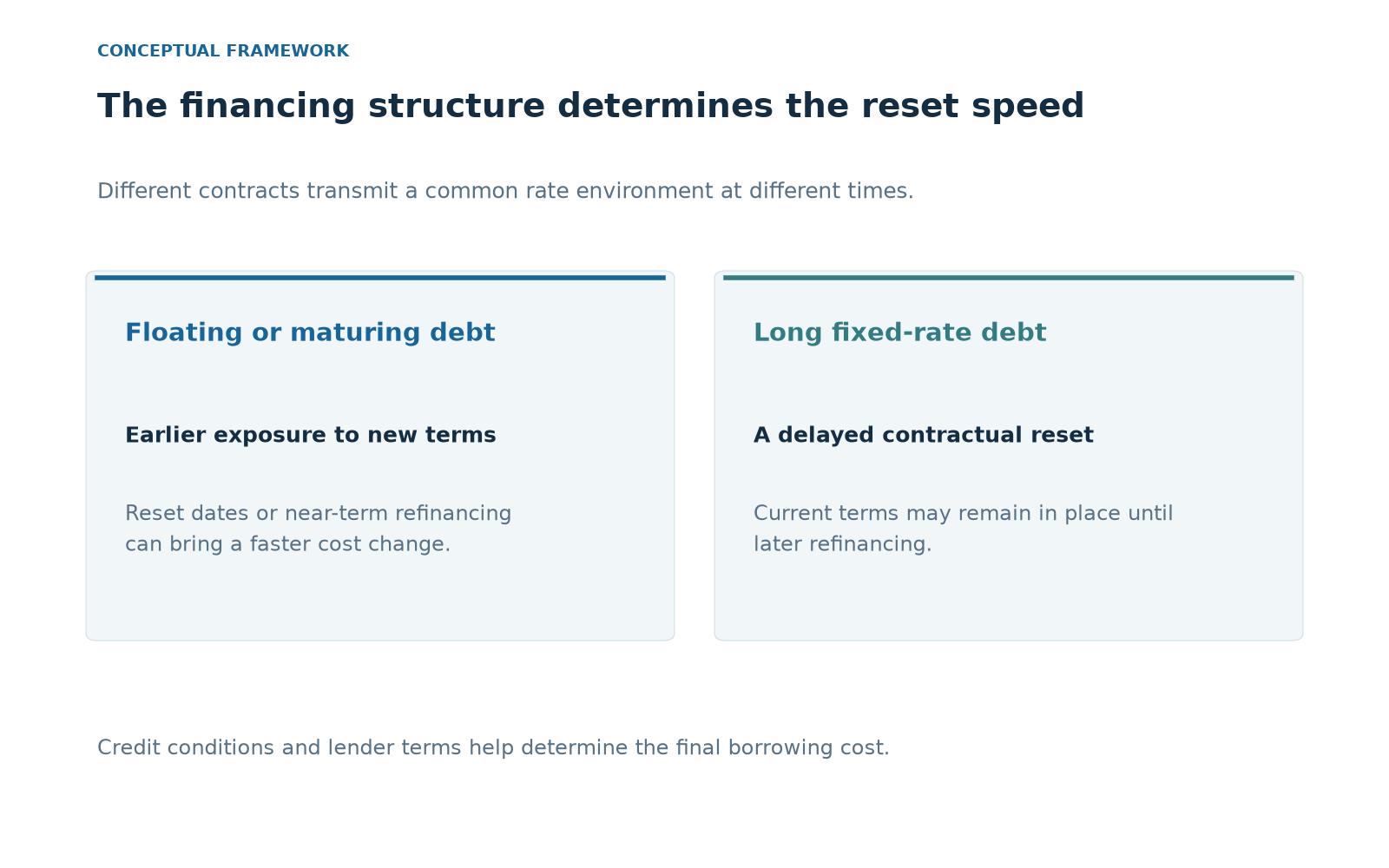
Consider a dealer with 40 machines costing $150,000 each at wholesale. The inventory represents $6 million. A floor-plan lender advances 80 percent of invoice cost, or $4.8 million, and the dealer supplies $1.2 million of its own capital. At a floating rate of 6 percent the annualized interest on a constant full balance is $288,000, or approximately $24,000 per month before exact day-count adjustments. A quarter-point pass-through increases annual interest by $12,000, roughly $1,000 per month. The dealer's first higher interest payment depends on the loan's benchmark, the contractual reset date, and the principal outstanding on that date.
Residence time on the lot can matter more. If the average financed balance on a particular $150,000 machine is $120,000, at 6.25 percent one extra month costs about $625 in simple interest. Keeping all forty machines an extra month would add about $25,000 compared with selling them on the original schedule. That carrying cost is separate from the roughly $1,000 monthly incremental rate effect on an unchanged full yard. Counting the entire $25,000 as the cost of September's quarter-point increase would confuse the financing rate with the duration and quantity of borrowing. Slow sell-through can produce a substantial financing problem even when the reference rate barely changes.
Suppose the dealer originally expects to sell a machine for $175,000. Wholesale cost is $150,000 and preparation, delivery, and warranty reserves total $10,000, leaving $15,000 of contribution before floor-plan interest and overhead. A discount of $8,000 to induce an earlier sale cuts contribution to $7,000 before interest. It would take more than twelve months of avoided $625 monthly carrying cost on the financed amount alone to offset that discount. Yet a quick sale could still make sense if the model is about to be superseded, collateral eligibility expires, storage capacity is constrained, or the released cash can fund a more profitable item. The comparison must include the real alternative use of inventory and funding.
Aging inventory can affect borrowing capacity as well as interest. A lender might reduce its advance rate from 80 to 70 percent once equipment passes a certain age, even if the machine remains physically sound. Applied to the same $6 million at cost, the permitted loan drops from $4.8 million to $4.2 million. Unless the dealer sells inventory, it needs $600,000 from cash, equity, or another facility to pay down the difference. That can dwarf the $12,000 annual interest increment from a quarter point. The lender may base eligible value on the lower of cost and appraised resale value, so a weak used-equipment market can tighten the constraint still further.
The buyer's loan has a separate feasibility limit
Assume a buyer makes a $35,000 down payment on a $175,000 machine and finances $140,000. To isolate the rate effect, first use annual interest-only figures. At 6 percent annual interest is $8,400; at 7 percent it is $9,800. The $1,400 difference is straightforward, but it is not the entire annual payment on an amortizing loan. With level annual payments over five years at 7 percent, the annual payment is approximately $34,145, assuming payments at year-end and no fees. Principal repayment accounts for most of the difference between that payment and interest alone. An affordability analysis that stops at the initial interest charge materially understates the cash obligation.
The buyer expects the new machine to save fuel, reduce repair downtime, and allow planting during a narrow weather window. Those benefits can justify the purchase, but some are highly seasonal. Suppose the machine generates $12,000 of annual operating savings under normal use and avoids a potential $25,000 loss only in a season when the old machine would fail during planting. Counting the full $25,000 every year assumes the failure occurs every year. Ignoring the loss entirely assumes the old equipment will never fail at the critical time. A useful case compares normal savings, adverse operating outcomes, repair options, and the cost of renting replacement equipment. For the planting window, compare the rental price with the crop margin at risk for each day of delay.
The financing limit can also act through the loan-to-value ratio. If the lender accepts a $165,000 valuation rather than the $175,000 selling price and permits lending only 80 percent of that valuation, it will advance $132,000. The buyer then needs $43,000 of down payment rather than $35,000. The $8,000 immediate cash gap can matter more than a modest change in the annual interest charge. A dealer offering a lower rate without addressing the cash requirement may fail to close the sale. A discount, a reliable trade-in value, a longer repayment term, or a documented operating saving can each address a different constraint, with different costs to the dealer and buyer.
The used-equipment trade can connect the two balance sheets
A sale often includes a trade-in. Suppose the dealer gives the buyer a $40,000 allowance for an older machine. The buyer sees more purchasing power. The dealer receives another item to inspect, finance, refurbish, and sell. If it later obtains only $33,000 after selling expenses, it has conceded $7,000 in economic value beyond what the sticker price of the new machine suggests. A fall in used-equipment collateral values can reduce both buyers' down payments and the dealer's realized margin. The national price of a consumer good or the advertised new-equipment price will not reveal that local market exposure.
There is also a timing issue. A used machine may sell after harvest when buyers can evaluate realized cash, whereas the new machine must be delivered before planting. A dealer can earn a reasonable combined gross margin and still experience a sharp seasonal financing peak. Building a monthly cash calendar tied to work seasons, loan covenants, and inventory eligibility is more informative than annualizing the busiest month. A manufacturer reporting strong shipments to dealers should distinguish genuine end-user sales from inventory accumulating in the distribution network. The two can diverge if manufacturer incentives encourage dealers to order early or accept more stock to meet a volume target.
For an equity analyst, the most persuasive operational measures include end-user registrations where available, days in dealer inventory, age distribution of used units, net prices after trade allowances, and cash collected. For a creditor, they also include advance rates, critical dates, eligible collateral, and the dealer's ability to inject cash during a slow season. A collateral-heavy business can look well secured at historical invoice cost and fragile at the actual price obtainable in a forced sale. The change in policy rates makes this concrete because the company now has to reconcile the interest bill, inventory age, and cash buffer under current rather than historical financing terms.
The curve moved more than the policy rate at some maturities
On August 31 the two-year U.S. Treasury par rate was 4.34 percent and the ten-year 4.75 percent. On September 30 they were 4.88 and 5.29 percent. Each rose 54 basis points over the month, leaving the ten-minus-two gap at 41 basis points at both endpoints. The thirty-year rose from 5.25 to 5.64 percent, an increase of 39 basis points. An unchanged spread between two maturities does not mean financial conditions were unchanged when the level of both increased materially. Neither is the entire monthly change an event-study estimate of the Federal Reserve's quarter-point decision. Many other developments entered market prices between the two dates.
The dealer's financing may be short-term and secured, while a public machinery manufacturer's bonds have longer maturities and an unsecured claim. A Treasury curve describes benchmark dollar rates, not the credit spread borrowers actually face. If the manufacturer holds cash at short maturities while its debt is fixed for years, higher short rates might increase current interest income even as discount rates on its equity rise. If its finance subsidiary funds long loans to customers with shorter debt, the rate mismatch can compress margins. Reading the consolidated interest expense without separating operating and financing activities can miss these opposing channels.
An international portfolio needs another distinction. A U.S. buyer of euro-area manufacturer shares may experience a local equity return and a separate dollar translation effect. An American dealer paying euro prices for imported components may have a different transaction exposure. A hedged company can still be affected by competitors sourcing equipment in different currencies or by buyers losing borrowing capacity. The ECB and Fed decisions alter the economic environment but do not constitute a simple currency trade. The hedge notional, maturity, coverage of future orders, and the actual use of other foreign-currency cash determine what is protected.

Separate a lower financing rate from a lower equipment price
Manufacturers sometimes support dealer sales by offering subsidized financing. Suppose a buyer can choose between a $5,000 cash discount and a low-rate loan at the undiscounted price. The financing program is not free simply because its stated rate is low. The buyer forgoes the cash discount, may face different fees, and might be unable to prepay without losing part of the benefit. The dealer might receive the full invoice while the manufacturer or its finance subsidiary bears the subsidy. Consolidated financial results can move part of the cost from equipment margin to financing income. To compare offers, calculate all dated payments under each alternative and compare them on a common basis.
Compare the two offers using a one-year interest-only loan of $100,000, with principal repaid at year-end. Calculate interest on the same outstanding balance before considering the dealer’s cash discount. Conventional funding at 7 percent costs $7,000, while a subsidized 3 percent loan costs $3,000 on the same amount. The interest saving is $4,000 over the year before discounting. If obtaining the subsidized loan requires surrendering an immediate $5,000 cash discount, that interest saving alone is insufficient. If the cash discount would reduce the amount financed as well, conventional interest could be lower than the original $7,000, strengthening that conclusion. Longer terms, different principal balances, and prepayments can reverse it. The arithmetic should follow the actual offer rather than attach value to the advertised rate in isolation.
The manufacturer may still prefer the subsidized program if it protects the published list price or gives the dealer a workable closing tool. That decision can conceal a decline in realized economic price from a reader watching only list prices. A dealer reporting no formal discounts may still receive support through financing rebates, inventory allowances, marketing contributions, or trade-in guarantees. Reconcile both sides of the sale and ask who ultimately bears the incentive. The cash contribution that remains after incentives, financing costs, warranty exposure, and actual used-equipment losses is a more reliable guide to the durability of current margins.
This is another reason to compare economics across the network. A lower apparent buyer rate might help the dealer turn inventory and free a credit line, while shifting a cost to the parent's financing business. The total gain or loss is visible only after the reciprocal payments inside the group have been removed.
Which observation would change the conclusion?
If end-user sales remain healthy while inventory days decline and net prices hold after trade-ins, the dealer can absorb a moderate financing increase more readily. If advertised new orders stay high but used stock accumulates, required down payments increase, and buyers ask to extend terms, the distribution network may be funding weak end demand. A higher manufacturer revenue figure would then be less reassuring. If lenders keep advance rates stable and commit facilities through the slow season, a temporary inventory build can be financed. If facilities shorten as inventory ages, a profitable-looking company can come under pressure before its income statement clearly deteriorates.
The maintenance decision can also improve resilience without changing the capital structure. Better inspection and repair of trade-ins may shorten the time to resale, but it costs labor and parts today. An offer to rent machines during harvest can produce income from otherwise idle units, while introducing operating, insurance, and maintenance risks. Selling a portion of older stock at a transparent discount can protect credit availability and reduce storage needs. These are actions with observable costs and benefits. A business does not have to predict the next rate decision accurately to calculate which of them protects cash before its next loan reset.
September's policy actions and market moves made financing exposure visible in dollars, dates, and loan limits. The economic evidence remained more nuanced than a simple tightening story: U.S. hiring had rebounded in August, inflation had firmed, and euro-area staff projected both resilience and persistent price pressure. For the dealer, none of this determines a sale until a buyer can fund a down payment, obtain a loan, and justify the machine's use. For the investor, the valuable exercise is to follow that sale through the manufacturer's accounts, the dealer's inventory facility, and the farmer's own obligations. That is where a change in official policy becomes a measurable economic outcome.
Related research

Monthly Research
August 2026: Moderate Inflation, Ambiguous Labor Signals
The late-summer evidence favors a closer look at assumptions rather than a broad market verdict.
Monthly Research
October 2026: Resilience and Inflation Remain in Tension
A global forecast update, firmer prices, and a policy hold keep the analysis conditional.

Monthly Research
July 2026: Inflation Relief Meets a Divided Policy Assessment
A favorable price observation does not remove uncertainty about the next stage.