
Weekly Research
Different Policy Decisions Do Not Create a Simple Currency Trade
- Report or archive date
- Coverage June 22–28, 2026
- Reading time
- 10 min read

Summary
June 22–28: the Fed and ECB decisions require a broader comparison.
The euro-area central bank raised rates in June, and the U.S. central bank left its target range unchanged. A chief financial officer still has to decide what to do about an invoice for a machine due in euros in September. It is easy to turn the contrast between the two policy decisions into a story about where the exchange rate ought to go. The person who signs the purchase order has a more useful question. How many dollars can the business afford to spend on that particular payment, and what happens if the machine is delivered late?
The June 22–28 review takes the two announced decisions as its starting point. The ECB's June 11 increase was a quarter percentage point, effective June 17. On June 17 the Federal Reserve retained a target range of 3.50 to 3.75 percent. They operate in separate currency areas, respond to separate mandates and evidence, and influence instruments with different terms. A euro can appreciate after an anticipated rate increase, depreciate if the news disappoints expectations, or move because of an unrelated development. The point is not that all explanations are equally good. It is that an investment explanation needs an initial price, a surprise relative to expectations, and an exposure that corresponds to the claim.
The invoice has a direction
Imagine a U.S. printing company ordering a specialized press from a European manufacturer. It owes €1 million on delivery in three months. Its contracts with publishers pay in dollars. A euro worth $1.10 today makes the stated purchase price equivalent to $1.10 million at today's spot rate. If the euro is $1.18 at delivery, the dollar cost is $1.18 million. If it is $1.04, the cost is $1.04 million. The foreign supplier has not changed its price in either case. The printing company's dollar exposure changes because it has agreed to buy euros in the future without matching euro receipts.
The manufacturer has a different perspective. It may pay its staff and most of its suppliers in euros. A contract denominated in its operating currency can remove part of its near-term transaction risk, while leaving longer-term competitive risk. A more expensive euro may discourage U.S. buyers from ordering their next press. Alternatively, if the American buyer has agreed to an enforceable noncancelable purchase, the manufacturer may have little risk to the existing sales price but significant exposure to the buyer's ability to pay. The same machine therefore appears as currency risk in one set of accounts, and as future demand or credit risk in another.
To decide whether the exposure is material, compare the $80,000 increase between $1.10 and $1.18 with the business's available budget and cash, not with the value of all printing equipment in the country. If the company had only $40,000 of unused room under its capital authorization, that movement could require an additional approval. A company with steady annual euro sales might already own or expect enough euros to settle. The size of the gross purchase tells us little until we know the currency, timing, and reliability of the other side of the ledger.
What the forward transaction buys
Suppose the print shop can arrange to buy €1 million in three months for $1.105 per euro. It locks a dollar payment of $1.105 million, neglecting costs and counterparty provisions for the moment. If the future spot rate reaches $1.18, the contracted rate saves $75,000 relative to buying on the delivery date. At $1.04 the contracted purchase costs $65,000 more than waiting would have done. Neither comparison by itself establishes whether the original hedge was a good decision. The central purpose was to make a known purchase affordable at a known price. Judging that purpose requires the budget that existed when the transaction was approved.
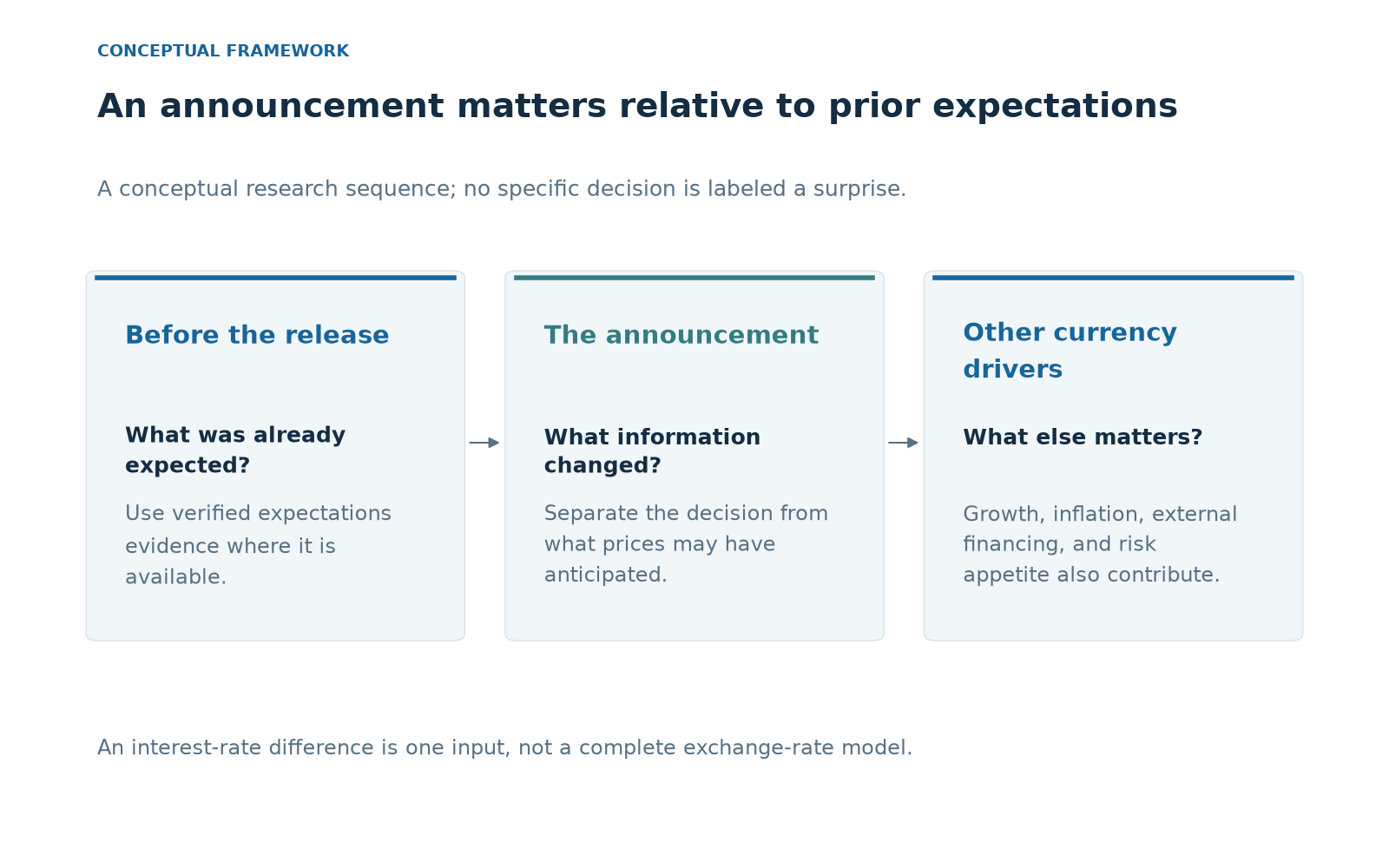
A forward rate is a price agreed today for a future exchange. In an idealized market its relationship to spot follows the cost of borrowing one currency and investing the other for the same term. To see the direction, assume dollars earn 4 percent a year and euros earn 2 percent, with a quarter-year term and simple interest. Using a spot rate of $1.10, the no-friction forward in dollars per euro is approximately 1.10 times 1.01 divided by 1.005, or $1.10547 per euro. A trader could compare borrowing and investing in the two currencies with contracting the exchange directly. The quoted forward of $1.105 is close to the rate implied by those funding costs. The policy rates in the news are not the assumed market funding rates in the arithmetic.
A corporate treasurer's quote will also reflect bid and ask spreads, collateral terms, credit limits, funding access, and the exact settlement date. Businesses do not generally borrow and invest unlimited amounts at the same rates as a dealer. Supply and demand for hedging can affect the effective funding difference. A forward quote is therefore neither a free insurance policy nor the market's promised spot rate on the delivery date. Its value can change before maturity, and that change can create funding demands if the contract requires collateral. It is possible to reduce the uncertainty of the final machine cost and simultaneously increase short-term liquidity needs.
A hedge can be right on price and wrong on quantity
Now suppose the order calls for a firm deposit of €300,000 and a balance of €700,000 conditional on acceptance testing. The deposit date is certain. The balance may be delayed if print quality fails a test. Buying all €1 million forward for one day makes the exchange rate predictable but creates a timing mismatch. If the supplier has not earned its balance when the forward settles, the print shop may receive euros before it needs them and have to finance that holding. It might close or roll the excess contract at prevailing prices. A rolling hedge has a funding history, not just a final spot comparison.
For a partial hedge, cover €700,000 at $1.105 and leave €300,000 open. If the entire payment is eventually due on schedule and spot is $1.18, the dollar cost is $773,500 plus $354,000, a total of $1,127,500. If spot instead is $1.04, the total is $773,500 plus $312,000, or $1,085,500. The difference between the two outcomes is $42,000. Without any hedge the outcomes differ by $140,000. The remaining uncertainty is exactly what the unhedged 30 percent would imply for these endpoints. Because the conditional payment and the hedge need not match, the firm still has to plan for the case where the press is rejected.
One alternative is an option that confers the right to buy euros at a predetermined strike. If an option on €1 million has a strike of $1.10 and an upfront dollar premium of $25,000, the maximum dollar purchase cost is $1.125 million including the premium, before financing costs. If spot is $1.04, abandoning the right and buying at spot brings the total to $1.065 million. An option can fit an uncertain payment quantity better than a binding forward, but the premium is paid even if the press is never accepted. Paying the premium now ties up cash for three months. The settlement terms and the counterparty’s ability to deliver euros also affect the financial value of the protection.
Which interest difference is the one that matters?
An investor comparing cash deposits has a different problem. Imagine converting $110,000 to €100,000 at $1.10 and earning a 2 percent euro return over a full year. There are then €102,000 before tax or fees. At $1.05 on reconversion, that becomes $107,100, a dollar loss despite positive local interest. At $1.15 it becomes $117,300. Investing the original dollars at 4 percent instead would produce $114,400. The exchange rate that equates the two outcomes is $114,400 divided by €102,000, about $1.12157 per euro. Above that exchange rate, the dollar value of the euro deposit exceeds the value of the dollar alternative.
Maturity and cash-flow timing are central. A three-month machine invoice does not present the same problem as a one-year deposit, a continuing equity investment, or a ten-year euro bond. A bondholder bears local interest-rate risk during the holding period as well as currency translation on sale and on coupons received in the meantime. A business with annual buying plans can face a sequence of future purchases rather than one dated amount. Rolling a succession of short contracts is not identical to fixing a single long rate. Currency protection can run out just as a permanent competitive change begins to affect future sales.
This week's U.S. Treasury data demonstrate the problem with treating the policy rate as a universal interest quotation. On June 18, two-year and ten-year constant-maturity yields were 4.19 and 4.46 percent. On June 26 the corresponding figures were 4.07 and 4.38 percent. The two-year rate declined twelve basis points and the ten-year rate eight. That took the ten-minus-two gap from 27 to 31 basis points. The observations describe dollar yields at specific maturities; they provide neither a euro borrowing quote nor the exchange rate on an invoice. Drawing a euro-dollar return from them would require additional market observations that the curve does not contain.
Operating exposure survives the hedge
Imagine the print shop fully hedges the acquisition price, only to discover that a competing U.S. printer buys a similar machine next year after the euro weakens. The competitor may enjoy a lower equipment cost and quote more aggressively on new jobs. The hedge fixed one payment. It did not guarantee the resale value of the installed press, the competitiveness of the company, or the demand for printed material. Conversely, a more expensive euro may increase the replacement cost of rival machines and help the incumbent's competitive position after it has locked in the purchase. The transaction hedge and the long-term business exposure can move in different directions.
The press might also require euro-priced spare parts, a maintenance contract based on local European labor, or software licenses renewed annually. A team that records only the original capital invoice might declare the business protected and then encounter a stream of smaller exposures. It would be more informative to separate firm one-time obligations, expected recurring purchases, and optional future upgrades. Signed contracts merit different hedging treatment from commercial opportunities. The business also needs to identify which account can actually deliver the euros and on what day. A euro receivable expected in sixty days cannot settle a liability due next Tuesday without bridge finance.

A useful control is to reconcile gross currency obligations against actual foreign-currency balances and reliable receivables by month. Suppose the company expects €200,000 from a reseller near the final payment date. If it is collectible before the equipment invoice falls due, the net euros to purchase could be €800,000. If the reseller has a history of paying late, treating the full receivable as cash would leave an unexpected shortfall. If the company sells that receivable to a financier, the fee and the currency in which the proceeds arrive change the comparison again. The ledger should follow the cash that can actually be used, alongside the accounting amount.
A better interpretation of June's policy divergence
Evidence for a currency investment thesis would include comparative rates for the relevant term, expectations already embedded in forwards, changes in the outlook for growth and inflation, funding conditions, and a defined investment horizon. Evidence for a hedge decision includes the amount and timing of the invoice, the budget rate, the cost of protection, collateral requirements, and what happens if the transaction is delayed. Confusing the two decisions can tempt a business to speculate with the funds set aside for equipment or to judge a needed hedge by hindsight alone.
One item also belongs in the purchase committee's minutes. What benchmark will it use to evaluate the treasury department? A comparison with the earliest budget rate measures how close actual spending came to authorization. A comparison with the market forward on the day of execution can reveal excessive dealer costs. A comparison with the eventual spot rate describes the realized benefit or opportunity cost of protection. A department can do well by the first two measures and appear to do poorly by the third. Withholding the choice of benchmark until the exchange rate is known gives the reviewer a convenient but misleading option to move the goalposts.
The proper reporting currency matters as well. An American parent can report a translation loss on foreign net assets while its local subsidiary pays every bill comfortably in euros. A funding request from the subsidiary is a different economic event. Before drawing conclusions about liquidity, a reader should ask whether the change passes through an actual payment, a translated accounting balance, or the future terms of trade. Each deserves attention, but each calls for different evidence.
For the buyer in this example, the next useful conversations are with the supplier about acceptance milestones, the bank about settlement and collateral, and the sales team about dependable euro receipts. For readers following central banks, a productive next question is which parts of the funding curve already reflected June's decisions. The policy divergence is real. Its significance depends on who owes which currency, for how long, and under what terms. Those particulars determine whether an exchange-rate change becomes an operating cost, a financing surprise, a paper translation adjustment, or barely a change at all.
Related research

Weekly Research
June’s Fed Hold Keeps Supply and Productivity in the Same Frame
June 15–21: unchanged rates coexist with a complex economic assessment.

Weekly Research
June Payroll Growth Slows in the Initial Release
June 29–July 5: stable-looking unemployment does not remove the need to examine labor supply.

Weekly Research
U.S. Inflation and an ECB Increase Highlight the Policy Trade-Off
June 8–14: price pressure is a cross-border issue, with different policy responses.