
Weekly Research
February’s Payroll Decline Requires a Composition Check
- Report or archive date
- Coverage March 2–8, 2026
- Reading time
- 10 min read

Summary
March 2–8: strike-related effects complicate a simple reading of the employment headline.
A payroll report counts jobs according to a survey rule. A business waiting for a worker to return, a worker waiting for a paycheck, and a patient waiting for an appointment each care about a different outcome. The distinction became important on March 6, when the initial estimate showed a February decline of 92,000 jobs in U.S. nonfarm payrolls. The unemployment rate was 4.4 percent. Health care employment fell, with strike activity affecting the count. Employment also moved lower in other industries for reasons the report did not reduce to a single cause. The arithmetic of the total was clear. The meaning of the total required looking inside it.
For the week ending March 8, a sensible research question was how much of the change might prove temporary, which weakness predated the month, and where lost work would leave an economic cost even if the jobs subsequently returned. It was possible to discuss all three without forecasting the next payroll print. It was also possible to make a serious error by declaring all 92,000 jobs permanently lost, or by waving away the entire decline because one industry was affected by a strike.
Check how a job enters the count
The establishment survey measures payroll jobs within a reference pay period. Workers receiving pay for any part of that period can be counted. An employee who receives no pay from the employer for the entire reference pay period because of a strike can fall out of the payroll count without the employment relationship being permanently severed. The household survey has different definitions and asks people about their status. Someone temporarily absent from a job because of a labor dispute can be regarded as employed there. Combining the two surveys as if they were checks on the same roster would invite a false reconciliation.
Consider a group of clinics employing 1,000 people, all initially on payroll. If 120 workers receive no pay from those clinics for an entire reference pay period during a dispute, the payroll observation can fall to 880 under those simplified conditions. If the same 120 return and receive pay in the following reference period, the count can rise back to 1,000. The second movement would largely undo the first. To distinguish returning staff from new hires, match the employees on the two payroll rosters. A return to the original count need not reflect an increase in patient demand.
The lost pay still matters. A worker who misses a paycheck may delay a purchase even if the dispute is expected to end. A clinic may postpone procedures, recruit temporary staff, or send patients elsewhere. A supplier may see orders shifted to a different facility or a different month. Calling a payroll effect temporary describes a possible pattern in future employment observations. It gives no assurance that lost appointments, earnings, or market share will be recovered in full. A research note should name the variable expected to reverse.
Reconcile the part and the whole
In February health care employment fell by 28,000, compared with a January increase revised to 77,000 in the March release. Within health care, physicians' offices lost 37,000 jobs and hospitals added 12,000. Strikes were a major factor in the movement at physicians' offices. Those two subindustries net to minus 25,000. The parent industry's minus 28,000 already includes both. Adding the decline in physicians' offices to the decline in health care to estimate the national effect would count some workers twice.

A simple subtraction provides a useful limit on the explanation. Taking the net health care decline of 28,000 out of the national decline of 92,000 leaves a decline of 64,000 in the rest of nonfarm payrolls combined. That calculation does not isolate the strike effect: some health care categories added jobs, and not every change at physicians' offices had to have the same cause. It does establish that the national decline cannot be explained by treating the net health care line as the entire story. A researcher claiming a precise strike-adjusted total needs a separately supported estimate of the relevant unpaid absences.
Information employment fell by 11,000, federal government employment by 10,000, and social assistance added 9,000. In transportation and warehousing, losses among couriers and messengers were partly offset by gains in air transportation. These movements illustrate different business settings. A reduction in federal staffing may affect local office demand. A change in courier employment might reflect parcel volumes, routing, staffing practices, or shifts between providers. The national report supplies the direction and size of an estimate. It rarely identifies the entire economic mechanism behind an individual industry's change.
Ask what happened to the appointment
Take a clinic that normally completes 2,000 appointments per month for an average of $120 in net receipts per visit, ignoring collection lags for the moment. If a disruption postpones 300 visits, current-period receipts associated with completed visits fall by $36,000 relative to plan. Suppose 200 are rescheduled in the next month at the same amount, 60 take place at a different provider, and 40 are never completed. The original clinic recovers $24,000 on the 200 later visits and forgoes $12,000 on the remaining 100. Its initial monthly shortfall and its ultimate lost receipts are very different quantities.
The broader economic interpretation differs again. The competing provider that takes 60 visits records work the original clinic lost. Some patients may incur extra travel or wait longer for care. If rescheduling displaces other appointments at the first clinic, even the 200 recovered visits may crowd out activity that would otherwise have occurred. No aggregate effect follows from counting cancellations alone. Available capacity, the urgency of the visit, and the alternatives offered to patients determine how much output shifts across time, how much shifts across providers, and how much disappears.
A supplier selling disposable items to both clinics may ultimately experience less damage than a vendor selling a specialized service only at the first location. A lender financing the first clinic could face a cash shortfall even if aggregate regional activity eventually recovers. To connect a national employment report to an individual claim, identify the contract and the timing of collections. A news report about clinics reopening may support a payroll rebound thesis while leaving the lender's repayment schedule or the vendor's lost order unresolved.
Why average pay can rise during a weak month
The February release also showed average hourly earnings for private nonfarm employees rising 0.4 percent to $37.32. A rise in the average and a decline in total payroll jobs can occur together. Some continuing workers can receive raises. The mix of jobs represented in the pay average can change. Employees working different hours can carry different weights in the aggregate. An increase in average hourly earnings is therefore useful evidence, but it does not establish the wage change received by a representative continuing worker or the amount of income lost by someone missing an entire pay period.

For an example, imagine 50 employees each working one hour for $20 and another 50 each working one hour for $40. The average hourly rate across the 100 hours is $30. If ten of the $20 hours disappear and all remaining rates stay constant, total wages fall from $3,000 to $2,800, while the average rate on the remaining 90 hours rises to approximately $31.11. Nobody receives a raise. Those workers who lose the hours have lower earnings. To measure the contribution of this effect in February, compare the actual hours worked at each pay rate.
A business comparing its wage bill with the national average should separate hourly rates for continuing staff, the number of paid hours, overtime premiums, and changes in occupational mix. A hospital using expensive temporary workers to maintain urgent services could have higher costs while the staffing agency responsible for those workers records revenue in a different industry. An investor looking at the facility's labor expense and the national health care payroll count might think the figures contradict each other. The accounting boundary can explain the difference without resolving whether the higher cost is temporary or permanent.
Look for a persistent loss in the right place
A permanent reduction in demand often leaves a different footprint from a short interruption. A courier business experiencing sustained weakness might close routes, release leased vehicles, reduce order-processing capacity, or guide to lower volumes for several quarters. A workforce temporarily absent around a pay-period boundary may reappear with much less change in equipment, contracts, or expected capacity. For a researcher, those physical and contractual observations are independent pieces of evidence. They are worth more than drawing a straight line through one payroll estimate.
Imagine a parcel operator handling 100,000 packages a week before a period of disruption. For two weeks its volume falls to 90,000. If customers defer shipments, a later week might exceed the previous pace. If they sign contracts with a competitor, the old volume may never return. If demand for the goods being shipped has weakened, both operators could stay below plan. The same initial ten-percent shortfall has three different implications for the operator, its competitor, and the industry. Monitoring volumes, contract renewals, and the destination of the missing packages is more informative than debating which adjective best fits the national labor market.
Distinguish layoffs from net employment changes as carefully as temporary disruptions from permanent losses. A net decline of 10,000 can arise from many departures and many hires, or from much smaller gross movements. A firm that slows recruiting may reduce net employment without a sudden rise in layoffs. A rapidly changing industry can have substantial layoffs and still add jobs on net. If the investment question concerns severance costs, vacancy rates, or employee turnover, payroll changes provide context but are not direct measures of the relevant gross flows.
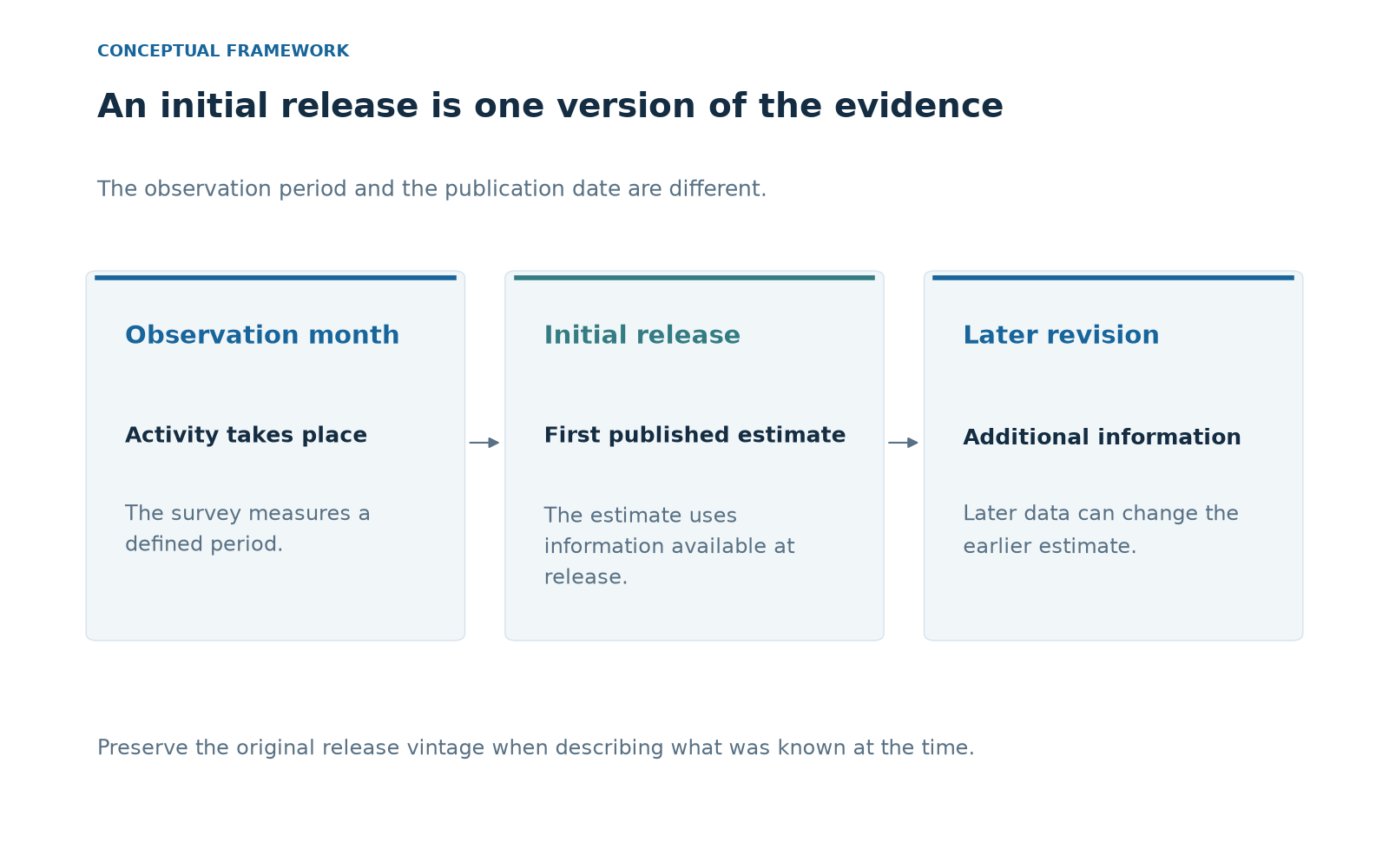
Preserve the comparison investors actually saw
The March release put January payroll growth at 126,000, revised from the initial 130,000. Combining that revised January figure with February's initial decline gives a two-month net increase of 34,000, or 17,000 per month on average. For someone tracing the path from December, those two monthly changes paint a less extreme picture than either observation alone. An average smooths the movement without proving that either month's change was misleading. It can also conceal a real shift at the end of the window, so it should be shown alongside the individual months.
A practical research workbook keeps a column for the observation month and one for the publication date. It can preserve both January vintages and mark the February estimate as initial. A portfolio manager asking why an old forecast changed then has a way to separate revised history from new developments. If the manager used the January initial figure in a decision made in February, that choice was consistent with the information set at the time. Replacing it silently in a retrospective simulation would give the simulated investor knowledge the real decision-maker did not possess.
An analyst can also record a conditional expectation without inventing a future release. If workers absent because of a dispute return to paid status, the relevant payroll category may rebound. If weakness extends across unrelated industries, that eventual rebound need not erase the broader concern. If waiting patients move to a competitor, a recovery in headcount need not restore the original facility's financial results. Writing all three conditions now makes the next release easier to assess. It becomes possible for the employment thesis to be right and the revenue thesis wrong, a distinction that matters directly to the person valuing the business. In a follow-up memo, that person should be able to point to the employment evidence and the cash evidence separately, even when the two lead to different decisions.
For a real-time review, it is worth deciding in advance which new evidence would actually justify changing a company estimate. A notification that a clinic has reopened may restore the available hours in a staffing model. A revised procedure calendar may restore expected sales of consumables. A payment deposited into the clinic's account may improve a lender's confidence about Friday's installment. These developments need not occur together. Raising every forecast the day a labor agreement is announced can reverse the original analytical mistake of cutting every forecast the day a strike begins.
A localized interruption can even create opposite changes in nearby households' spending. An employee missing a paycheck might postpone a home repair. A temporary replacement working extra shifts might bring one forward. A local contractor serving both households would observe bookings, cancellations, and deposits, not a single economic state shared by the neighborhood. If the contractor's customers are concentrated among workers at one clinic, the net effect could be substantial. If they are dispersed across employers, it could be modest. The reason for checking local concentration is to connect a plausible story with the people who can actually change the business's receipts.
The February decline deserves attention because it changed the labor-market evidence available in early March. It also contained enough identifiable complexity to make a one-line interpretation unreliable. Separate the reference period from the employment relationship, the parent category from its components, and a recovered job from a recovered payment. These distinctions turn a surprising aggregate into testable questions about workers, providers, and companies exposed to them. They also establish what remains unknown before the next payroll release arrives.
Related research

Weekly Research
Global Growth Needs a Local Financing Lens
February 23–March 1: the January global forecast remains a conditional reference point.

Weekly Research
February Inflation Does Not Resolve the New Uncertainty
March 9–15: price data describe an earlier observation period than the current news environment.

Weekly Research
The Price-Volume Split Matters for Corporate Earnings
February 16–22: January inflation is a backdrop for business analysis, not a substitute for it.