
Weekly Research
Global Growth Needs a Local Financing Lens
- Report or archive date
- Coverage February 23–March 1, 2026
- Reading time
- 10 min read

Summary
February 23–March 1: the January global forecast remains a conditional reference point.
The trucks are full, the export order book looks healthy, and the bank balance is running out. Those conditions can describe the same business. An order may be priced in dollars, materials paid for in local currency, and shipping financed by a bank that wants to be repaid before the buyer releases the final installment. A global outlook can describe a favorable market for the product and miss the week the exporter cannot make payroll. During the week ending March 1, January's global forecast remained a useful reference for aggregate demand. The question here is how to test the financing of a sale that the forecast suggests should be possible.
The January outlook projected 3.3 percent global growth for 2026. That number describes expected activity in aggregate. It assigns no currency to a particular borrower's debt and no date to the arrival of its next payment. To study a local investment, take a single transaction, follow the invoice across borders, and put the financing alongside it. Income, debt service, and access to currency can move differently even when the quantity sold is exactly what the business expected.
Meet the borrower in its operating currency
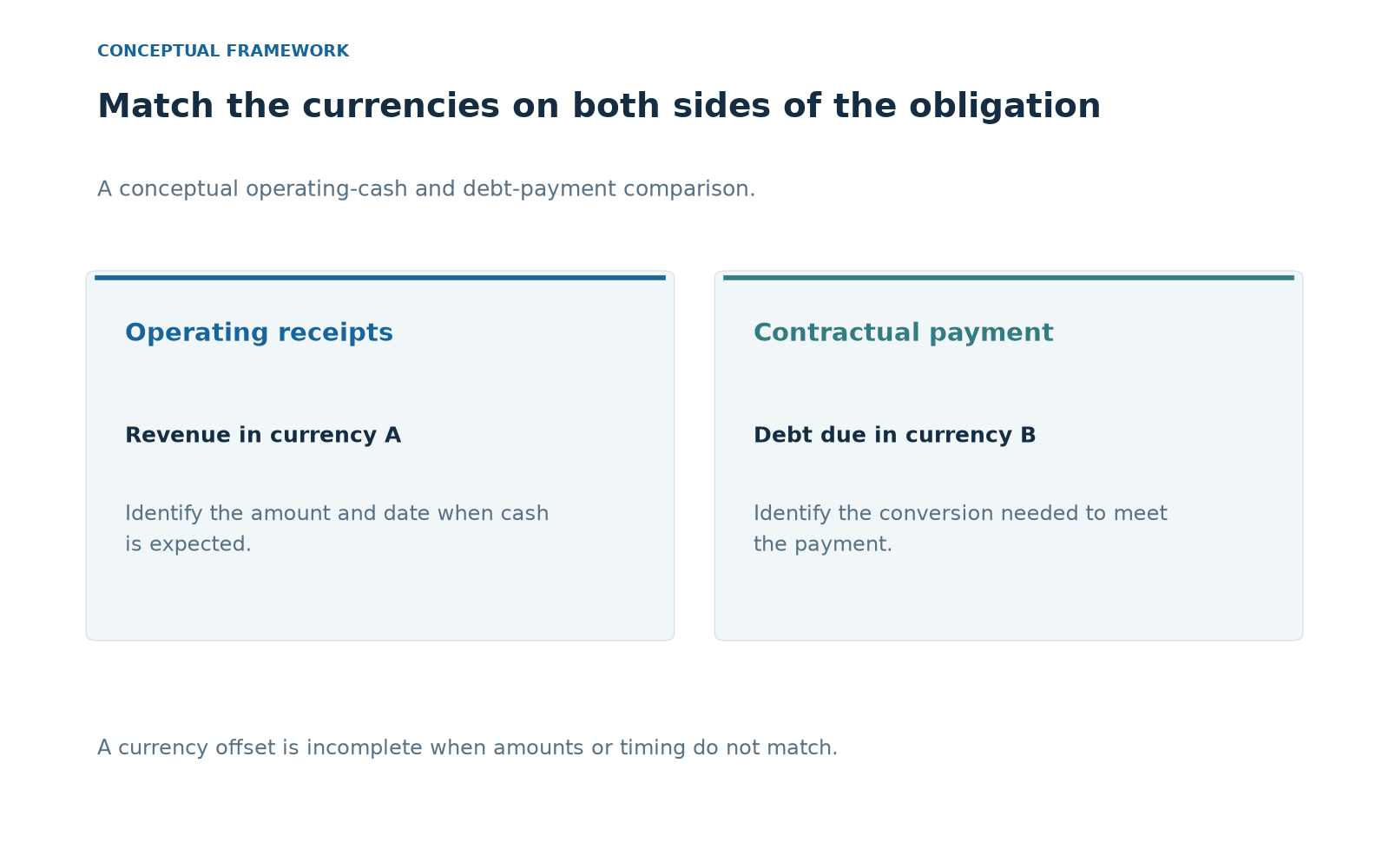
Consider a manufacturer that earns local currency from selling equipment to domestic businesses. It borrowed $5 million in U.S. dollars because the dollar loan offered a lower stated coupon than a local loan. Interest is 5 percent annually and the principal is due in two years. At ten units of local currency per dollar, annual interest of $250,000 costs 2.5 million local units. If the exchange rate moves to twelve local units per dollar and stays there when payment is due, interest costs 3 million local units. Dollar interest has not moved by a cent. The local-currency burden rises 20 percent.
Principal creates a larger exposure. At the original rate buying $5 million would require 50 million local units. At the second rate it would require 60 million. A local-currency profit of 8 million a year could cover annual interest under either assumption while leaving considerable uncertainty about refinancing principal. Simply comparing the 5 percent coupon with a more expensive local loan would overlook that exchange-rate change. A borrower can acquire exposure to the dollar through its financing even if it never sells a product in the United States.
Now change only the revenue stream. Suppose the borrower also collects $400,000 a year on a service contract from a foreign customer. If the receipts arrive when expected and can be used to pay interest, they exceed the $250,000 annual interest obligation by $150,000. That natural offset helps with current interest. It does not cover $5 million of principal due in two years, nor does it guarantee that the service customer will renew. A statement that the company “earns dollars” is too coarse to establish the quality of the match. Ask how many dollars, at what dates, under which contract, and available at which legal entity.
A shipment can be profitable and still require a loan
Give the manufacturer a new export order worth $1 million. It must pay $600,000 equivalent for inputs and wages before shipment and another $100,000 for transport and completion. The buyer pays a $100,000 deposit and the remaining $900,000 sixty days after delivery. Ignoring tax, financing costs, and other overhead, the order produces $300,000 of surplus after the $700,000 of costs. Before final payment the company has disbursed $700,000 and received only $100,000. Its maximum funding need under this simple timing assumption is $600,000.

If the bank advances at most $450,000 against the order, the remaining $150,000 must come from the company's cash, a larger deposit, supplier credit, or another financing arrangement. Improving the final sale price by $50,000 without changing payment terms would improve the expected profit and leave the pre-collection cash gap unchanged. Bringing $150,000 of the final payment forward to a binding progress milestone could close the gap without changing the total selling price. This comparison demonstrates why the timing of a contract can determine whether a seemingly attractive trade actually takes place.
A bank deciding whether to finance the production period will ask who carries the risk at each stage. Are the inputs usable for another customer if the order is cancelled? Can the exporter document completion before dispatch? Does it hold shipping insurance? Is the importer obliged to pay when documents are in order, or only after testing the equipment at the destination? The nominal buyer may be a subsidiary with little independent standing even when its parent has a familiar name. The best evidence about the loan is often inside the commercial contract rather than in an aggregate credit statistic.
Consider the buyer's incentives as well. A supplier may agree to sixty-day terms to win a valuable contract or because the buyer needs time to install the equipment and obtain its own funding. The same term on the invoice can reflect very different bargaining positions. An investor seeing a rising receivables balance should ask whether additional credit won new customers, whether existing customers started paying later, or whether shipments merely occurred later in the accounting period. Those explanations have different implications for demand, credit quality, and future cash generation.
Why dollar availability differs from dollar profitability
A consolidated company may report dollar revenue in one subsidiary and dollar debt in another. Whether one can service the other depends on legal structure, funding agreements, availability of distributable cash, and the timing of transfers. A profitable unit can be required to retain funds for local operating needs. A parent may provide support voluntarily without being contractually obliged to do so. Adding all dollar assets and subtracting all dollar liabilities gives an economic first pass, but it can hide an urgent mismatch inside the entity that owes money next week.
Take two subsidiaries under a common owner. The export subsidiary holds $700,000 in cash, of which $500,000 is committed to wages and suppliers before its next buyer payment. The domestic subsidiary owes $350,000 interest on Friday. Even if transfers are immediately permitted, the exporter can spare only $200,000 under those assumptions. The group's consolidated cash of $700,000 exceeds the interest payment, while the group still faces a $150,000 shortfall relative to its combined operating requirements. A cash reconciliation should identify what has already been promised. Ownership of two bank accounts does not allow the same funds to settle obligations in both.
Country-level analysis has an analogous issue, though a country is not a single consolidated company. Export receipts can support the availability of foreign currency in an economy. Public authorities, private banks, and individual borrowers have separate balance sheets and obligations. A foreign-currency reserve held by an authority is not automatically available to retire a private company's loan. An analyst must establish the arrangements that connect the resources to the obligation before treating a large aggregate as proof that a particular payment will clear.
A lower coupon can conceal a more expensive outcome
Compare this dollar loan with local-currency financing at a higher stated rate. Suppose a borrower can obtain 50 million local units for one year at 9 percent, with principal and interest due at maturity. Total repayment would be 54.5 million local units. Alternatively it can borrow $5 million at 5 percent when the exchange rate is ten local units per dollar. It receives the same initial local proceeds, ignoring transaction costs. It owes $5.25 million in a year. The break-even exchange rate is 54.5 million divided by 5.25 million, approximately 10.38 local units per dollar.
If a dollar costs eleven local units on repayment day, the foreign loan requires 57.75 million local units, above the 54.5 million on the local loan. At ten local units per dollar it requires 52.5 million, below the local alternative. The two loans switch places at the break-even exchange rate. A hedge locking the future conversion could change the comparison, and its terms would need to be included. Comparing 5 percent with 9 percent without converting the future payments effectively assumes an exchange rate while leaving it off the page.
There is also a distinction between economic cost and the ability to pay in an unfavorable state. A borrowing strategy might look cheaper under a central forecast yet create a repayment the company cannot meet if local currency weakens beyond a threshold. Expected cost alone can miss the value of staying solvent. A researcher can ask where the borrower would get the extra local cash or dollars under stress and whether those resources tend to become scarce at the same time. A credit line that disappears when collateral values fall is a different backstop from an unconditional cash reserve.
Trace the common customer across an international portfolio
A portfolio with equity positions in several countries can have a concentrated financing risk. Imagine a domestic equipment maker, a foreign leasing company financing equipment purchases, and a bank lending to both. Their shares may trade on three exchanges in three currencies. All may rely on the same major buyer completing its investment program. If the buyer slows work or its lender cuts its facility, orders, lease originations, and bank asset quality can weaken together. A country count describes listing diversity; it does not reveal the concentration in the origin of cash.
Work backward from the promised payments. The equipment maker needs an order followed by collection. The lessor needs enough demand to deploy equipment and a lessee able to pay over time. The bank needs borrowers to service loans and maintain collateral. A single funded expansion program may support all three streams, but the exposures have different seniority and timing. The manufacturer can earn revenue before a leasing problem becomes visible. The bank can receive interest for several quarters before a maturity reveals a capital shortfall. Simultaneous weakness is possible, but the accounting evidence may emerge at different times.

The most useful portfolio note names a common event and estimates its first effect on each position. A six-month delay to the buyer's project might postpone the manufacturer's final $900,000 payment, reduce the lessor's equipment utilization, and extend the bank's exposure to working capital. Testing that particular delay is more revealing than reducing each company's revenue by the same arbitrary percentage. It also identifies evidence that could disprove the concern: a progress payment received, a replacement lessee signed, or a committed credit facility extended beyond the delayed completion date.
Collateral can connect the same companies a second time. Assume a lender advances seventy percent of eligible invoices and excludes any amount more than sixty days past due. A delayed $900,000 invoice that was previously eligible could remove up to $630,000 from the borrowing base if the contract applies that rule and the credit line was already fully drawn against eligible balances. The borrower would face a funding problem at precisely the moment a customer was late. If it had unused collateral elsewhere, the actual cash call could be smaller. Borrowing-base eligibility and the amount already drawn are both necessary to calculate the effect.
A supplier comparing alternative financing arrangements can use that timing to ask a sharper question than which bank quotes the lower fee. Will a late invoice merely stop supporting new loans, or can its removal trigger immediate repayment of an existing draw? Is there a cure period, and can another invoice be substituted? A modest difference in rates may matter less than a clause that turns one buyer's delay into an urgent demand for cash. A reader needs the credit agreement and receivables aging schedule to see that link. Dated account statements can then confirm whether the bank actually applied the rule as the company expected. A headline measure of national credit growth would leave the contractual turning point entirely hidden.
What to ask at the next financing review
The first question is what has to be paid in the next ninety days, in each currency and by each entity. The second is which resources are available by then without relying on a new approval. The third is what happens if one large buyer pays a month late. These questions can be answered on a short schedule showing opening cash, certain receipts, conditional receipts, and uses of cash. A person reviewing the schedule can disagree about a condition while preserving the arithmetic. The disagreement becomes specific enough to investigate.
This exercise can produce a surprisingly constructive conclusion. A borrower that looks highly exposed in consolidated foreign-currency debt figures may have reliable, matched export receipts due under enforceable contracts. A smaller borrower that appears lightly indebted may have an uncovered payment due before its inventory can be sold. Improving the terms or timing of a single invoice may create more financing headroom than a small change in an annual growth forecast. Those results can be established from records whose relationship to the payment is direct.
The world outlook still serves as the starting point for thinking about demand. A local financing analysis tells us what it would take to participate in that demand and who has the resources to do so. By the end of this week, a defensible investment file would contain a cash date, a currency, and a named source for each material payment. Where one of those entries is missing, the economic story remains incomplete even if the trucks are full and the order book looks excellent.
Related research

Weekly Research
The Price-Volume Split Matters for Corporate Earnings
February 16–22: January inflation is a backdrop for business analysis, not a substitute for it.

Weekly Research
February’s Payroll Decline Requires a Composition Check
March 2–8: strike-related effects complicate a simple reading of the employment headline.

Weekly Research
January Data Offer a Mixed but More Detailed Picture
February 9–15: employment and inflation releases need to be read together.