
Weekly Research
The Fed Raises Its Target Range in September
- Report or archive date
- Coverage September 14–20, 2026
- Reading time
- 10 min read

Summary
September 14–20: the policy baseline changes, while the size of the economic response remains uncertain.
For the owner of a building financed with fixed-rate debt, the first tangible effect of a rate increase may arrive in a conversation with a prospective buyer. The building's existing mortgage payment can remain unchanged, yet a buyer financing a purchase at current rates can afford less. An owner with a floating construction loan may instead receive a revised interest calculation on the next reset date. A tenant may experience neither effect until renewal, when the landlord must decide whether to offer incentives to keep the space occupied. One policy action can change the market value, cash burden, and bargaining position of an asset on three distinct schedules.
On September 16 the Federal Reserve raised its target range for the federal funds rate by a quarter percentage point to 3.75–4.00 percent. All twelve voters supported the action. The July meeting had held the former 3.50–3.75 percent range with three dissenters favoring an increase. September therefore changed the official policy setting, not merely the wording surrounding it. The committee described solid activity, resilient domestic spending, strong productivity, robust capital investment, and inflation that remained elevated. It associated the action with returning inflation to its 2 percent objective more promptly. The statement did not establish the size or timing of a further change.
The action and the news are not identical
The lower boundary moved from 3.50 to 3.75 percent and the upper boundary from 3.75 to 4.00 percent. The width of the target range remained a quarter percentage point. Neither the upper boundary nor the midpoint is a contractual mortgage rate, a credit card rate, or the yield paid on every depositor's money. They help define conditions in a specific overnight funding market. Expectations about future monetary policy and compensation for term, credit, and liquidity influence other borrowing rates. A headline saying rates rose by 25 basis points is correct for the target and incomplete for nearly every private-sector instrument.
Investors also need to separate the change in policy from the surprise relative to what was priced. Suppose a market had fully anticipated a quarter-point increase but expected unusually strong language about more to come. A decision delivering the expected increase with less forceful guidance could reduce some longer-term yields. Alternatively, an anticipated increase accompanied by information about stronger demand could lift them. To distinguish these explanations, examine instruments sensitive to the policy path immediately before and after the release, and check for other news within that interval. A price recorded before the statement may reflect different information from one recorded after the press conference begins.
Daily Treasury par observations offer a useful boundary. From September 15 to 16, the two-year rate rose from 4.67 to 4.74 percent and the ten-year from 5.00 to 5.01 percent. The thirty-year edged from 5.36 to 5.35 percent. These were movements of positive seven, positive one, and negative one basis point, not a 25-basis-point parallel shift. The curve uses indicative market quotations and fixed maturities. The interval includes more than the announcement itself, so even these narrowly dated observations do not isolate a pure policy effect. Between September 11 and 18 the two-year rose thirteen basis points and the ten-year five. The chosen window changes what the comparison describes.
A building has several interest rates around it
Consider the finances of a neighborhood medical office building. It collects $2.4 million a year in rent and reimbursements and spends $900,000 in ordinary property operating costs, leaving $1.5 million of net operating income before debt service, capital expenditure, and taxes on the owner. Its existing $12 million interest-only mortgage is fixed at 4 percent for two more years. Interest is $480,000 a year. Nothing in the September decision rewrites that signed rate. Under these assumptions the owner retains $1.02 million before capital expenditure and the other excluded items. The immediate property cash calculation is the same the day after the announcement.
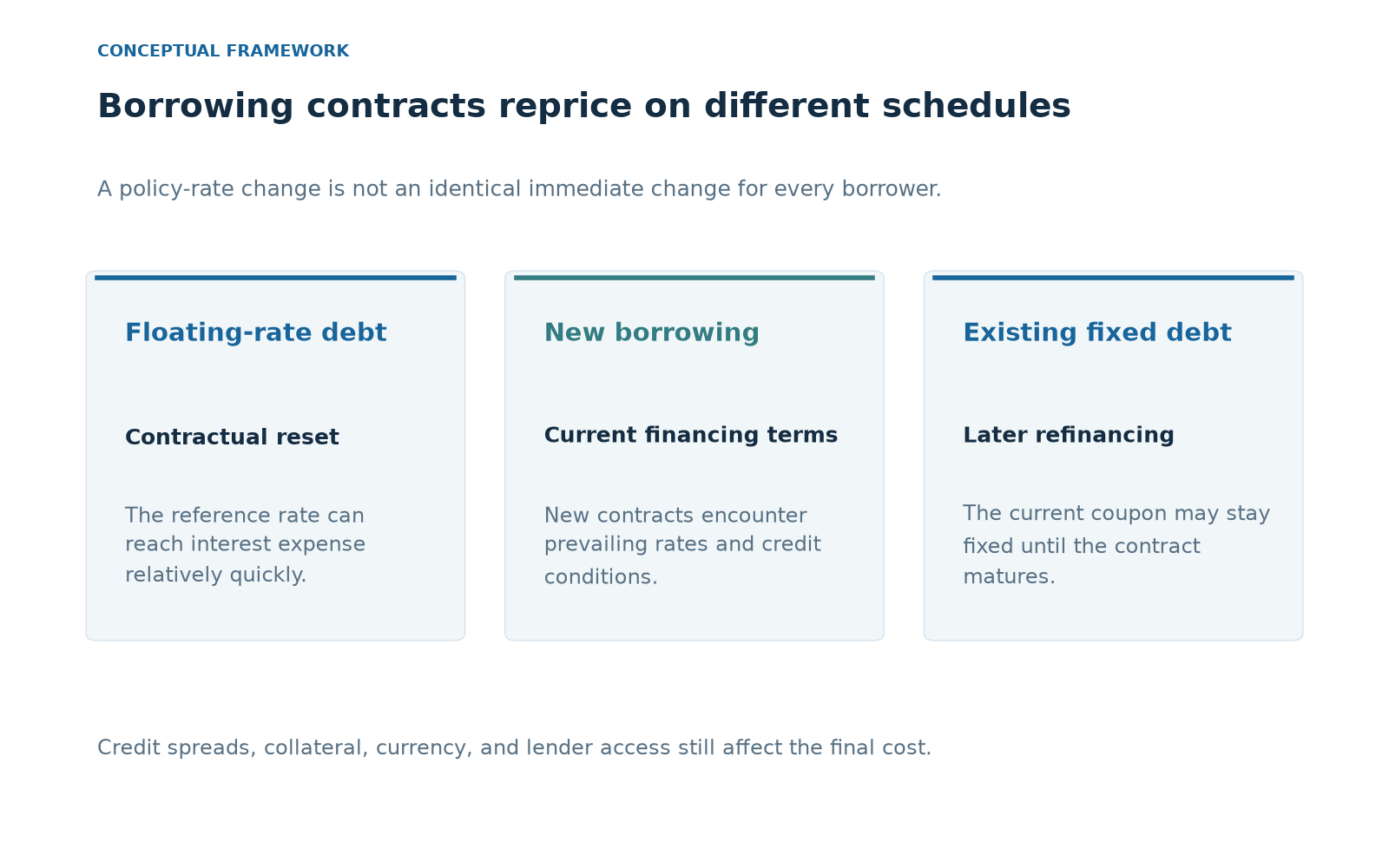
A prospective buyer is different. Suppose its available mortgage quote is 6.25 percent on an identical balance. Annual interest would be $750,000, leaving $750,000 before the same excluded outlays. The buyer faces $270,000 more interest a year than the existing owner, of which only $30,000 would correspond to a quarter point on $12 million. The rest reflects the difference between an older contract and today's assumed financing. Comparing the entire $270,000 with September's monetary action would overattribute years of changes in market rates, credit terms, and contract timing to a single meeting.
An investor valuing the building by capitalizing net operating income might assume a 6 percent capitalization rate, implying $25 million of value from $1.5 million divided by 0.06. At a 6.5 percent cap rate the same income supports about $23.08 million. A change of half a percentage point in the assumed cap rate reduces the value by about $1.92 million, or 7.7 percent. The cap rate is the relationship between current income and property value, not a bank rate or a Federal Reserve setting. Growth expectations, location, tenant quality, lease length, capital needs, liquidity, and required returns all affect it. The $1.92 million difference comes from changing the cap rate alone while holding the building’s annual income constant.
The tenant schedule decides whether income holds
Suppose the building's largest tenant, a diagnostic clinic, generates 40 percent of annual rent and reimbursements. That represents $960,000 of the $2.4 million gross. If its renewal is delayed by three months and nothing is collected during that quarter, the simple gross revenue loss is $240,000 before any offsetting savings or replacement rent. If operating expenses remain fixed, net operating income would fall to $1.26 million for that year. If the buyer pays $750,000 in interest, the remaining amount falls to $510,000 before capital needs. A short occupancy gap can matter far more to annual cash than a quarter-point rate change on the existing loan.
The renewal can be economically weaker even if the rent per square foot rises. A new five-year lease may include free months, landlord-funded interior improvements, and a brokerage commission. Nominal rent on the first paying month can increase while the present value of cash received falls. Analyze the lease over its term, taking account of the landlord's outlays, expense recoveries, and the probability of collection. If a clinic installs specialized equipment that is costly to move, retention may be high. If the clinic's own funding is impaired or its services move to another location, the fact that the building is medically specialized can make replacement tenants harder to find.
The macro release offers context for those questions. The August labor report initially showed 162,000 additional jobs and stable unemployment at 4.1 percent. August CPI rose 0.4 percent on the month and core CPI 0.3 percent. These are aggregate U.S. indicators. They cannot establish demand for this clinic or the reimbursement rate it receives. The useful bridge would be the local patient base, the clinic's contract mix, appointment volumes, staffing availability, and competing facilities. An analyst can recognize that domestic spending appears resilient while still questioning whether one tenant can afford a renewal under a particular set of terms.

A financing threshold can arrive before maturity
Lenders often assess the relation of operating income to debt service and the relation of loan balance to collateral value. Consider a maximum loan-to-value ratio of 55 percent for a new loan. At a $25 million valuation the ceiling would be $13.75 million, enough to replace the $12 million balance. At $23.08 million it is about $12.69 million, leaving less headroom. If a lasting tenant loss reduces sustainable net operating income to $1.26 million and the market cap rate is 6.5 percent, the implied value is around $19.38 million. At 55 percent the implied new loan is roughly $10.66 million. Replacing $12 million then requires around $1.34 million in other capital before fees.
The one-year vacancy calculation should not automatically become a permanent reduction in cap-rate income. The last calculation explicitly assumes the lower $1.26 million is sustainable, a harsher case than a temporary quarter of vacancy followed by a sound long-term lease. A short interruption is better modeled as a specific lost cash flow plus leasing and preparation costs; capitalizing it forever would overstate the damage. Conversely, pretending a structurally obsolete space will be reoccupied at yesterday's rent can greatly overstate collateral. Distinguish temporary cash loss, recurring income impairment, and the one-time spending needed to restore use.
Refinancing terms can also depend on an interest coverage or debt-service coverage test. A loan can meet a collateral limit yet fail a cash test if interest and amortization consume too much income. Interest-only comparisons are useful for isolating rate exposure, but a lender may require principal repayment. A near-term cash surplus for the old owner can coexist with a refinancing shortfall at maturity. The appropriate response is a cash calendar covering the remaining two years and a realistic estimate of proceeds when the old loan ends. Spot property value and annual accounting earnings alone cannot settle whether the owner will have enough cash on that date.
Policy crosses borders on different contracts
September 16 was also the effective date of the ECB's previously announced rate increase, including a deposit facility rate of 2.50 percent. Two institutions changing settings near the same date does not make the dollar and euro borrowing environments interchangeable. Different inflation outlooks, banking systems, loan structures, and currency exposures affect the transmission. An American owner buying European medical equipment can face a euro invoice even if every tenant pays dollars. A European investor buying the building bears the dollar property return and, unless hedged, a currency return on conversion. The asset's location alone cannot specify the investor's economic exposure.
A cross-border lender can also charge a different spread or require hedging, collateral, or fresh equity. An agreement to hedge principal may leave rental cash exposed. A hedge that covers estimated sale proceeds in two years can become too large if the valuation falls. The fact that two central banks raised rates does not tell us whether a particular cross-currency forward became more or less attractive without matching maturities and actual quotes. The defensible judgment is that the policy backdrop has changed and the major cash claims deserve recalculation on their own contractual terms.

How a reader can monitor the next stage
Separate the earliest observations from the slow ones. Overnight and short-term market rates can respond quickly to a change in policy or expectations. New mortgage quotes and reset notices follow their own schedules. Property transactions may take months, and appraisal values often update only when deals close or lenders review collateral. Tenant decisions and renovations can take longer still. A lack of immediate sales at lower prices is not evidence that required returns stayed constant; it may mean owners and buyers have not yet agreed on a price. Conversely, a small number of distressed sales need not establish the clearing value of every comparable building.
Useful evidence for the property in this example includes a signed tenant renewal, a firm financing offer, property-level expense recoveries, actual maintenance demands, and transactions involving comparable tenants and lease terms. For the national picture, check the breadth of price increases, measured activity, labor income, and how private borrowing conditions change. Stronger policy restraint can show up in a smaller loan or longer approval time, not only in a posted interest rate. The committee can act today while the most important corporate consequences occur at a later renewal or maturity.
The directors should also scrutinize any plan to distribute today's cash surplus. If a refinancing gap of the illustrated size is plausible, retaining cash over the remaining two years can reduce the need for expensive emergency equity. At the same time, spending now on a tenant improvement that secures a long lease could protect later collateral value. Keeping cash and investing it in the building address different risks. Compare their cost, their effect on the refinancing date, and the conditions that would make either action ineffective. A larger reserve will not make a permanently vacant floor productive; a renovation will not fund a loan payoff if the lender closes early.
One final issue concerns the release of any guarantee when the loan is repaid. If the old owner has pledged additional assets, a smaller replacement loan may free some collateral but require cash at closing. If the new lender requests recourse to the owner personally, a lower quoted interest rate can come with a broader claim on assets outside the building. Fees for assuming an existing mortgage, if assumption is permitted, can also alter the buyer's comparison. The effective cost of finance includes the amount, timing, security, and rights being exchanged. Looking only at the lowest coupon may direct the parties toward a materially different risk than they intended to accept.
September's decision is a clear, dated change in U.S. monetary policy. The analytical work begins after recording the new range. Determine which contract resets, which investor marks a price to market, which tenant can change its commitment, and which lender can reduce proceeds. The owner with a fixed loan, the buyer with a new quote, and the tenant deciding on a renewal all face the same monetary news. Their cash consequences look different because their decisions, obligations, and deadlines are different.
Related research

Weekly Research
August Inflation Firms as the ECB Raises Rates
September 7–13: the new observations increase the importance of persistence and regional differences.

Weekly Research
Refinancing Becomes a More Concrete Test After the September Increase
September 21–27: the policy change matters through actual maturities and cash flows.

Weekly Research
August Hiring Rebounds in the Initial Report
August 31–September 6: a stronger payroll observation updates the labor side of the outlook.