
Weekly Research
Refinancing Becomes a More Concrete Test After the September Increase
- Report or archive date
- Coverage September 21–27, 2026
- Reading time
- 10 min read

Summary
September 21–27: the policy change matters through actual maturities and cash flows.
A company can pay interest on time for years and still be unable to repay a note when it matures. An income statement records borrowing costs over the year. A maturity date is a demand for a particular amount of cash on a particular day. They answer different questions. After the Federal Reserve's September 16 increase to a 3.75–4.00 percent target range, a useful weekly review moves beyond the size of the policy step. For each borrower approaching maturity, how much principal must be replaced, what cash is actually available, how much new financing can be obtained, and on what conditions?
The week of September 21–27 began with an established change in policy. It did not establish a common refinancing rate for every company. Dollar Treasury yields, corporate spreads, collateral values, underwriting standards, and issuance fees can move differently. A large issuer with ample cash and staggered debt faces a different decision from a small operator with one concentrated maturity. A company can also choose to refinance early, use cash, sell assets, cut distributions, or raise new equity. Those alternatives carry different costs to lenders, shareholders, and the continuing business. The identity of the missing dollar matters as much as the quoted price of the next dollar borrowed.
Start with the money due, not the coupon
Consider a regional cable operator. It has a $30 million note due in nine months, unrestricted cash of $9 million, and a board requirement to maintain at least $5 million for operations. Restricted cash held against construction permits is excluded. The business expects to generate $3 million of additional free cash before maturity after taxes, maintenance, interest, and other committed expenses. On those assumptions only $4 million of current cash plus the future $3 million is available for repayment. The company needs $23 million of new principal to retire the old $30 million balance without violating its cash floor. Subtracting the full $9 million cash balance and calling the financing need $18 million would consume the reserve the business requires.
Fees can increase the amount necessary at closing. Suppose lenders charge 2 percent of the new face amount and deduct it from proceeds. To receive $23 million in cash, the company must issue about $23.47 million, because 98 percent of that amount is $23 million. Borrowing exactly $23 million would net $22.54 million, leaving a $460,000 gap before any legal costs or settlement adjustments. The fee is not ongoing annual interest, but it affects the effective cost of the loan and the amount of debt left on the balance sheet. A refinancing analysis should state whether a quoted dollar amount means gross principal or cash actually received.
At a new fixed coupon of 7 percent on $23.47 million, annual interest is about $1.64 million. If the old $30 million note carried a 4 percent coupon, its annual interest was $1.20 million. The increase is approximately $443,000, even though gross principal declines materially. Multiplying the three-point coupon difference by the full old $30 million would suggest $900,000 of additional interest and ignore the paydown. Multiplying only the Fed's quarter-point move by the balance would also miss most of the difference between an old contract and a new borrowing environment. Reconcile the old balance, new balance, old rate, and new rate separately.
The lender may not approve the amount the borrower needs
Suppose the prospective lender caps gross debt at three times a defined annual operating measure. The figure recognized by the bank is $7.5 million, so the ceiling is $22.5 million if there are no other debts inside that calculation. Net proceeds after a 2 percent fee are $22.05 million. Against the $23 million cash need, the closing shortfall is $950,000. A financing quote that sounds adequate in interest-rate terms thus fails a size requirement. The lender's definition of earnings can exclude proposed cost savings, one-time reimbursements, or income from assets that will be sold before maturity. An analyst using management's larger adjusted figure without checking the loan definition could miss the gap.
Collateral can impose a second ceiling. The network might have substantial replacement cost but lower value in a forced sale, especially where it shares infrastructure, easements, or permits with other operators. Customer contracts may have cancellation rights, and a lender may haircut receivables from delinquent accounts. If the leverage test permits $22.5 million but the eligible collateral test permits only $21 million, the tighter limit controls. It is not correct to average the two limits. A borrower can have more than enough accounting net assets and still lack sufficient eligible security to replace a maturing note.
A revolving facility does not automatically fill the difference. It might be uncommitted, mature before the note, reserve capacity for letters of credit, or prohibit drawing to repay subordinated debt. A new lender might require the revolver to remain undrawn as a liquidity cushion. If borrowing under it also increases debt in the three-times test, drawing it can reduce the permitted size of the new term loan. A financing table that lists every facility at its face amount can double count the same collateral or headroom. Verify maturity, legal availability, conditions for drawing, and the amount already committed elsewhere.
Stress the business that generates the $3 million
The projected $3 million of free cash before maturity is itself a forecast. Suppose churn in a competitive neighborhood reduces cash collections by $1.1 million and an unexpected equipment replacement costs $600,000. Free cash available for repayment falls to $1.3 million. The company then needs $24.7 million net rather than $23 million. If the lender's recognized earnings also weaken, approved debt can shrink precisely when the borrower needs more. A stress that increases only the coupon while leaving earnings, collections, and loan limits at optimistic levels can systematically understate refinancing risk.
The cable business is a good example because subscriber count, revenue recognized, and cash collected are distinct. A promotional customer might pay little for the first several months, a delinquent account can remain connected during a grace period, and a recently installed connection can require substantial equipment and labor before cash arrives. A large number of new connections can therefore consume rather than generate immediate cash. To test the forecast, examine net paying additions, the cost to connect a new household, collection history, and the timing of promotional price increases. An upgrade that may improve retention next year cannot be spent at the note's maturity date.
The borrower could reduce capital spending, but maintenance and growth are not completely interchangeable. Deferring a new territory expansion can preserve cash with a defined opportunity cost. Deferring replacement of failing network equipment can create outages, increase refunds, lose subscribers, and reduce collateral quality. A plan that treats the entire investment budget as discretionary can make a refinancing appear possible only by weakening the asset that supports it. Obtain the minimum work schedule necessary to satisfy service commitments, repair standards, and any lender covenants before assigning every dollar of spending as an available source of repayment.

Time has a price in a concentrated maturity
The operator could seek financing now rather than in nine months. Suppose it issues an additional $23 million early at 7 percent and holds proceeds earning 4 percent until the old note can be repaid, with both rates fixed over that interval. For six months the simple difference between interest paid and earned is about $345,000, before fees, taxes, and any increase in required liquidity. That cost buys certainty about a future funding source. If the old note can be redeemed immediately and has a call premium, compare the premium with the cost of carrying both debts and the risk that financing becomes unavailable. An apparently expensive early transaction can be rational when the alternative includes a material chance of missing maturity.
Early financing can also change bargaining power. A borrower with nine months to seek competing quotes can negotiate covenants on asset sales, distributions, and additional borrowing. With three weeks left, its priorities may shift to certainty and closing speed. A term sheet is not a signed commitment, and a signed commitment can still have conditions requiring satisfactory collateral review or successful syndication. A research file should identify which conditions remain, who controls them, and how long they take. The date by which a decision must be made is earlier than the date printed on the old note.
September's market data underline the point without supplying the operator's actual spread. Between September 18 and 25 the two-year U.S. Treasury par yield rose from 4.76 to 4.81 percent and the ten-year from 5.01 to 5.17 percent. The ten-year increase was sixteen basis points compared with five at two years. A company seeking longer fixed financing might face a different base-rate change from one using a short bridge. Corporate spreads and fees could move in either direction relative to the Treasury curve. The published reference curve is useful for decomposing a quote; it cannot identify the amount the lender will commit or the cost of its conditions.
Who pays to close the gap?
Suppose the original $950,000 shortfall remains after the first bank quote. Raising equity can provide permanent funding without additional interest but dilute existing owners. Selling a nonessential tower site can produce cash but eliminate future rental income or introduce a new lease expense. Suspending a distribution protects cash but may reduce the appeal of the shares to income-oriented owners. Negotiating with the current noteholders for an extension could reduce near-term risk while increasing the coupon, adding fees, or granting security ahead of other creditors. None is a free plug in the spreadsheet. Recalculate the future cash and rights of every affected claim.
Asset sales deserve particular scrutiny. A property producing $150,000 of annual cash sold for $1.2 million may appear to solve the closing gap. If the lender's earnings or collateral calculation included that property, loan capacity can fall when the sale closes. If the company must then lease back essential equipment, the new rent reduces operating cash. Transaction expenses and timing can further reduce cash available on the maturity date. Compare the net sale proceeds with the reduction in borrowing capacity and the value of future income surrendered. A sale can be economically sensible yet deliver less immediate headroom than the headline price suggests.

The lender's own risk can shift as new financing arrives. Existing unsecured creditors may be disadvantaged if new debt takes a senior claim on valuable network assets. The new lender may accept a lower coupon in exchange for stronger collateral and restrictions. The old shareholders might dislike those restrictions even if the transaction removes near-term default risk. An investor comparing two bonds issued by the same company should read the claims, guarantees, priority, and maturity sequence rather than assuming common issuer identity means an equal recovery. A refinancing can improve the company's survival prospects while redistributing value among its securities.
A closing calendar that can actually be followed
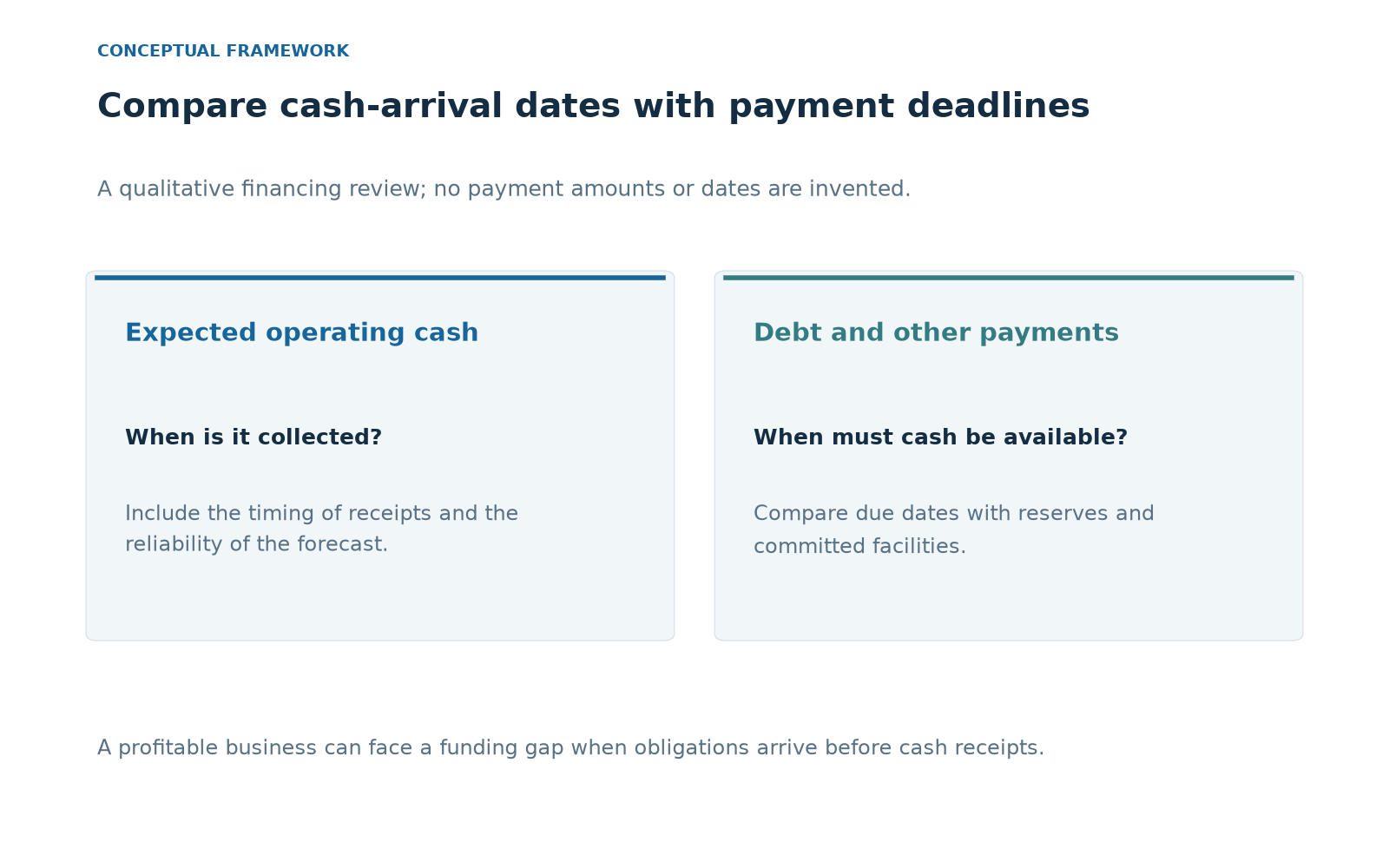
Work backward from the principal payment date. Allow time for notice to noteholders, lien releases, transfer of funds, regulatory consents, legal review, valuation of collateral, credit committee approval, and any required shareholder action. Identify sale proceeds or donor commitments that become available only after a condition is met. Add a contingency for ordinary delays. A plan listing $30 million of sources against $30 million of uses can still fail if $2 million of the sources arrives a week late. If the bridge for that gap must be committed now, its fee and conditions belong in the current decision.
Then test a business slowdown and an adverse financing quote together. Update the free cash forecast monthly, compare it with actual collections, and recalculate the permitted loan on the lender's definitions. If the gap grows, management can act while it has time to stage an asset sale, seek equity, or reduce discretionary spending. Waiting until the income statement shows distress can be too late because the main risk is a dated principal claim rather than today's interest payment. Conversely, a borrower with ample cash, long contractual funding, and little near-term maturity may have time to adapt even if quoted market rates have risen.
One more source of confusion is a debt balance shown net of unamortized issuance fees on the balance sheet. The accounting carrying amount can be lower than the principal the trustee expects in cash at maturity. An investor should reconcile face value, carrying value, accrued interest, and the settlement amount required by the agreement. A similar distinction applies to available investments: selling a security shortly before it matures may involve a spread, a market loss, or a delay before proceeds settle. Combining face-value liabilities with optimistic same-day values for every asset can leave a hidden closing deficit. The refinancing worksheet should use the cash that will actually clear on each date.
For the outside reader, the most informative disclosure may be an executed commitment with a stated amount and conditions or a maturity schedule matched to truly available cash. A general assertion of good bank relationships is weaker evidence. So is a comparison of interest expense with an accounting profit measure that includes noncash income and excludes essential maintenance. The September increase made one part of the environment observable. The work of a refinancing review is to find the dollars still missing after all usable resources, fees, restrictions, and dates have been reconciled. That is where a change in policy becomes a concrete test of a borrower's staying power.
Related research

Weekly Research
The Fed Raises Its Target Range in September
September 14–20: the policy baseline changes, while the size of the economic response remains uncertain.

Weekly Research
September Payroll Growth Is Modest in the Initial Release
September 28–October 4: the labor observation adds a new constraint to the policy discussion.

Weekly Research
August Inflation Firms as the ECB Raises Rates
September 7–13: the new observations increase the importance of persistence and regional differences.