
ResearchFixed Income
A Bond Is a Schedule of Cash Flows
- Report or archive date
- Archive placement January 12, 2026
- Reading time
- 13 min read

Summary
A bond becomes easier to understand when its payments are placed on a timeline. Face value, coupon, purchase price, maturity, and credit quality each describe a different part of that timeline, and none should be mistaken for a complete measure of return.
Begin with the promised payments
A bond is a financing claim with specified terms. The issuer receives funding and undertakes obligations to the holder, which may include interest payments and repayment of principal. Before comparing yields or reading a market forecast, identify those obligations: the amount, date, currency, conditions, and party responsible for each payment.
This approach turns an unfamiliar security into a sequence that can be inspected. It also exposes the difference between a contractual promise and the investor's actual outcome. A plain fixed-rate bond may specify every payment in advance, while the price paid to acquire that schedule can change. Credit problems, contractual options, and an early sale can alter what the holder ultimately receives.
The word fixed in fixed income therefore requires care. Some instruments have fixed nominal payments, while others have floating payments, inflation adjustments, or embedded options. Even a fixed payment schedule does not make the market price fixed. The structure of the claim comes first; the label on an investment category is only a starting point.
A useful first reading can be done without forecasting interest rates. Write the payment schedule, identify the initial cash outlay, and mark the circumstances that could change either. This establishes what is known from the terms and what remains dependent on market conditions or the issuer's financial strength.
Construct a plain bond from five dates
Consider a bond issued on January 12, 2026 with a face value of $1,000, a fixed annual coupon rate of 5%, and a maturity date of January 12, 2031. Assume coupons are paid once a year, there are no embedded options, and every payment is made as promised.
The annual coupon is $50: 5% multiplied by $1,000. The holder receives $50 on January 12 in 2027, 2028, 2029, and 2030. On January 12, 2031, the holder receives the final $50 coupon plus the $1,000 principal, for a final payment of $1,050. The final coupon is additional to principal repayment.
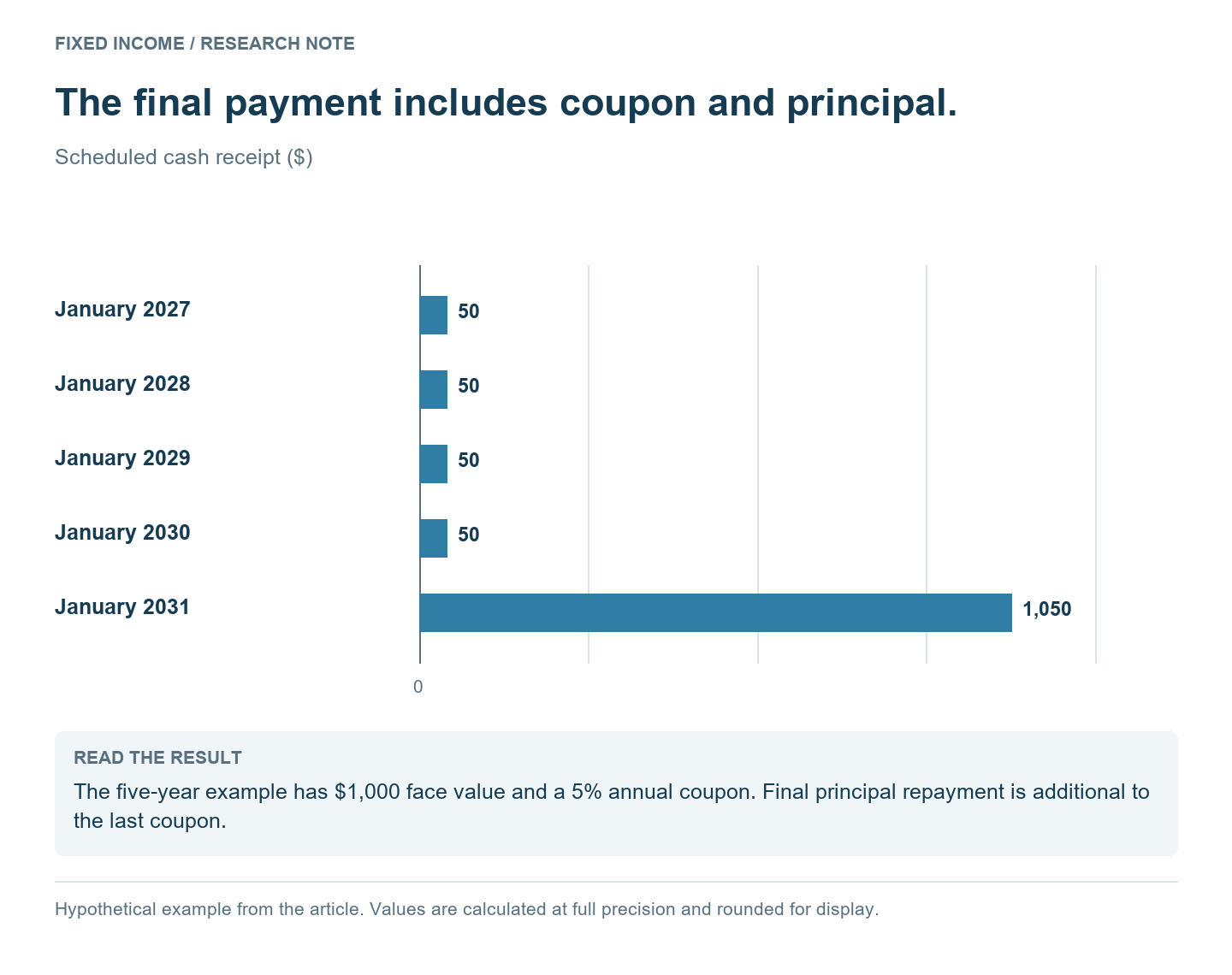
Across the five years, promised coupons total $250 and promised principal repayment is $1,000. Total nominal receipts are $1,250. That sum is not the bond's current value or its annual return. It adds payments made at different dates without adjusting for their timing, the purchase price, or the risk that they are not made.
The schedule should also specify payment frequency. A 5% annual coupon paid semiannually would ordinarily divide the year's coupon into two $25 payments for this face value under a simple regular schedule. The annual coupon amount is unchanged, but the dates differ. Payment timing matters for valuation, cash planning, and reinvestment.
Face value and market price are separate quantities
Face value, also called par value in a plain bond, is the reference amount used to calculate the coupon and the principal scheduled for repayment. Market price is the amount a buyer pays to acquire the claim. The two can be equal, but they need not be. A secondary-market purchase does not generally rewrite the issuer's promised coupon solely because the price changes.
Suppose the bond is bought for $960 immediately after issuance under the stated annual schedule, with no accrued interest or fees. The coupon remains $50 and the maturity principal remains $1,000. Paying below face value creates a $40 difference between purchase price and promised principal repayment, provided the bond reaches maturity and pays in full.
If another buyer pays $1,040 for the identical schedule, that buyer still receives the same $50 coupons and $1,000 principal. The purchase premium is not automatically refunded at maturity. The investor receives the contractual principal amount, not the amount previously paid to another holder in the market.
This distinction prevents a common misunderstanding about holding to maturity. Full payment of face value can remove uncertainty about a future sale price for a plain noncallable bond, but it does not guarantee recovery of a premium purchase price as principal. The total result includes coupons, the purchase outlay, timing, and any other relevant costs.
Quoted prices may be expressed per hundred of face value
Bond quotations often use a percentage of face value rather than a dollar amount for the entire holding. A quote of 95.8 means $95.80 per $100 of face under that convention. For $1,000 face value, the quoted amount is $958. For $10,000 face value, it is $9,580. The position size must be applied before estimating the cash required.
The quote may exclude accrued interest, which is interest accumulated since the last coupon date under the bond's day-count convention. A price excluding accrued interest is commonly called the clean price. The full or dirty price includes it. The cash needed for settlement can also include transaction charges and other applicable costs.
In a simplified example, a $958 clean price plus $20 of accrued interest produces a $978 full price. Adding a $2 transaction charge gives a $980 cash outlay. The quote has not become inconsistent; the figures measure different boundaries. A return calculation should begin with the actual cash paid, not an incomplete quoted number.
Day-count methods, settlement dates, and special trading conventions can change the accrued-interest calculation. Reconcile the settlement cash with the quoted amount, accrued interest, and transaction costs.
Accrued interest allocates a coupon across owners
A coupon is paid on a specified date, but ownership can change between payment dates. The buyer may receive the next full coupon even though the seller held the bond for part of the coupon period. Accrued interest is part of the mechanism used in many bond trades to account for that elapsed period.
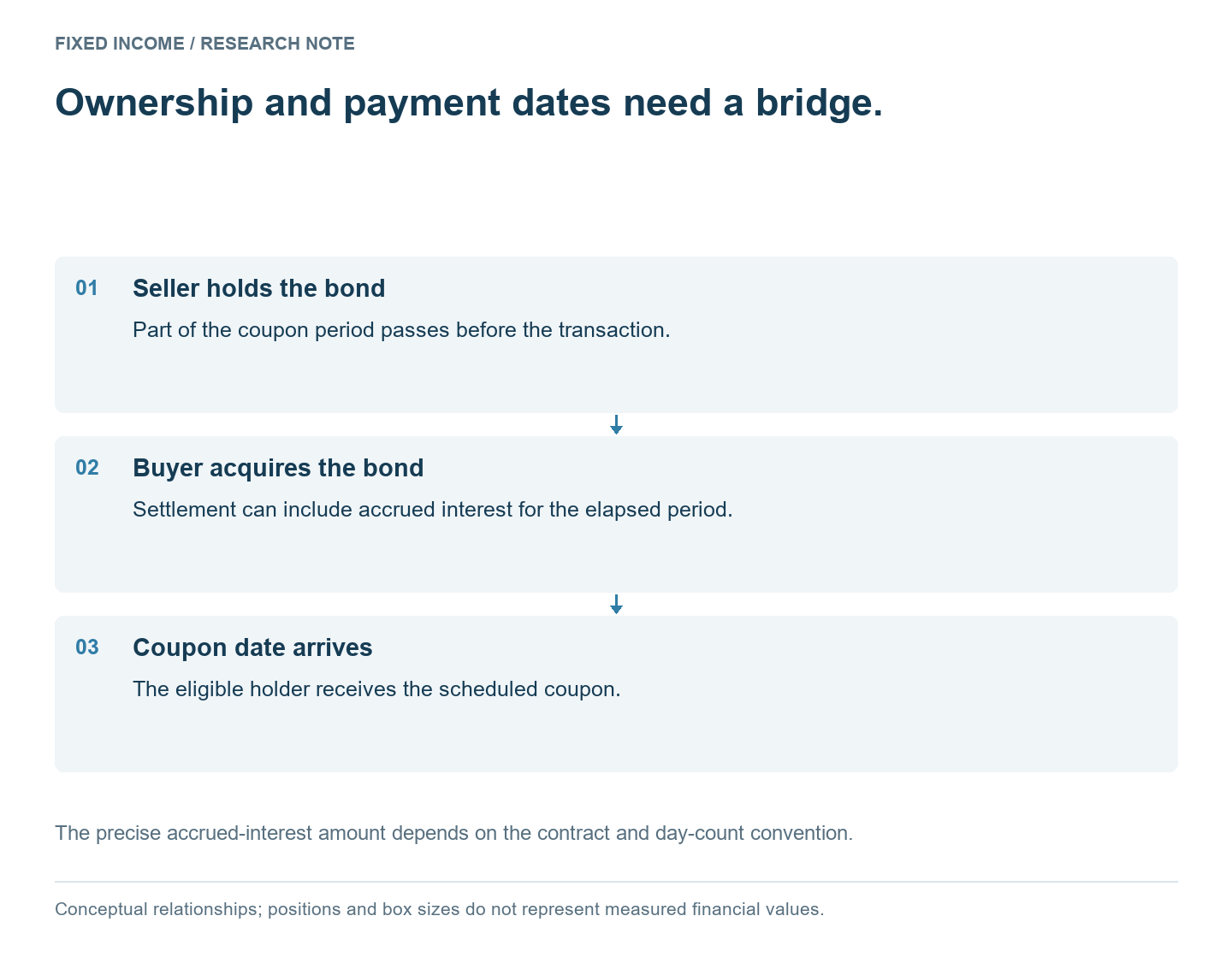
Suppose an annual $50 coupon period is two-fifths complete under an expressly simplified accrual convention. Accrued interest is $20. A buyer paying that amount to the seller has not purchased an extra coupon. The payment compensates for the portion of the coming coupon associated with the elapsed period under the assumed terms.
When the buyer later receives the $50 coupon, treating all $50 as new economic income earned since purchase would ignore the $20 already paid in settlement. The correct cash-flow record includes both the initial accrued-interest payment and the later coupon receipt. Tax treatment and accounting classification may differ from this basic cash-flow example.
The lesson is to follow money rather than labels. A coupon receipt can look larger than the income attributable to a short holding period, and an initial settlement amount can look larger than the quoted price. A complete timeline reconciles both without inventing a gain or a hidden cost.
Coupon rate, current yield, and return answer different questions
The coupon rate describes the annual coupon relative to face value. In the bond, it is 5% regardless of whether the market price is $960 or $1,040. Current yield divides the annual coupon by the current price. At $960, $50 divided by $960 is approximately 5.21%. This ratio describes coupon income relative to that price, not the full investment result.
Current yield leaves out the difference between purchase price and principal repayment. It also leaves out the timing of intermediate payments, reinvestment, credit losses, and sale proceeds if the bond is sold early. A higher current yield can therefore coexist with an unattractive total outcome under some circumstances.
Yield to maturity is the discount rate that equates the present value of the promised cash-flow schedule with the relevant purchase price under a specified convention. It uses more of the schedule than current yield, but it is still a calculation based on assumptions. The realized compound return over a horizon can differ if payments are missed, the bond is sold, or reinvestment occurs at another rate.
The safest first step is not to choose the largest displayed percentage. Identify what each measure includes and which question it answers. A coupon rate is a contract term, current yield is a price-relative income ratio, and a total-return analysis follows all cash flows and changes in value over the investor's actual period.
Timing gives the payment schedule a present value
A dollar received today can be used or invested immediately; a promised dollar several years from now cannot. Valuation accounts for that timing by discounting future payments at rates appropriate to the analysis. The chosen rates also reflect relevant risk and opportunity cost, so the same promised schedule can trade at different prices as conditions change.
For the bond with five annual $50 coupons and $1,000 principal, a 5% annual discount rate produces a value of $1,000 when evaluated at the start of the regular schedule. A higher required yield reduces the present value of the fixed payments. A lower required yield raises it, holding the schedule and other assumptions unchanged.
This is a valuation relationship, not a guarantee about the next market move. Actual yields can change because benchmark rates, credit risk, liquidity, and expectations change. A bond with embedded options requires additional analysis because the payment schedule itself can change when conditions change.
The cash-flow approach clarifies what is being repriced. The issuer's fixed coupon may remain the same while investors require a different return for holding it. The price adjusts to reconcile that existing promise with the return available or required in the market.
Maturity organizes principal repayment, not every risk
Maturity is the scheduled date for repayment of principal under the bond's terms. A plain bullet bond repays principal at the end. An amortizing bond returns portions earlier, creating a different schedule and reducing the outstanding principal over time. Two instruments with the same final maturity can therefore distribute cash very differently before that date.
The distinction matters for income planning and reinvestment. Earlier principal receipts can be used sooner but must be reinvested if the investor wants to maintain exposure. A single large maturity payment creates a different future funding or spending opportunity. The final date alone does not describe the entire pattern.
Maturity also differs from duration, which describes sensitivity to yield changes under a defined calculation. Duration reflects the timing and weighting of cash flows, not merely the last payment date. A beginner need not calculate duration immediately to recognize that a coupon-paying bond and a zero-coupon bond with the same maturity have different cash-flow timing.
Holding an individual bond to maturity can avoid the need to sell at an uncertain interim price, but it does not eliminate default, purchasing-power, reinvestment, or opportunity costs. The relevant question is which risks the strategy changes and which remain. A maturity date is a contractual feature, not a universal guarantee of a satisfactory outcome.
Zero-coupon bonds make the timing distinction visible
A zero-coupon bond does not make regular coupon payments. In a simple structure, the investor pays a discounted amount and receives a specified amount at maturity if the issuer performs. The return comes from the difference between purchase price and the maturity payment rather than periodic cash income.
Consider a zero-coupon bond bought for $900 with a $1,000 payment due in two years. The total promised increase over the purchase price is approximately 11.11%. That is a two-year cumulative return under full payment, not an annual rate. Dividing or compounding across the correct horizon is necessary before comparing it with an annual yield on another instrument.
The absence of coupons means there is no interim coupon reinvestment decision in this simplified example. It also means all promised cash arrives at the end, making the timing especially important. A holder who needs money earlier may have to sell at the market price then available.
Tax treatment can create obligations that do not match the timing of cash receipts, depending on the instrument and account. A cash-flow schedule should therefore be accompanied by the relevant product and account information when making an actual decision. The example isolates the investment payments and does not assume a universal tax result.
Fixed dollars do not guarantee fixed purchasing power
A nominal payment can arrive exactly as promised and still buy less than expected. If prices rise 3% annually for five years, a $1,000 maturity payment has purchasing power equivalent to approximately $862.61 at the starting date's prices. The calculation divides $1,000 by 1.03 raised to the fifth power.
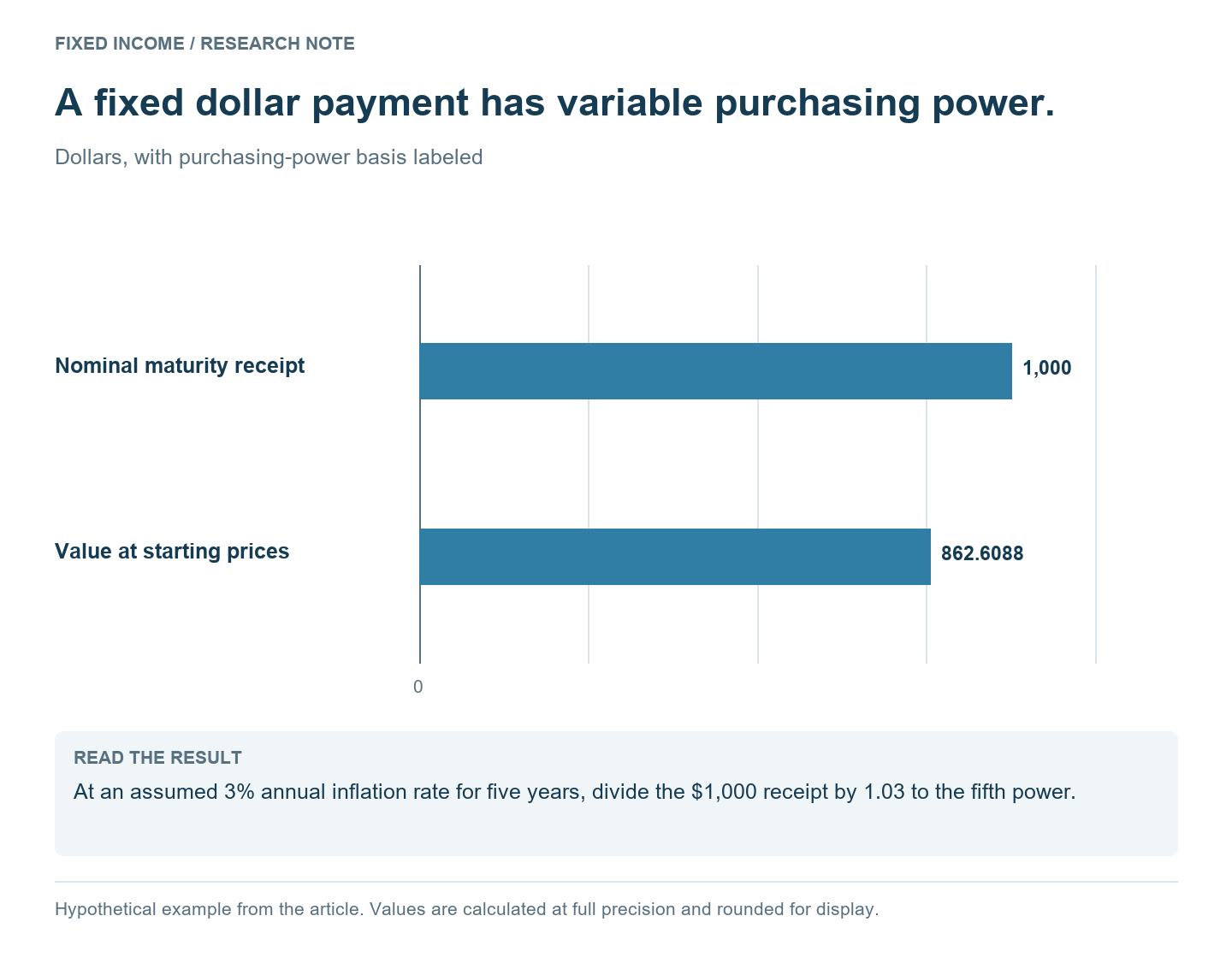
The coupon payments also need to be considered at their respective dates when evaluating a real return. Adjusting only the final principal does not describe the full investment. Inflation-linked structures can change the relationship, but their precise terms and reference indexes must be understood rather than assumed from the label.
Currency creates a separate issue when the investor's expenses are in a different currency from the bond's payments. Receiving the promised foreign-currency amount does not fix its value in the spending currency. The cash-flow schedule should therefore identify both the payment currency and the investor's comparison currency before a nominal return is interpreted as an improvement in purchasing power.
The issuer's ability to pay sits behind every promised date
A contract can specify a payment without ensuring that the issuer will have the resources to make it. Credit analysis examines the issuer's capacity and willingness to meet its obligations, along with the claim's position and terms. Revenue, cash generation, debt maturity, liquidity, and economic conditions can all affect the assessment.
For a corporate issuer, accounting profit is not identical to cash available for debt service. Large working-capital needs, capital spending, or other obligations can consume cash. A refinancing-dependent borrower may be vulnerable when funding markets tighten even if its current operations remain active. The payment schedule should be compared with the issuer's funding schedule.
If a bond defaults, recovery can be less than face value and may arrive after a delay. The result depends on the circumstances and the claim. A recovery percentage is a scenario input; realized recovery depends on the circumstances and the claim.
For example, a holder paying $960 who receives two $50 coupons and later only $400 in final recovery has collected $500 in total, a $460 shortfall relative to the original outlay before timing and other costs. The example is deliberately simplified. It shows why the promised schedule and the realized schedule must remain separate.
Contractual options can change the expected timeline
A callable bond allows the issuer to redeem under specified conditions before the final maturity. If called, later coupons that would otherwise have been paid no longer arrive. The holder receives the contractual redemption amount and applicable interest under the terms, then faces a new decision about how to use the proceeds.
The issuer may have an incentive to refinance when borrowing becomes cheaper, though the specific decision depends on the contract and circumstances. This can expose the holder to reinvestment at a less attractive rate. A high coupon alone may therefore overstate the income that can be expected across the full stated maturity if early redemption is possible.
Other instruments can include put rights, conversion features, floating coupons, inflation adjustments, or principal repayments linked to underlying assets. Each feature changes the cash-flow analysis. It is not enough to copy the fixed-rate bullet example and leave the additional terms in a footnote.
The useful reading habit is to ask who has the option, when it can be exercised, and what payments follow. That question identifies whether a date on the schedule is unconditional, contingent, or subject to another party's decision. It also explains why bonds with similar quoted yields can carry different economic exposures.
An early sale replaces future payments with a market price
A holder who sells before maturity receives the sale proceeds instead of the remaining bond payments. The realized result then combines coupons received, purchase cash, sale cash, and transaction costs. The original maturity value no longer determines the holder's final receipt because the claim has been transferred to another buyer.
Suppose an investor pays $960, receives one $50 coupon, and sells immediately after that coupon for $940, with no accrued interest or fees in the example. Total cash received is $990, producing a $30 gain relative to the initial outlay, or 3.125% over the assumed one-year holding period. The bond's price fell, but coupon income more than offset the decline.
If the sale price were $880 instead, total receipts would be $930 and the result would be a $30 loss, or negative 3.125%. The same coupon can accompany either outcome. Looking only at the price chart or only at the coupon omits part of the cash-flow result.
Liquidity affects the sale as well. The price available for a particular trade can depend on market depth, position size, and trading costs. An indicative valuation is not necessarily the exact amount available on demand. A plan that may require an early sale should account for that uncertainty rather than assuming the bond can always be converted to cash at a convenient quoted price.
Turn the schedule into a complete investment question
The final worksheet should contain the actual purchase outlay, every expected payment date, the currency, the principal structure, and any conditions that can change the schedule. It should separately identify reinvestment assumptions, a possible sale date, and the evidence supporting the issuer's ability to pay. That structure prevents one yield quotation from carrying more meaning than it deserves.
For the plain five-year example, the promised $1,250 of nominal receipts becomes useful only when connected to those details. A buyer paying $960 has a different starting point from one paying $1,040. A holder collecting every payment has a different result from one selling early or experiencing a default. The schedule is the common foundation from which those differences can be calculated.
Understanding bonds begins with that foundation. Once the dates and amounts are clear, price, yield, credit, duration, and reinvestment become connected questions rather than isolated vocabulary. The bond is a schedule of claims on future cash; the investment result depends on what that schedule costs and how closely the eventual cash flows match it.
Related research

ResearchFixed Income
Why Bond Prices Move Opposite to Yields
The inverse relationship between a plain bond's price and yield follows from discounting a fixed payment schedule. Understanding that calculation also reveals why a policy announcement, a quoted coupon, and an investor's eventual return are different things.

ResearchFixed Income
Coupon, Current Yield, and Yield to Maturity Answer Different Questions
Several percentages can describe the same bond without contradicting one another. A complete comparison begins by identifying the cash flows, denominator, time horizon, and assumptions behind each measure, then checking whether the measure answers the investor's actual question.

ResearchFixed Income
Duration Is an Approximation, Not a Complete Stress Test
Duration translates a small change in yield into an approximate change in bond value. A useful risk assessment also considers curvature, different movements along the yield curve, credit spreads, contractual options, liquidity, and the timing of the investor's obligations.