
ResearchFixed Income
Why Bond Prices Move Opposite to Yields
- Report or archive date
- Archive placement January 27, 2026
- Reading time
- 13 min read

Summary
The inverse relationship between a plain bond's price and yield follows from discounting a fixed payment schedule. Understanding that calculation also reveals why a policy announcement, a quoted coupon, and an investor's eventual return are different things.
The payment can stay fixed while its value changes
Imagine being offered the same delivery contract on two different days. The contents have not changed, and delivery is still scheduled for the same date. What has changed is the attractiveness of the alternatives available for your money. A fixed-rate bond poses a similar valuation question: what should someone pay now for a specified set of future payments?
The issuer does not ordinarily rewrite a plain bond's coupon whenever market yields change. Buyers and sellers instead negotiate a different price for the existing payments. The market value can therefore decline even when the issuer remains financially healthy and continues paying interest on schedule. A change in price is not, by itself, evidence that a payment was missed.
The precise mathematical relationship concerns a bond's own yield and its unchanged cash flows. If that yield increases, the discounted value of those payments decreases. Statements about a government benchmark or the central bank's policy rate require an additional step: establishing how the yield relevant to this particular bond changed. That distinction prevents a reliable valuation relationship from becoming an unreliable trading rule.
Build the example before interpreting it
Consider a bond with three years remaining, a $1,000 face value, and annual coupons of $40. It has no call feature, makes no principal payments before maturity, and pays every amount in full. The three future receipts are $40 after one year, $40 after two years, and $1,040 after three years. These assumptions isolate discounting from other risks.
Place the valuation immediately after a coupon date, with the next payment exactly one year away. There is no accrued interest in this example. Ignore taxes, transaction costs, and differences between borrowing and lending rates. The annual discount rate uses annual compounding, matching the payment intervals. A real bond with semiannual coupons or a different settlement date requires the corresponding conventions.
At a 4% required annual yield, the price is the sum of three present values: $40 divided by 1.04, $40 divided by 1.04 squared, and $1,040 divided by 1.04 cubed. The result is $1,000. The bond trades at face value because its coupon rate matches the yield used to value these annual payments under the stated assumptions.
Do not add the promised payments and call that the price. The total scheduled receipts are $1,120, but they arrive at different times. Receiving $1,000 today and receiving it three years from now are different economic propositions. Discounting makes those dates comparable without pretending that future dollars are already available to spend.
Why a higher required yield produces a lower price
Now change only the required annual yield from 4% to 5%. The promised payments remain $40, $40, and $1,040. Their new price is $40 divided by 1.05, plus $40 divided by 1.05 squared, plus $1,040 divided by 1.05 cubed. The total is approximately $972.77. No cash flow disappeared; its present value changed.
Every denominator is larger at the higher yield. Dividing the same positive payment by a larger denominator produces a smaller present value. Adding those smaller values gives a smaller price. This is the entire mathematical mechanism for the example. It does not require an assumption that investors are panicking, that the issuer is distressed, or that the economy is weakening.
The opportunity-cost interpretation says the same thing in ordinary language. A buyer who requires 5% cannot obtain that yield by paying $1,000 for this 4% coupon schedule. A discount to face value compensates the buyer partly through the difference between the purchase price and the eventual principal repayment. The lower purchase price and the scheduled coupons together produce the quoted yield.
The price decline from $1,000 to approximately $972.77 is about 2.72%, not 1%. The yield rose by one percentage point; the bond price fell by a different percentage. A percentage-point movement in yield is not a percentage change in price. Confusing those units can produce a badly understated or overstated estimate of a portfolio's exposure.
The reverse calculation explains a premium
If the required yield instead falls from 4% to 3%, the unchanged payment schedule is worth approximately $1,028.29. Buyers can pay more than face value because the bond's fixed coupons are attractive relative to the lower required yield. The premium is not an extra payment promised by the issuer. It is part of the amount exchanged between buyer and seller.
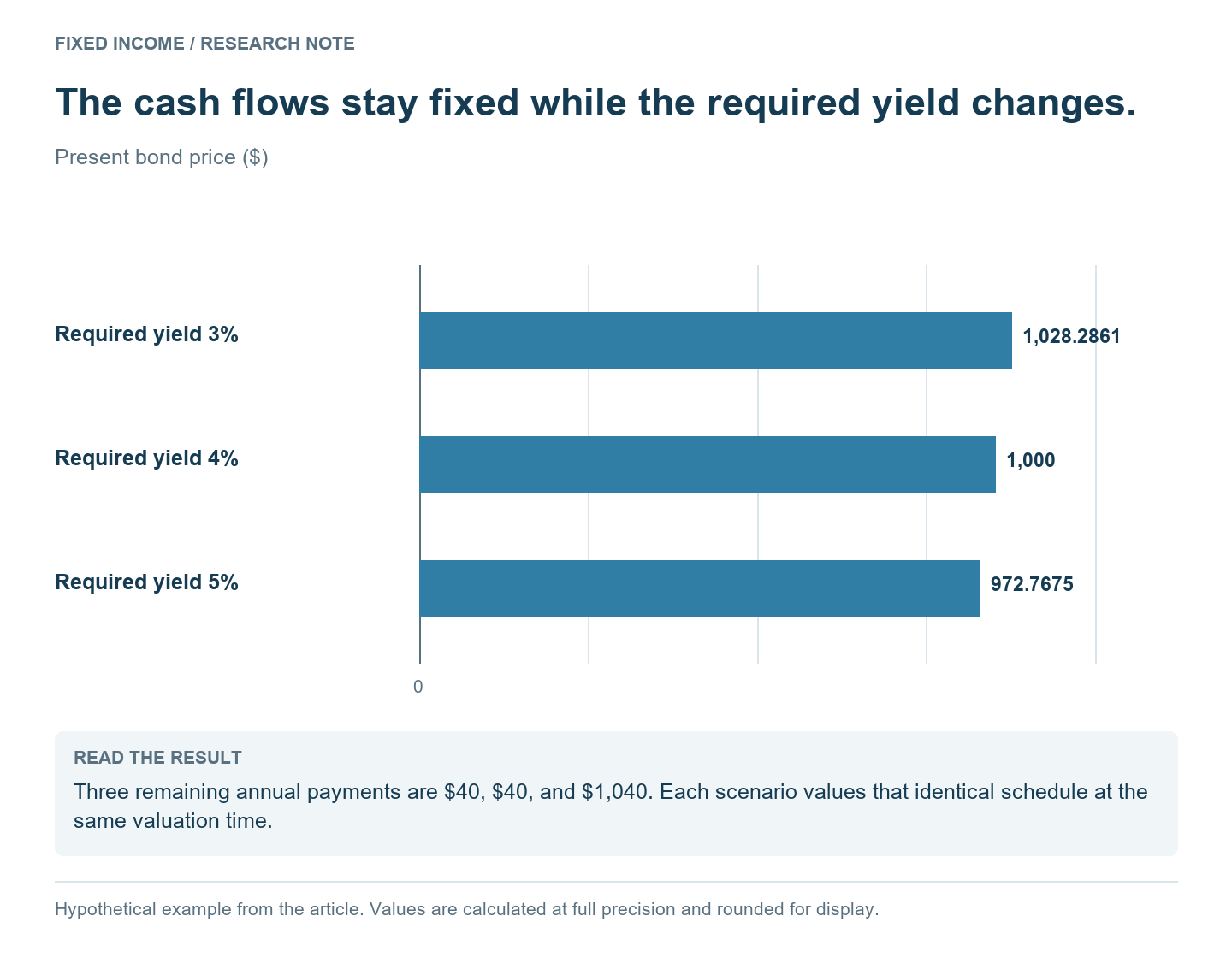
A premium buyer still receives only $1,000 of principal at maturity in this example. The yield calculation incorporates that difference. Reading the 4% coupon and treating it as the return on a $1,028.29 purchase would ignore both the higher initial outlay and the eventual decline from the premium purchase price to the principal repayment.
The upward price change when yield falls to 3% is about $28.29, while the downward change when yield rises to 5% is about $27.23. Equal yield changes in opposite directions do not produce exactly equal dollar price changes. The price-yield relationship is curved. For this option-free bond with positive payments, that curvature is positive convexity.
Convexity should not be interpreted as a promise of profit. Both alternative prices are conditional valuations of the same payments at the same instant. An investor cannot simply collect the favorable side while avoiding the unfavorable side. Future rates, transaction prices, financing needs, and changes in credit conditions still determine the realized result.
Time changes how strongly discounting matters
The effect of a higher discount rate accumulates over the time until a payment arrives. A $1,000 payment due in one year is worth approximately $952.38 when discounted at 5%. The same amount due in ten years is worth approximately $613.91 at that rate. Waiting longer creates more periods over which the discount factor compounds.
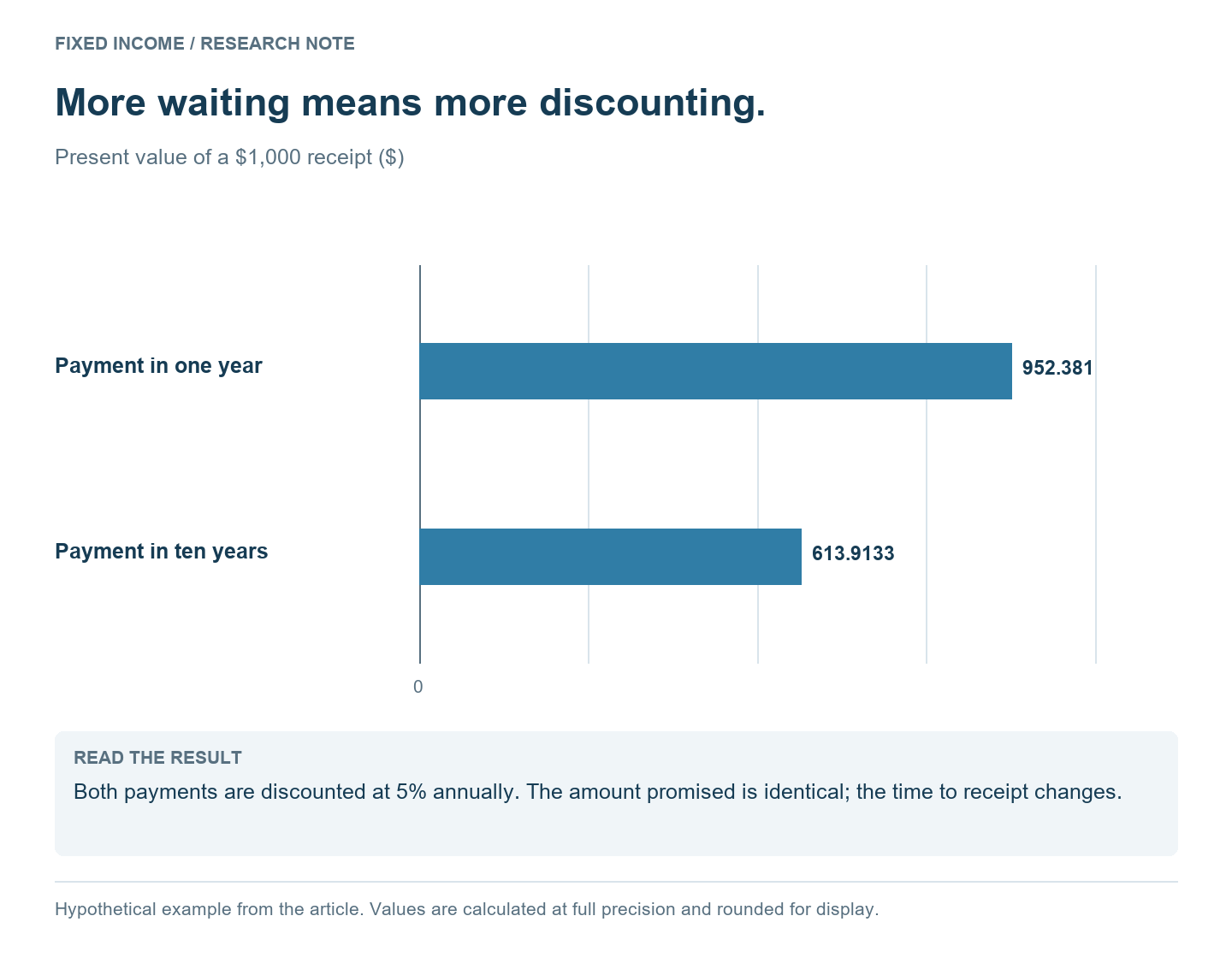
These two present values alone are not a measure of price sensitivity; they compare different payment dates. To measure sensitivity, revalue each payment at a second yield and compare its own prices. The distinction matters because a small present value and a large percentage response are different descriptions. A security's exposure depends on the timing of its full schedule, not on its face value alone.
Coupons distribute part of that schedule before the final principal payment. A bond that returns more value earlier generally has less proportional exposure to a small yield change than an otherwise comparable bond that concentrates more value later. Duration provides a formal way to summarize that timing, while a complete repricing can show the effect of a specified larger move.
Maturity remains useful, but it is not the complete explanation. Two bonds can share a maturity date while having different coupon amounts and different price responses. Amortizing instruments also return principal before the stated final date. A maturity label cannot replace a cash-flow schedule when evaluating how much money is exposed to distant discounting.
Which interest rate actually changed?
A news headline may report a change in an overnight policy rate, a two-year government yield, a ten-year government yield, or a corporate borrowing spread. These are related market quantities, but they are not interchangeable. The three-year bond needs a valuation relevant to its own payments and risks. It does not automatically adopt the change in whichever rate happens to lead the news.
Suppose a corporate bond is being analyzed with a simplified yield decomposition. A benchmark component increases by 0.40 percentage point, while the additional spread investors require narrows by 0.60 percentage point. The resulting yield falls by 0.20 percentage point in this example. Its price can rise even though the benchmark increased. The bond's own price-yield relationship has not broken.
The decomposition is a diagnostic shortcut, not a universal pricing formula. Cash flows at different dates can be discounted using different rates, and credit valuation can require assumptions about default and recovery. An observed yield to maturity compresses the price and promised schedule into one number. It does not identify the individual economic reasons that buyers accept that price.
An analyst should therefore describe both the observed change and the proposed explanation. Saying that a bond's yield rose is different from saying its price fell because inflation expectations increased. The first can be checked from the price and terms; the second requires evidence about what changed across the relevant markets and why alternative explanations are less persuasive.
Expected policy moves may already be in the price
Markets can change prices before an official decision. If buyers already expect a particular policy action, the announcement itself may add little new information. Details about the future path, economic assessment, or implementation can matter more than the headline decision. The inverse relationship cannot tell an analyst how much of a policy announcement was anticipated.
Imagine two observers who agree that a rate increase will occur but disagree about the subsequent path. One expects further increases, while the other expects the move to be temporary. They may value a multiyear bond differently even though they predict the same immediate decision. Its future payments extend beyond a single overnight-rate setting.
For this reason, a correct statement about bond mathematics does not establish a profitable forecast. Predicting a price requires a view about the future yield relevant to that instrument, the information already reflected in today's price, and the time horizon being evaluated. Knowing the direction of a conditional calculation is valuable; it is not the same as knowing which condition will occur.
Separate an immediate repricing from a year of ownership
The earlier price comparisons occurred at one valuation time. No coupon was paid and no year passed between the 4%, 5%, and 3% scenarios. A holding-period return asks a different question. It combines the sale or ending value with payments received during ownership and compares that total with the investor's actual starting outlay.
Suppose an investor buys the bond for $1,000 at its 4% yield and holds it for one year. Immediately after receiving the $40 coupon, the bond has two years remaining. If its required yield is then 5%, the remaining payments are worth approximately $981.41. The year's coupon plus ending value total approximately $1,021.41, producing a return of about 2.14% before costs and taxes.
That positive return coexists with a lower ending bond price. The coupon more than offsets the price decline over this particular holding period. Calling every decline in a bond's quoted price a negative total return would miss the cash payment. Conversely, a coupon can be smaller than a price decline, leaving a negative total return even though the issuer paid on time.
Now consider a different investor who initially buys the same three-year schedule for its full-precision 5% yield price of approximately $972.77. If the yield remains 5% for a year, the two-year remaining price is approximately $981.41. Adding the $40 coupon produces a one-year return of exactly 5% before rounding, costs, and taxes. The different starting price explains the different outcome.
Why holding to maturity changes the question
A holder who can keep the bond until maturity may not need to realize an intermediate market-price decline. Under the example's assumptions, the scheduled payments remain available on their specified dates. This can be useful when those dates align with a known spending requirement. It does not mean that the market value stopped changing or that the investor faced no opportunity cost.
The conditions matter. The issuer must make the payments, the bond must not contain an exercised option that changes the schedule, and the holder must avoid an unexpected need to sell. A plan that depends on never selling is only as reliable as the cash reserves and circumstances supporting that plan. A contractual maturity date cannot eliminate an unrelated liquidity need.
Inflation adds another distinction. Receiving the promised number of dollars does not establish what those dollars will purchase. The discounting example concerns nominal cash flows and nominal yields. A household planning a future expense may also need to consider changes in that expense, which need not match a broad inflation measure or the bond's fixed coupon rate.
Reinvestment can move in the opposite direction
Higher yields can reduce the market value of existing fixed payments while improving the terms available for reinvesting future receipts. Lower yields can increase the current bond price while making later reinvestment less attractive. The importance of each effect depends on the holding horizon, coupon schedule, and intended use of the cash.
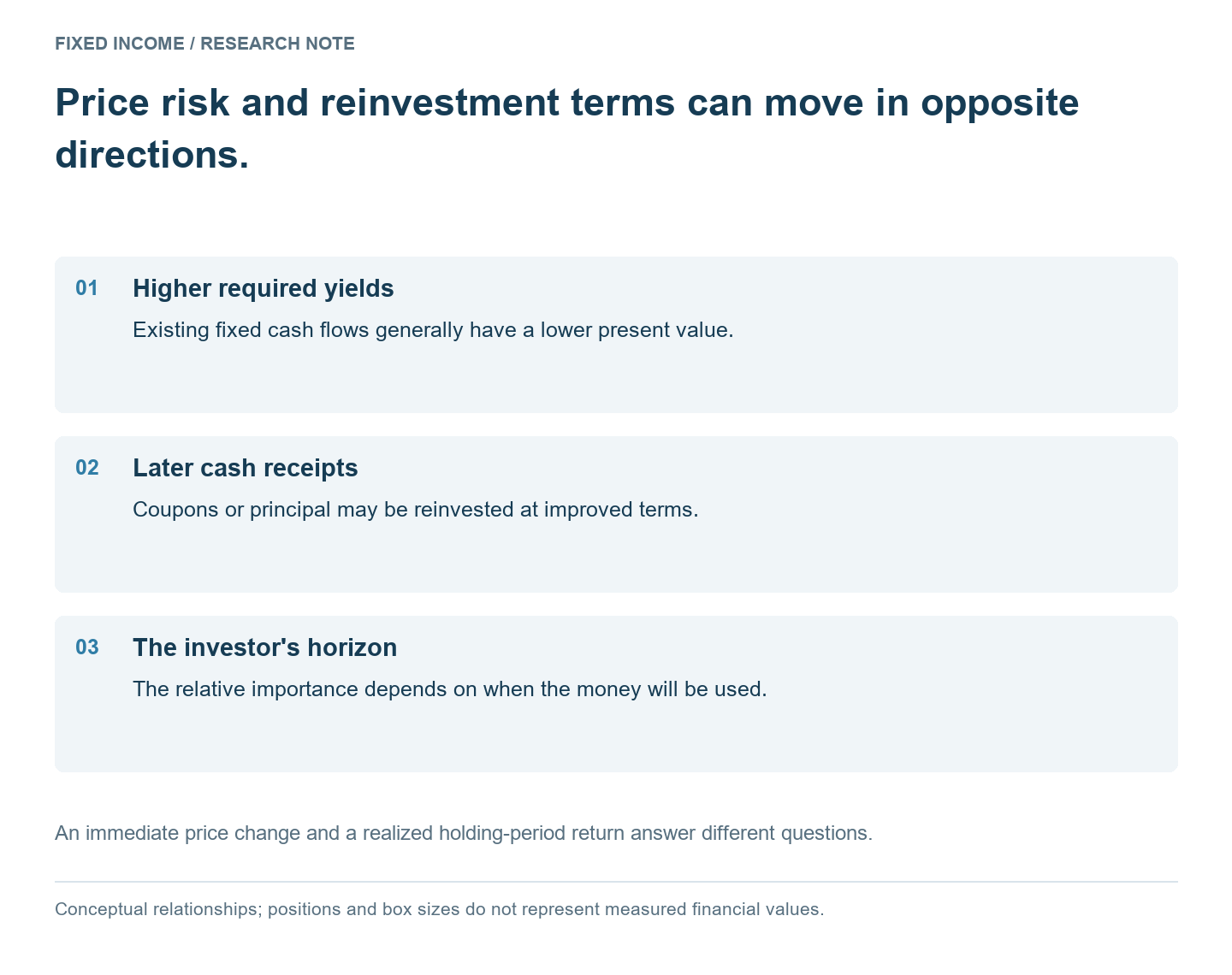
In the three-year example, the first $40 coupon arrives before the final maturity date. If the investor wants to accumulate all proceeds until maturity, that coupon's subsequent earnings depend on reinvestment opportunities. The original yield to maturity is the internal discount rate of the promised schedule. Converting it into a compound terminal-wealth outcome requires an additional reinvestment assumption for interim payments.
This is why an initial yield should not casually be presented as a guaranteed annual account balance increase. Price changes matter before maturity; reinvestment matters for cash received along the way; default or contractual changes can alter the payments themselves. An exact valuation formula remains exact only for the quantities and assumptions it actually describes.
Clean prices and payment dates require consistent comparisons
Real quotations often separate the clean price from accrued interest. The settlement amount generally combines the quoted price with the applicable accrued interest, subject to the market's conventions and any fees. The example avoids that complication by placing valuation on a coupon date. Applying its result to an actual trade requires checking the settlement timing rather than assuming the displayed quote is the entire cash outlay.
A price chart can also show a mechanical decline around a coupon payment when viewed on a basis that includes accrued interest. Some value has moved from the security into cash received by the holder. Comparing only the security values across that date can mistake a transfer into cash for an economic loss. Total-return analysis must include the payment consistently.
Units create another common mistake. A quote of 97 may mean 97% of face value, rather than a $97 price for an entire bond with $1,000 principal. Yield figures may use different compounding conventions, especially across markets. Before comparing two numbers, align face amounts, dates, quotation bases, and payment frequencies. Apparent precision does not repair mismatched inputs.
When the plain-bond explanation needs modification
A callable bond gives the issuer a contractual ability to repay under specified conditions. Falling rates can make that option more relevant, limiting how far the price rises relative to an otherwise similar noncallable bond. The future schedule may no longer remain unchanged across the scenarios. A simple fixed-payment comparison therefore misses an important part of the valuation.
Floating-rate instruments present a different issue: future coupons may reset with a reference rate. Inflation-linked instruments can adjust specified amounts according to their terms. Securities with uncertain repayment or recovery need explicit credit assumptions. These structures do not make present-value reasoning obsolete; they require the analyst to model the payments that the structure can actually produce.
An investment fund adds portfolio activity, expenses, and distributions to the analysis. Its holdings may mature, be sold, or be replaced. A fund does not necessarily deliver the same fixed terminal payment as an individual bond kept to maturity. Understanding its exposure requires examining the portfolio and mandate rather than transferring the three-year example unchanged to the fund's share price.
A discount is not automatically a bargain
Compare the original 4% coupon bond with another three-year bond that pays $50 annually and returns the same $1,000 principal. Give both identical credit quality, payment dates, and contractual terms. At a 5% required yield, the second bond is worth $1,000, while the original bond is worth approximately $972.77. The cheaper security does not automatically offer the better deal.
The difference consists of three additional $10 payments from the higher-coupon security. Discount those differences at 5% for one, two, and three years. Their combined present value is approximately $27.23, exactly the price gap before rounding. The higher price purchases additional cash flows. Both securities have the same yield in this deliberately controlled comparison, despite their different coupons and quoted prices.
An investor who simply selects the lower dollar price would overlook what is being purchased. Another investor who selects the larger coupon would overlook the extra amount paid to obtain it. The comparison should begin with equivalent face amounts and complete payment schedules, then consider whether the timing of those payments fits the intended use of the money.
Real securities will rarely match this neatly. A higher yield may compensate for weaker credit, less liquidity, an unfavorable option, or a different tax treatment. A lower price can also reflect a longer wait for principal. Once those differences are identified, the analyst can ask whether the compensation is sufficient. The word discount describes a relationship to face value; it is not a conclusion about investment merit.
A practical way to test understanding
Begin with the payment schedule and ask which input a proposed scenario changes. If only the discount yield rises while positive cash flows and their dates stay fixed, the price falls. If the story changes credit quality, an issuer option, or a coupon reset as well, identify those changes separately. This prevents a complicated security from being reduced to one oversimplified slogan.
Next identify whether the question concerns an instantaneous price change or a return over time. For the first, compare valuations at the same date. For the second, include cash paid during the interval, the actual purchase outlay, and the remaining security value. A correct answer to one question can be a wrong answer to the other without any arithmetic error.
Finally, write down what would invalidate the conclusion. A benchmark move may be offset by a spread move; an anticipated policy action may deliver little surprise; a call can alter the schedule; an urgent sale can make an interim price important. The useful skill is not predicting that every rate headline must produce a particular trade. It is explaining exactly which cash flows, discount rates, and dates connect a change in yield to a change in value.
Related research

ResearchFixed Income
Coupon, Current Yield, and Yield to Maturity Answer Different Questions
Several percentages can describe the same bond without contradicting one another. A complete comparison begins by identifying the cash flows, denominator, time horizon, and assumptions behind each measure, then checking whether the measure answers the investor's actual question.

ResearchFixed Income
A Bond Is a Schedule of Cash Flows
A bond becomes easier to understand when its payments are placed on a timeline. Face value, coupon, purchase price, maturity, and credit quality each describe a different part of that timeline, and none should be mistaken for a complete measure of return.

ResearchFixed Income
Duration Is an Approximation, Not a Complete Stress Test
Duration translates a small change in yield into an approximate change in bond value. A useful risk assessment also considers curvature, different movements along the yield curve, credit spreads, contractual options, liquidity, and the timing of the investor's obligations.