
ResearchMarket Sentiment
A Research Journal Can Expose Hindsight Bias
- Report or archive date
- Archive placement October 23, 2026
- Reading time
- 13 min read

Summary
A useful research journal preserves what was believed before the outcome, including uncertainty and the conditions that would change the view. It helps separate forecast quality, decision quality, and investment results without rewriting the original thesis after events become clear.
Memory is an unreliable archive of uncertainty
After an event occurs, its path can feel more obvious than it did beforehand. The warning signs seem easier to recognize, alternative outcomes fade, and a cautious possibility can be remembered as a confident prediction. This is one reason a research process needs a record that does not depend entirely on memory.
A journal is not useful merely because it contains many pages. Its value comes from preserving the information available at the decision time, the reasoning connecting that information to a view, and the uncertainty that remained. Without those elements, a journal can become a collection of persuasive explanations written after the fact.
The objective is not to prove that the writer was right. It is to make learning possible. A clear record can reveal that a profitable outcome came from a different mechanism than expected, or that an unprofitable outcome followed a reasonable process under genuine uncertainty.
Begin with a question that can be resolved
The subject is an industrial equipment supplier preparing a new production line. The journal's first question is specific: will the line complete the defined qualification process by September 30? Completion means documented acceptance under the specified qualification standard, not a management statement that work is progressing.
That definition matters. A vague prediction that the project will succeed eventually cannot be evaluated fairly if the author can extend the deadline indefinitely or change what success means. A usable forecast needs an event, a horizon, and a resolution criterion.
The investment thesis is broader than this single event. It may also involve demand, margins, funding, and valuation. Keeping the milestone forecast separate prevents the writer from claiming the whole investment thesis was correct merely because one operational event occurred.
A journal can contain several questions, but each should have a clear role. Some concern the business, some concern valuation, and some concern the decision itself. Combining them into one broad statement such as this is an attractive company makes later review unnecessarily ambiguous.
Entry one: preserve the original belief
In the August 1 entry, the analyst assigns a 60% probability to qualification by September 30. The stated reasons are that two required tests are complete and the remaining supplier delivery is scheduled before the deadline. The main uncertainty is whether the final integration test will reveal a redesign need.
The entry records a competing explanation: management's schedule may be achievable only if each remaining step proceeds without meaningful delay. Under that alternative, the existing progress is real but the timeline lacks a sufficient buffer. The analyst does not treat the alternative as impossible simply because it is not the preferred case.
The entry also specifies what would change the forecast. Evidence of a delayed critical component or a failed integration test would reduce the probability. Documented completion of the remaining test would increase it. A repeated statement of confidence without new operating evidence would not, by itself, justify a revision.
This entry is useful because it preserves uncertainty and the reason for the estimate. The 60% figure is still a judgment, not a measured frequency. Writing it down does not make it accurate. It makes the judgment available for a later comparison with evidence and outcome.
Entry two: record an update without erasing the first entry
On August 20, the critical component is reported delayed. The analyst reduces the probability of qualification by September 30 from 60% to 35%. The journal records which fact changed, why it affects the schedule, and which parts of the broader business thesis remain unchanged.
The original August 1 forecast remains visible. Replacing it with the August 20 estimate would hide the fact that the analyst initially assigned a higher probability. Both forecasts can be evaluated, but they were made with different information and at different distances from the deadline.
The update also distinguishes a forecast revision from a decision revision. New information can reduce confidence without immediately requiring a transaction if the position, price, and constraints still fit the decision rule. Conversely, a price change can alter the investment choice even when the operating forecast is unchanged.
A timestamped update preserves that distinction. It shows whether the analyst responded to new evidence, to a changed price, or simply to discomfort after a market move. Those are different reasons, and they should not be blurred into a single statement that the thesis evolved.
Entry three: resolve the defined event
In the record, the line is not qualified by September 30. It completes qualification on October 12. The original event resolves as not occurring, because the deadline was part of the definition. The later completion is a separate fact relevant to the ongoing business analysis.
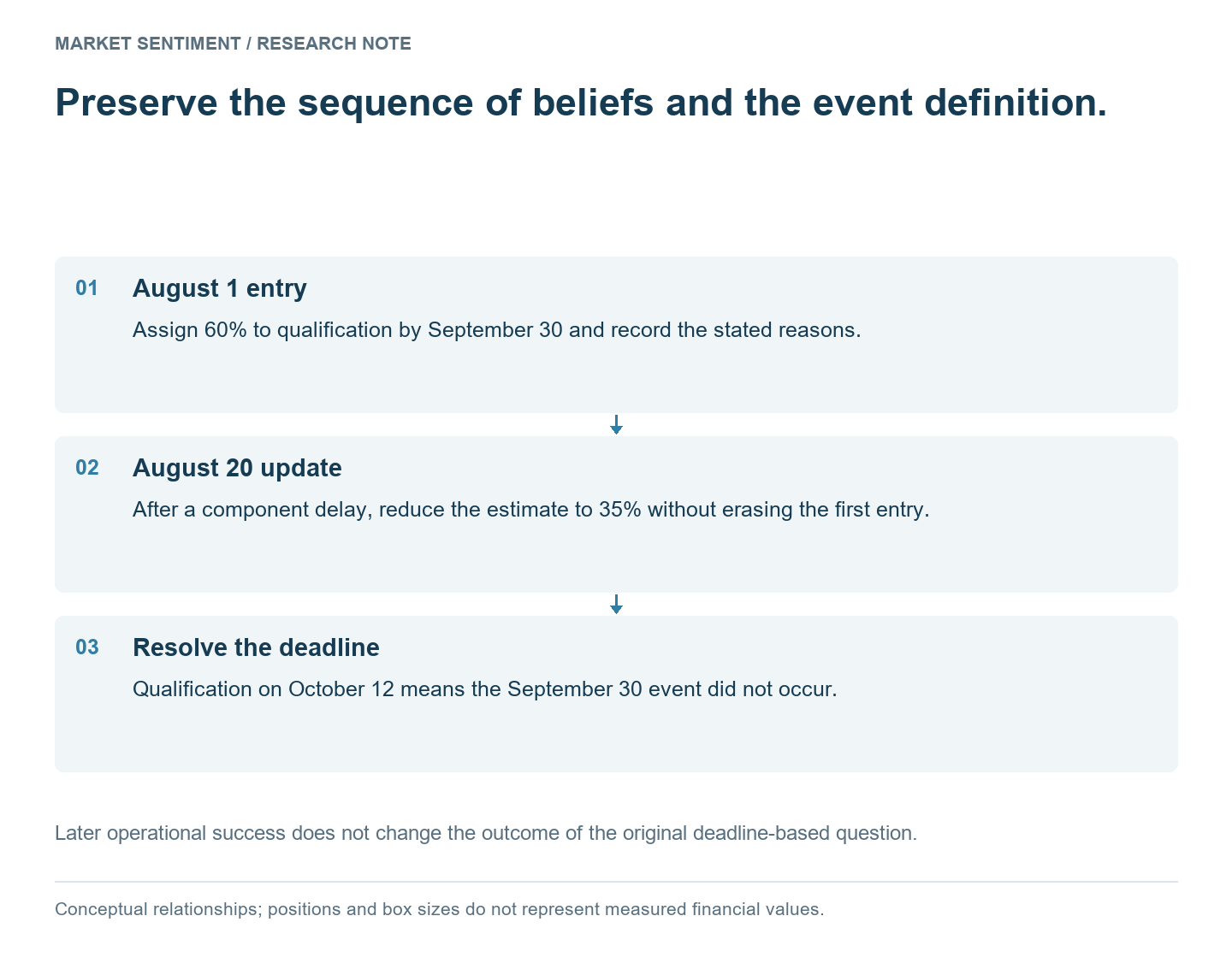
It would be misleading to mark the September forecast correct because the line eventually qualified. It would also be misleading to describe the entire project as a permanent failure because it missed the original deadline. The record needs both facts: a missed forecast horizon and a later operating achievement.
The review asks whether the delay mechanism was anticipated and whether the probability updates were proportionate to the evidence. It also asks whether the financial consequences of the delay were assessed correctly. A schedule forecast can be wrong while the estimated funding cushion remains adequate, or right while the cost estimate proves weak.
This separation produces a more useful lesson than a single success or failure label. It allows the analyst to identify which component of the reasoning needs improvement instead of defending or discarding the entire thesis as one indivisible story.
Score a probability without pretending one event proves skill
For a binary event, one version of the Brier score is the squared difference between the forecast probability and the outcome, where the outcome is one if the event occurs and zero otherwise. Scores range from zero to one under this single-event convention, with lower values better.
The August 1 forecast assigned 0.60 to an event that did not occur by the deadline. Its score is 0.36. The August 20 forecast assigned 0.35, producing a score of 0.1225 for the same eventual outcome. The later forecast was closer to the realized result, but it also had more information and a shorter horizon.
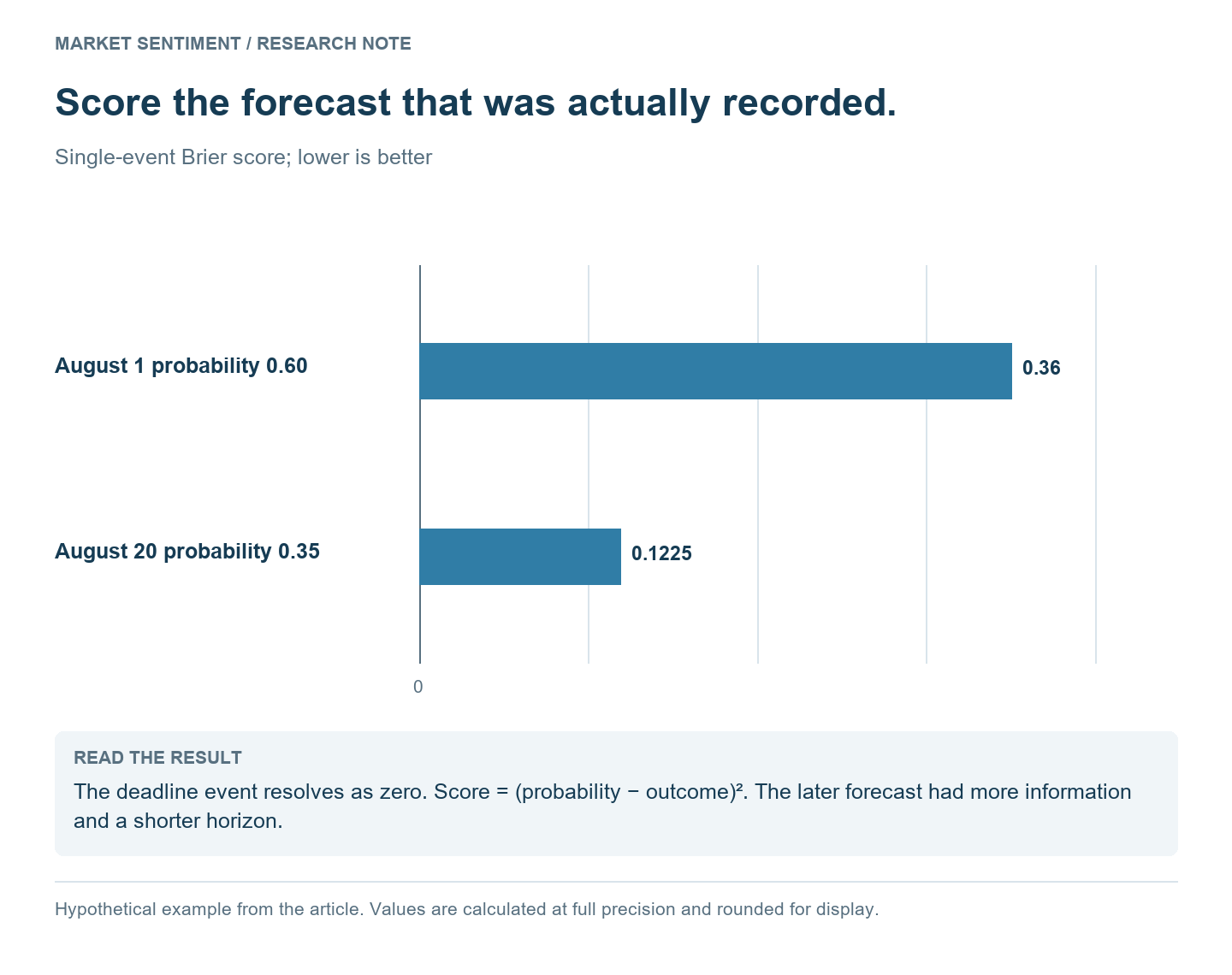
A 95% forecast of the missed event would score 0.9025. That larger penalty reflects greater confidence in an outcome that did not happen. However, one event cannot establish whether a forecaster is systematically overconfident or underconfident.
A 60% forecast should sometimes be followed by failure. Calling every such failure a bad forecast would reward excessive certainty about the outcome after it is known. Forecast quality requires a collection of clearly defined, comparably evaluated predictions, not a verdict based on one memorable case.
Evaluate a set without changing the scoring rule
Suppose six separate forecasts each assign a 70% probability to a binary event. Four events occur and two do not. Under the same Brier convention, each success contributes 0.09 and each failure contributes 0.49. The average score is approximately 0.2233.
A preselected benchmark that assigned 50% to each of those six events would score 0.25. The 70% forecasts score better in this small constructed sample. That arithmetic does not establish statistically reliable forecasting skill or show that the same approach will work elsewhere.
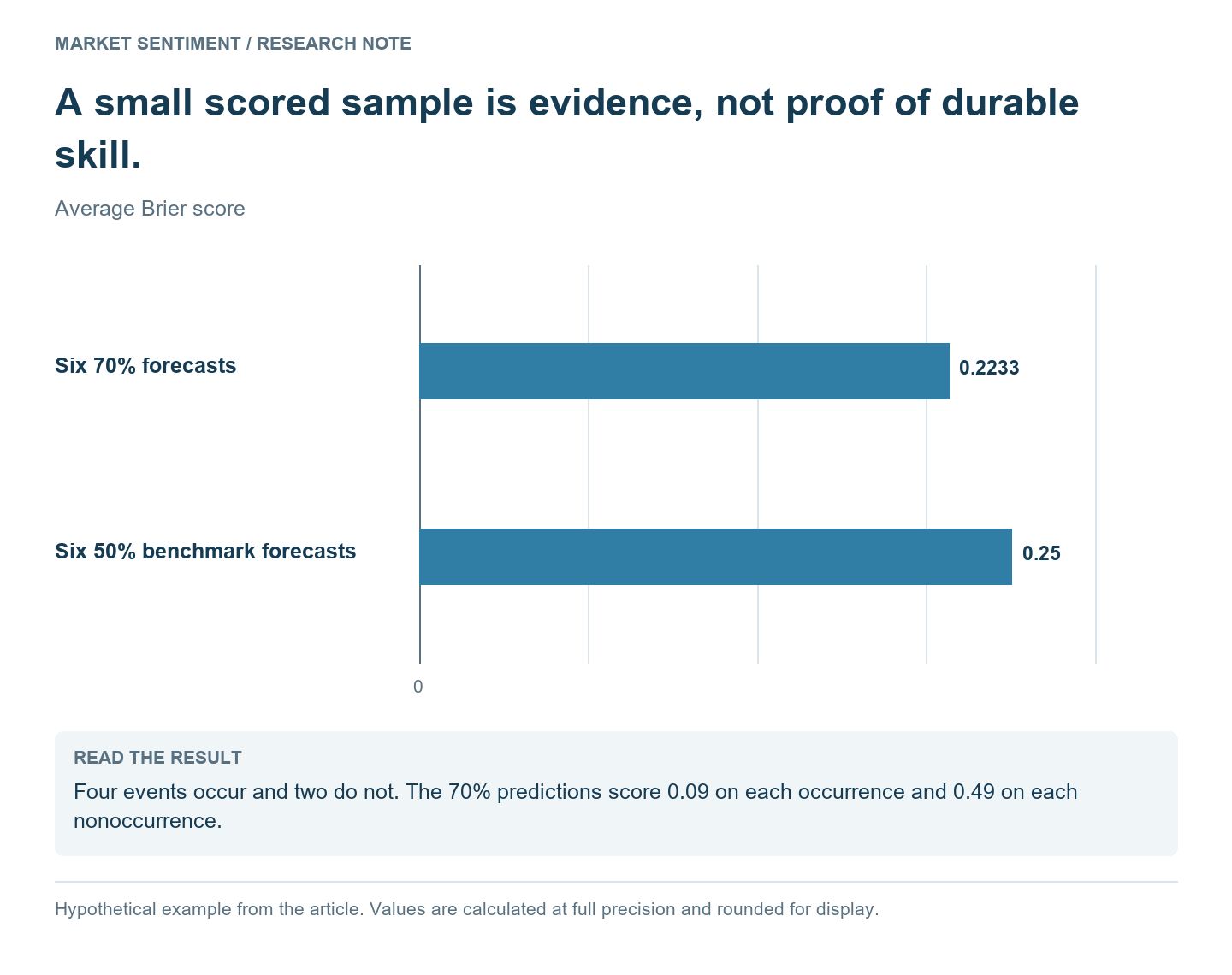
The observed success rate is approximately 66.67%, but six observations are too few to treat the difference from 70% as a precise measure of calibration. One outcome changes the sample frequency by approximately 16.67 percentage points. The sample's granularity should temper the interpretation.
Keep the event definitions, scoring rule, and benchmark fixed before reviewing the results. Selecting only favorable forecasts, changing deadlines after the event, or choosing a benchmark because it performs poorly in the completed sample would undermine the exercise. A journal should make those choices visible.
Repeated updates are not independent forecasting successes
The two production-line forecasts concern the same eventual event. Scoring both can show how the estimate changed, but treating them as two independent tests would exaggerate the amount of evidence about skill. Daily updates to one event can create many journal rows without creating many independent outcomes.
Choose a consistent evaluation design. One approach is to compare forecasts made at a fixed distance from their deadlines. Another is to evaluate a defined sequence of updates while keeping event-level dependence visible. The important point is to decide the convention before selecting which entries to report.
Closely related events can create a similar issue. Qualification of a component, completion of an integrated test, and final delivery may depend on the same underlying problem. Success on all three is not necessarily three independent confirmations of a general forecasting ability.
The journal can preserve those relationships by identifying a shared project or causal assumption. A review can then examine both individual questions and the broader cluster. This is particularly useful when a portfolio contains several companies exposed to the same spending cycle or policy development.
Missing and unresolved forecasts also need a policy. If a deadline has not arrived, the outcome should remain unresolved. If the original event definition proves ambiguous, record the ambiguity and improve future definitions rather than quietly choosing whichever interpretation produces a favorable score.
These practices make the record less flattering but more informative. The aim is to understand performance under comparable information and uncertainty, not to maximize the number of entries that can be labeled correct.
Forecast accuracy is not the same as investment profitability
An accurate business forecast can still support a poor investment if the price already reflects the favorable outcome. An inaccurate forecast can accompany a profit if another development raises the share price. The journal should track the operational prediction and the investment return separately.
In the production-line case, the share price might rise for an unrelated reason even though qualification is delayed. That would not make the deadline forecast correct. It might reveal that the analyst misunderstood which developments mattered most to the price.
Likewise, the milestone could be achieved on schedule while the stock falls because the result was already anticipated or the broader outlook deteriorated. A price loss would not erase the factual success of the operating forecast. It would prompt a review of valuation and the other exposures.
This is why a research journal needs a causal account, not only a return number. Record what the position was expected to earn from, what actually changed, and whether the observed outcome supports the proposed mechanism. A profitable coincidence is different from evidence that the reasoning worked.
Decision quality includes position size and constraints
Suppose a portfolio has $200,000 and allocates $10,000 to the equipment supplier. The position is 5% of the portfolio. An assumed 25% position loss would reduce the portfolio by $2,500, or 1.25%, if all other holdings were unchanged and no other costs applied.
Doubling the position to $20,000 would make it 10% of the portfolio and turn the same 25% position loss into a $5,000 reduction, or 2.5% of the portfolio. The business forecast has not changed in this comparison, but the consequences of being wrong have doubled.
The journal should therefore preserve the decision rule as well as the thesis. What loss or liquidity need was considered? Was the position consistent with the portfolio's other exposures? What assumptions about financing or execution mattered? These questions concern the quality of the decision made under uncertainty.
The 25% loss is a scenario, not a maximum possible loss or a guaranteed execution level. Actual prices can move further, and an order may not execute at a desired price. A sound record should not confuse a planning scenario with an enforceable boundary on investment risk.
A good outcome can conceal a poor process
Imagine an analyst ignores a known funding problem, exceeds the stated position limit, and earns a profit after an unexpected favorable event. The profit is real, but it does not validate the ignored risk or the violation of the decision rule. Repeating the same process may expose the portfolio to outcomes the analyst did not evaluate.
The reverse is equally important. A carefully researched decision can lose money when an adverse but plausible scenario occurs. The review should ask whether the risk was identified, appropriately priced, and sized within the intended constraints, rather than treating the loss alone as proof of incompetence.
This does not excuse every bad result as bad luck. A process can be flawed because it used weak evidence, ignored alternatives, or relied on inconsistent assumptions. The point is to evaluate those features directly instead of allowing the final return to decide how the earlier reasoning is remembered.
A useful review can hold two judgments at once: the outcome was disappointing, and the process was reasonable; or the outcome was favorable, and the process needs correction. That distinction is central to learning from uncertain decisions.
Write the strongest alternative before the outcome
A journal that records only supporting evidence can make the preferred conclusion seem inevitable. Include the most credible competing explanation and the observations that would favor it. The goal is not to invent a weak objection that is easy to dismiss.
For the equipment supplier, an alternative might be that delivery growth reflects an unusually concentrated order cycle rather than a durable expansion. Another might concern the cost of supporting installed systems. Each alternative should connect to observable consequences rather than remain a vague warning that something could go wrong.
When evidence arrives, compare it with both explanations. A delayed component may affect the timing hypothesis without resolving the demand hypothesis. A strong order announcement may support demand while leaving margins uncertain. The journal should allow partial updates instead of forcing every observation into a complete reversal or complete confirmation.
This structure makes disagreement productive. It identifies what different views assume and what evidence would separate them. It also reduces the temptation to claim after the outcome that an alternative was always the main thesis when the original record shows otherwise.
Record the missing information as carefully as the known facts
Research often proceeds with incomplete information. The journal should identify the missing items that could materially change the conclusion: contract terms, remaining project costs, timing of collections, or the amount of funding available for a delay. An unknown is not a zero, and it is not automatically favorable.
The response depends on the importance of the gap. Some missing details can be represented with a range of scenarios. Others may prevent a useful valuation or make the proposed decision premature. Recording that limit is more informative than filling the gap with a precise number that lacks support.
Also distinguish unavailable evidence from evidence not yet checked. The first is an external information limit; the second is unfinished research. Treating them as the same can allow avoidable omissions to become permanent assumptions.
When later information resolves a gap, update the record without rewriting the earlier state of knowledge. The review can then assess whether the original decision handled uncertainty sensibly or depended on an assumption that should have been verified first.
Separate changes in the world from changes in the explanation
A thesis can legitimately change when the business changes. New contracts, cost structures, financing terms, or competitive conditions can alter the investment case. The journal should describe the new facts and explain how they affect the original reasoning.
A different problem arises when the explanation changes only to defend an existing position. A short-term valuation thesis becomes a permanent strategic holding after a decline; a failed demand forecast becomes a story about technology's eventual importance. Those changes may be defensible, but they require a new decision rather than an unacknowledged rewrite.
Ask whether the revised thesis would justify the position if it were being considered for the first time at the current price. That question does not automatically dictate a trade. It helps separate a forward-looking assessment from the desire to preserve consistency with an earlier choice.
The original journal entry remains useful even when the thesis evolves. It shows what changed, what was learned, and which assumptions failed. Removing it would make the process look smoother while making the learning less reliable.
Close the review with a specific process change
A review that ends with be more careful is difficult to apply. Identify a change connected to the observed weakness: distinguish a target from a verified milestone, preserve the pre-release forecast, reconcile a cash-flow gap, or compare the proposed position with existing exposures.
Avoid designing a new rule solely to prevent the last loss. A rule that perfectly avoids one historical outcome may create other problems or fit noise. Ask whether the change addresses a repeatable reasoning error and whether it can be evaluated on future decisions.
The journal should remain usable. A concise entry with a clear question, evidence, alternatives, probability or scenario, decision, and review is more valuable than pages of copied commentary. The record's purpose is to preserve the logic of the decision, not to demonstrate how much material was collected.
Over time, that record can reveal patterns in judgment: forecasts that are consistently too confident, costs that are repeatedly underestimated, or situations in which the analyst has little useful advantage. It can also show when uncertainty was handled well despite an unfavorable outcome. The benefit is a more honest account of learning, with less room for the past to become obvious only after it happened.
Related research

ResearchMarket Sentiment
One Labor Release Should Not Become a Complete Market Narrative
A labor report contains several measures of jobs, people, hours, and pay. Reading them together helps distinguish competing economic explanations without turning one monthly estimate into a complete forecast of growth, inflation, policy, or asset returns.

ResearchMarket Sentiment
Building a Sentiment Checklist That Can Say I Do Not Know
A useful sentiment checklist organizes evidence without forcing it into a bullish or bearish verdict. It keeps measures, horizons, populations, and uncertainty distinct, then specifies when the available information is insufficient for the proposed conclusion.

ResearchMarket Sentiment
Surprise Depends on the Expectation That Came Before It
A policy decision is not surprising merely because it changes an interest rate. Surprise is a comparison with a prior expectation, and the immediate decision, the future policy path, and uncertainty about that path can change in different ways.