
ResearchFixed Income
Accrued Interest Explains the Difference Between Two Bond Prices
- Report or archive date
- Archive placement August 4, 2026
- Reading time
- 13 min read

Summary
A bond's quoted price may exclude interest already earned during the current coupon period. Following one purchase through settlement, resale, and a coupon date shows how to reconcile the quote with cash paid and investment performance.
The quote and the cash amount answer different questions
A bond screen shows a price of 102.25. An investor intends to buy $10,000 of face value and calculates a cost of $10,225. The confirmation then shows a larger amount. That difference is not necessarily a hidden price increase. For an ordinary coupon-paying bond quoted without accrued interest, the settlement amount adds the interest attributable to the elapsed portion of the current coupon period.
The quoted amount excluding accrued interest is commonly called the clean price. The amount including accrued interest is the full or dirty price. “Dirty” is simply a market term; it does not imply that the price is unreliable. Separate commissions or other transaction charges may increase the final cash outlay further.
These distinctions are easiest to understand by following actual cash entitlements. A conventional issuer generally pays a full coupon on the scheduled payment date rather than dividing it between everyone who owned the bond during the period. When a bond changes hands between payments, the settlement calculation ordinarily compensates the seller for the elapsed accrual, while the buyer acquires the entitlement to the next payment under the security's applicable rules.
The practical task is therefore to connect three quantities: the quoted price, accrued interest, and total settlement cash. Reading any one without the others can distort a comparison, a return calculation, or the amount needed to complete a purchase.
Specify the bond before doing the arithmetic
Consider a fixed-rate bond with $10,000 face value and a 6% annual coupon. It pays $300 every January 15 and July 15. Its principal remains unchanged throughout the example. It is performing normally, has regular coupon periods, and is assumed to transfer the next coupon entitlement to the buyer. There are no unusual first coupons, ex-coupon complications, or delayed payments.
The bond uses a specified 30/360 accrual convention. For the ordinary dates chosen here, each month contributes thirty days and the half-year coupon period contains 180 convention days. We deliberately avoid month-end and February cases, where the precise version of a day-count convention matters. A real calculation must use the security's documented terms rather than infer them from a broad label.
The trade settles on April 15, 2026. The previous coupon date was January 15, and the next is July 15. Under our convention, ninety days have accrued out of the 180-day period. The clean quote is 102.25 per $100 of face value. It is a percentage-of-face quotation, not a price of $102.25 for the entire position.
Calculating yield to maturity requires the maturity date and the full remaining payment schedule.
Reconcile the purchase one line at a time
The annual coupon cash is $10,000 multiplied by 6%, or $600. Semiannual payments divide that into two regular coupons of $300 each. Accrued interest at April 15 is $300 multiplied by ninety divided by 180, which equals $150.
The clean principal-price component is $10,000 multiplied by 102.25 divided by 100, or $10,225. Adding the $150 accrued interest gives a full settlement value of $10,375 before transaction charges. If the transaction also carries a separately stated $25 commission, the total cash required is $10,400.
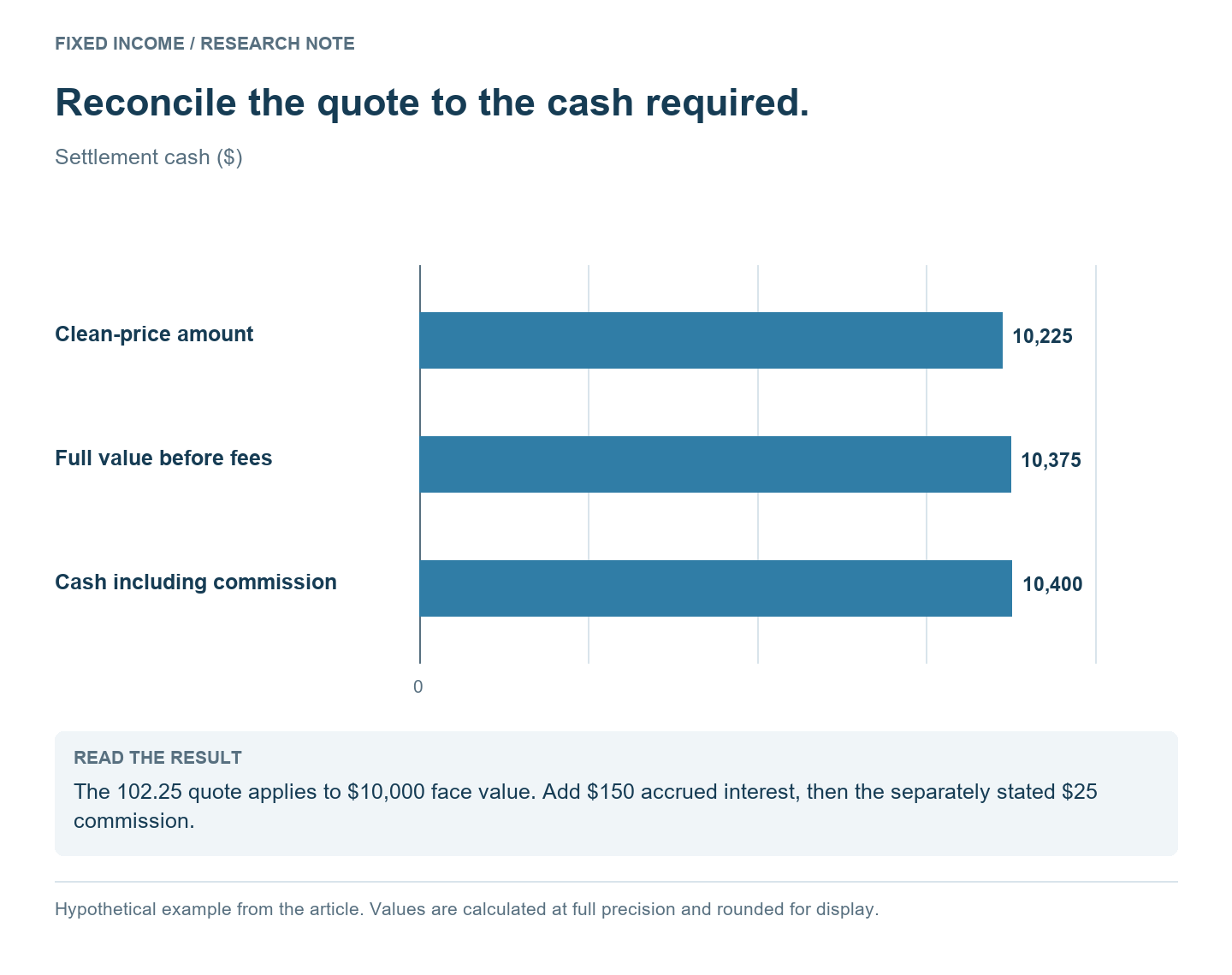
The same reconciliation can be expressed per $100 face value. The clean price is 102.25, accrued interest is 1.50, and the full price is 103.75. Multiplying 103.75 by one hundred gives $10,375 because the $10,000 position contains one hundred units of $100 face value. Mixing a per-$100 accrued amount with a whole-position price is a common source of a hundredfold error.
The $150 is not an additional coupon paid by the issuer. It is cash transferred from buyer to seller as part of this transaction. Nor is the $225 clean-price premium the same thing as accrued interest. The premium reflects the quoted price above face value; accrued interest reflects the elapsed portion of the coupon period under the specified convention.
Why the next coupon is not entirely new income
Suppose the buyer holds the position through July 15 and receives the full $300 coupon. Half of that cash corresponds to the $150 accrued interest paid at purchase. Treating all $300 as income earned during the April-to-July holding period would ignore that initial payment and overstate the economic result.
For a deliberately simple example, assume the clean price remains 102.25 on July 15 immediately after the coupon is paid. This is a stated price assumption, not a claim that an unchanged yield always produces an exactly unchanged clean price. Accrued interest has reset to zero, so the bond's full value is then $10,225.
Add the $300 cash coupon to that ending value and subtract the $10,375 initial full value. The pre-cost gain is $150. Relative to the starting full value, the holding-period return is approximately 1.4458%. It is not an annualized return, and it is not the 6% coupon rate. The example isolates the remaining half-period accrual while holding the clean price constant.
If the clean price falls, the gain can shrink or turn into a loss. If the issuer fails to pay, the expected coupon does not become cash merely because accrued interest was recorded. Accrual is part of the agreed pricing convention; it is not a separate guarantee of payment.
A resale before the coupon date
Now use a different outcome from the same April 15 purchase. Instead of holding through July, the investor sells with settlement on June 15. Under the chosen 30/360 convention, 150 days have elapsed since January 15. Accrued interest is therefore $300 multiplied by 150 divided by 180, or $250.
Assume the sale's clean quote is 101.75. The clean-price component is $10,175, and the full sale value is $10,425 before transaction charges. No coupon has been received during the holding period. Subtracting the $10,375 full purchase value produces a pre-cost gain of $50, or approximately 0.4819% of the initial full value.
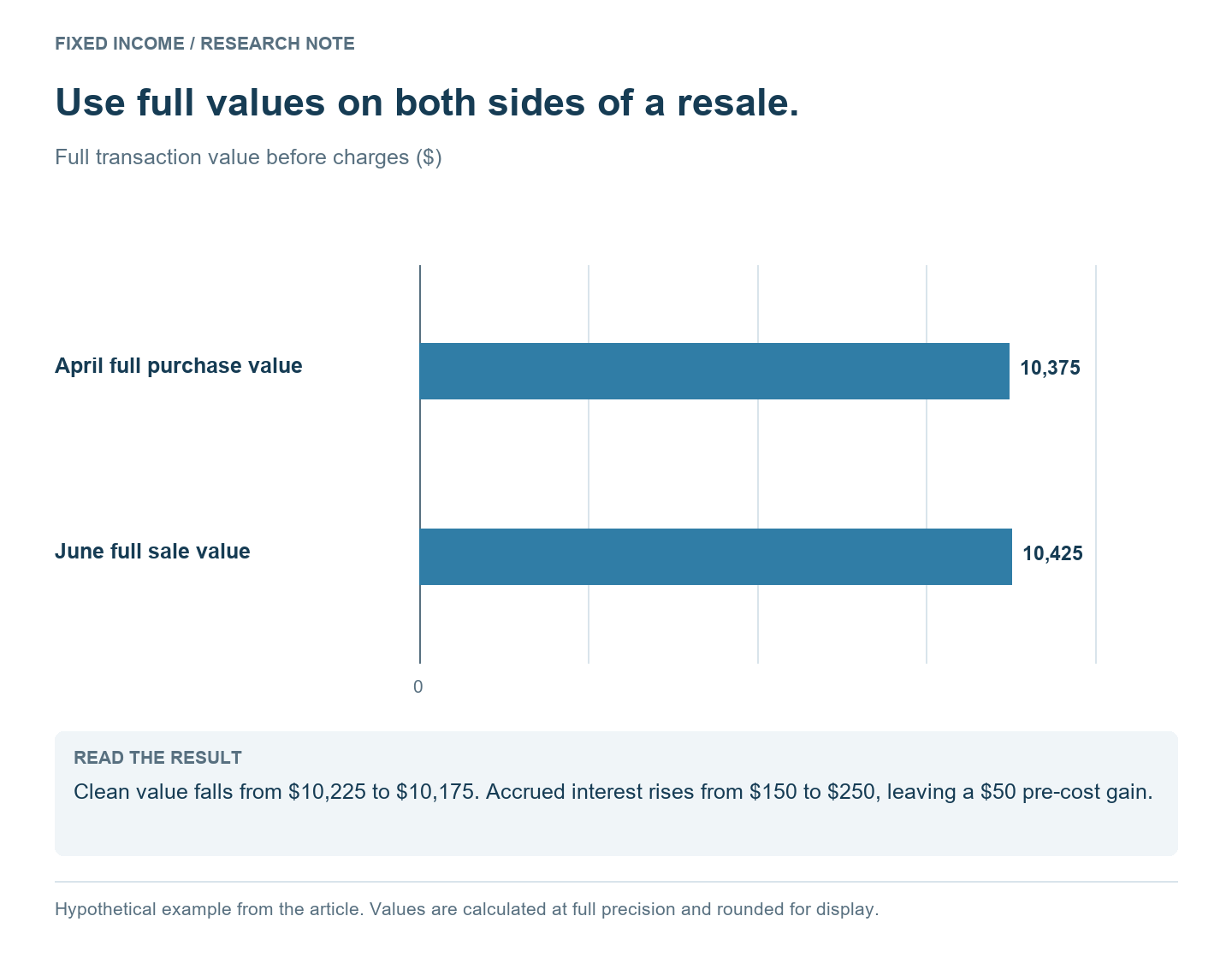
The result can be reconciled another way. The clean-price component fell by $50, from $10,225 to $10,175. Accrued interest increased by $100, from $150 to $250. The net gain is $50. Looking only at the clean quote would report a price decline and miss the accrual earned during the holding period.
If separate $25 commissions apply to both purchase and sale, the cash paid is $10,400 and the net sale proceeds are also $10,400. The net gain becomes zero in this transaction. Accrued interest explains part of the settlement amount, but it should not be used to disguise the effect of actual trading costs.
The day-count convention is part of the contract
An alternative bond can have the same face value, coupon rate, and payment dates but use an actual-day convention for allocating a regular coupon. For comparison, define that convention here as the actual elapsed days divided by the actual days in the coupon period. We are not claiming that every convention with “actual” in its name uses this exact formula in every circumstance.
From January 15 to July 15, 2026, there are 181 actual days. From January 15 to April 15, there are ninety. Under this explicitly defined allocation, accrued interest would be $300 multiplied by ninety divided by 181, approximately $149.17. The 30/360 result was $150. The difference comes from the denominator, not an arithmetic error.
The starting and ending date treatment also matters. The interval used here runs from the previous coupon date up to, but excluding, the settlement date. Changing inclusion rules without changing the formula can add or remove a day's interest. Holiday adjustments and unusual payment schedules may require additional rules.
The safe calculation order is to identify the applicable convention, establish the contractual coupon dates, determine the settlement date, count the period and elapsed portion consistently, and only then multiply by the coupon amount. Starting with a generic calculator and forcing the result to resemble a confirmation reverses that logic.
Settlement date deserves its own field
The date an order is agreed and the date securities and cash are exchanged are not necessarily the same. Accrued-interest calculations normally depend on the applicable settlement date. Using the trade date by habit can therefore produce a different amount even when every other input is correct.
In the example, April 15 is the stated settlement date. We do not derive it from an assumed universal settlement cycle. A real transaction requires the cycle and calendar applicable to that security and market, together with any specifically agreed settlement terms. Nonbusiness days can affect the result, and cross-border transactions may involve more than one relevant calendar.
Suppose two otherwise identical quotations assume different settlement dates. A difference in their full cash amounts might reflect an extra portion of coupon accrual rather than a difference in clean valuation. Conversely, equal full amounts need not imply equal clean prices if accrued interest differs. A meaningful comparison aligns dates before interpreting the price gap.
The coupon entitlement rules also deserve attention near a payment date. Some markets have ex-coupon periods or record-date arrangements that change which party receives the next payment and how settlement is adjusted. Our ordinary examples assume the buyer receives it. Extending their formula automatically into a different entitlement arrangement could give the right-looking arithmetic for the wrong contractual cash flow.
The coupon-date drop does not create a windfall or a loss by itself
As a regular coupon date approaches, accrued interest approaches the scheduled coupon amount under the applicable convention. Once the coupon is paid, the accrual for that completed period disappears and the next period begins. A chart of full bond value can therefore show a downward step associated with the transfer of value into cash.
For our $10,000 position, hold the clean-price component at $10,225 for this example. Immediately before a full $300 coupon is detached and paid, the combined value attributable to clean price and the completed accrual is $10,525. Immediately after payment, the bond component is $10,225 and the investor holds $300 in cash. The combined total remains $10,525 before any other market movement.
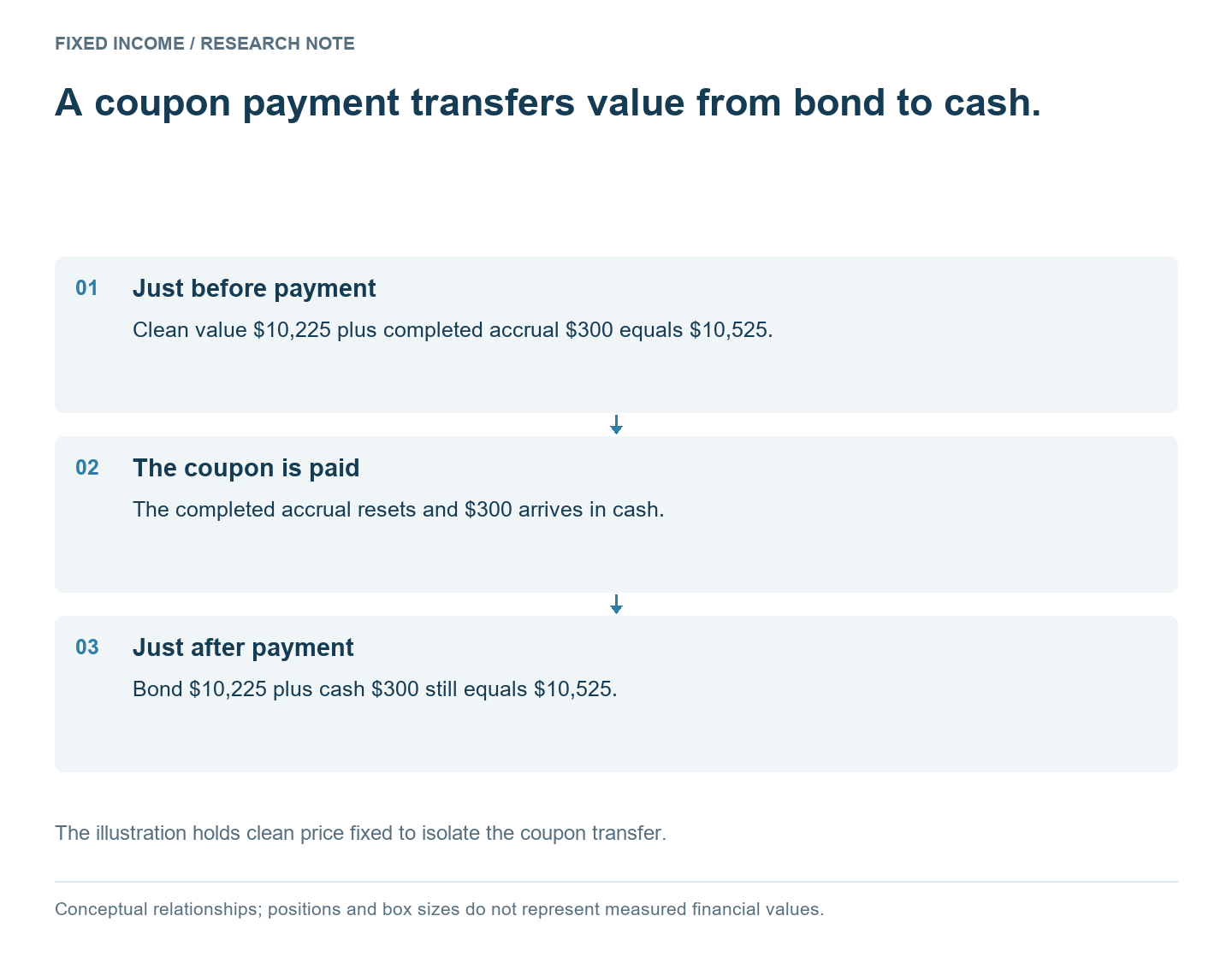
It would be incorrect to describe that isolated $300 reduction in bond value as a $300 investment loss. It would also be incorrect to describe the cash payment as a $300 gain while ignoring the corresponding reduction in full value. Performance must follow both the security and the cash leaving it.
Actual trading around a payment date can involve market changes and entitlement conventions that complicate a literal before-and-after quotation. The example is an accounting identity under fixed-price assumptions. It explains why a coupon-adjusted performance series tells a different story from an unadjusted series of security values.
Do not use accrued interest as a substitute for yield
Accrued interest measures the portion of a specified coupon allocated to the elapsed period. It does not tell the investor how attractive the bond is relative to alternatives. Two bonds can have identical accrued interest but different prices, maturities, credit quality, and expected returns.
Our 6% coupon bond trades at a clean premium. The coupon rate applies to face value, whereas the investor's cash outlay is larger than face value. The remaining maturity and repayment terms affect how that premium enters the yield calculation. Knowing the next coupon and its accrued portion is insufficient to calculate yield to maturity.
The same distinction applies to a bond bought below face value. Its return may include movement toward the promised redemption value, but that potential gain is not coupon accrual. Combining premium amortization, discount accretion, and ordinary accrued coupon into one unexplained income figure makes it harder to identify what drives the result.
A zero-coupon security illustrates the boundary. It does not pay regular coupons and therefore does not have the ordinary between-coupon adjustment used in this article. Its economic return and any accounting or tax accrual can still develop over time. The word “accrual” can refer to different processes, so the calculation must identify which one it means.
Read the confirmation as a reconciliation
Comparing two offers demonstrates why the reconciliation matters before execution. Keep the same bond, $10,000 face amount, April 15 settlement, and $150 accrued interest. Offer A has the original clean quote of 102.25 and a separate $25 commission. Its total cash requirement is $10,400.
Offer B has a higher clean quote of 102.40 but no separate commission in this example. Its clean-price component is $10,240, and its full cash requirement is $10,390. Although Offer B's displayed clean quote is higher, its stated total cost is $10 lower. The extra $15 in clean price is more than offset by the $25 difference in separate charges.
This is not a rule that a higher quote is preferable, or that an offer without a separate commission has no embedded trading cost. It is a comparison of two completely specified cash amounts for the same security, quantity, and settlement date. A real comparison also needs executable availability and the same side of the market. An indicative bid from one screen cannot be compared with an executable offer from another as though both were purchase opportunities.
Quantity can change the available quote. An attractive price for a smaller lot may not apply to the entire intended purchase. A minimum denomination can also prevent the buyer from choosing an arbitrary face amount to use an exact cash budget. The arithmetic should follow the executable position size rather than assume fractional units are available.
A cash budget should therefore reserve room for the full settlement amount and known charges. Planning only around face value can underfund a premium-priced purchase, while planning around the clean quote alone can omit accrued interest. The difference is usually explainable in advance once the quotation convention and dates are supplied.
A useful confirmation review starts with the security identifier and face amount. Similar issuer names do not guarantee identical coupon terms or maturities. Next confirm the quoted price convention and convert it into the dollar amount for the actual position. Then check the stated settlement date against the accrued-interest calculation.
Separate the price component, accrued interest, and explicit charges. A markup or markdown can be incorporated into an execution price, while a commission may be stated separately. Those arrangements require a careful reading of the actual transaction information. The purpose of the reconciliation is to explain cash, not to assume every cost appears in the same place on every platform.
If the total does not agree, isolate the discrepancy before changing inputs. A difference near one day's accrual suggests a date or day-count issue. A multiple-of-one-hundred discrepancy suggests a quotation-unit problem. A small residual may reflect rounding. These are diagnostic clues, not proof; the underlying confirmation and security terms determine the correction.
Rounding should occur at a stated stage. An intermediate calculation rounded too early can differ from one carried at full precision and rounded only at the final cash amount. For a portfolio with many positions, individually rounded accruals may not equal a rounded total calculated from unrounded values. The treatment needs to remain consistent when reproducing a statement.
Avoid double counting in a performance report
The full purchase value already contains the accrued interest paid to the seller. If a return calculation uses that full value as the opening investment, it should not subtract the same accrued interest again as a separate expense. Conversely, using only the clean purchase value without accounting for the additional cash understates the opening investment.
At the end of the period, apply the same convention. Use full ending value plus coupons received, or reconstruct the result from clean-price changes, changes in accrued interest, and cash coupons. Both approaches can reconcile when consistently applied. Mixing a clean beginning value with a full ending value generally introduces an artificial gain.
External cash contributions and withdrawals need separate treatment. Adding money to an account to buy more bonds is not investment income. Removing a coupon from the account does not erase the coupon from the investment's return. Account balance changes must be separated from performance before attributing the result to bond prices or interest.
Our June resale illustrates the simplest possible reconciliation: no interim coupon, one purchase, one sale, a $50 clean-price loss, and a $100 increase in accrued interest. The pre-cost gain is $50. That same result emerges directly from the difference between full sale and purchase values. Agreement between the two approaches is a useful arithmetic check.
Know when the ordinary example stops applying
Irregular first or last coupons, changing principal balances, floating coupon rates, inflation adjustments, and payment defaults can require different calculations. A distressed bond may trade under conventions that do not add ordinary accrued interest in the same way. A payment that is contractually due but uncertain also raises a valuation question beyond the mechanical day count.
Tax reporting is another distinct layer. The cash reconciliation here explains the transaction's economics; it does not determine every investor's tax treatment. Jurisdiction, instrument structure, and account type can affect reporting.
The central habit is simple enough to apply before learning every exception: follow the same cash flow from the security's terms to the quote, from the quote to settlement, and from settlement to the return calculation. When the dates, units, and entitlements agree, the difference between two displayed bond prices becomes explainable rather than mysterious.
Related research

ResearchFixed Income
Reading Policy Disagreement Without Turning It Into a Trade
A divided policy vote reveals a disagreement about the current decision. Understanding its significance for bonds requires a separate assessment of future economic conditions, market expectations, and the cash flows exposed to each possible path.

ResearchFixed Income
Floating-Rate Debt Still Carries Risk
A resetting coupon can reduce exposure to changes in a reference rate. It does not automatically protect against worsening credit, a changing required spread, illiquidity, or falling future income. The contract determines which risks actually move with the coupon.

ResearchFixed Income
The Yield Curve Can Shift, Steepen, or Twist
Two portfolios can have the same duration and still respond very differently when short, intermediate, and long yields move in different directions. Three fully specified scenarios show how cash-flow location changes the outcome.