
ResearchFixed Income
Floating-Rate Debt Still Carries Risk
- Report or archive date
- Archive placement August 18, 2026
- Reading time
- 13 min read

Summary
A resetting coupon can reduce exposure to changes in a reference rate. It does not automatically protect against worsening credit, a changing required spread, illiquidity, or falling future income. The contract determines which risks actually move with the coupon.
The word floating describes a formula
A floating-rate bond promises interest determined by a rule rather than one fixed coupon rate for its entire life. That rule may respond to a short-term reference rate, making interest payments adjust as the reference changes. The attractive intuition is straightforward: if rates rise, the holder may receive more income instead of remaining locked into an older fixed coupon.
The intuition is incomplete. A resetting coupon does not make the issuer more able to pay it. It does not force other investors to accept the original credit spread, guarantee a buyer for the bond, or establish the price at which the holder can exit. A floating-rate security can lose value even while its contractual coupon increases.
The first analytical question is therefore not whether the instrument is floating. It is what floats, when it changes, and what remains fixed. The reference rate, contractual margin, reset date, payment frequency, floor, cap, and redemption provisions jointly determine the cash flows. The issuer and the instrument's place in its capital structure determine a separate set of risks.
Those distinctions also matter for funds. A portfolio of Treasury floating-rate notes and a fund of leveraged corporate loans may both use a floating-rate label. That shared description says little about their comparative credit exposure, liquidity, or response to a recession. Read the underlying holdings and contracts before treating the name as a risk classification.
Start with one completely specified coupon
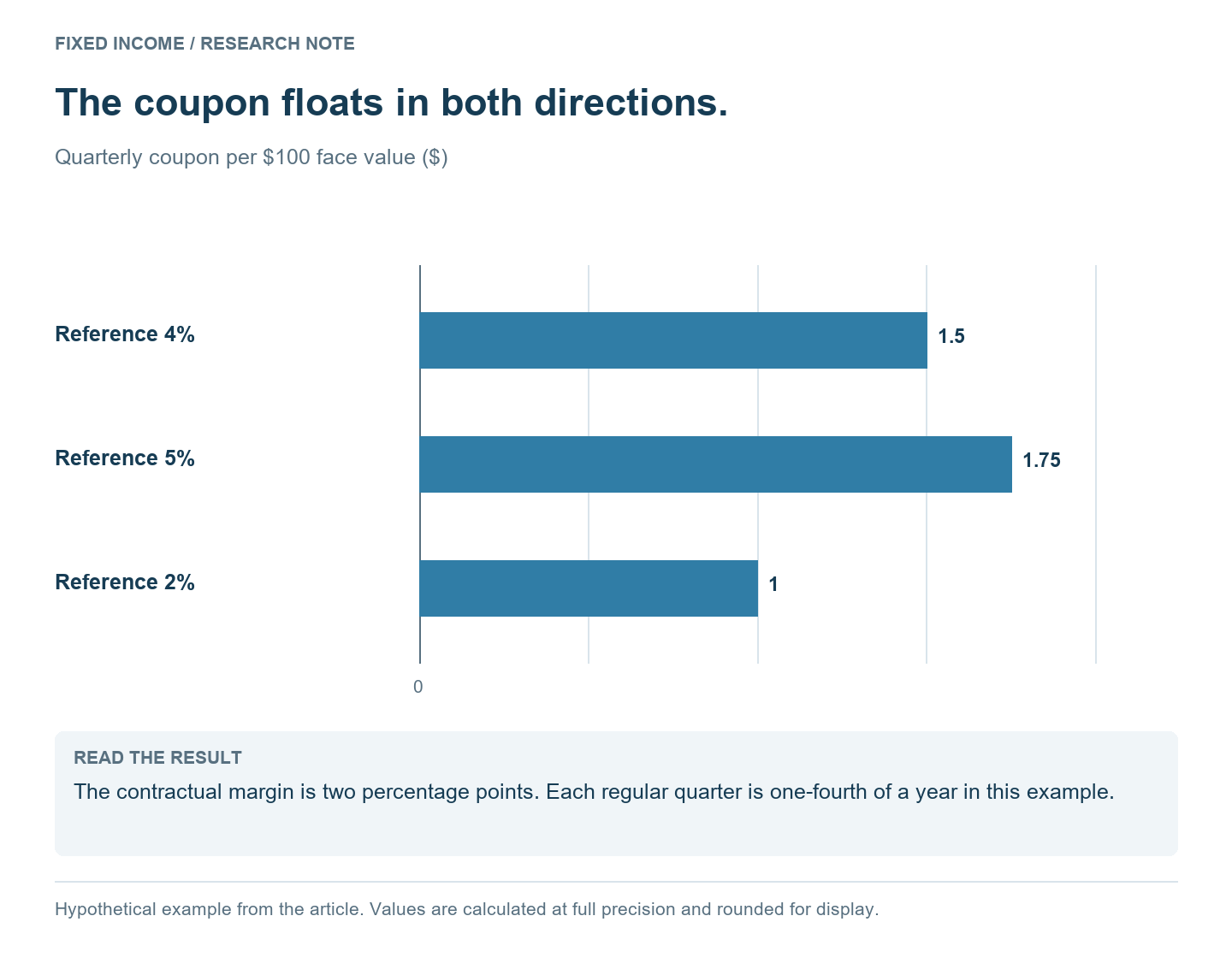
Consider a two-year corporate note with $100 face value. Its annual coupon rate resets at the beginning of each quarter to a reference rate plus a fixed margin of two percentage points. The reference rate for a quarter is known at its start and remains the coupon's reference for that period. Each regular quarter is treated as one-quarter of a year in this example.
Initially, the reference rate is 4%, so the annual coupon rate is 6%. The quarter's cash coupon is $100 multiplied by 6% divided by four, or $1.50. If the reference rate is 5% at the next reset, the annual coupon becomes 7% and that quarter's payment becomes $1.75.
If the reference rate instead falls to 2%, the annual coupon becomes 4% and the quarterly payment becomes $1. Income is variable in both directions. The mechanism that helps income adjust upward can also reduce the cash available to meet a recurring spending need.
These are simplified contractual terms, not a description of every floating-rate instrument. Some use daily observations or compounded overnight rates. Some determine interest using rates observed during the period rather than a single rate fixed at its beginning. Actual day-count conventions can also produce amounts different from simply dividing an annual rate by four.
Reset frequency and payment frequency are different
A coupon can be recalculated more frequently than cash is paid. U.S. Treasury floating-rate notes provide a useful real example: their index is linked to the high rate at the most recent relevant thirteen-week Treasury bill auction, the index ordinarily resets weekly, and interest is paid quarterly. The spread established for a particular note remains fixed. Specific accrual and lockout rules govern the calculation.
That structure differs from our corporate note, whose coupon reference is fixed at the beginning of each quarter. The word quarterly would not be enough to distinguish them if it referred only to the payment schedule. A reader needs both the reset mechanism and the payment dates.
Timing also creates exposure between resets. If the reference rate rises halfway through a quarter, the already fixed $1.50 coupon does not immediately become $1.75. The next scheduled reset may change the following coupon. The current payment and the market discount rate can move out of alignment before then.
This is why a floater's sensitivity to its reference rate is often lower than that of a comparable long fixed-rate bond, yet not necessarily zero. The amount of time until reset, the shape of the reference curve, contractual limits, and other pricing inputs matter. A compact duration statistic should be read alongside those assumptions.
The contractual margin is not the market's required margin
The two-percentage-point margin in our note is written into its coupon rule. It does not automatically increase when the issuer becomes less creditworthy. Investors may begin demanding four percentage points above the same reference rate to hold comparable exposure, even though the existing note still pays reference plus two.
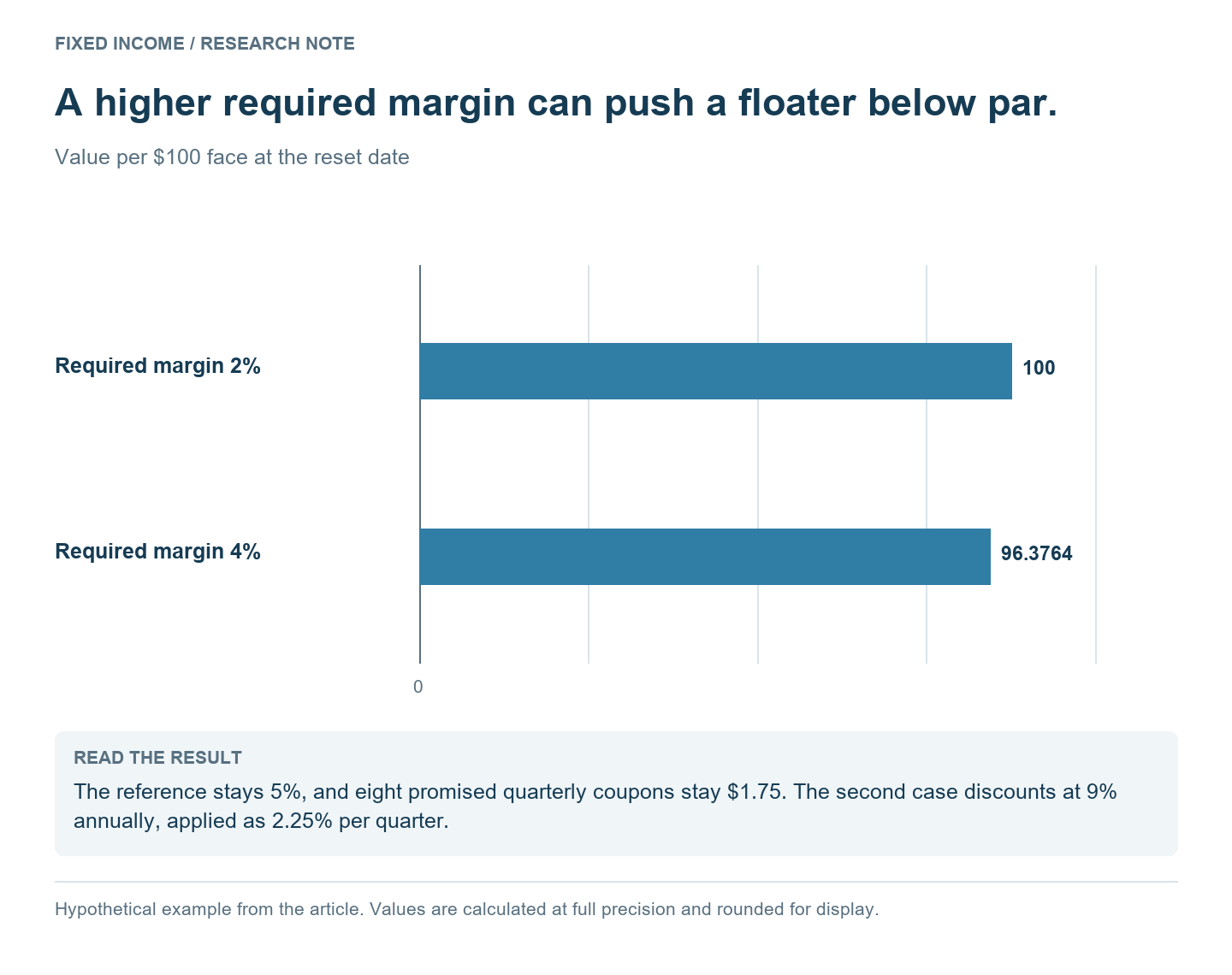
To see the consequence, value the note at a reset date with eight quarters remaining. Assume the reference rate is 5% and stays there throughout the example. The promised coupon is therefore $1.75 each quarter. At maturity, the issuer also promises $100 principal. There are no caps, floors, options, transaction costs, or defaults in the cash-flow calculation.
If the market's required margin is still two percentage points, the assumed annual discount rate is 7%, applied as 1.75% per quarter. Discounting the eight $1.75 coupons and the final $100 repayment at that quarterly rate gives a value of $100. The coupon and discount assumptions line up at the reset date.
Now assume the market requires a four-percentage-point margin. With the same 5% reference rate, the simplified discount rate becomes 9% annually, or 2.25% per quarter. The promised coupons remain $1.75. Discounting them and the principal at the higher required rate produces a price of approximately $96.38, a decline of about 3.62% from par.
The example uses a single constant required return to expose the mechanism; an actual valuation can require a richer curve and credit model. Its lesson is narrower and robust: the reference-rate reset does not repair an insufficient contractual credit margin. A floating coupon can coexist with a meaningful price decline.
Higher lender income can mean a more strained borrower
Imagine a company with $100 million of debt paying reference plus two percentage points. At a 4% reference rate, annual interest is $6 million. At a 7% reference rate, it becomes $9 million. The additional $3 million is income promised to lenders and an additional cash requirement for the same borrower.
Suppose the company generates $12 million of annual cash before interest and required maintenance investment. Assume that amount is already after its ordinary operating expenses, taxes, and working-capital needs. With $5 million of maintenance investment, the 6% debt-cost scenario leaves $1 million after interest and that investment. The 9% scenario leaves a $2 million deficit.
Nothing in this example assumes revenue has fallen. The financing change alone eliminates the available cushion. If the company also faces weaker demand or higher input costs, the pressure could be greater. If it has cash reserves, hedges, asset sales, or new financing available, the outcome could be less severe. Those resources must be examined rather than assumed.
An increase in coupon income is therefore not automatically an improvement in the lender's expected result. The probability of receiving the promised payments can change at the same time. A useful credit review follows cash after interest, upcoming principal maturities, covenant headroom, and the reliability of funding sources under the higher-rate scenario.
Floors and caps can interrupt the simple pass-through
For a separate note, suppose the reference rate has a 1% floor and the contractual margin is two percentage points. If the observed reference rate falls to 0.25%, the coupon uses 1% plus two percentage points, producing a 3% annual coupon. The floor applies to the reference component in this example, not to some differently defined total rate.
The floor limits how far the coupon falls under those terms. It can be valuable to the holder, but its presence does not eliminate credit risk or guarantee a particular market price. The floor's value also depends on the likelihood and duration of low reference rates, as well as the issuer's ability to make the payments.
For another separate contract, suppose the total coupon is capped at 7%. A 6% reference rate plus a two-point margin would produce 8% before the cap, but the paid annual coupon is limited to 7%. Further increases in the reference no longer pass through fully, while market discount rates may continue rising.
The wording matters. A floor on the reference rate, a floor on the total coupon, and a cap on the total coupon are different provisions. Inspecting only the current coupon can conceal these differences until rates approach the relevant boundary. The examples should not be combined into one contract unless its terms actually contain both features.
Two floating rates need not cancel each other
Suppose an organization owns a floating-rate asset and finances it with floating-rate borrowing. It might appear insulated from rate changes because both sides adjust. That conclusion requires the reference rates, reset schedules, payment dates, and contractual margins to align. “Floating” on both sides is not enough.
The asset might fix its coupon quarterly while the borrowing cost changes daily. Funding costs could rise before asset income catches up. The two instruments might also reference different markets whose rates do not move identically. The resulting mismatch is basis risk: the apparent offset depends on a relationship that can change.
Floors create another asymmetry. An asset reference could continue falling while a borrowing reference is held above a contractual floor. Alternatively, an asset's total coupon cap could stop additional income while an uncapped funding cost keeps rising. The net interest margin can narrow even though neither contract has malfunctioned.
A useful cash-flow map shows the observation date, reset date, payment date, and rate formula for each side. It also distinguishes a rate-setting mismatch from a liquidity mismatch. Two payments can eventually offset economically while occurring on different dates, leaving a temporary need for cash. The capacity to fund that interval is part of the position's risk.
Seniority helps define a claim, not a guaranteed recovery
A floating-rate instrument can be secured, unsecured, senior, or subordinated. The coupon formula does not determine that legal position. Collateral and priority may improve expected recovery relative to junior claims, but the value available for repayment can still be insufficient.
Consider a recovery exercise with $80 million of realizable asset value and $10 million of costs that must be paid before creditor distributions. The remaining pool is $70 million. Assume the specified priority rules give a $50 million claim full payment before a second $40 million floating-rate claim receives anything.
Only $20 million remains for the second claim, implying 50% recovery of its principal in this simplified exercise. Its floating coupon does not create additional recovery assets. A different priority arrangement, collateral scope, or realizable value would change the result.
The research question is therefore what assets support the claim, what competing claims exist, and how the contract restricts additional borrowing or asset transfers. A strong coupon can attract attention while weak protections remain buried in the documents. Credit analysis should examine both the promised payment and the circumstances in which payment might fail.
Early repayment changes the income horizon
Some floating-rate instruments allow the borrower to repay or refinance before the stated maturity, subject to their terms. If the borrower's credit improves and new funding becomes available at a smaller margin, it may have an incentive to replace expensive existing debt. The holder then needs a new investment for the returned principal.
That outcome can truncate an attractive income stream. A model that projects the current margin through maturity may overstate future cash receipts if early repayment is allowed and economically plausible. A premium paid for the instrument can also be affected by the redemption terms. The promised maturity date is not always the likely holding horizon.
The opposite environment can create a different problem. A borrower that cannot refinance cheaply may leave the debt outstanding while its financial condition weakens. The holder retains exposure precisely when the credit has become less appealing. Rate resets continue to operate, but they do not ensure a convenient exit.
A complete scenario therefore considers repayment behavior as well as reference rates. What happens if the principal returns early? What happens if it stays outstanding? What terms govern the repayment price? Those questions belong in the cash-flow analysis before annualizing a recent distribution into an assumed permanent income rate.
Liquidity can dominate a short holding period
An investor may understand the coupon formula and credit risk yet still encounter a poor sale price when cash is needed. Market liquidity concerns the ability to transact a particular quantity at an acceptable price and within the required time. A continuously updating quoted value does not prove that the full position can be sold at that value.
Some corporate loans involve transfer conditions and settlement processes different from exchange-traded securities. A fund holding them may face a timing gap between meeting withdrawals and receiving cash from asset sales. The relevant details depend on the fund structure and holdings; they should not be inferred from a broad floating-rate category.
For a fund investor, the review therefore includes the underlying assets, cash holdings, financing arrangements, redemption mechanics, and any leverage. An exchange-traded fund's share liquidity and the liquidity of its underlying holdings are related but distinct. A mutual fund's reported net asset value is also not a promise that every underlying position could be liquidated immediately at its last valuation.
Diversification can reduce dependence on one issuer, but it does not eliminate a common exposure to heavily indebted borrowers or tightening financing conditions. Many individually different loans can respond to the same economic shock. The important comparison is the underlying source of risk, not merely the number of securities listed.
Income and total return can move in different directions
Suppose an investor buys a floating-rate security for $100, receives $7 of cash over a year, and ends the year with a sale value of $94. With no reinvestment, costs, taxes, or external contributions, the holding-period return is 1%: $94 plus $7 minus $100, divided by $100.
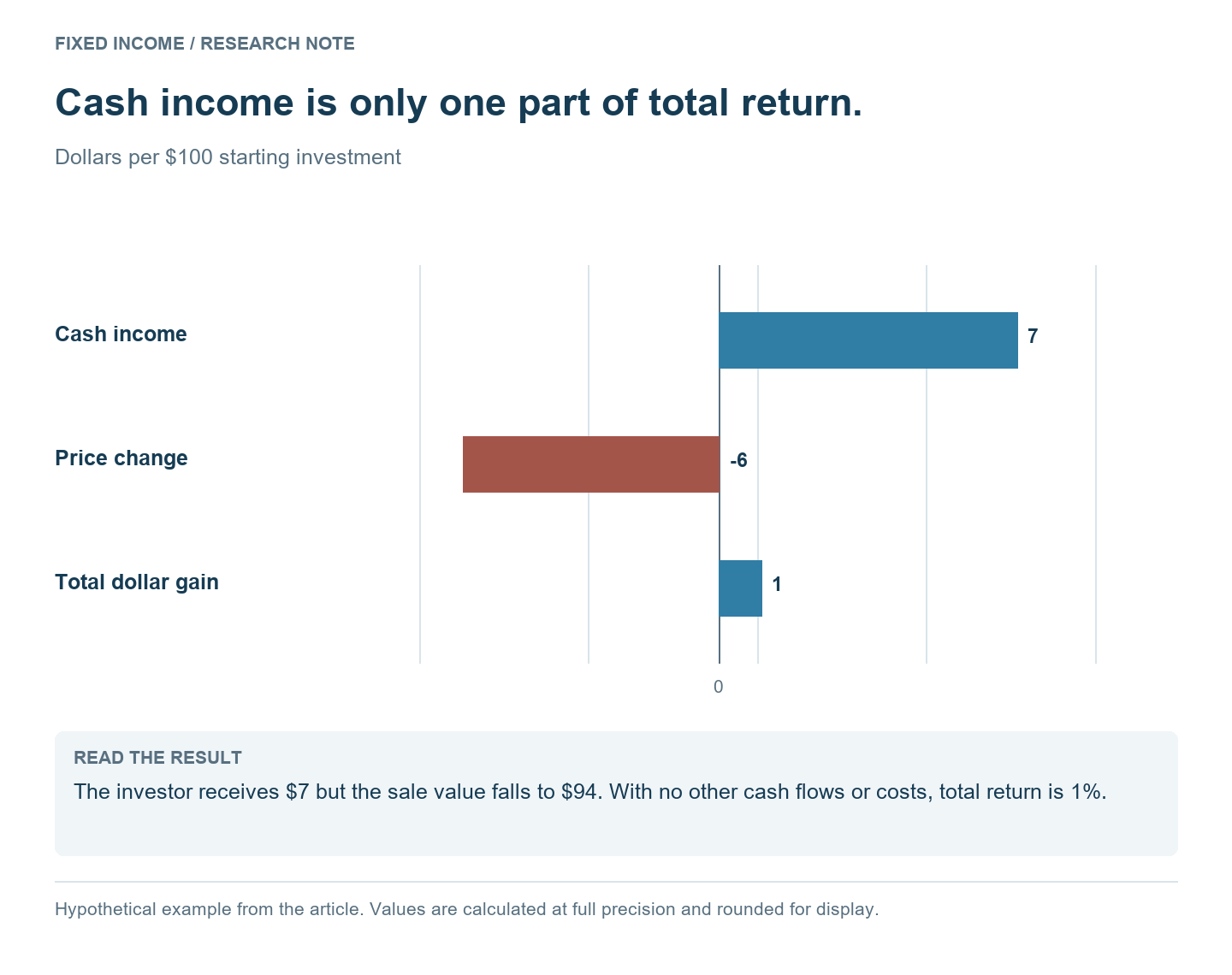
If the ending sale value is $90 instead, the return is negative 3%. The same $7 cash receipt accompanies two different results. Calling the investment a “7% return” merely because it distributed $7 would confuse income with total performance.
The distribution itself also needs a time reference. A recent payment may reflect a coupon set under earlier conditions. An annualized recent distribution is not necessarily the income expected over the next twelve months, especially when reference rates are changing or holdings are being replaced. For funds, expenses and portfolio changes further affect the connection between asset coupons and cash distributed to shareholders.
An income budget can test lower-rate scenarios explicitly. In our original note, a reference decline from 4% to 2% reduces a quarterly coupon from $1.50 to $1. The percentage decline in that payment is one-third. Principal might remain relatively stable under unchanged credit conditions, yet the spending capacity supported by the income falls materially.
Use the contract to organize the research
The strongest stress tests connect related risks without assuming they always move together. Return to the borrower with $12 million of cash before interest and maintenance investment. If that operating cash falls by 20%, it becomes $9.6 million. With $9 million of interest and $5 million of maintenance investment, the remaining deficit is $4.4 million. Higher financing costs and weaker operating cash reinforce each other in this scenario.
But another downturn could bring lower reference rates. That might relieve interest expense while a wider required credit margin lowers the debt's market price. The borrower could receive some cash-flow relief at the same time the holder experiences a valuation loss. A scenario that assumes every rate must rise or fall together would miss that combination.
The cash-flow model and the valuation model should therefore be linked but kept distinct. The contractual reference rate determines coupons according to the note's rules. The market's required margin helps determine price. Operating cash and refinancing access help assess payment capacity. Moving one variable does not automatically specify the others.
Avoid simply adding the largest standalone loss from every separate scenario. Some assumptions may be mutually inconsistent, and some effects may already be embedded in another calculation. For example, a stressed required return may reflect concerns about weaker repayment prospects. Adding an unrelated default-loss estimate to the same valuation without explaining the model can count the credit deterioration twice.
A transparent exercise instead describes a coherent state of the world, states which cash flows are still assumed to be paid, and calculates the price or realized loss appropriate to that state. It can then show other states separately. This does not remove uncertainty, but it lets the reader see whether a result comes from coupon mechanics, a changed market valuation, an actual payment shortfall, or a combination that has been explicitly modeled.
A practical review begins by identifying the issuer, currency, principal repayment, and ranking of the claim. It then records the reference-rate definition, fixed margin, reset and payment dates, day count, floors, caps, and early-redemption terms. That establishes what the holder is actually promised.
Next examine the issuer under higher debt-service costs and weaker operating conditions. Then test the market price under a wider required margin, rather than changing only the reference rate. Finally, connect the position to the date on which the investor may need cash and the income level the investor expects to use.
Floating-rate debt can be useful precisely because it changes the pattern of exposure. It exchanges some fixed-coupon rate sensitivity for variable income while leaving other risks in place. Understanding that exchange requires following the rate formula all the way through the borrower's cash resources, the market's valuation, and the holder's own cash-flow needs.
Related research

ResearchFixed Income
A Credit Rating Is a Starting Point for Research
A rating condenses a credit opinion into a category. Useful bond research expands that category back into its assumptions, identifies the exact obligation being rated, and examines the consequences of a changing credit profile before relying on the label.

ResearchFixed Income
Accrued Interest Explains the Difference Between Two Bond Prices
A bond's quoted price may exclude interest already earned during the current coupon period. Following one purchase through settlement, resale, and a coupon date shows how to reconcile the quote with cash paid and investment performance.

ResearchFixed Income
From a Rate Hike to a Bond Portfolio Scenario
The September policy increase is an observed decision. A bond portfolio's response still depends on changes in market yields, cash-flow timing, and the investment horizon. A worked scenario shows how to connect those inputs without treating a policy move as an automatic portfolio loss.