
ResearchCross-Asset Allocation
AI Exposure Reaches Beyond Technology Stocks
- Report or archive date
- Archive placement July 30, 2026
- Reading time
- 13 min read
Summary
The first invoice at a new computing campus may come from a civil engineer. The last unpaid invoice in a failed project may belong to an electrical contractor.
The first invoice at a new computing campus may come from a civil engineer. The last unpaid invoice in a failed project may belong to an electrical contractor. Between them are commitments to buy chips, reserve power, install cooling, lease space, insure buildings, and service debt. A technology-sector weight on a portfolio statement will miss some of the businesses carrying those obligations. It will also include companies whose earnings depend relatively little on spending for artificial intelligence. For an investor, the relevant question is who has promised what, to whom, at which stage, and with whose money.
Begin with a project instead of a list of potential winners. A tenant wants computing capacity at a specified location. A developer proposes to build it. A utility or other supplier must make electricity available on terms the project can afford. Contractors need equipment and labor. A bank or bondholder may supply capital years before the first commercial computation. A successful project can generate revenue for many participants, but each one earns a different return on a different investment and faces a different loss if the schedule slips. A portfolio assembled by collecting company names from these industries can be more concentrated than it looks.
What one hundred megawatts does and does not tell us
Consider a campus designed for 100 megawatts of information technology load. That is a power rating. Multiplying by time gives energy consumption. If average IT load over a standard 8,760-hour year is 70 megawatts, the computers use 613,200 megawatt-hours. Suppose the ratio of total facility energy use to IT energy use is 1.25 over the same period. Total facility energy becomes 766,500 megawatt-hours. At an assumed uniform energy price of $60 per megawatt-hour, that simple energy charge would be $45.99 million. The case ignores demand charges, taxes, network charges, and differences by hour.
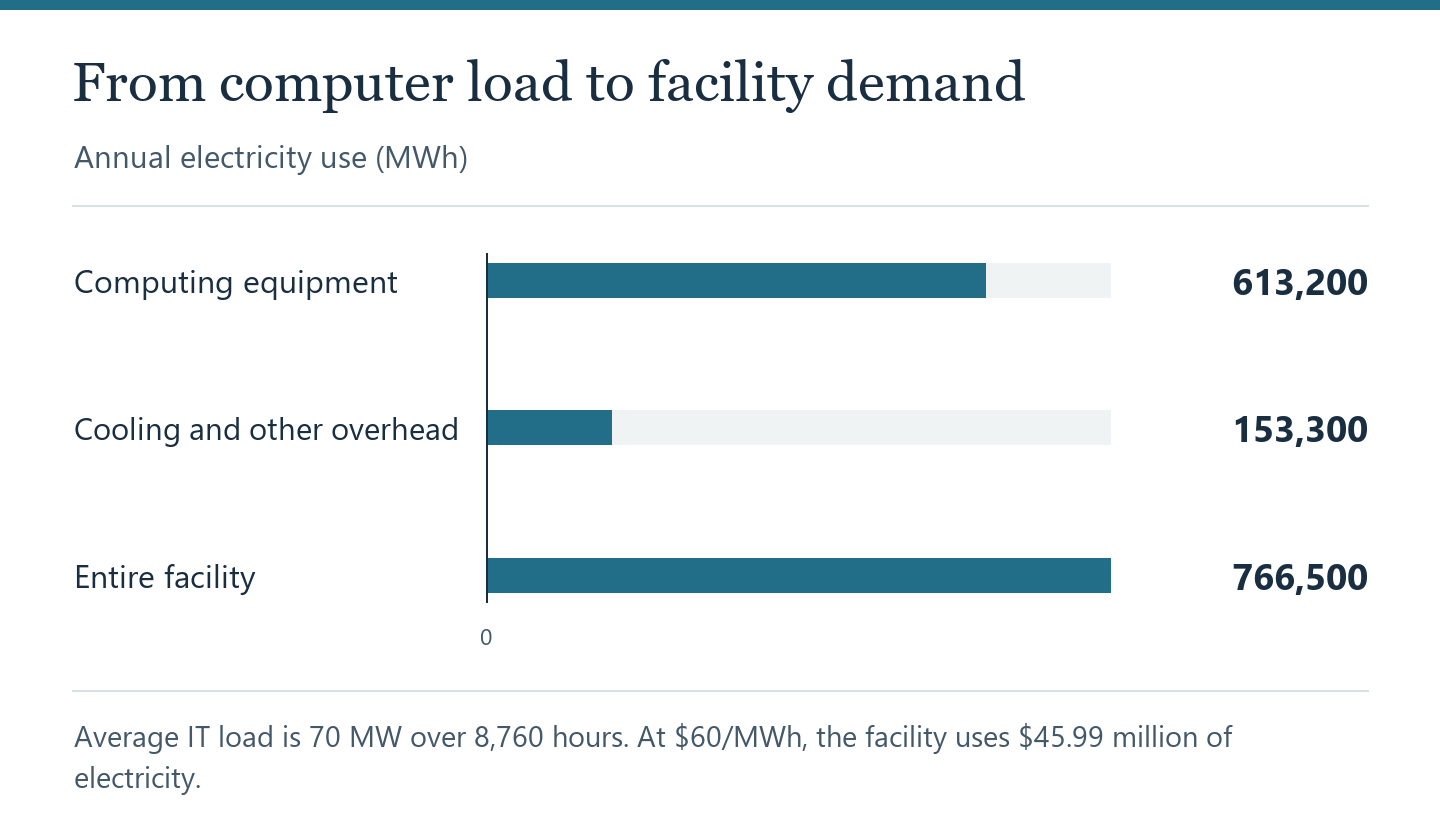
Several common mistakes appear immediately. The 100-megawatt rating is neither annual energy consumed nor a guarantee that the computing equipment will be occupied at full load. The factor of 1.25 applies to IT energy to estimate facility energy, including overhead such as cooling and power conversion. Applying it once to get energy billed and again to the resulting electricity bill would count overhead twice. An announced 100-megawatt capacity can mean different things in different presentations, including facility supply or an IT load figure. A technically meaningful comparison identifies which boundary the rating describes.
The calculations above still say nothing about the proportion of computing time that earns revenue. A facility can draw substantial power while equipment is being tested, reserved but lightly used, or running tasks with different revenue per hour. Conversely, efficient equipment and scheduling can produce more useful work from a given amount of electricity. Electrical utilization, hardware utilization, and billable service utilization are related but distinct. A landlord charging reserved capacity, an operator selling computing time, and a utility billing peak demand will each care about different combinations. A forecast that multiplies nameplate power by a fashionable price per computing hour has likely skipped an entire business model.
Read the tenant contract before valuing the building
Suppose a developer expects annual rent of $32 million once the tenant accepts the facility. Construction costs $300 million, excluding financing and land for simplicity. Dividing rent by construction cost gives about 10.67 percent. That number is a gross ratio. It is not a project return. It omits operating expenses, lease incentives, construction time, equipment renewal, financing, taxes, and the possibility that rent never starts on the expected date. Before comparing this ratio with a bond yield or a property valuation, identify what the lease requires the landlord to provide.
The tenant may be obliged to pay for a reserved amount whether or not it uses all of it. Alternatively, revenue may depend on equipment being available within tight operating tolerances. A power connection alone may be insufficient to trigger rent if cooling fails an acceptance test. A commitment from an operating subsidiary can differ from a guarantee by its parent. A term sheet announcing intended capacity can differ materially from an executed agreement with remedies for cancellation. A researcher should identify the document that turns projected rent into a legal claim and the condition that starts the billing clock.
If acceptance slips by six months, a simple first-pass estimate of deferred gross rent is $16 million under the stated annual rent and uniform monthly billing. Whether the revenue is lost permanently depends on whether the lease end moves, the term is fixed to calendar dates, or the parties renegotiate. Debt interest may continue during the delay, and the developer may have to fund additional engineering work. A buyer of the completed property may lower its offer if future tenants will require different equipment. “Delayed by six months” is therefore a financing event, a revenue timing event, and potentially a change in residual property value.
Follow a chip purchase through capacity and cash
A chip designer, a semiconductor foundry, an advanced packaging provider, and a server integrator participate in different transactions. Designing a device does not in itself manufacture a usable processor. Fabricating wafers does not ensure that packaging, memory, networking, and final assembly are available at suitable yields and dates. Even complete systems cannot generate revenue for the campus operator until power, cooling, installation, and commissioning are in place. The order of these constraints matters because spending before the slowest stage can create inventory rather than productive capacity.

Take an installation requiring 10,000 working modules. Suppose 95 percent of units entering final integration meet specifications on the first pass. At that assumed yield, putting 10,000 units into integration produces an expected 9,500 first-pass units. Planning for 10,000 expected first-pass units requires roughly 10,527 incoming units, rounding up to whole units. The first-pass figure is an expected count. Rework, spares, variability across batches, and contractual acceptance standards influence how much inventory must actually be committed. A supplier announcing the number of units shipped may therefore be reporting a different quantity from the number ready for billable use.
Now put cash around that constraint. If the developer has already paid for servers but the power connection is delayed, the equipment owner carries financing and potential obsolescence risk. If servers are purchased only after the site passes a connection milestone, the chip supplier or integrator may instead carry inventory risk. A noncancelable procurement agreement can shift part of that risk back to the buyer. An investor discovering a large order in a supplier's backlog should ask which items can be delayed, what deposits have been received, and who bears the cost if the technical specification changes before delivery.
The economic significance of semiconductor capacity also depends on what the capacity can produce. A facility optimized for one process or packaging method may not be an immediate substitute for another. Tools must be installed and qualified, processes must reach acceptable yields, and customers may require product-specific validation. Treating square feet of factory space or aggregate wafer capacity as freely interchangeable productive units can overstate the speed of supply response. A finance model needs a schedule of usable output, not simply a map of factories.
The utility may build first and earn later
An electricity supplier can see an attractive prospective load and still need to make a difficult capital decision. New transmission, substations, or generation can require large expenditures before the customer is able to draw power. The allocation of those costs depends on agreements, tariffs, regulatory decisions, and the customer's obligations if it reduces or cancels its request. A large queue of connection requests is evidence of interest; it does not establish that every request is funded, distinct, technically feasible, or certain to generate revenue.
Consider a utility contemplating $120 million of dedicated upgrades. One proposal requires the project sponsor to fund $50 million upfront and make minimum annual payments once the connection becomes available. Another leaves most construction financed by the utility, with receipts based on actual energy consumed after occupancy. Both proposals can refer to exactly the same 100-megawatt project. The second leaves more uncertainty about when and from whom the utility recovers its investment. The first still requires checking the timing, enforceability, and credit quality of the sponsor's commitment.
The operating pattern matters even after the site opens. Using 766,500 megawatt-hours at a constant assumed energy rate simplified the earlier bill, but a real contract may include charges based on peak capacity, time of day, or network upgrades. A facility with lower annual energy consumption can still create a substantial peak requirement. Moving flexible computing tasks to lower-cost hours might reduce some charges while leaving demand or capacity charges unchanged. The company claiming savings should show which billing component changes and whether the performance commitments to its users permit that scheduling flexibility.
For a diversified investor, a utility's exposure can be quite different from an equity stake in the developer. A regulated rate arrangement might make some investments recoverable over time, subject to approval and prudence requirements. A private power supplier with a negotiated contract may face different risks on fuel, output, and counterparty credit. Neither relationship can be inferred from the single statement that a data center needs electricity. The details governing payment for unused capacity are often more informative than an estimate of long-run power demand.
A full order book can strain a contractor
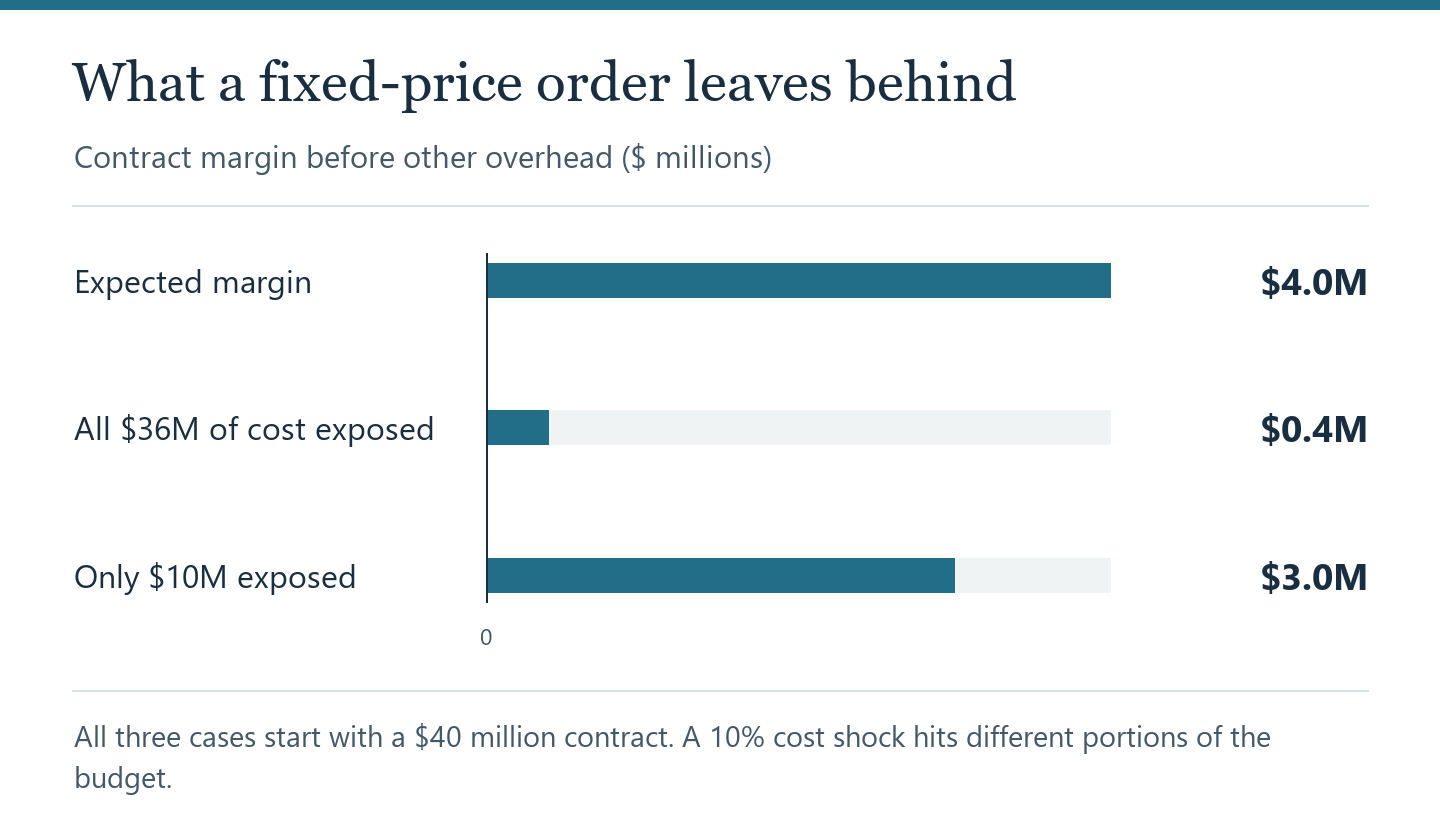
An electrical contractor might win a $40 million fixed-price contract with an expected $36 million cost, leaving $4 million before other overhead. A 10 percent increase in the entire projected cost would raise it to $39.6 million and reduce that margin to $400,000, a 90 percent reduction. If only $10 million of the costs are exposed to the increase, the same percentage change adds $1 million and leaves $3 million. Both calculations start with a strong order and the same headline cost shock. Exposure depends on which purchases are locked in, how labor is contracted, and whether the contract allows price adjustments.
The contractor may also have to buy long-lead electrical equipment before it can submit a progress invoice. Suppose it pays a $5 million supplier deposit now and receives reimbursement on a certified milestone four months later. Even if reimbursement is certain, someone must finance those four months. A large order can depress near-term cash flow precisely when the earnings forecast looks strongest. If several projects require deposits at once, a firm with solid gross margins can hit the limit on its revolving credit. Monitoring supplier prepayments, customer advances, and cash conversion is central to evaluating the investment theme.
Ask how the contractor earns its next dollar if the campus is delayed. It may receive a change order for additional work or be required to absorb idle labor. The answer depends on whether delays qualify for compensation, who caused them, and whether the contract specifies penalties. A company whose revenue rises after issuing a change order may still lose money if the compensation fails to cover its extra costs. A model that awards every supplier a fixed percentage of the campus construction budget overlooks the striking differences between equipment sales, reimbursable work, and guaranteed-price installation.
A bondholder is funding a promise, not a megawatt
Suppose the developer finances half of the $300 million construction cost with $150 million of debt at 6 percent annual interest, with the entire loan outstanding. Annual interest is $9 million. A six-month delay adds $4.5 million of interest exposure during the extra period, assuming no change to principal or rate. Whether the amount is expensed, capitalized, or funded from an interest reserve is a separate accounting and financing question. The creditor's economic issue is where the $4.5 million comes from and whether paying it leaves enough liquidity to complete the site.
A credit agreement might require additional sponsor equity before the lender advances the last construction draw. That provision can protect the lender while increasing the risk to the equity investor who must decide whether to contribute another dollar. It can also create a coordination problem if the sponsor needs the completed facility to raise additional funds. A firm guarantee from a creditworthy entity is different from an indication that a sponsor intends to support the project. Identifying the legal obligor and the conditions for drawing funds matters as much as identifying the prominent company whose name appears in a presentation.
If the facility succeeds, the lender may receive the coupon and principal it originally expected. The shareholder can participate in additional profits from higher rents or expansion. If it fails, the lender's recovery depends on collateral, seniority, and its value to another user. A specialized partly completed building may have a lower resale value than its construction cost. The common phrase “exposure to AI growth” conceals these asymmetric claims. The same increase in the probability of project completion can mean reduced default risk for one security and significant upside for another.
Useful life and the cost of standing still
A completed building and the machines inside it may have very different useful lives. Consider a separate operator that owns $80 million of computing equipment. If it assumes a four-year useful life, zero residual value, and straight-line depreciation, its annual depreciation is $20 million. Extending the assumed life to five years at inception would yield $16 million annually instead. That difference can materially change a comparison of operating margins even when power costs, collections, and the initial cash paid for equipment are identical. A change in a financial estimate is not evidence that a machine will remain commercially attractive for another year.
The economic test is the price customers will pay for the service as competing equipment improves. Older servers may still run technically but earn less revenue per unit of electricity or require a different class of workload. Conversely, a machine judged obsolete for one high-performance task could remain useful for another. Calculate the expected net receipts from continued operation and compare them with the value of redeploying, selling, or replacing the equipment. Assumptions about resale value should reflect the configuration and the pool of potential buyers. The installation cost that put a machine into service is not automatically recoverable from the next owner.
A tenant that owns rapidly depreciating equipment inside a long-term lease also has two clocks to manage. Suppose it owes five more years of fixed rent but expects to replace its installed hardware after two years. It must finance the replacements and confirm that the building can support their power density and cooling requirements. A lease that appears comfortable using the present installation can become restrictive if a future generation requires a retrofit. Responsibility for that work may sit with the landlord, the tenant, or both under specific provisions. A researcher interested in renewal prospects should ask about physical adaptability before extrapolating today's occupancy.
One practical check is to compare depreciation expense with actual replacement spending over a sufficiently long cycle. A new campus can report little maintenance capital expenditure while all its equipment is young. A mature group of campuses with staggered vintages may show a steadier need for reinvestment. Neither observation proves by itself that accounting lives are right or wrong. Adding the age profile, workload, resale experience, and funded replacement plan can reveal whether attractive cash margins depend on spending that is merely deferred beyond the forecast horizon. A tenant that must buy replacements before collecting its next contract payment should include that date in its liquidity plan even if accounting depreciation already looks conservative.
Build a portfolio map around the binding constraint
Put four holdings on a single sheet: a chip-equipment supplier, an electrical contractor, a utility, and the developer's bonds. For each, identify the next milestone required for cash generation. The supplier might need server orders confirmed; the contractor might need site access and certified progress; the utility might need commissioning and minimum load payments; the bondholder might need a completed project meeting coverage tests. Those are four milestones, but one delayed connection could affect all four. Listing the holdings under technology, industrials, utilities, and fixed income does not diversify the shared connection risk.
Run one specific alternative. The power connection slips by a year, while demand for computing services remains healthy. The developer could lose or defer rent and incur extra interest. The contractor might experience delayed billing but earn compensation under the contract. The chip supplier could redirect its products to a competing site if the configuration and commitments permit. The utility could still recover dedicated costs if its agreement requires minimum payments or sponsor reimbursement. Different outcomes under the same scenario are the point of the exercise. Setting all four holdings down ten percent by assumption would hide the mechanism the analysis is meant to discover.
A second alternative reverses the bottleneck. Power is available on time, but computing customers will pay less per unit of service than the operator expected. The landlord may remain protected under a binding capacity lease while its tenant bears the immediate earnings loss. The lender can look secure until a renewal or tenant credit event. The equipment supplier's existing invoice might be collected even as repeat orders weaken. Timeline and contractual priority determine who discovers the shortfall first. They also determine which public evidence would justify changing a forecast.
The final investment question is neither how impressive the building looks nor how large the announced technology budget is. It is whether a particular holding earns an adequate return on the cash it must commit before the project produces a reliable payment. A good research note can identify the power boundary, the hardware dependency, the signed obligation, and the next date on which money changes hands. With those details, an investor can recognize AI-related exposure outside technology stocks and distinguish a business with well-paid work from one financing somebody else's ambitious construction schedule.
Related research

ResearchCross-Asset Allocation
A Satellite Theme Should Fit the Whole Portfolio
The first question at the investment meeting sounded easy. How much of the portfolio was invested in the new technology theme?

ResearchCross-Asset Allocation
Speculative Growth Needs a Financing Scenario
A spacecraft can pass a difficult engineering test and leave its early shareholders with a disappointing investment.

ResearchCross-Asset Allocation
Volatility and Drawdown Describe Different Risks
Two investment accounts finish June with exactly the same amount of money. They began with the same balance in January, earned the same six monthly returns in a different order, and had no deposits, withdrawals, or fees.