
ResearchCross-Asset Allocation
Speculative Growth Needs a Financing Scenario
- Report or archive date
- Archive placement August 12, 2026
- Reading time
- 13 min read

Summary
A spacecraft can pass a difficult engineering test and leave its early shareholders with a disappointing investment.
A spacecraft can pass a difficult engineering test and leave its early shareholders with a disappointing investment. The test may increase the value of the enterprise while proving more expensive, or arriving later, than the original capital budget allowed. If the company has to raise money on unfavorable terms before it reaches the next milestone, much of the value created by its engineers may accrue to new investors or lenders. To study a speculative growth theme, follow both the technical milestones and the ownership claims that finance the journey between them.
Consider the financing choices facing a manufacturer, Meridian Instruments. It builds sensor modules for space systems and also sells testing equipment to industrial businesses. Meridian needs $20 million to qualify a new module, build the first production units, and finance the interval before the buyer accepts them. It has 10 million existing common shares. Its board can issue equity, borrow, wait for cash from the established business, or negotiate different terms with the buyer. Each choice changes the meaning of a favorable industry outlook for someone who already owns a share.
Give every milestone a technical test and a payment test
Meridian's engineers distinguish a successful prototype test from qualification for a particular customer's operating environment. The customer distinguishes qualification from delivery and delivery from final acceptance. The accountant distinguishes recognized revenue from collected cash. The investor has to understand all four distinctions. A promising technical result could justify further testing without entitling Meridian to a single dollar on the main contract. A shipment could satisfy a physical delivery requirement while a contractual acceptance payment remains contingent on documented performance.

Break the funding requirement into three stages. Suppose detailed engineering and qualification require $8 million, tooling and initial production require $7 million, and holding inventory while waiting for acceptance requires another $5 million of financing. These add to $20 million of funding need in the assumed schedule. The last $5 million is a working-capital requirement rather than an assertion that the inventory has no recoverable value. The first two components may also be accounted for differently depending on the circumstances. What unifies the figures for the board is the need to pay people and suppliers before the program generates enough cash.
When a buyer announces a potential order worth $60 million, the headline does not answer this financing question. The figure might refer to a maximum contract value over multiple years with options that the buyer is not obliged to exercise. Even a binding purchase agreement may pay against milestones that require considerable spending first. Suppose an initial deposit of $4 million arrives only after qualification. It can finance part of production but cannot pay yesterday's test laboratory. An analyst should attach each prospective dollar to the condition that makes it collectible and the date it can be used.
This timeline also helps separate technical and commercial failure. A module might pass the customer's qualification and still face lower-than-expected demand because other parts of the spacecraft are delayed. Conversely, demand for the service the spacecraft will provide might be strong while Meridian's specific component fails validation. Diversification across exciting end markets offers little protection if all sales require the same technical approval. Monitoring the number of qualified customers, the breadth of compatible programs, and the cost of requalifying for another application is more useful than counting every announced mission as an available buyer.
An equity raise changes who owns the result
Take the simplest financing offer. Meridian can issue 2.5 million new shares at $8 each to raise $20 million before costs. The company then has 12.5 million shares, and its original owners collectively hold 80 percent. An original holder of 100,000 shares goes from owning 1 percent of the company to owning 0.8 percent. The share count rises by 25 percent, while the holder's ownership percentage falls by 20 percent relative to its prior percentage. Both descriptions can be correct because the denominators differ.
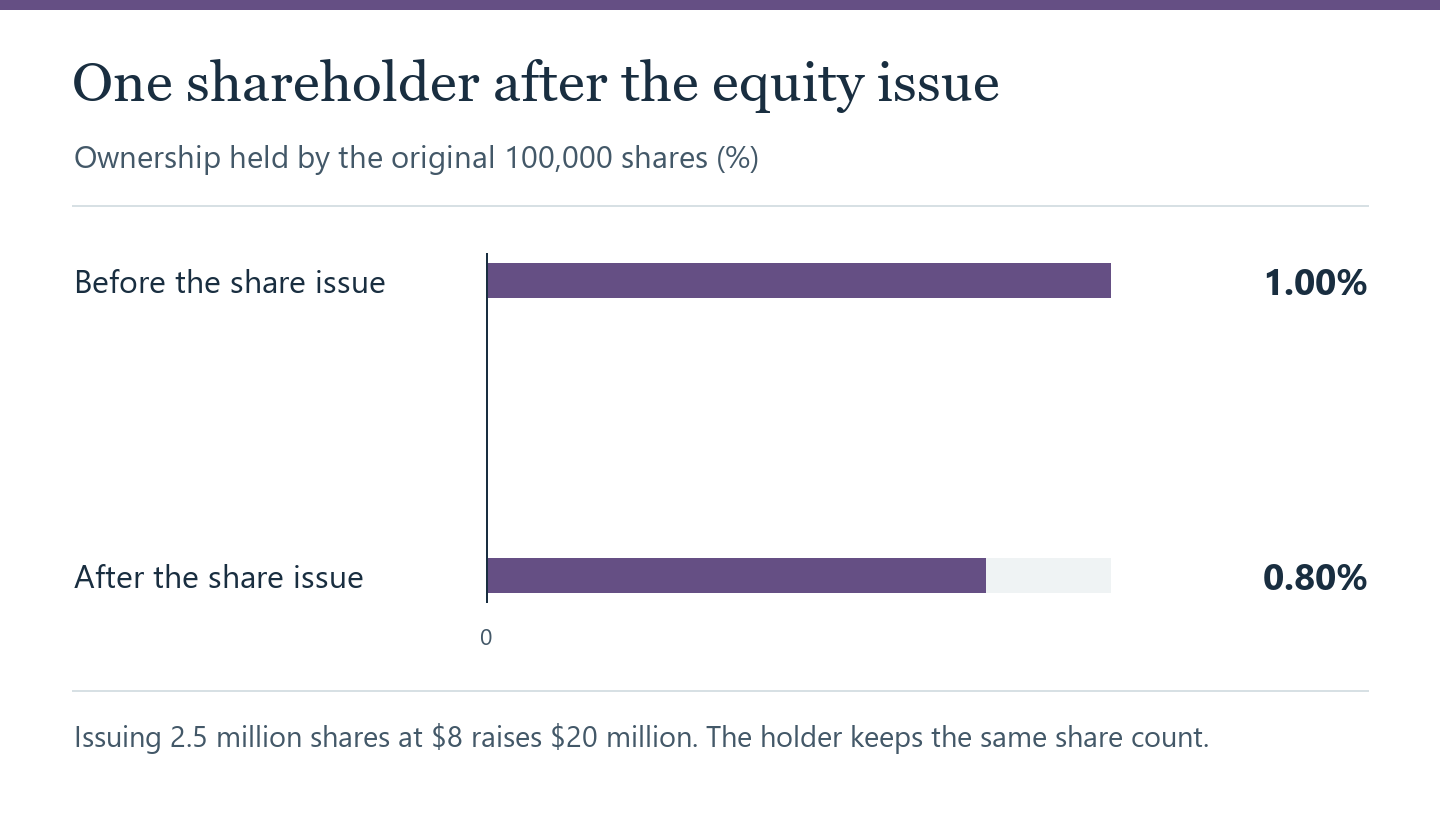
It would be wrong to conclude that raising capital destroys 20 percent of the original owners' economic value on the day of issuance. The company also receives $20 million. If the original enterprise's equity was worth $80 million and the new shares are sold at a fair $8, immediately after a frictionless raise the combined value is $100 million. The original owners' 80 percent is still worth $80 million. Their smaller share of a larger company funds a risky project. Whether the financing creates or destroys value subsequently depends on what Meridian achieves with the money, the price at which it raised it, and the costs of issuance.
Now imagine capital markets deteriorate before the board signs. The company still needs $20 million but can sell shares at only $5. It must issue 4 million shares, bringing the total to 14 million. Original owners retain about 71.43 percent. This scenario describes a financing offer at a different price, which may itself reflect new information about the business. It cannot be used to infer an immediate value transfer unless the analyst also specifies what the pre-raise company was economically worth at the time. It does establish that more claims will divide any given future equity value.
Compare the two equity-funded plans at the same endpoint. The successful program leaves $150 million available to common shareholders, with no other senior claims under either plan. The $8 issue leaves $12 per share. The $5 issue leaves about $10.71. The technology outcome is identical by assumption. The finance outcome differs because Meridian sold 1.5 million more claims in the second case. A research report that specifies a terminal company value without a future share count has not yet calculated the outcome for today's shareholder.
Debt preserves the share count and adds a prior claim
The alternative financing is a $20 million loan. Suppose interest accrues at 9 percent per year, is added to principal annually, and the entire balance is due after two years. No interim interest is paid in this particular example. The amount due becomes $23.762 million. Assume no fees, warrants, taxes, or other claims, and measure the value available to all capital providers at that same two-year date. With $150 million available, debt is paid first and equity receives $126.238 million, approximately $12.62 for each of the original 10 million shares.
At first sight, $12.62 appears better than the $12 under the $8 equity raise. But lower enterprise outcomes change the comparison. If the terminal amount available to all investors is $60 million, the debt case leaves $36.238 million for common equity, or about $3.62 per share. The $8 equity raise leaves the same assumed $60 million spread across 12.5 million shares, or $4.80. Debt preserved more of the upside and concentrated more of the downside. A creditor's priority has economic value precisely in the states where early shareholders would most like to share the losses.
There is a break-even terminal value under these restrictive assumptions. Set the debt-funded per-share outcome equal to the equity-funded outcome: the terminal value less $23.762 million, divided by 10 million shares, must equal the terminal value divided by 12.5 million shares. The result is $118.81 million. Above that value the debt structure produces more for each original share; below it, while the company remains able to repay, the $8 equity structure produces more. The break-even is a property of the assumed financing terms, not a target price or an assessment of the probability of technical success.
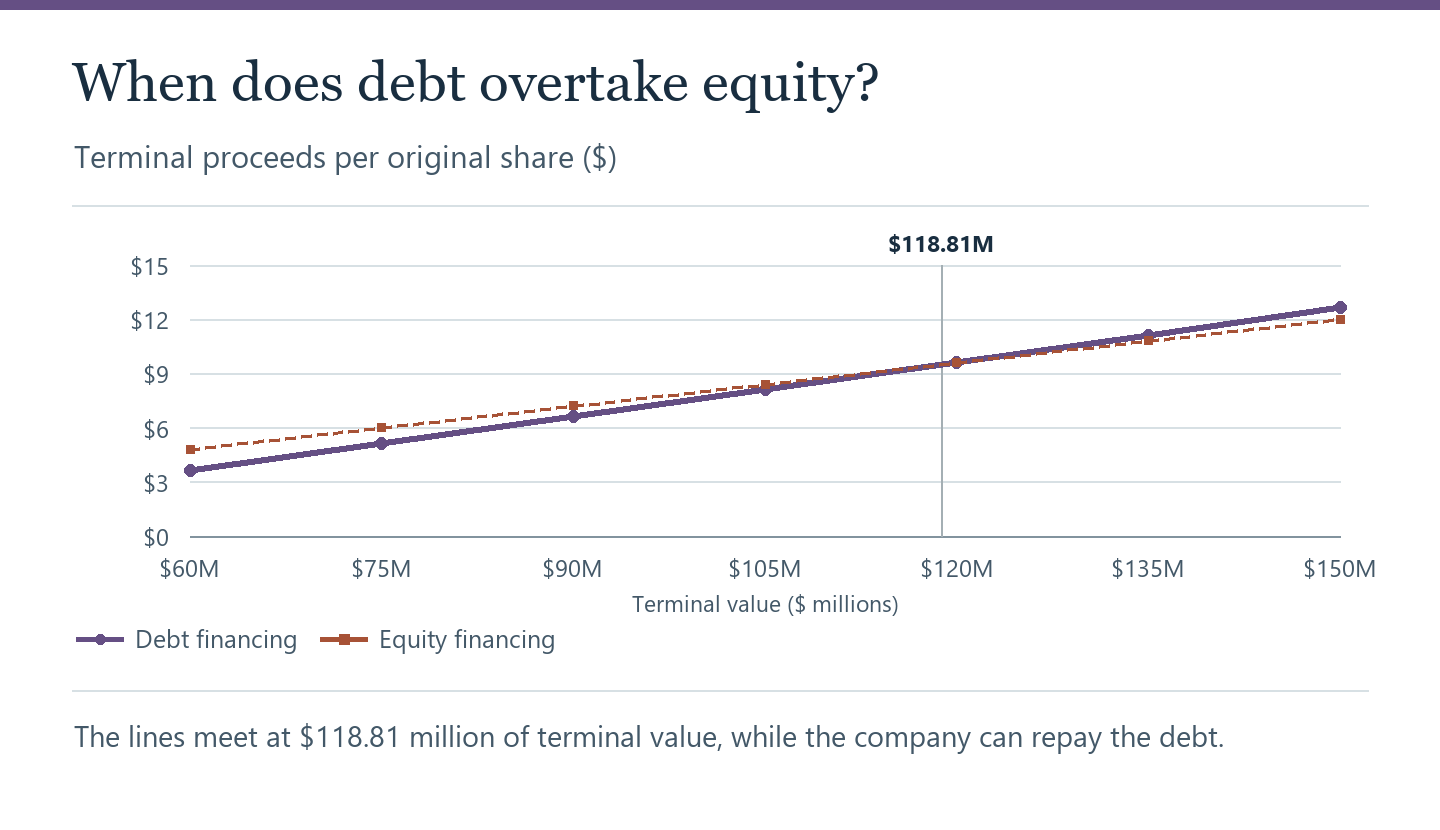
Below the amount due on the loan, the simple subtraction would yield negative equity value. In an ordinary limited-liability common equity example with no additional support obligation, the residual cannot fall below zero. Creditors then face potential loss and may exercise rights over the assets or seek a restructuring. The project might have technical value even when existing equity is worth little. A lender taking control could sell engineering assets, license designs, or fund completion on terms that substantially change the ownership structure. A successful mission at a later date need not rescue the original shares.
The debt agreement matters before maturity too
A loan due in two years can influence decisions well before repayment. A lender may require minimum cash, restrict additional borrowing, or attach milestones to future draws. Suppose Meridian spends $8 million on qualification, then learns a test must be repeated for $3 million with a six-month delay. If its remaining draw is contingent on successful qualification by the original date, the company can have an impressive signed facility and no access to the next dollar it needs. Reading only the face amount of the loan would miss the condition that gives the lender bargaining power.
Even a lender willing to grant a waiver can require a higher spread, additional collateral, a fee, or an equity contribution. The prospective cost of debt financing should include plausible responses to delays. A nine percent coupon in a clean two-year model may understate what the company pays if the economic path requires an amendment. Conversely, a genuinely committed, flexible facility can be worth more than another loan with a slightly lower quoted rate but restrictive draw conditions. The board is buying access to money through a sequence of uncertain technical events.
A creditor examining collateral should ask about resale value to someone other than Meridian. A specialized test rig designed for one module may cost millions to build and be of limited use to another buyer. Patents may support a future licensing stream but take time and money to defend. A small engineering team may be central to the value of the designs and difficult to retain through distress. Book value, replacement cost, and proceeds available in a hurried sale can differ dramatically. The lender's upside is often capped while the operational complexity of recovery is substantial.
Self-financing has an opportunity cost
Meridian's established testing-equipment division can generate cash. Suppose it can retain $5 million per year after necessary maintenance, ordinary working capital, and existing obligations. Accumulating $20 million would take four years if the amount remains steady and every dollar can be redirected. Calling that money free ignores the time and the alternative uses of the cash. The existing business might have attractive incremental projects, shareholders might otherwise receive distributions, and the space-system customer's qualification window might close before the fourth year.
A staged project could make self-financing more practical. If Meridian can spend $5 million this year to resolve the most uncertain engineering questions, the company might raise the remaining capital later at a better price. It could also discover early that the program is uneconomic and avoid spending the rest. The value of the staging depends on whether the first-stage test truly changes the probability of technical or commercial success and whether suppliers and the customer will wait. An inexpensive milestone that leaves every important question open may simply postpone the difficult financing decision.
Consider a separate illustration. Suppose Meridian spends $5 million from retained cash and then needs $15 million of new equity. At an $8 issue price it sells 1.875 million shares rather than 2.5 million. If completing a credible test raises the available issue price to $10, it sells 1.5 million shares. If a failed test or tighter market reduces the available price to $4, it must sell 3.75 million shares for the same remaining requirement. Staging reduces the initial amount to raise, but it introduces uncertainty about the price at which the later financing can occur. The correct comparison includes both features.
The existing division and the new theme may also be less independent than they look. A downturn in industrial capital spending could cut retained cash at exactly the moment external financing becomes expensive. The program then consumes liquidity from a core business facing difficulties of its own. A portfolio investor holding Meridian for the mature division has acquired a contingent commitment to the new program unless the board has defined a stop condition. Identifying that condition matters as much as forecasting the revenue of a spacecraft that has not yet flown.
Let the customer finance what it values
Meridian can try to change the commercial contract rather than choosing only between common shares and loans. An upfront development payment, a refundable deposit, an advance tied to delivery, and a minimum purchase obligation are different instruments. A nonrefundable payment for a completed engineering milestone can reduce funding needs and provide evidence of customer commitment. A refundable deposit can improve liquidity temporarily while creating a repayment obligation under specified conditions. Treating all buyer advances as permanent free equity would misstate the claims on the company.
Suppose the buyer offers $6 million upfront in return for a reduction of $1.5 million on each of the first five production orders. If all five occur, the nominal price concession totals $7.5 million. This does not automatically make the arrangement unattractive. Timing, risk sharing, the probability of orders, and the alternative cost of capital all matter. If production never occurs, the governing agreement determines whether any part of the $6 million must be returned. On a successful program it may be expensive financing. On an uncertain one it might share risk in a way that ordinary debt cannot.
A supplier can share risk as well by accepting later payment, but the supplier may charge more, request exclusivity, or require minimum volumes. The relevant cash comparison should show what the concession costs in the scenarios where the project succeeds and who bears the loss if it fails. A research analyst looking only at a reduced debt balance might celebrate a financing improvement while missing a larger claim hidden inside future unit economics. The obligation has moved from the balance sheet into commercial terms.
Read the fully diluted share count as a set of conditions
The simple comparisons assumed ordinary shares with identical rights. A real financing can include warrants, employee awards, convertible instruments, or preferences. Take a separate case in which a lender receives warrants to buy 500,000 newly issued shares at $6 each. If the warrants are exercised for cash, Meridian receives another $3 million and issues the shares. Ignoring the exercise proceeds while adding the shares would overstate dilution in a valuation model. Counting the proceeds now even though exercise may never occur would overstate current liquidity. The timing and conditions matter on both sides of the calculation.
A financing described as carrying a low cash interest rate can therefore be expensive in a successful outcome if the lender also receives a valuable participation right. Conversely, that right may end up worthless if the project fails. To compare proposals, calculate the distribution to existing holders in at least a successful, a middling, and a distressed outcome. A single fully diluted average can smooth away the state in which a particular claim becomes valuable. The board needs to see which investor receives the next dollar after the loan is repaid and which participant must provide more money if the program misses its date.
There is a practical check for a shareholder presentation. Begin with existing ordinary shares and add each class of potential shares only under its own stated assumptions. Reconcile the resulting count to the cash or reduction in other claims associated with exercise or conversion. Then mark options held by investors separately from commitments the company can draw. An investor holding a warrant may choose to exercise when it is favorable to that investor. The company cannot treat the entire potential exercise amount as emergency funding it controls on demand.
This check is particularly valuable for a small company comparing a public equity raise with a private financing package. The public issue may show dilution immediately in the basic share count. The private package may defer visible dilution while attaching rights that become valuable if the technology works. Identical basic share counts today can therefore imply different participation in future success. A clear comparison traces a representative original share through the terms of each offer and explains how much additional money its holder would have to invest to preserve a chosen ownership percentage.
Carry the financing scenario into the whole portfolio
An investor can own exposure to Meridian through several routes. A broad growth fund might hold the common shares. A private credit vehicle might hold the loan. An industrial supplier in a separate portfolio could have committed capacity to the same module. These claims respond differently to a technical milestone yet share the same risk that Meridian cannot fund the next stage. A diversified list of industry labels is no protection against a common financing deadline. Look through to the necessary cash event before summing theme weights.
For a modest position, the most useful scenario may be an unfavorable follow-on raise rather than outright technical failure. What if the test succeeds but arrives late enough to force equity issuance at $5? What if existing shareholders can retain their percentage only by contributing more capital? What if debt cannot be rolled and a successful licensing agreement transfers most of its value to creditors? Running these cases helps a committee decide how much it might actually have to commit to maintain the exposure it thought it had already bought.
A disciplined thesis ends with two dated milestones. One belongs to the laboratory: the result that will resolve an identifiable technical risk. The other belongs to the treasurer: the latest date on which committed funding covers the program under a specified delay. If the funding deadline comes first, an investor has to analyze the next financing before rewarding the company for future technical progress. Meridian's shareholders own a residual claim after everyone with a prior commitment has been paid. Designing a sensor, selling a sensor, collecting for it, and owning the benefit per share are four achievements on four different calendars.
Related research

ResearchCross-Asset Allocation
AI Exposure Reaches Beyond Technology Stocks
The first invoice at a new computing campus may come from a civil engineer. The last unpaid invoice in a failed project may belong to an electrical contractor.

ResearchCross-Asset Allocation
Capital Spending Connects Equity and Credit Risk
A crane lowers a new bottling line into place. In one portfolio it represents a growth opportunity for the beverage company buying the line.

ResearchCross-Asset Allocation
A Satellite Theme Should Fit the Whole Portfolio
The first question at the investment meeting sounded easy. How much of the portfolio was invested in the new technology theme?