
ResearchFixed Income
Bond ETFs and Individual Bonds Solve Different Problems
- Report or archive date
- Archive placement May 22, 2026
- Reading time
- 13 min read

Summary
A bond fund and a directly held bond can provide exposure to similar underlying risks while offering different cash-flow control, trading arrangements, and maturity behavior. A useful comparison begins with the purpose of the investment and examines the actual holdings and costs of each approach.
Start with the claim being purchased
An individual bond is a claim on an issuer under specified terms. Its coupons, principal, payment dates, and contractual options describe what the issuer undertakes to provide. A bond exchange-traded fund represents an interest in a portfolio managed according to a stated mandate. The shareholder's experience reflects the portfolio, fund expenses, distributions, and the market price of the shares.
These structures can be used for different purposes. A specific bond may help fund a particular dated payment, assuming it performs as promised. A fund may provide convenient exposure to a broad segment of the bond market. Neither description establishes that the investment is suitable for every objective or that its underlying risks are small.
The important comparison is between actual exposures, not between labels. A short government-bond fund and a long speculative corporate bond differ in far more than packaging. To isolate the effect of the structure, compare holdings with reasonably similar currency, credit quality, duration, and contractual characteristics before evaluating costs and cash-flow control.
An individual bond has a schedule, subject to its terms
A bond with $1,000 face value and a five-year final maturity may promise annual coupons and $1,000 principal at the final date. If bought for $1,050, the investor does not receive $1,050 of principal simply because that was the purchase price. The premium must be included when calculating the return from the scheduled payments.
The schedule also depends on the bond's provisions and the issuer's performance. A call can return principal earlier; a default can reduce or delay receipts. Holding to maturity can avoid having to sell at an unfavorable interim price, but it does not turn those conditional payments into an unconditional guarantee of the initial investment amount.
Direct ownership gives control over whether to retain a particular security, subject to such events. It also places the responsibility for selecting, monitoring, and replacing that security on the investor or whoever manages the portfolio. The ability to see a maturity date is useful, but it does not replace the work of evaluating the issuer and terms.
An ongoing fund may maintain its exposure rather than wind down
Many bond funds continually replace holdings as they mature or move outside the mandate's eligibility rules. A fund targeting a maturity segment can sell bonds as they become too short and buy others within the intended segment. Its average duration can therefore remain broadly persistent even as each individual security gets older.
A shareholder generally cannot point to a date when an ordinary ongoing fund must return a fixed face amount per share. The fund distributes income and can be sold at its market price, but the portfolio's continuing activity differs from one bond moving toward a specified repayment. This is a structural distinction, not evidence that one investment has hidden losses while the other has none.
The fund's mandate determines the details. An active fund may alter exposures within its permitted range, while an index fund follows its methodology using the stated replication or sampling approach. The word bond says little about how those exposures evolve. The investment objective, portfolio data, and prospectus supply the relevant information.
Defined-maturity funds are a separate case
Some bond ETFs hold securities concentrated in a specified maturity year and plan to terminate around that period. They can be useful for organizing exposures by year, but their final distribution is not the same as a contractual face-value promise made by an individual issuer to a bondholder.
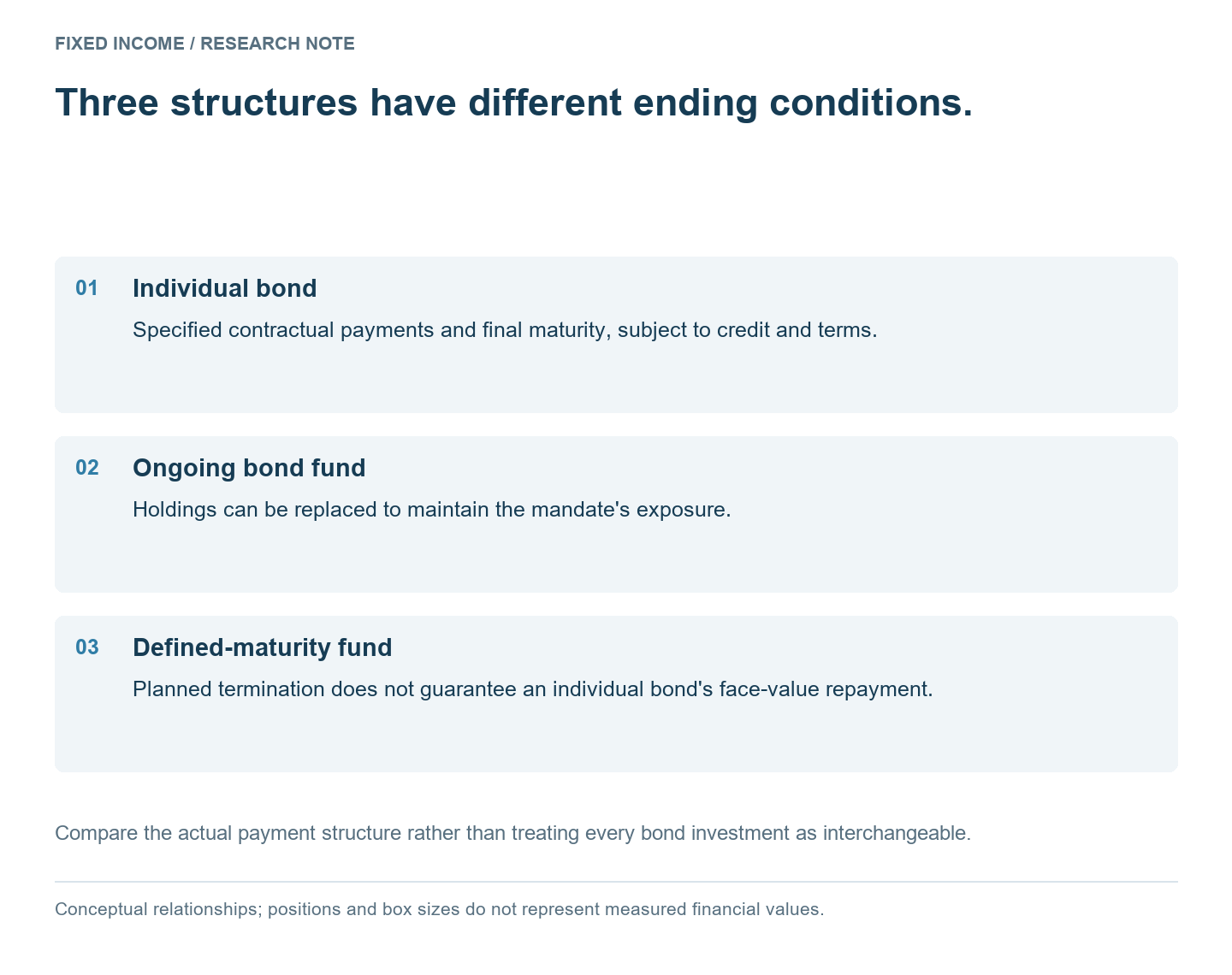
The amount ultimately distributed depends on portfolio receipts, defaults or sales, expenses, cash management, and the fund's termination process. Holdings can mature at different dates within the final year, leaving proceeds in cash or short-term instruments until the final distribution. The fund's income and exposure can change during that transition.
A comparison should therefore distinguish an ongoing fund from a defined-maturity fund rather than assuming every ETF behaves identically. For a dated obligation, the exact expected distribution window and uncertainty around the final amount still matter. A calendar-year label is not a guarantee that a particular bill due earlier in that year will be funded.
Diversification can be easier to obtain through a fund
A fund can spread assets across many securities in trade sizes that would be difficult for a smaller direct portfolio to replicate. That can reduce the effect of one issuer's failure relative to a concentrated holding. The benefit depends on the holdings, their weights, and the risks they share, rather than the number of line items alone.
A portfolio of many bonds from related issuers or one industry can retain substantial common exposure. A government-only fund can have low exposure to corporate default while still carrying significant duration risk. A lower-quality credit fund can be diversified across issuers and still be vulnerable to a broad deterioration in financing conditions.
Direct portfolios can also be diversified, but implementation may require more capital, research, and trades. The practical question is whether the intended exposure can be constructed and maintained efficiently at the available scale. Comparing a single bond with a broad fund without acknowledging concentration would conflate a portfolio choice with the ownership structure.
Separate issuer concentration from the wrapper
Consider a deliberately simplified $20,000 direct position in one issuer and a $20,000 fund position divided equally among 200 unrelated issuers. Assume positions were acquired at face value, ignore coupons and expenses, and let one issuer default with an immediate recovery of 40% of principal. If that issuer is the entire direct position, the principal loss is $12,000, or 60%.
In the equally weighted fund example, the same issuer represents $100 of the position. A 60% loss on that $100 is $60, or 0.3% of the $20,000 fund investment, assuming every other position is unchanged. The difference comes from concentration. A direct portfolio with the same 200 equal exposures would have the same simplified principal-loss result before implementation differences.
Now suppose issuers representing 20% of the fund all experience that same 60% loss. The simplified portfolio loss is 12%. Diversification reduced the impact of a single failure, but common exposure can still produce a substantial result. The number of holdings alone does not establish the independence of their risks or the size of a plausible combined shock.
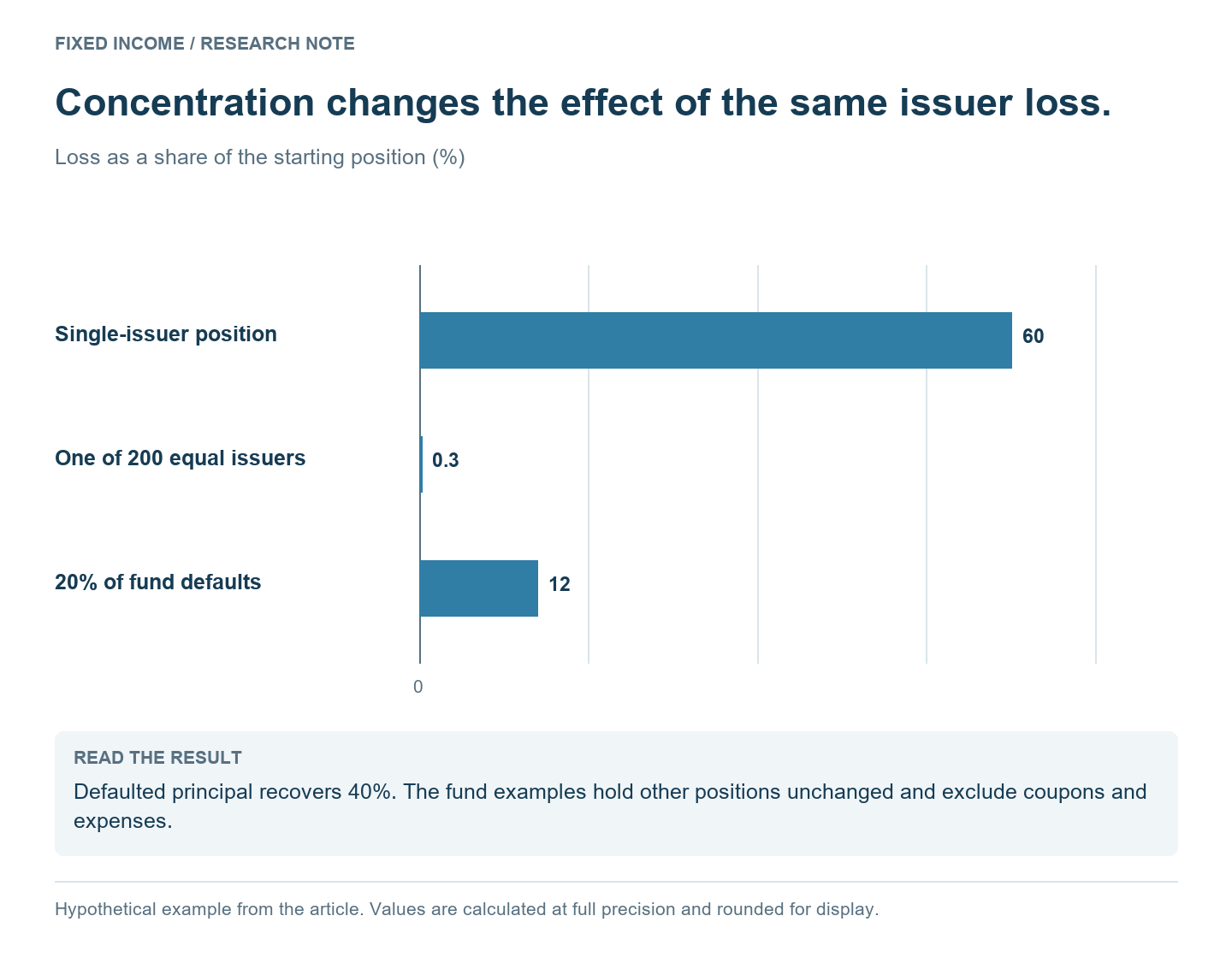
These are principal-recovery illustrations, not forecasts of default or precise market-price paths. Recovery can take time, and unaffected securities can also reprice during stress. The calculation clarifies what can reasonably be attributed to diversification and what cannot be attributed merely to owning a fund rather than a bond directly.
Both structures are affected by the value of their bonds
If two portfolios hold economically similar fixed-rate exposures, higher required yields can reduce their market values regardless of whether the holdings sit in a fund or a direct account. A fund displays that change through its net asset value and trading price. A directly held bond also has a changed market value even if its owner chooses not to sell.
For a local sensitivity, an exposure with modified duration of six has an approximate 6% price decline for a one-percentage-point increase in its own modeled yield, other inputs unchanged. The estimate is not unique to a fund. A comparable direct portfolio can have similar first-order sensitivity, subject to its exact payments and risks.
The difference lies partly in the investor's intended endpoint. An individual bond can provide a specified principal receipt if held to maturity and paid as promised. An ongoing fund continues implementing its mandate. A fair comparison should show both interim values and horizon cash flows rather than presenting only whichever measure favors the preferred structure.
NAV is a valuation calculation; market price is a transaction price
A fund's net asset value per share is its assets minus liabilities, divided by shares outstanding, using the applicable valuation process. ETF shares trade on an exchange at prices set by buyers and sellers. The trading price can be above NAV, called a premium, or below NAV, called a discount.
Suppose an ETF has NAV of $50 and a market price of $50.40 at a matched observation time. The premium is 0.8%, calculated as $50.40 divided by $50 minus one. Purchasing 1,000 shares at that price costs $50,400 before transaction charges, compared with $50,000 of reported NAV represented by those shares.
That $400 difference is not a separate management fee. It is the difference between the market purchase price and the valuation measure used for comparison. Whether it persists, narrows, or changes sign matters to a shareholder who later sells. The premium calculation should use a clearly identified NAV and observation time rather than mix unrelated prices.
Bond valuations can be less immediate than exchange prices
Some underlying bonds trade infrequently. Their valuations may use evaluated prices, recent comparable trades, or other inputs rather than a fresh transaction in every security at the exact moment the ETF trades. During rapidly changing conditions, the fund's share price and the values used in its NAV can incorporate information at different speeds.
For a simplified example, suppose reported NAV is $50 and the ETF trades at $49.80. The apparent discount is 0.4%. If an analyst's current executable-value estimate for the portfolio is instead $49.60 per share, the trading price is about 0.4032% above that estimate. The same market price can look cheap or expensive relative to different valuation references.
The second estimate is not automatically correct merely because it is more recent. It illustrates why a discount is not conclusive evidence of a bargain or a broken fund. The quality, timing, and transaction basis of the reference valuation must be examined. A evaluated value also should not be presented as an assured execution price for the entire portfolio.
Creation and redemption link shares with the portfolio
Authorized participants can exchange specified large blocks of ETF shares with the fund using the applicable baskets and cash arrangements. That process provides a mechanism through which differences between share prices and portfolio values can be arbitraged, subject to costs and risks. Retail shareholders generally buy and sell shares in the secondary market instead of redeeming individual shares for a chosen bond.
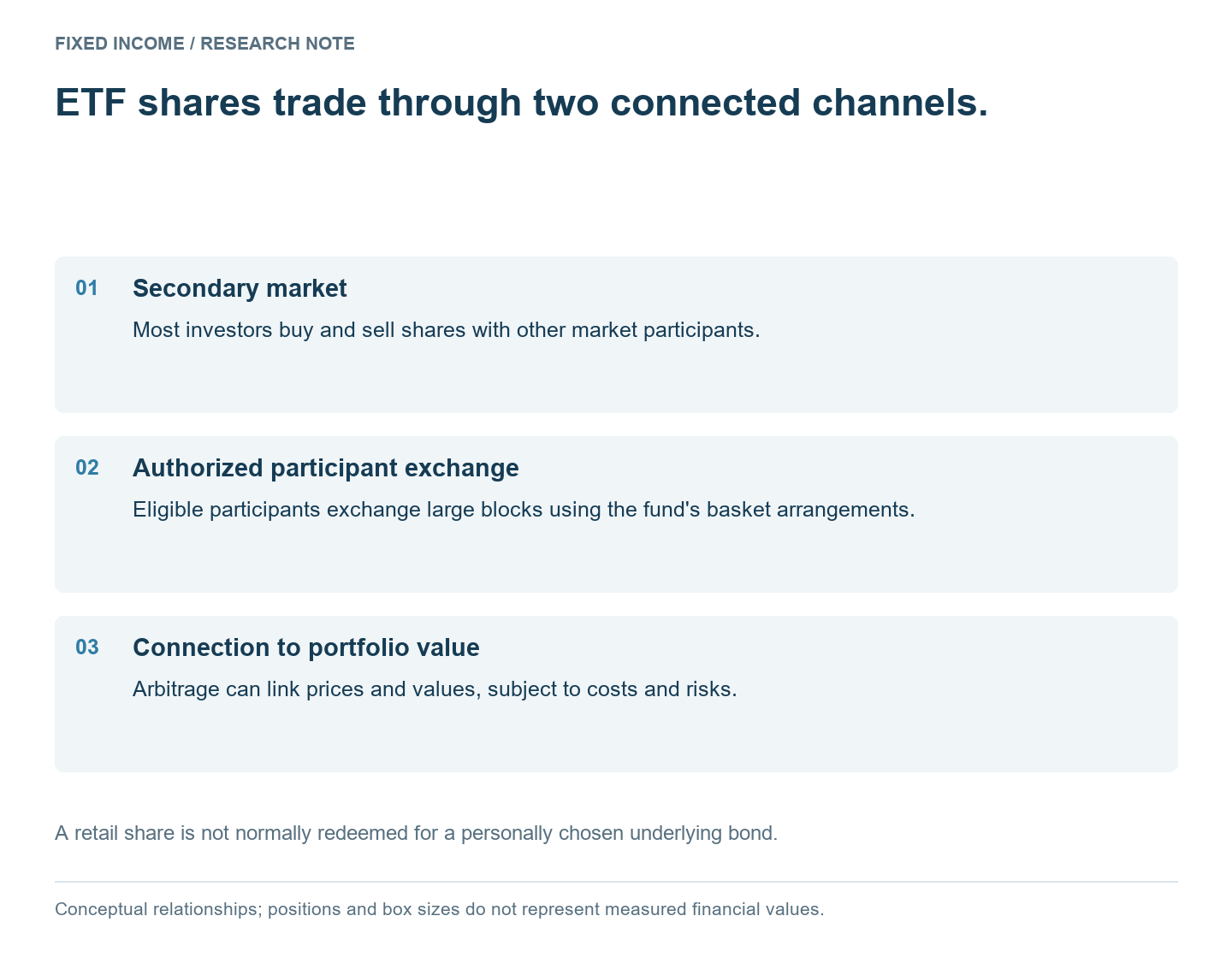
The mechanism encourages price alignment but does not guarantee that every trade occurs exactly at NAV. Transactions in the underlying securities, financing, hedging, operational requirements, and available market-making capacity affect the economics. When those costs or risks change, the range within which a price difference is unattractive to arbitrage can change too.
A sale of ETF shares from one investor to another does not necessarily force an immediate sale of every underlying bond. Secondary-market trading and portfolio transactions are related but distinct. Understanding that distinction prevents ordinary share turnover from being mistaken for an identical amount of direct selling in each bond held by the fund.
Liquidity needs a price as well as a trading opportunity
Being able to submit an exchange order is not the same as being able to transact any desired amount at the last displayed price. Bid-ask spreads and available depth matter for ETF shares. The liquidity of underlying holdings and the capacity of intermediaries can also influence the terms available when markets become stressed.
Suppose an ETF's bid is $49.95 and its ask is $50.05. The quoted spread is $0.10, or 0.2% of the $50 midpoint. A buyer and an immediate seller using those respective sides incur that spread even if the midpoint does not move. The example excludes commissions and assumes sufficient quoted size for the transactions.
Direct bonds have trading costs and liquidity limits as well. A dealer's bid for a small holding may differ from an indicative valuation or a price observed for a larger trade. The comparison should evaluate executable terms for the intended size on both sides, rather than compare an actual ETF price with an idealized bond valuation.
Distributions are part of total return
A fund can pay cash distributions while its share price falls. To evaluate the shareholder's result, include both the ending value and the distributions received, applying a consistent treatment of reinvestment. A price-only chart can omit a meaningful part of the return, while a distribution-only comparison can ignore a decline in capital value.
For an one-share example, buy at $50, receive $2 of distributions during the period, and end with a share worth $48.50. If distributions are retained without reinvestment and costs and taxes are excluded, total wealth is $50.50. The holding-period return is 1%, even though the share price declined 3% and the cash distribution equaled 4% of the initial price.
The distribution is not automatically a separate gain on top of an unchanged asset value. When a fund pays out assets, its NAV reflects that transfer, apart from other simultaneous changes. The same economic value cannot be counted both as cash received and as though it remains fully inside the fund. Accurate performance analysis tracks where the value resides.
Yield measures need comparable definitions
A fund's distribution yield, a standardized income yield, and its portfolio's average yield to maturity can answer different questions. They may use different periods, denominators, expense treatments, and assumptions. None should be compared casually with an individual bond's yield to maturity as though the labels describe an identical cash-flow calculation.
The portfolio's average yield also need not become the shareholder's realized return. Holdings can change, credit losses can occur, prices can move, and distributions can be spent or reinvested at different rates. Expenses and the price paid for the ETF shares further affect the result. The published statistic is a starting point for analysis, not a universal return guarantee.
For a useful comparison, identify the definition, observation date, and period behind each yield. Then construct the cash-flow or return scenario relevant to the intended holding horizon. A slightly larger headline number is uninformative if one figure measures recent distributions and the other measures promised payments over several years.
Expenses should be counted once and on the right base
An expense ratio of 0.25% applied to an assumed constant average asset value of $100,000 corresponds to $250 over a year. Actual expense accrual depends on the fund's values and terms over time. The calculation gives a scale for comparison; it is not an exact cash invoice for every account holding the fund.
Fund expenses are reflected in fund performance and NAV under the applicable reporting treatment. If a reported return is already net of those expenses, subtracting the expense ratio again would double count them. Separately paid commissions, spreads, or account costs may still need to be included when calculating the investor's own experience.
Direct bonds avoid a fund's ongoing management expense but are not costless. A $20 transaction cost is 2% of a $1,000 purchase and 0.1% of a $20,000 purchase. The effect on annualized return depends on the holding period and schedule. Scale, turnover, and available execution terms can change which implementation is more economical.
Control over holdings comes with different responsibilities
A direct holder can decide whether to retain a specific issuer, realize a particular gain or loss, or match a bond to a known payment date. That control can be useful when the portfolio requires customization. It also requires monitoring credit, notices, calls, corporate events, and the cash produced by each holding.
A fund delegates selection and ongoing implementation within its mandate. The shareholder must instead monitor whether that mandate and the resulting exposures remain appropriate for the purpose. Delegating individual security decisions does not remove the need to understand duration, credit quality, concentration, currency exposure, and the fund's operating structure.
Indexing does not make the holdings static. Index eligibility rules can require changes when securities age, ratings change, or new issues enter the universe. An active approach can make different decisions but introduces its own process and execution considerations. The comparison should examine the actual method rather than assume passive means unchanging or active means unrestricted.
Tax and account circumstances can alter the comparison
The treatment of coupon income, fund distributions, discounts, premiums, and realized gains can differ with the instrument and account. A pretax comparison should not be presented as an individual's after-tax result without those facts. The timing of recognition can matter as much as a headline tax rate.
Fund ownership can also expose a shareholder to distributions arising from portfolio activity, while direct ownership allows more control over which security is sold. The practical consequences depend on the fund's structure and transactions. Broad claims that every ETF has the same tax outcome would substitute a product label for an actual analysis.
The important discipline is to keep separate the underlying investment result, fund-level expenses, transaction costs, and account-specific consequences. Combining them into one unexplained yield can make it impossible to see why two approaches differ or which assumptions would change the comparison.
Choose the comparison around a concrete job
For a known future payment, examine the date and reliability of cash receipts, including whether an early sale is required. For continuing market exposure, examine diversification, duration, credit composition, cost, and rebalancing. For a flexible reserve, evaluate the amount that can be accessed and the price uncertainty involved, rather than treating every bond investment as cash.
A defined-maturity ETF, an individual bond ladder, and an ongoing bond fund can each organize fixed-income exposure differently. A fair evaluation holds the desired risk and funding purpose as consistent as possible, then examines the tradeoffs in execution and control. Comparing unmatched instruments can make a structural choice appear responsible for differences that actually come from the assets selected.
The useful conclusion is not that funds are inherently safer or that individual bonds cannot lose money. It is that structure determines how exposure is owned, traded, managed, and converted into cash. Understanding those mechanics allows the underlying bond risks and the investment's intended purpose to guide the comparison instead of relying on a familiar product name.
Related research

ResearchFixed Income
A Bond Ladder Trades Some Timing Risk for Other Risks
Staggered maturities can spread reinvestment decisions across time and organize expected cash receipts. They do not remove credit risk, guarantee spending capacity, or prevent market-price declines. The ladder's purpose and maintenance rules matter as much as the spacing of its rungs.

ResearchFixed Income
The Spread Between Government and Corporate Bonds Needs Context
A corporate bond's excess yield can compensate for expected losses, uncertainty, liquidity, and contractual features. Understanding a spread requires identifying the benchmark, separating changes in its components, and resisting the temptation to translate a quoted percentage directly into a probability of default.

ResearchFixed Income
Cross-Border Bonds Add a Currency Decision
A foreign-currency bond combines a local bond exposure with an exchange-rate exposure relative to the investor's spending currency. Hedging can change that combination, but the hedge's price, payment schedule, and ongoing management determine what risk is actually reduced.