
ResearchFixed Income
Cross-Border Bonds Add a Currency Decision
- Report or archive date
- Archive placement June 12, 2026
- Reading time
- 13 min read

Summary
A foreign-currency bond combines a local bond exposure with an exchange-rate exposure relative to the investor's spending currency. Hedging can change that combination, but the hedge's price, payment schedule, and ongoing management determine what risk is actually reduced.
A foreign yield is only one part of the return
On June 11, 2026, the European Central Bank announced a 25-basis-point increase in its three key rates, with the deposit facility rate set to reach 2.25% effective June 17. For an investor measuring wealth in U.S. dollars, that decision did not by itself establish the return available from a euro-denominated bond or predict the euro's next movement.
Cross-border fixed income involves several distinct questions. What payments does the bond promise in its own currency? How will that currency translate into the currency used for spending or reporting? Will the investor accept the exchange-rate exposure or use a hedge? Each choice affects the eventual result, and none can be answered by comparing two headline yields alone.
Assume annual payments. Convert each payment into the investor’s currency, then calculate what the currency hedge changes.
Country of issuer and currency of payment are different
A company based in one country can issue debt in another country's currency. The issuer's location helps identify legal, operating, and credit considerations, but the payment currency determines the direct conversion exposure for the holder. A foreign issuer's dollar bond and its euro bond do not create identical currency exposures for a dollar-based investor.
The same distinction applies to a fund. Its listing currency, accounting currency, underlying bond currencies, and any currency hedge are separate characteristics. Buying a fund through a dollar-denominated trading line does not automatically remove the foreign-currency exposure of its holdings. The mandate and share-class terms need to be examined.
The investor's relevant currency also depends on the purpose of the money. Someone funding a known euro expense faces a different mismatch from someone funding a dollar expense, even if both can report account values in dollars. Currency risk is a relationship between assets and obligations, not a property determined solely by a security's country label.
Fix the quotation convention before calculating
Use a spot exchange rate of $1.10 per euro. Converting $11,000 produces EUR 10,000 before costs. The quotation tells us how many dollars one euro buys. A fall from $1.10 to $1.00 per euro means the euro buys fewer dollars and has weakened against the dollar under this convention.
The inverse quotation is euros per dollar. At the starting rate, one dollar buys approximately EUR 0.9091. If the rate becomes one euro per dollar, the dollar's purchasing power in euros has increased by 10%, while the euro's dollar value has declined by approximately 9.0909%. Percentage changes in reciprocal quotations are not equal in magnitude.
Keeping the units attached to each rate prevents sign errors. Multiplying euro receipts by dollars per euro produces dollars. Dividing those same receipts by a dollars-per-euro quote would produce the wrong result. The direction of conversion should be checked before interpreting a gain or loss.
Trace an unhedged one-year bond
Suppose EUR 10,000 buys a one-year bond at par. It pays a 5% annual coupon and repays principal at year-end, producing EUR 10,500 in one final payment. Assume the issuer pays in full and there are no interim receipts, fees, or taxes. The local-currency return is exactly 5% under these terms.
If the year-end exchange rate is $1.00 per euro, the EUR 10,500 becomes $10,500. Compared with the initial $11,000, the dollar return is approximately negative 4.5455%. The bond paid every euro it promised, yet the investor lost dollars because the currency move outweighed the local bond gain.
If the year-end rate is instead $1.20 per euro, the final payment becomes $12,600. The dollar return is approximately 14.5455%. The local bond outcome is unchanged; the exchange-rate conversion produces the difference between these two dollar results.
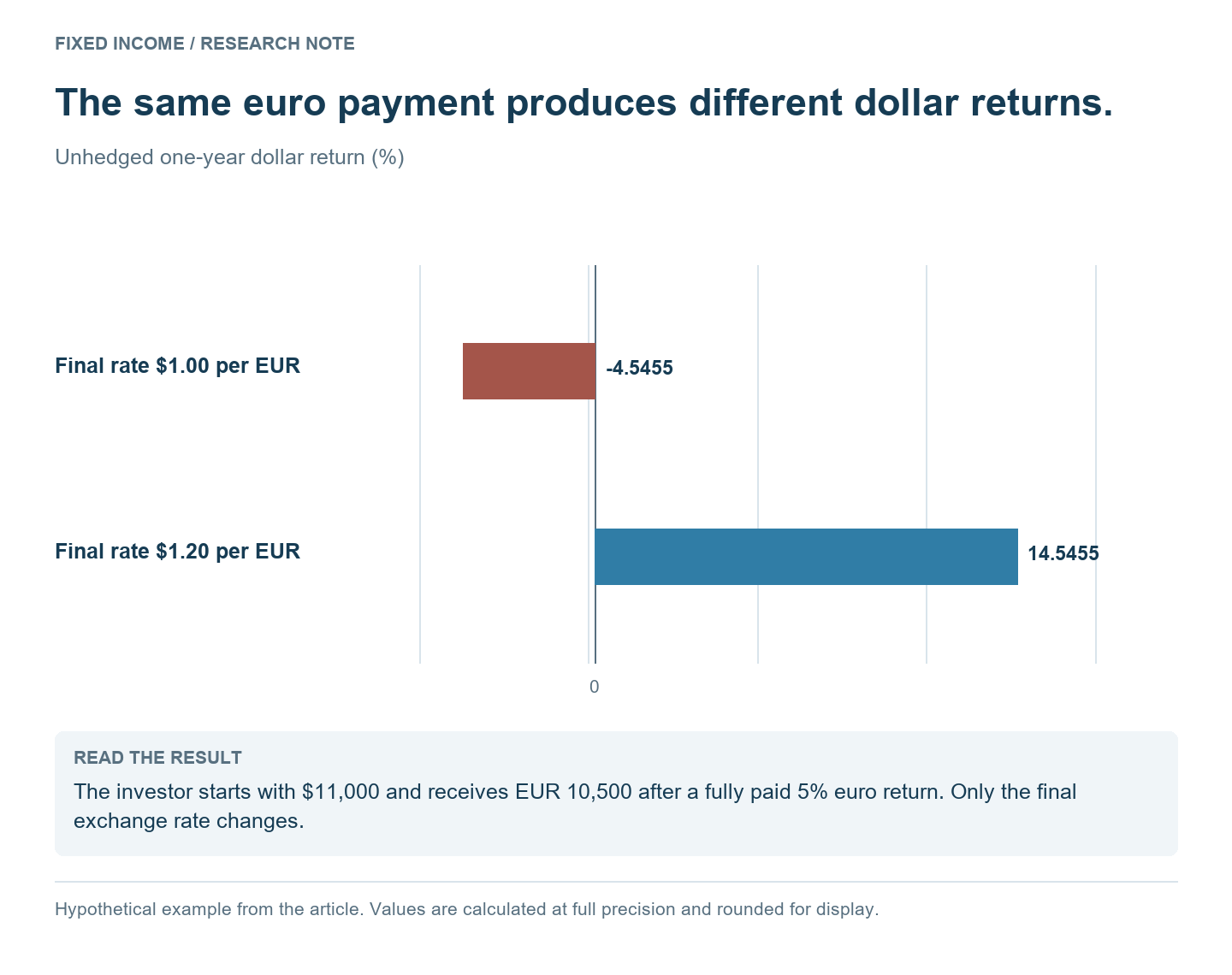
Neither case proves that a higher foreign yield is attractive or unattractive. They show that a local yield and a home-currency result are different measurements. The appropriate analysis must identify the currency in which success is being measured and the exchange-rate exposure retained over the holding period.
Combine the two returns multiplicatively
When the entire local investment result is converted at the endpoint, home-currency growth equals local-currency growth multiplied by exchange-rate growth, using a consistent quotation. In the weaker-euro case, the calculation is 1.05 times the ratio of 1.00 to 1.10, minus one. It produces the same negative 4.5455% dollar return as the cash-flow conversion.
Adding the local 5% return to the euro's negative 9.0909% movement gives an approximation, but it omits the interaction between the two changes. The exact result includes that interaction because the currency movement applies to both the original investment and the local return. Larger movements make the difference between addition and multiplication more consequential.
With several coupons paid at different dates, the conversion problem becomes a dated cash-flow problem. Each receipt may be converted, retained, or reinvested at a different rate. The single-endpoint formula should not be applied to an account that has already converted or spent intermediate payments without accounting for those actions.
A forward hedge fixes a specified conversion
Suppose the investor enters a separate agreement to sell the entire EUR 10,500 year-end receipt at $1.08 per euro. If the bond pays as promised and the forward is performed as agreed, the conversion produces $11,340. Relative to the initial $11,000, the dollar return is approximately 3.0909% before costs and taxes.
The forward replaces uncertainty about that specified conversion rate with a contractual rate. It does not create a 5% dollar return simply because the bond earns 5% in euros. The difference between the starting spot rate and the forward rate is part of the hedged result.
This example assumes the hedge amount and settlement date exactly match the bond's final receipt. It also assumes both counterparties perform. A real hedge can require collateral, periodic settlement, or other operational arrangements. Fixing a future exchange rate does not eliminate those requirements or the bond issuer's credit risk.
Hedging principal alone leaves some exposure
Now hedge only EUR 10,000 of principal at the same $1.08 rate, leaving the EUR 500 coupon unhedged. If the final spot rate is $1.00, principal conversion produces $10,800 and the coupon produces $500. Total dollar proceeds are $11,300, for a return of approximately 2.7273%.
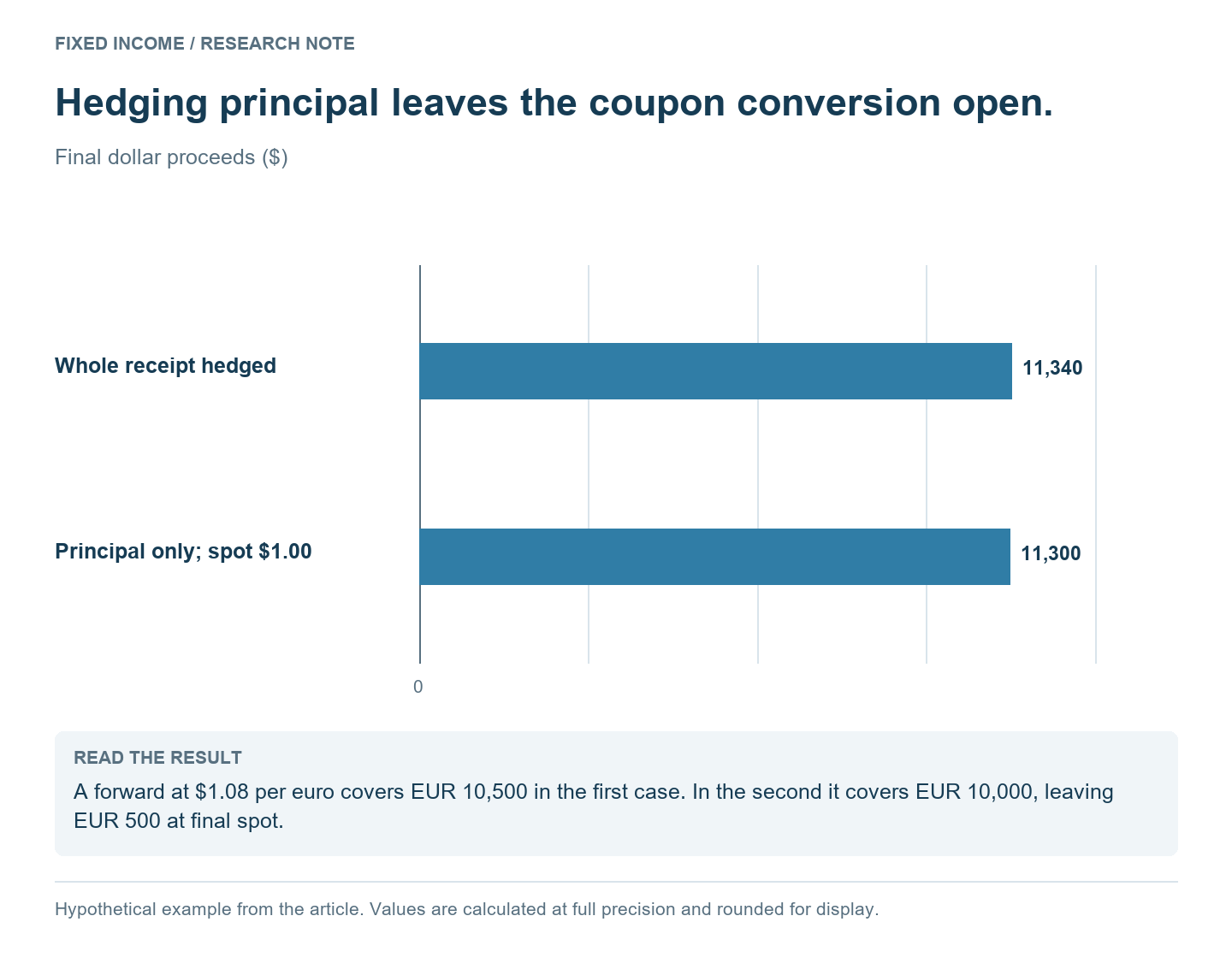
The difference from the full-receipt hedge comes from the coupon's conversion. Describing the principal-only arrangement as fully hedged would overstate what was fixed. The hedge ratio and the definition of the exposure being hedged need to be stated together.
For a portfolio containing many payment dates, matching each known receipt may require several contracts or a broader hedging policy. If market values change, a hedge based on yesterday's portfolio value can become larger or smaller relative to current exposure. The practical implementation matters as much as the decision to use the word hedged.
A partial hedge needs a clearly defined denominator
Suppose the investor chooses to hedge half of the known EUR 10,500 final receipt rather than all principal or all proceeds. The forward amount is EUR 5,250 at the $1.08 rate, producing $5,670. The other EUR 5,250 remains exposed to the final spot rate. This is a 50% hedge of the assumed final receipt, not a statement that every possible risk has been reduced by half.
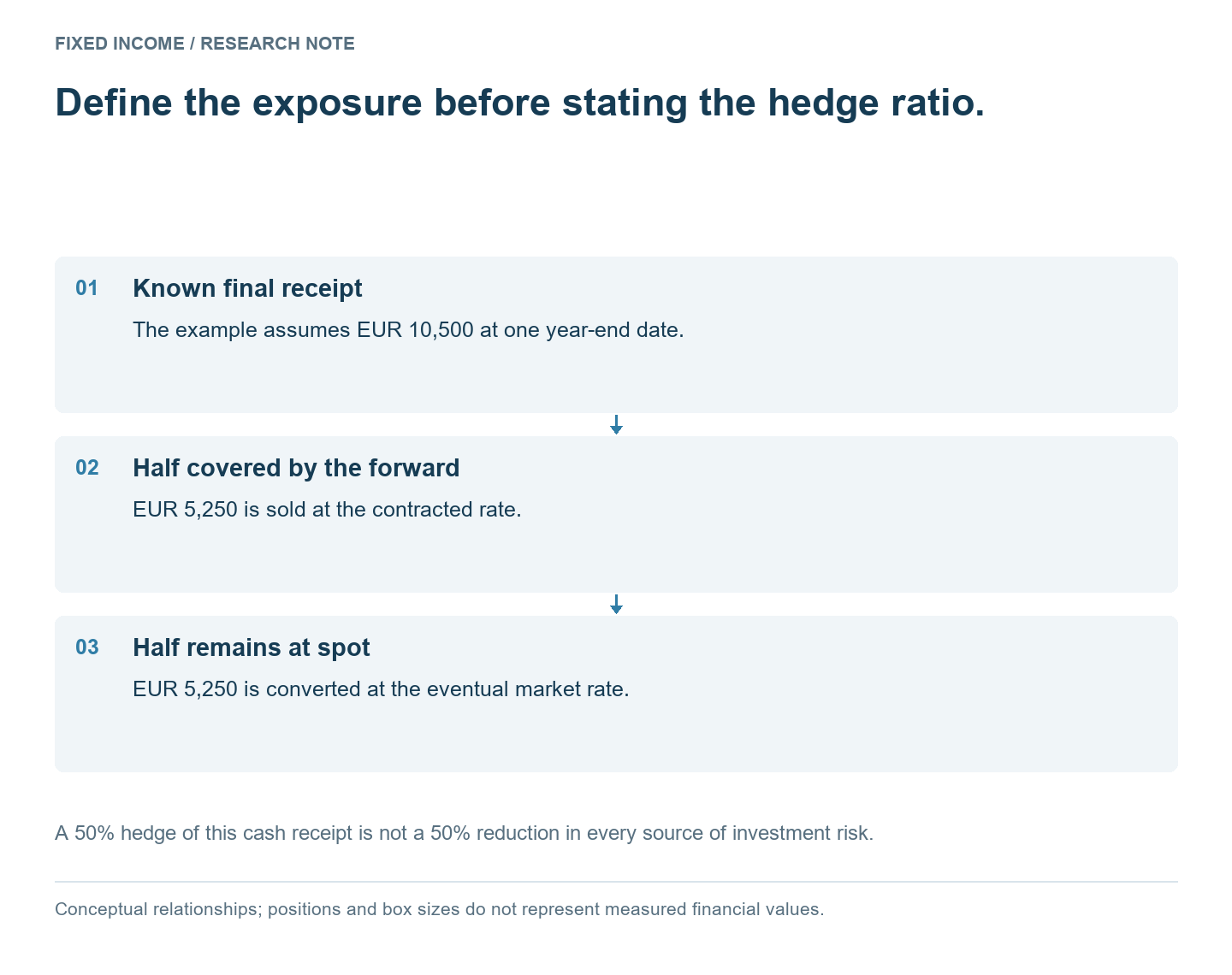
At the weaker-euro endpoint of $1.00, the unhedged half produces $5,250. Total proceeds are $10,920, for a dollar return of approximately negative 0.7273%. The result lies between the earlier unhedged and fully hedged outcomes because half the same receipt follows each conversion path under the common assumptions.
The partial hedge also retains some benefit from a stronger euro. It should therefore be evaluated as a deliberate mixture of exposures, rather than judged only by whether it would have beaten the other choices after one exchange-rate outcome is known. A policy chosen in advance needs a rationale that can survive both favorable and unfavorable currency moves.
For an actual fund, a stated hedge percentage might refer to current asset value, net currency exposure, or another defined base, and it may be adjusted only at scheduled intervals. That can differ from this example's known final receipt. Reading the denominator and reset policy is necessary before comparing two products both described as partially hedged.
The same discipline applies when an investor changes the hedge over time. Reducing protection after a currency loss or increasing it after a gain changes the future exposure; it does not reverse the prior result without a cost or market movement. Keep the completed cash flows separate from the new hedge decision so that an attribution record explains what actually happened rather than retroactively assuming the preferred policy was always in place.
Forward pricing reflects interest-rate relationships
In a simplified frictionless setting with comparable credit conditions and unrestricted transactions, covered interest parity connects spot and forward rates with the two currencies' interest rates. With the quote expressed as dollars per euro, the one-year forward equals the spot rate multiplied by one plus the dollar rate, divided by one plus the euro rate.
Use a separate example with spot at $1.10 per euro, a dollar rate of 4%, and a euro rate of 5%, all under annual compounding. The parity forward is approximately $1.089524 per euro. It is lower than spot because the euro interest rate is higher in this assumed pair of funding opportunities.
EUR 10,000 earning 5% becomes EUR 10,500. Converting that amount at the full-precision parity forward gives $11,440, exactly 4% above the $11,000 starting amount. The apparent advantage from the higher euro rate is offset by the forward conversion relationship in this controlled example.
The example is separate from the earlier supplied $1.08 hedge quote; they are not claimed to describe the same market conditions. The parity example assumes matched one-year instruments without credit or transaction differences. A risky foreign bond cannot be treated as equivalent to a funding deposit merely because both display an annual percentage.
The forward rate is not a promise about future spot
The parity calculation establishes a pricing relationship among transactions that can be arranged now under its assumptions. It does not say that the future spot exchange rate will equal the forward. The forward can differ from the spot rate eventually observed without violating the arithmetic of the original covered transaction.
An investor who leaves the currency unhedged is accepting that future spot outcome. An investor who locks a forward accepts the contractual conversion instead, subject to the hedge's performance and matching. The comparison should not quietly give the unhedged position the forward rate as if it were guaranteed while also claiming the freedom to benefit from a favorable spot move.
This distinction prevents a frequent narrative error: interpreting a forward discount as a certain forecast of depreciation. Interest-rate differentials are central to the forward's pricing, while future exchange rates depend on uncertain outcomes. A precise contract rate and an uncertain forecast are different types of information.
Real hedging costs can depart from the simplest relationship
Actual markets include bid-ask spreads, financing differences, collateral terms, counterparty considerations, and constraints on intermediaries' balance sheets. Hedging demand can also be uneven across currencies. A cross-currency basis describes departures from a specified covered-parity relationship under the conventions used, rather than an automatic opportunity available on identical terms to every investor.
The sign of a quoted basis depends on the currency pair and quotation convention. A statement that the basis is negative is incomplete without explaining which funding leg or conversion it affects. The practical question is how the available hedge changes the investor's own cash flows and effective financing terms.
For comparisons, use the forward quote available for the relevant amount and date, together with all applicable costs. A theoretical relationship is useful for understanding the mechanism and checking consistency. It should not replace executable terms when evaluating the result of an actual investment or hedging arrangement.
A rolling hedge does not lock the entire investment horizon
An investor can hedge a long-term bond using shorter forward contracts that are renewed periodically. Each renewal exposes the strategy to the terms then available. The bond may have five years remaining while the currency conversion is fixed only for the next month or quarter.
The resulting hedged return depends on the sequence of roll rates, any cross-currency basis, transaction costs, and the changing size of the exposure. The initial short-term hedge cost should not be multiplied across several years and presented as a guaranteed long-term cost unless the relevant terms have actually been locked for that period.
Rolling can provide flexibility, but it creates management and liquidity requirements. The portfolio may need cash to settle a losing hedge even while an offsetting gain remains embedded in an unsold foreign asset. An economically offset position can still require attention to the dates on which cash must move.
Changes in bond cash flows can create a hedge mismatch
The full-receipt example assumes EUR 10,500 will arrive on the hedge settlement date. A default, restructuring, or early call can change that amount or date. The forward contract does not automatically disappear merely because the expected bond receipt changed. The investor may need to resize, close, or settle the hedge under the available terms.
For a simple amount example, if only EUR 4,000 is received while the agreement still requires delivery of EUR 10,500, the shortfall is EUR 6,500. Acquiring or otherwise resolving that shortfall has a cost that depends on the exchange rate and contract terms. Currency hedging has not insured the issuer's repayment obligation.
The same principle applies to expected sale proceeds. A hedge sized to an assumed future bond price can become mismatched if the actual sale value differs. Matching contractual principal and coupons is different from hedging an uncertain market value. The exposure definition should reflect what is genuinely known and what is a forecast.
Local interest-rate and credit risks remain
A dollar hedge can reduce exposure to exchange-rate conversion while leaving the foreign bond's sensitivity to local yields intact. If required local yields rise, the bond's local market value can fall. A currency hedge does not generally offset that price change unless it was specifically designed to address a broader combined exposure.
Credit deterioration can likewise reduce the local value or actual receipts. The issuer's revenues, funding structure, legal obligations, and recovery prospects still matter. Diversifying across countries does not eliminate the need to examine whether the borrower can make the promised payments in the currency it owes.
The issuer itself may have a currency mismatch. A company earning mostly local-currency revenue but borrowing in dollars can face a larger local-currency debt burden when its currency weakens. That issuer-level exposure is separate from the bondholder's choice of reporting currency and hedge. Both can affect the investment through different channels.
Match currency exposure to the future obligation
Suppose an investor knows that EUR 10,000 will be needed for a future expense. A euro payment arriving on the appropriate date can help match that liability even if its dollar value fluctuates. A dollar-based report showing volatility may not fully describe the funding risk relevant to the euro bill.
If the expense is instead fixed in dollars, the same unhedged euro asset introduces conversion uncertainty. The investor's home address does not determine which case applies. The purpose, currency, date, and amount of the obligation should be specified before describing a currency exposure as helpful diversification or unwanted risk.
An apparent match can still be incomplete if the bond is risky, the payment date differs, or the expense amount changes. Matching currency is one dimension of a funding plan, alongside timing, credit quality, liquidity, and purchasing power. It should not be treated as a substitute for those other dimensions.
Cross-border implementation adds practical considerations
Custody arrangements, settlement procedures, withholding, documentation, and access to issuer information can differ across markets. Currency controls or transfer restrictions can also affect the availability of cash in some settings. The specific jurisdiction and security determine the relevant issues; they should not be assumed identical across every foreign investment.
Transaction costs can occur at both the security and currency levels. A quoted bond yield may omit conversion spreads, hedge expenses, and account-level charges. The final comparison should start with the amount of the investor's spending currency actually paid and track the receipts available in that currency after the selected implementation.
Published fund returns also need their currency and hedging basis identified. Comparing an unhedged foreign-market index with a hedged share class can mix different exposures. A difference in performance may reflect the currency policy as well as security selection, fees, and market timing.
Keep the analysis in three linked ledgers
First record the bond's payments and potential price changes in its own currency. Second record conversions and any hedge contracts, including amounts and settlement dates. Third translate the resulting cash into the currency relevant to the intended use. This structure makes it harder to count a currency gain twice or overlook a payment left unhedged.
The ECB's June announcement changed a policy setting on a specified effective date, but it did not complete any of those ledgers for an investor. Local bond terms, currency pricing, and hedge implementation still needed separate evaluation. Higher local interest rates can coexist with either stronger or weaker home-currency results depending on the other parts of the exposure.
Cross-border bonds can broaden the set of available issuers and interest-rate environments. Understanding the investment requires deciding how much currency exposure to retain and what a hedge actually fixes. A foreign coupon is a payment in a specified currency; the return useful to the investor emerges only after its amount, timing, conversion, and risks are all considered together.
Related research

ResearchFixed Income
The Spread Between Government and Corporate Bonds Needs Context
A corporate bond's excess yield can compensate for expected losses, uncertainty, liquidity, and contractual features. Understanding a spread requires identifying the benchmark, separating changes in its components, and resisting the temptation to translate a quoted percentage directly into a probability of default.

ResearchFixed Income
The Yield Curve Can Shift, Steepen, or Twist
Two portfolios can have the same duration and still respond very differently when short, intermediate, and long yields move in different directions. Three fully specified scenarios show how cash-flow location changes the outcome.

ResearchFixed Income
Bond ETFs and Individual Bonds Solve Different Problems
A bond fund and a directly held bond can provide exposure to similar underlying risks while offering different cash-flow control, trading arrangements, and maturity behavior. A useful comparison begins with the purpose of the investment and examines the actual holdings and costs of each approach.