
ResearchFund Flows
Cash Fund Flows Do Not Automatically Signal Fear
- Report or archive date
- Archive placement May 26, 2026
- Reading time
- 13 min read

Summary
Money market fund inflows can reflect yield competition, operating cash, scheduled payments, or changes in portfolio risk. The balance alone cannot identify the motive, and a larger pool of cash-like assets is not a promise of future stock purchases.
A higher cash fund balance needs an explanation
Money market fund assets rise, and a familiar interpretation follows: investors are frightened and waiting outside the stock market. Sometimes a move toward more liquid, less volatile holdings does reflect concern about risky assets. But the same increase can result from routine cash management or a switch between two already liquid instruments.
The destination is observable in a fund flow report. The original source of the money, the owner's other holdings, and the intended use may not be. Without that information, a statement about fear is an interpretation rather than a direct reading of the data.
This distinction matters because cash management has several objectives. A business needs money for payroll and inventory. An institution may hold proceeds before a planned payment. A portfolio may compare the yields and access features of deposits, Treasury bills, and money market funds. None of those decisions necessarily expresses a new forecast for equity prices.
Similar inflows can arise from different decisions. Compare sentiment with competing explanations and ask which observations would distinguish them.
Moving between cash vehicles can leave the risk allocation unchanged
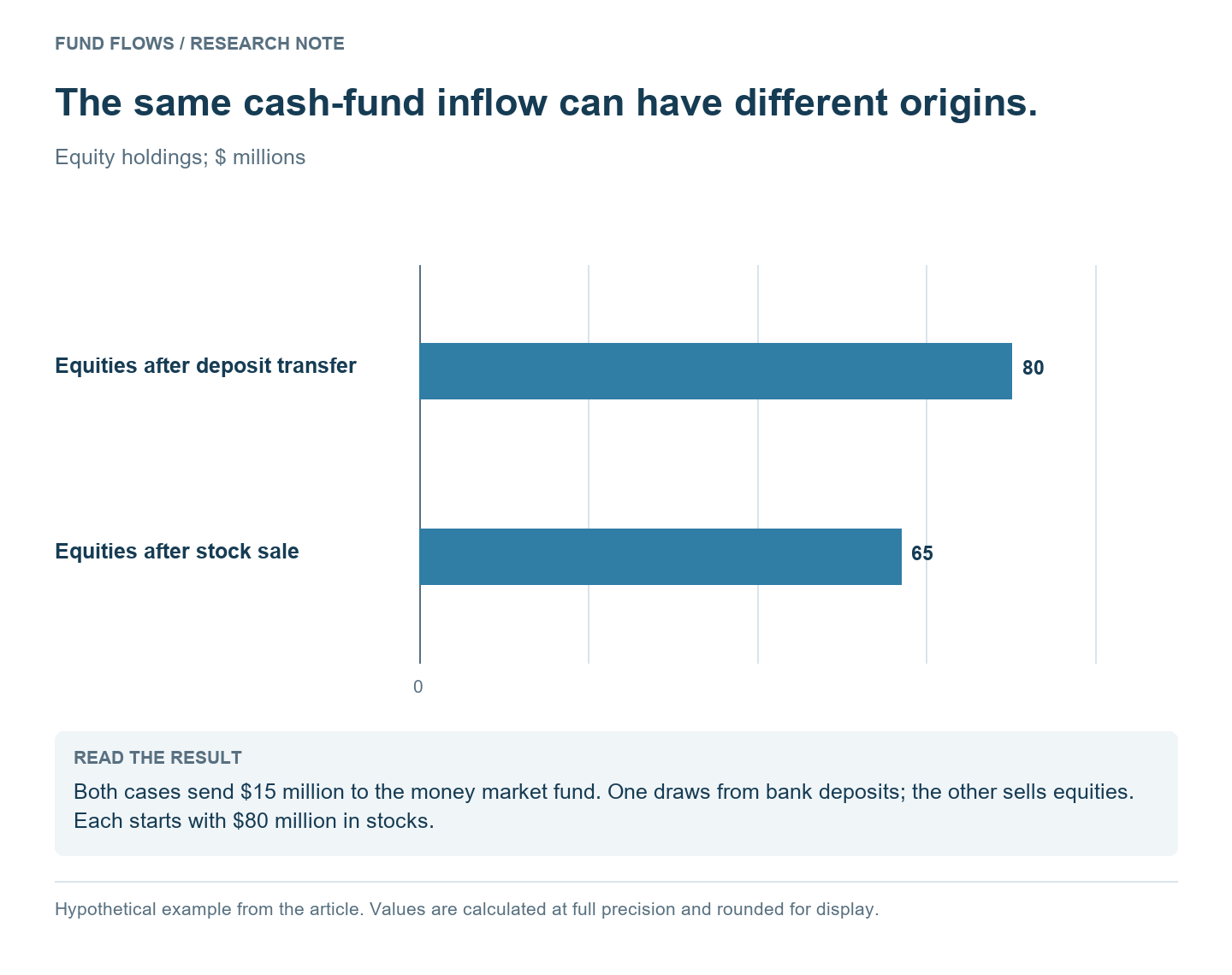
Consider a portfolio with $80 million in equities and $20 million in bank deposits. It transfers $15 million from the deposits to a money market fund, leaving $5 million in the bank. Assume no market movements or transaction costs.
The money market fund receives a $15 million inflow. The portfolio still has $80 million in equities and $20 million across its two cash-management holdings. Its broad allocation between equities and those liquid holdings is unchanged. Calling the transfer a $15 million exit from stocks would be incorrect.
This does not imply that a deposit and a money market fund have identical features or risks. They differ in legal form, protections, access arrangements, and underlying exposures. The example only establishes that the equity position did not fund the transaction.
Now consider a separate case in which the portfolio sells $15 million of equities and places the proceeds in the money market fund while keeping its $20 million bank balance. Equity holdings fall to $65 million and cash-management holdings rise to $35 million. The same $15 million fund inflow now accompanies a genuine reduction in the portfolio's equity allocation, although the motive still requires explanation.
Yield competition can matter without a change in market outlook
Suppose an organization compares two permitted cash arrangements offering assumed annualized net yields of 3.2% and 4.2%. If it holds $10 million for one-quarter of a year and both yields remain constant, a simple-interest calculation gives a $25,000 difference in income before taxes and other costs.
The calculation is $10 million multiplied by the one-percentage-point yield difference and by one-quarter. It is not a quotation of current available yields, nor a forecast that either yield will remain unchanged. It demonstrates why a seemingly modest yield spread can matter for a large cash balance.
An organization could respond to that spread while leaving its long-term investment allocation intact. It would still need to evaluate liquidity, principal risk, operating requirements, and the relevant protections. Yield is one consideration within cash management, not proof that two products are interchangeable.
Short-term yields also adjust differently across products and institutions. A money market fund's income reflects its holdings and their reinvestment, while a bank sets deposit rates under its own funding and business considerations. Differences in how quickly rates adjust can encourage transfers between the two without implying a simultaneous decision to sell risky assets.
An annualized recent yield is not a locked future return
A quoted money market fund yield usually summarizes income over a specified recent interval and expresses it at an annualized rate under a defined convention. It should not be treated as a promise that an investor will earn the same rate for the coming year. Holdings mature, market rates change, and expenses or waivers can affect the income received.
A comparison also needs compatible yield measures. A rate before expenses is not directly comparable with a rate after expenses. A simple annualized yield and a compounded yield differ in construction. A bank rate with conditions attached may not apply to the entire balance or the full period being considered.
These details matter to the flow interpretation. If money moves toward a product offering a temporarily attractive yield, the transfer can reflect ordinary competition within cash management. It may reverse if the relative terms change, even if the investor's expectations for equities or the economy remain the same.
Conversely, a similar yield across two products does not establish that transfers between them must be driven by fear. Settlement convenience, account consolidation, investment policies, or access features can matter. A flow figure identifies the transaction balance, not which feature determined the choice.
Operating cash follows receipts and obligations
Imagine a manufacturer receiving $20 million from a completed commercial transaction. It retains $5 million in its operating account for near-term payments and temporarily places $15 million in an eligible money market fund. The $15 million is scheduled to pay for inventory and equipment over the following months.
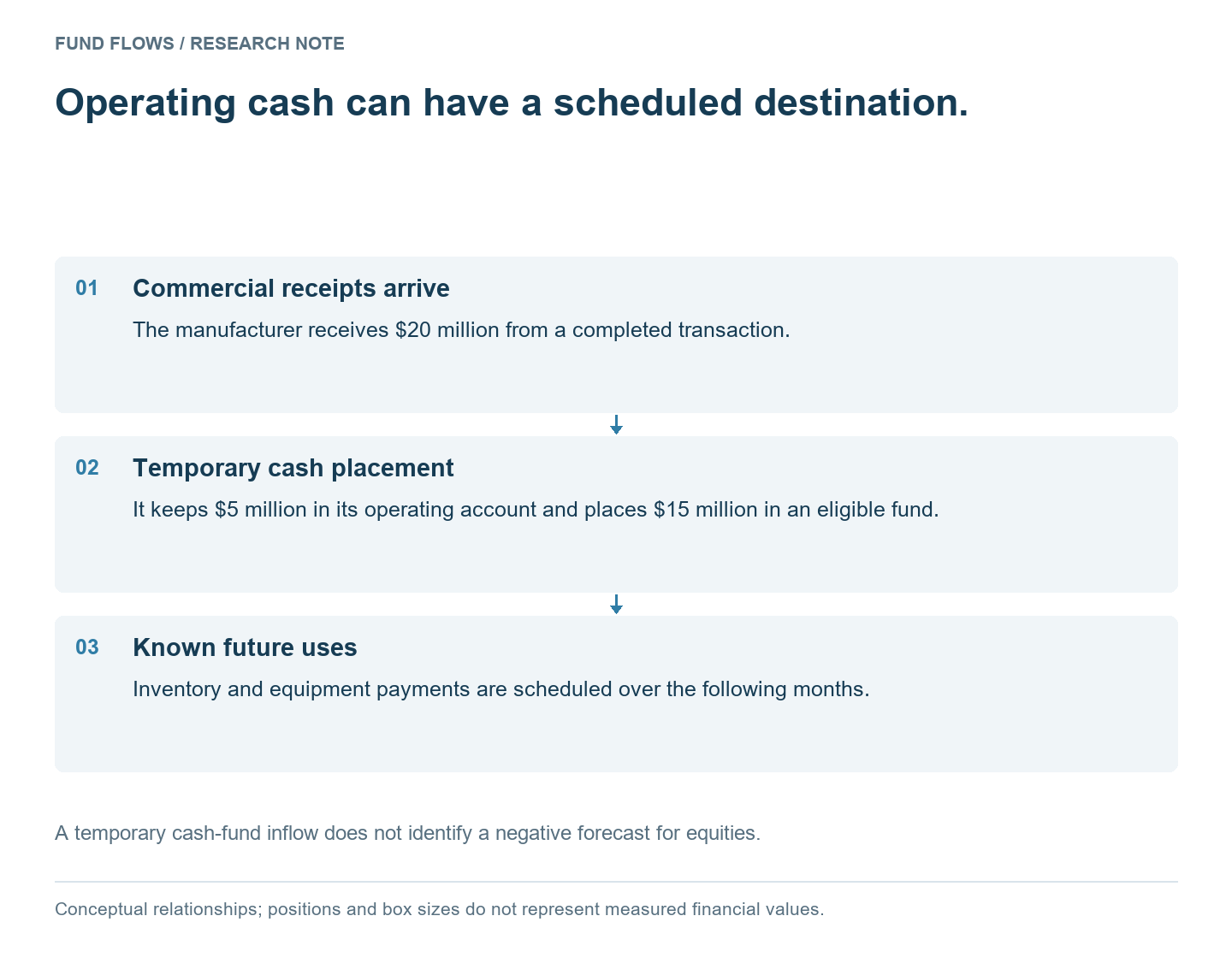
The fund inflow does not represent the manufacturer abandoning an equity investment. It reflects the interval between receiving cash and spending it. When the bills become due, redemption from the fund may likewise say little about optimism toward stocks. The money is moving into the company's operations rather than into a market-risk position.
The timing can be large enough to affect an institutional flow series. Acquisition proceeds, debt issuance, capital contributions, and asset sales can create temporary balances. Scheduled debt payments, distributions, and supplier obligations can later reduce them. The economic purpose exists outside the fund report itself.
An analyst should therefore distinguish operating liquidity from discretionary investment reserves where the data permit. If the distinction is unavailable, the interpretation should remain broad. A category total that combines several uses of cash cannot identify the proportion belonging to each merely from its direction.
Payment calendars can create recurring patterns
Tax payments, payroll cycles, distributions, and other scheduled obligations can generate purchases and redemptions around predictable dates. The relevant timing depends on the owner, jurisdiction, and payment schedule. There is no reason to assume every account follows the same calendar.
Suppose one institution contributes $40 million during a week while another redeems $35 million to meet a known obligation. Their combined net contribution is $5 million, while gross activity is $75 million. The net amount conceals two substantially different cash-management decisions.
Comparing that week with an ordinary week can produce an exaggerated narrative if the recurring payment is ignored. Comparing with the same nominal week in another year also requires care because holidays, weekends, and payment dates can shift activity between reporting periods.
Seasonal interpretation should be based on a documented pattern rather than used as a convenient explanation for any unexpected movement. If the data are not seasonally adjusted, identify the relevant calendar context. If they are adjusted, understand the method and whether a large unusual transaction could still dominate the result.
Separate fund categories before interpreting a transfer
Money market funds are not one uniform portfolio. Government, prime, and municipal categories can hold different types of short-term instruments and serve different uses. A transfer from one category to another may change credit exposure or other characteristics without increasing the total amount invested across money market funds.
For example, a $8 million redemption from a prime fund accompanied by an $8 million subscription to a government fund leaves the combined total unchanged. The category movement may be meaningful, but describing it as $8 million of new cash entering the entire money market fund sector would double-count the change in location.
Even that matched amount does not prove the two public aggregate observations came from the same investor. Establishing a direct transfer requires transaction-level or other supporting evidence. Similar inflows and outflows in separate series may reflect unrelated participants acting at the same time.
The categories' product characteristics also matter. A money market mutual fund is not an FDIC-insured bank deposit. Different funds can use different valuation and liquidity arrangements under their applicable rules. These distinctions help explain why an investor might prefer one vehicle; they should not be erased by casually labeling every choice cash.
Assets and new contributions are not identical
Money market fund assets can grow through income that shareholders leave invested, as well as through new external contributions. A change in total assets should therefore be reconciled with transactions and distributions before it is labeled entirely new money.
Consider a fund beginning with $1 billion. During the period it earns $3 million of net investment income and distributes the full $3 million. Shareholders reinvest $2.4 million and take $0.6 million in cash. Separately, net external purchases are $100 million. Assume no other gains, losses, or changes.
Ending assets are $1.1024 billion. The calculation starts with $1 billion, adds $3 million of income, subtracts the $3 million distribution, adds $2.4 million of reinvestment, and adds $100 million of external flow. Assets rose by $102.4 million, while the defined external net contribution was $100 million.
The difference is small relative to the fund in this example, but the conceptual point matters across larger pools and longer intervals. Reported assets, reinvested income, and external flows should remain separate measures. A stable share-price convention does not eliminate the need to understand how shares and distributions change the balance.
A higher cash percentage can arise without buying cash
Return to a portfolio with $80 million in equities and $20 million in cash-management holdings. Suppose equities lose 20% of their value while the liquid holdings remain at $20 million. Equity value falls to $64 million and total portfolio value falls to $84 million.
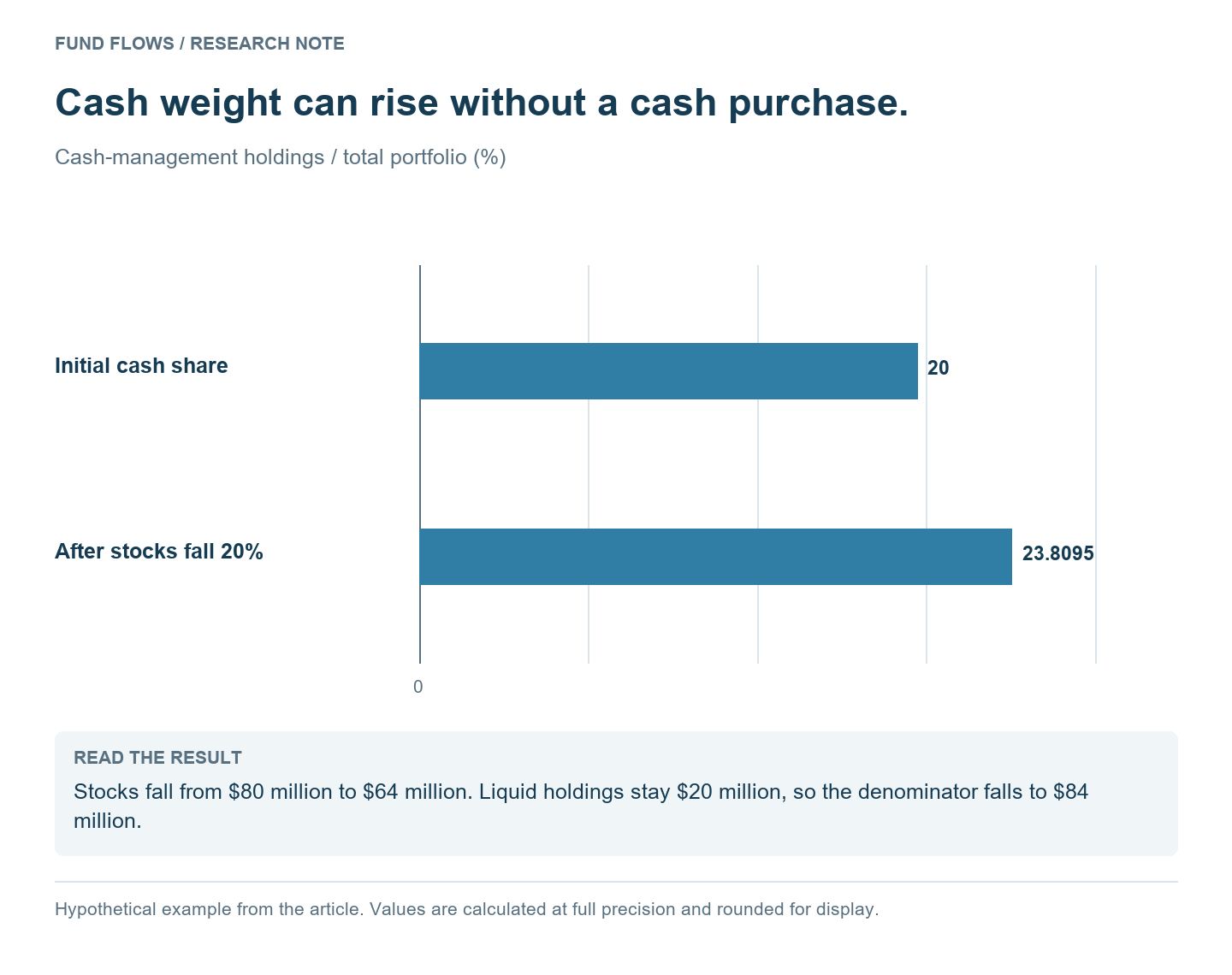
The liquid share rises from 20% to approximately 23.81%, despite no transfer into those holdings. The denominator declined. Describing the higher percentage as an active increase in cash would attribute a decision to a change caused by market prices.
In a separate rising-market case, equities gain 20%, becoming $96 million. Total value is $116 million, and the unchanged $20 million liquid position represents approximately 17.24%. The lower cash percentage does not prove that the portfolio spent cash to buy stocks.
This distinction becomes important when comparing money market fund assets with a broad measure of household or institutional wealth. Both the cash numerator and the wealth denominator can change. A sentiment interpretation should identify which component moved and whether the shift resulted from transactions or valuation.
The recipient's investments matter to the funding chain
Money placed in a money market fund does not simply sit outside the financial system. The fund holds permitted short-term assets and can participate in markets that finance governments, financial institutions, or other borrowers, depending on its mandate. The portfolio destination is different from an equity purchase, but it remains an investment in financial claims.
Moving a deposit into a fund also does not imply a permanently equal decline in total banking-system deposits. If the fund buys an existing security from another holder, that seller receives a payment. Other transactions and counterparties determine where balances ultimately appear. The path cannot be inferred solely from the first investor's transfer.
This does not mean funding composition is irrelevant to banks or markets. Changes in who holds deposits, which institutions retain them, and what other funding replaces them can matter significantly. It means the analysis needs to follow the balance-sheet relationships rather than treating money as if it disappeared when the initial account was debited.
A flow report is one view of that chain. Understanding the economic effect requires attention to the fund's holdings and the counterparties to its investments. A label such as money leaving the market is too broad to describe the actual transactions.
More liquid assets are not a guaranteed stock-market inflow
A large money market fund balance is sometimes described as potential buying power waiting to support equities. Some holders may eventually buy stocks. Others may pay taxes, repay debt, fund operations, purchase property, or keep a permanent liquidity reserve. The aggregate balance does not identify the intended destination.
The willingness to change allocation matters as much as the ability to transact. An institution may be required to keep funds liquid for a known obligation. A household may hold money for near-term spending. A portfolio may prefer the current income and risk characteristics of its cash-management allocation. Those balances are not necessarily waiting for a particular stock-market signal.
Even when an investor buys an existing stock, another participant sells it and receives payment. Prices can rise as buyers become more willing to pay, but the cash does not mechanically vanish from the broader system. Market valuation cannot be projected by treating a measured cash balance as a reservoir that must be emptied into equities.
The relevant research question is conditional: what changes in expected returns, needs, constraints, or confidence might lead particular holders to change allocations? That question is more useful than assuming that the entire current balance shares one objective or will move in the same direction at the same time.
A known obligation changes the purpose of liquidity
Imagine an organization that has already committed to a $2 million payment in three months. It holds the required amount in an eligible liquid investment while arranging the payment. The reserve is tied to a liability, not necessarily to an expectation that risky assets will perform poorly.
At an assumed constant 4% annualized simple yield for one-quarter of a year, $2 million would earn $20,000 before taxes and any unaccounted costs. That income is secondary to the organization's ability to meet the payment.
If the organization instead placed the same amount in an equity investment and it fell 15% before the payment date, the position would be worth $1.7 million, leaving a $300,000 shortfall. This is a stress scenario. It explains why the time and amount of a liability can influence allocation even when the organization has no bearish market view.
The interpretation of the eventual redemption follows the same logic. Paying the obligation reduces the reserve because it has fulfilled its purpose. That outflow is not evidence that the organization has become more optimistic about stocks. Connecting a cash balance to its intended use can explain both its arrival and its departure more directly than a sentiment narrative.
Similar labels can conceal different interest-rate exposure
A short-term bond fund and a money market fund may both appear in discussions of relatively liquid investments, but the labels should not make their exposures interchangeable. Portfolio maturity, credit quality, valuation, and redemption arrangements determine how each behaves. A fund with greater duration can experience a more noticeable price change when market yields move.
A transfer from a bond fund into a money market fund might therefore reduce interest-rate sensitivity rather than express a specific concern about equities. A move in the other direction could reflect a willingness to hold duration or a need to match a longer obligation. Those decisions belong to the investor's broader balance sheet and cannot be fully classified from the destination fund alone.
Relative yields also change through time. When short-term rates decline, a money market portfolio reinvests maturing holdings under new conditions. Its income does not remain fixed indefinitely at an earlier quoted rate. An instrument that locks a return under different terms may introduce price or access considerations that the investor must weigh separately.
For research, the useful distinction is between changes in liquidity preference, duration exposure, credit exposure, and the location of operating balances. Several can occur in one transaction. Keeping them separate avoids treating every move among short-term products as either an unambiguous retreat from risk or an unambiguous return to it.
When a defensive interpretation is better supported
Evidence of a deliberate move away from risk might include documented sales of risky holdings, an increase in liquid allocations after adjusting for valuation effects, and statements or portfolio records linking the change to a revised risk assessment. Agreement across several measures can strengthen the interpretation.
It still matters whose behavior is being observed. Corporate operating balances, investment portfolios, and individual saving accounts can respond to different incentives. An aggregate category may contain all three. A broad claim about investors should not be based on a narrow subgroup without acknowledging the boundary.
Market volatility, credit conditions, and survey evidence can provide context, but correlation does not establish which mechanism caused the flow. A period of stress can coincide with yield competition or scheduled payments. The analysis should consider whether those alternatives could explain a meaningful part of the result.
If the evidence remains incomplete, describe the measured movement and present the competing interpretations in proportion to their support. The uncertainty is about motive, not necessarily about whether the fund received money. Keeping that distinction clear preserves the value of the observation without adding an unsupported emotional explanation.
Read cash flows as part of a wider allocation record
Begin with the correct measure: assets, external net flows, gross purchases, or redemptions. Identify the fund category and reporting period. Then examine relative yields, payment timing, other portfolio changes, and the treatment of income or internal transfers where information is available.
The best conclusion distinguishes a change in cash vehicle from a change in overall risk allocation. It explains whether the data reveal an operating requirement, a relative-yield decision, a defensive shift, or only a destination whose motive remains unknown.
Money market fund flows can be economically important without being a direct measure of fear. Understanding the purpose and origin of the money makes them more informative. Treating every inflow as the same sentiment signal removes precisely the distinctions that a careful allocation analysis needs.
Related research

ResearchFund Flows
Fund Categories Can Change the Apparent Winner
A category can rise to the top of a flow ranking because a fund changed classification rather than because investors changed their transactions. A consistent fund universe, explicit category rules, and a record of classification dates help separate market activity from changes in the reporting map.

ResearchFund Flows
Index Rebalancing Can Move Trading Without Changing a View
Index-related trading can follow a change in membership, weights, or eligible shares without expressing a new judgment about a company's prospects. Separating price drift, portfolio rebalancing, and investor subscriptions helps explain what observed demand actually means.

ResearchFund Flows
ETF Holdings Overlap Can Hide a Concentrated Capital Flow
Different ETF names can lead back to the same companies. Looking through each fund's holdings reveals the combined exposure, while a separate flow analysis shows why assumed allocation of new money must not be confused with observed trading or corporate financing.