
ResearchFund Flows
Index Rebalancing Can Move Trading Without Changing a View
- Report or archive date
- Archive placement May 12, 2026
- Reading time
- 13 min read

Summary
Index-related trading can follow a change in membership, weights, or eligible shares without expressing a new judgment about a company's prospects. Separating price drift, portfolio rebalancing, and investor subscriptions helps explain what observed demand actually means.
A trade can follow a rule rather than a new forecast
A stock experiences heavy buying near an index review. It is tempting to conclude that institutions have become more optimistic about its earnings. That may be part of the explanation, but an index-tracking portfolio can buy because the benchmark requires a larger position, even if its manager's assessment of the business has not changed.
The distinction does not make the transaction unreal. Mechanical demand can still affect execution, available liquidity, and prices. It changes what can be inferred about motivation. Buying to match a benchmark is different from buying because an analyst revised a valuation or expected return.
Index rules can change which securities are eligible, how much weight they receive, and when a portfolio should reflect the new composition. Corporate actions can require additional adjustments between scheduled reviews. Understanding the applicable rule is the first step toward explaining the resulting trade.
To estimate demand from an index change, check the current index rules, existing holdings, assets tracking the index, and how trades will be executed.
Reconstitution and reweighting answer different questions
Reconstitution generally concerns the securities included in an index. A company can be added, removed, or moved between segments when the eligibility rules are applied. Reweighting concerns the relative allocation among constituents. Index providers may use these terms somewhat differently, so the specific methodology remains important.
A security can stay in an index but receive a different weight because its eligible shares, free float, or a weighting constraint changed. Another can leave even though its business remains viable because it no longer satisfies a size, liquidity, maturity, or other eligibility rule. Neither event is automatically an endorsement or rejection of the company as an investment.
Review calendars are also part of the mechanism. In January 2025, FTSE Russell announced a planned move to June and November reconstitutions for its US indexes beginning in 2026, with the added November event contingent on a successful 2025 test. The announcement illustrates why relying indefinitely on an old annual calendar can be misleading.
That calendar fact does not identify any particular future addition or trade. It establishes that the schedule itself can change. For an event analysis, the relevant information includes the current published process, ranking or reference dates, announcement dates, and implementation dates rather than an assumed timetable carried over from a prior year.
Price appreciation does not always force a purchase
Consider a simplified capitalization-weighted portfolio holding two stocks. Its position in Company A is worth $60 million and its position in Company B is worth $40 million. The portfolio matches an index with the same relative capitalization weights. Assume unchanged eligible shares, no cash flows, and no corporate actions.
If A's price rises 20% and B's price is unchanged, the holdings become worth $72 million and $40 million. Total portfolio value is $112 million. A's weight rises from 60% to approximately 64.29% simply because its existing shares appreciated.
Under these assumptions, the capitalization-weighted index changes in the same way. The fund does not need to buy more A solely because A's price rose and its index weight increased. The position it already held appreciated along with the corresponding index capitalization.
This corrects a common shortcut in descriptions of passive investing. A higher weight following a price increase is not by itself evidence of additional purchases. Transactions may arise from subscriptions, share-count changes, constituent changes, or other rules, but ordinary price drift within a matching capitalization-weighted portfolio can occur without a rebalance trade.
Equal weighting creates a different adjustment
Take a separate portfolio with $50 million in A and $50 million in B. It follows an equal-weight methodology that periodically resets each security to half the portfolio. If A rises 20% while B is unchanged, the holdings become $60 million and $50 million, totaling $110 million.
At a reset with unchanged prices and no costs, each position should be $55 million. The portfolio sells $5 million of A and buys $5 million of B. The trades restore the specified weights; they do not require a new negative forecast for A or a positive forecast for B.
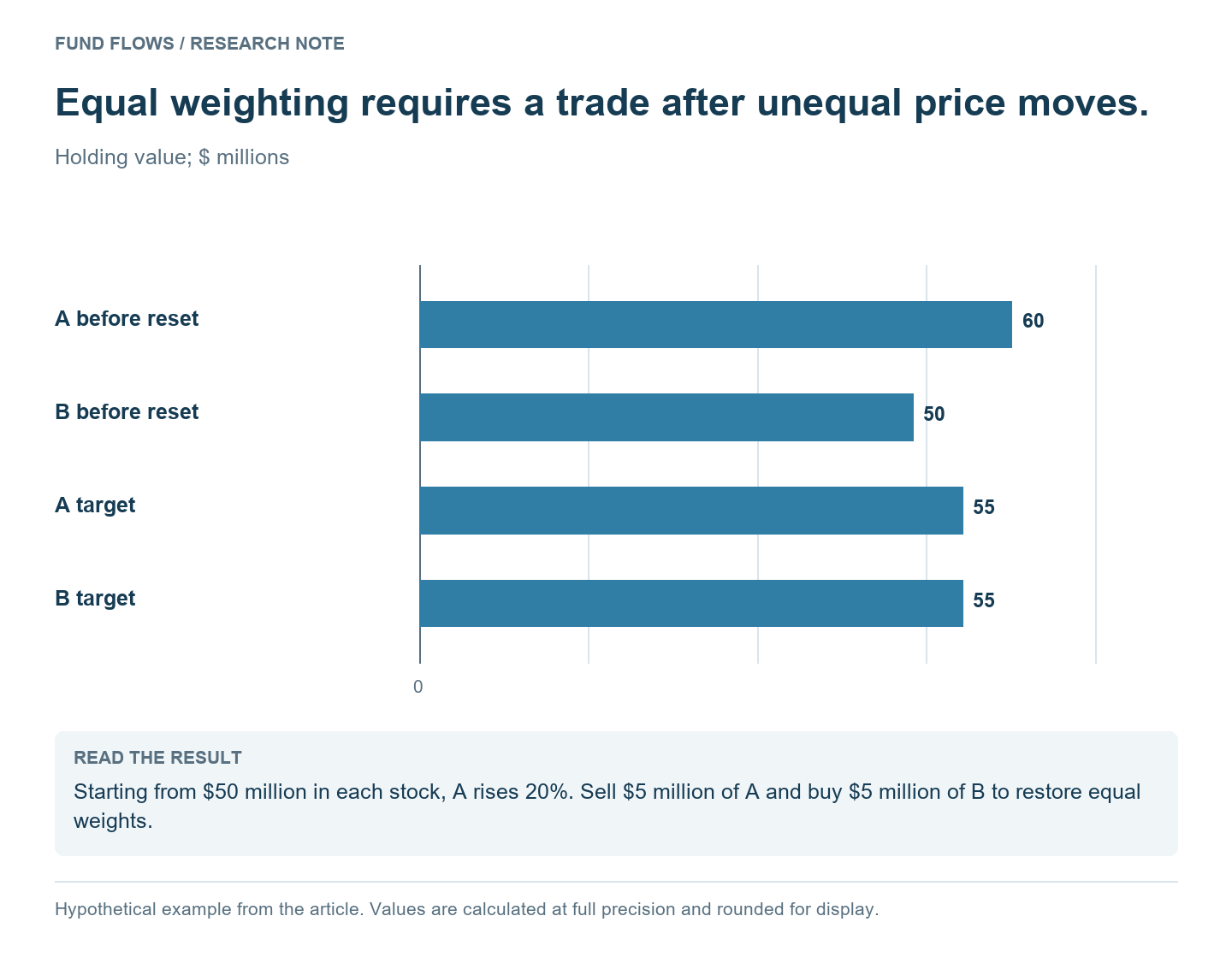
The two-sided dollar activity is $10 million. The amount shifted from one holding to the other is $5 million, or approximately 4.55% of the $110 million portfolio. These transaction measures are distinct from the fund's formally reported annual turnover ratio.
The example shows why weighting methodology matters. Two indexes holding the same companies can create different trading requirements after the same price movement. Observing a sale without knowing the benchmark rule can lead to an incorrect conclusion about the manager's conviction.
Rebalancing does not require an investor inflow
Suppose a $100 million portfolio has three holdings at weights of 40%, 35%, and 25%. A rule change requires weights of 45%, 30%, and 25%. Assume prices remain fixed during the adjustment and ignore costs for this allocation calculation.
The fund buys $5 million of the first holding and sells $5 million of the second. The third is unchanged. Its assets remain $100 million and it has no net investor subscriptions. There is $10 million of two-sided portfolio trading, but no new outside capital entered the fund.
Calling the $5 million purchase an inflow into that company's shares can sometimes be shorthand for demand from the identified portfolio. It should not be confused with a subscription into the fund or cash paid directly to the company. If existing shares are purchased in the secondary market, the payment goes to the selling holder.
The transaction changes the fund's allocation of already invested assets. That can matter to market prices, but the economic chain differs from new investor contributions or a corporate share offering. Keeping those boundaries separate prevents the same dollars from being counted several times as new capital.
Subscriptions can offset part of a rebalance
Now add a $10 million subscription to that same $100 million portfolio immediately before it implements the new 45%, 30%, and 25% weights. With no market movement or costs, the new total is $110 million. The target holdings are $49.5 million, $33 million, and $27.5 million.
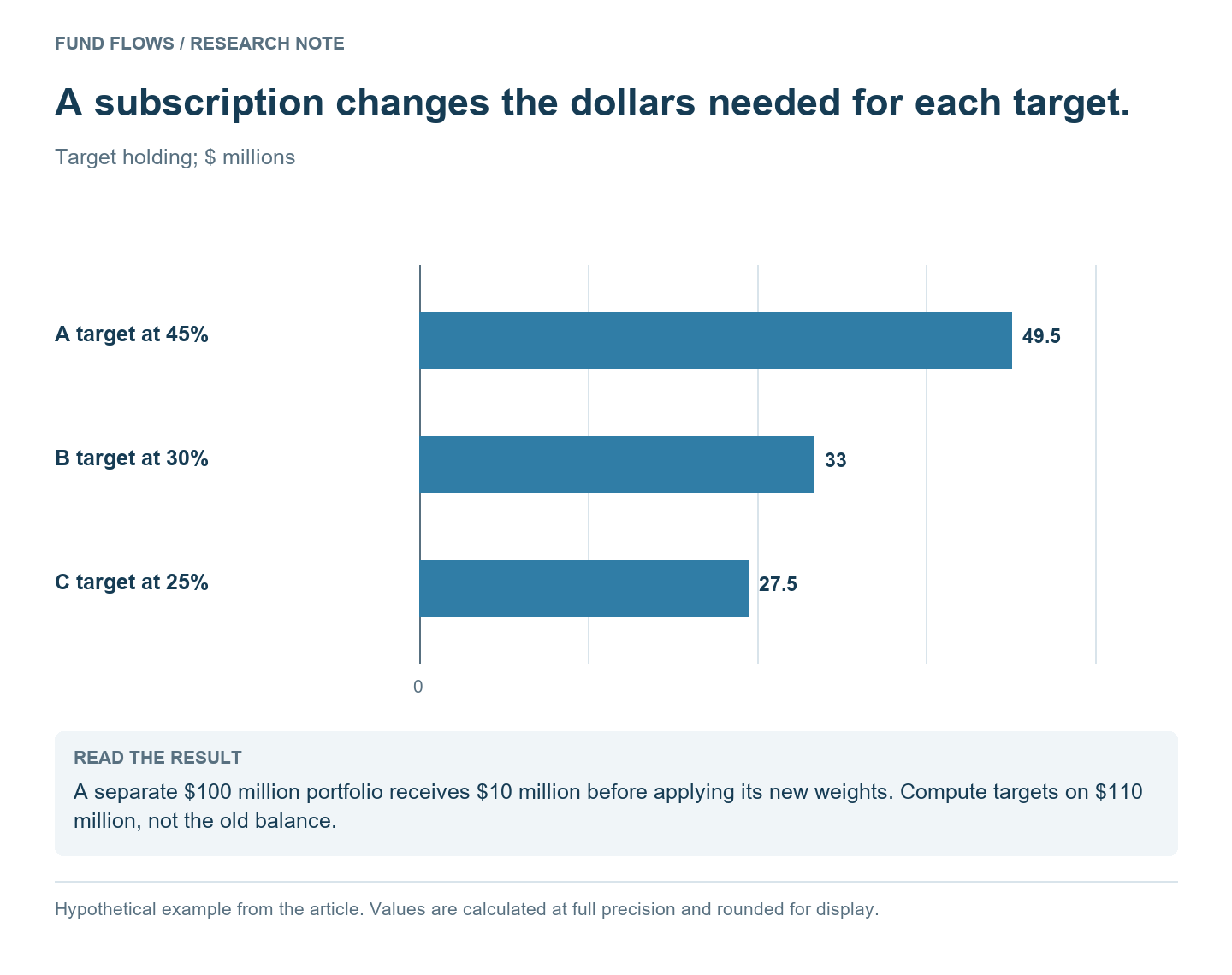
Compared with the original $40 million, $35 million, and $25 million holdings, the fund buys $9.5 million of the first, sells $2 million of the second, and buys $2.5 million of the third. Gross purchases are $12 million, sales are $2 million, and net purchases equal the $10 million subscription.
The new cash reduces the required sale of the second holding from $5 million in the no-subscription case to $2 million. It also changes the required purchases. An estimate that simply adds the old rebalance trades to a proportional investment of new money can be wrong if it does not recalculate the combined target.
In actual implementation, funds may coordinate cash flows, portfolio transactions, and creation baskets. The exact trades depend on existing holdings and operational choices. A benchmark-weight change multiplied by an old asset total is therefore only a starting approximation, not an automatic record of what must trade.
Free float changes the investable weight
Consider an issuer with 100 million shares outstanding at $50 per share, giving a total market capitalization of $5 billion. Suppose the index methodology initially treats 60% as eligible free float. Its float-adjusted capitalization is $3 billion. The eligible capitalization of all other constituents totals $7 billion.
The issuer's initial index weight is therefore 30%. If its eligible float factor rises to 70% with its share price and total shares unchanged, its float-adjusted capitalization becomes $3.5 billion. The index total becomes $10.5 billion, and the issuer's weight rises to one-third, or approximately 33.33%.
The $500 million increase in eligible capitalization is not automatically $500 million raised by the company. A classification of existing shares can change the amount treated as available for investment without a new corporate financing transaction. The specific cause of a float update must be examined separately.
For an unchanged $100 million tracker holding the old 30% weight, the new target would be approximately $33.33 million. It would require roughly $3.33 million of additional exposure under the simplified assumptions. That demand arises from the revised benchmark representation, not necessarily a new estimate of future earnings.
Some corporate actions change units without changing value
A stock split can increase the number of shares while reducing the price per share proportionately. A portfolio holding 10,000 shares at $100 has a $1 million position. After a two-for-one split, 20,000 shares at $50 still represent $1 million, assuming no independent market movement.
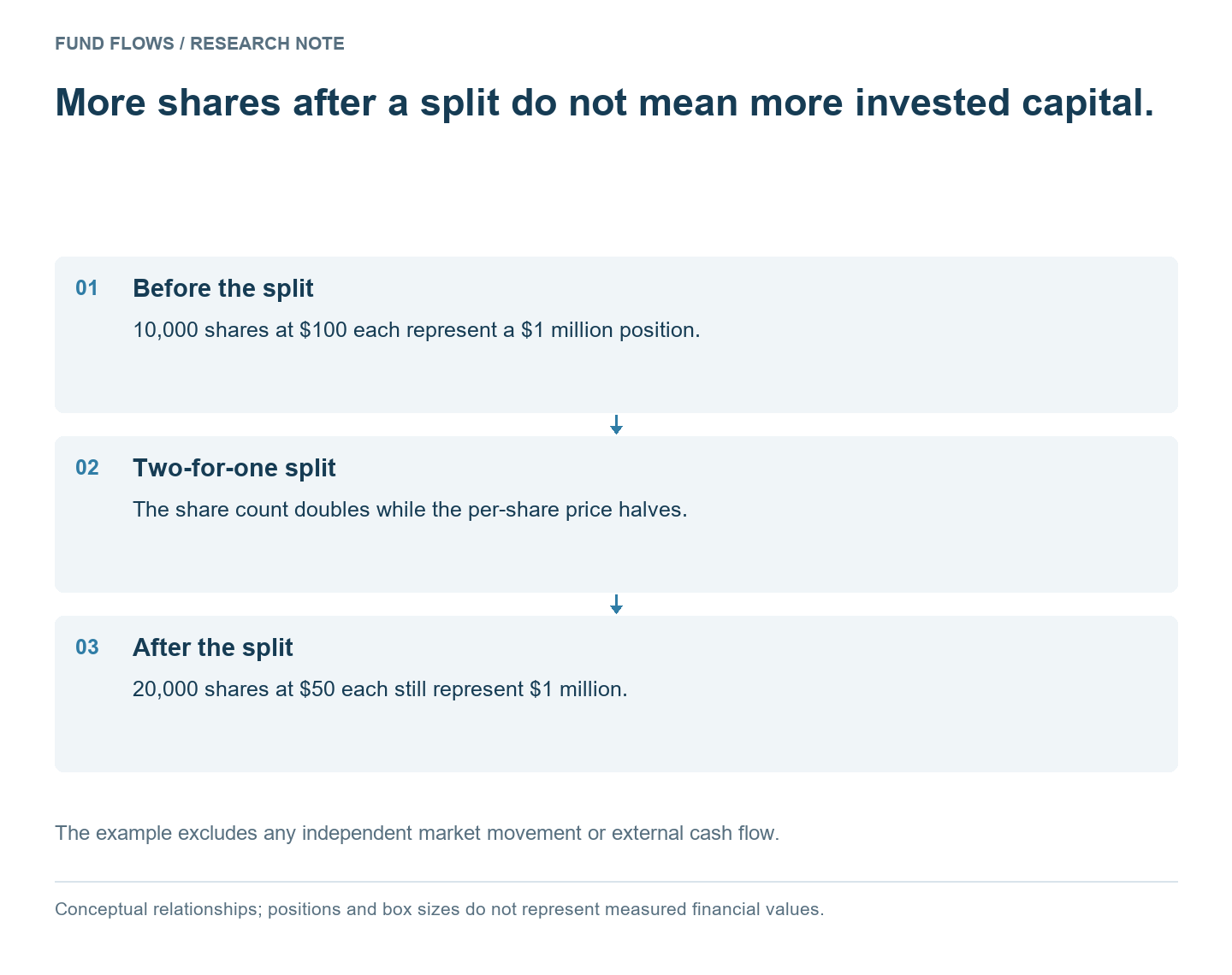
The additional 10,000 shares are not evidence that the fund bought another $1 million of stock. They arise from the corporate action. A holdings comparison based only on share counts can therefore misclassify a mechanical adjustment as investment demand.
Other corporate actions require different treatment. A cash acquisition, stock merger, spinoff, or rights issue can alter securities, cash, and index eligibility in distinct ways. There is no single adjustment that correctly handles every event. The security identifiers, conversion terms, and effective dates determine how the position should be reconciled.
Index calculation procedures may also adjust divisors or related quantities to preserve continuity around non-market changes. An index-level adjustment is not itself a fund cash flow. It belongs to the construction of the benchmark, while portfolio trades and investor transactions occur in separate records.
Estimate demand from actual tracking assets
Suppose a security is assigned a 0.15% weight in an index. Assume $20 billion of portfolios fully replicate that index and currently hold none of the security. Multiplying the weight by those assets gives a $30 million target holding before costs, timing differences, and other implementation details.
Now suppose $80 billion of assets are described broadly as benchmarked to the index, but only $20 billion are assumed to follow it through full replication. Multiplying the full $80 billion by 0.15% would give $120 million. That does not establish $120 million of compulsory purchases: actively managed portfolios can use the index as a comparator without matching each weight.
Even within the $20 billion tracking group, existing holdings matter. If the group already holds $5 million of the security, the incremental target under the same simplified assumptions is $25 million. Confusing the total target position with the incremental trade overstates the required purchase.
The estimate should therefore distinguish benchmarked assets from mechanically tracking assets, current holdings from targets, and full replication from sampling or derivative implementation. The final number is conditional on those choices. It should not be reported as a precisely observed order unless actual orders are available.
Demand can offset across benchmarks
A security might enter one index while leaving another or move between size segments. Suppose a defined group of trackers needs to buy $30 million while another defined group needs to sell $20 million of the same security. Their combined net requirement is a $10 million purchase, while the sum of their absolute trade requirements is $50 million.
Those quantities answer different questions. The net requirement describes the balance across the specified tracker groups. The gross amount describes their aggregate intended activity before considering how orders might match or be implemented. Neither is identical to total exchange trading, which includes counterparties and unrelated participants.
Ignoring the offsetting group can exaggerate the directional imbalance. Assuming perfect offset can also be misleading if the groups trade at different times or through different channels. An implementation analysis needs both the amounts and the timing rather than choosing whichever total makes the event appear largest.
Changes across related indexes are particularly important when portfolios share constituents. A headline addition can be accompanied by a deletion elsewhere. The appropriate unit of analysis is the set of affected portfolios and securities, not an isolated announcement viewed without its broader benchmark context.
Announcement and implementation create different risks
An index decision can be announced before the date on which the new composition takes effect. Market participants may adjust positions during that interval, while trackers may choose implementation schedules based on their objectives and constraints. The final implementation trade is only one part of the sequence.
Anticipation can change prices before the effective date. It can also be wrong if expected membership differs from the final decision or if an announced change is revised. A trading strategy based on a predicted index event carries those uncertainties in addition to ordinary market risk.
Matching the benchmark's effective closing valuation can reduce one form of tracking deviation, but it may concentrate execution at a busy time. Trading earlier or later can alter both costs and tracking outcomes. There is no universal rule that every tracker must submit an identical order at the same moment.
An event study should distinguish the reference date, announcement, and implementation. A price move during one interval cannot automatically be assigned to trades in another. Evidence about timing is needed before a correlation between an index event and a return becomes a causal explanation.
Liquidity affects the cost of following the rule
Suppose the $5 million purchase in the no-subscription rebalance incurs an assumed implementation cost of 10 basis points, or $5,000. The $5 million sale incurs 15 basis points, or $7,500. Combined cost is $12,500, equal to 1.25 basis points of the initial $100 million portfolio.
This is a separate cost example layered onto the earlier cost-free target calculation. Actual holdings after costs would need to reflect the smaller remaining asset pool and the chosen way of paying those costs. The example does not claim that the original targets remain exact to the dollar after fees and price impact.
Costs can depend on spreads, order size, available depth, urgency, and the response of other traders. A large target purchase relative to ordinary volume may require careful execution, but the ratio cannot determine how many days the trade will take or how far the price must move.
Mechanical trading can therefore be economically significant without conveying a discretionary view. Its significance may lie in who needs liquidity, when they need it, and what it costs to transfer the required exposure. Those questions are more precise than interpreting every benchmark-related purchase as confidence in a company's fundamentals.
An active weight can change without a portfolio trade
Suppose a separate active portfolio allocates 2.5% to a company whose benchmark weight is 2%. Its active weight, defined as portfolio weight minus benchmark weight, is positive 0.5 percentage points. Now assume a benchmark rule update raises the company's index weight to 3% while the portfolio's weight remains 2.5%.
The active weight becomes negative 0.5 percentage points. The manager has moved from an overweight to an underweight relative to the benchmark without selling any shares under these assumptions. The reference portfolio changed. A report describing the change as an active sale would confuse relative exposure with an actual transaction.
The manager might subsequently trade to restore a preferred relative position, but that would be a separate decision. Maintaining a fixed absolute holding, a fixed portfolio weight, and a fixed active weight are different objectives. They can lead to different transactions when a benchmark changes.
This distinction matters when interpreting institutional holdings. A lower active weight need not mean fewer shares, and a higher share count need not mean a larger active weight if the benchmark position increased faster. Identify the specific exposure measure before assigning a directional opinion to its change.
Selection rules can reduce unnecessary switching
Some index methodologies use retention buffers or other rules intended to limit repeated additions and deletions around an eligibility boundary. In a ranking system, a company moving just below an entry cutoff might remain eligible under a separate retention rule. The exact thresholds must come from that index's methodology.
This means a simple ranking spreadsheet may not reproduce the official membership decision. Existing-constituent status, available float, liquidity tests, corporate actions, and implementation conventions can all matter. Predicting a trade from a single rank while ignoring those rules can produce an incorrect demand estimate even if the market-cap calculation is accurate.
The underlying business can also influence both the ranking and the stock price. Improved earnings might raise the price and help a company qualify for an index. A subsequent return cannot automatically be attributed entirely to index demand when the same fundamental development also affected valuation.
To separate those explanations, an analysis needs a suitable comparison and an event window that respects when information became available. The existence of a mechanical buying requirement is useful evidence about one channel. It does not establish that every price movement surrounding the event was caused by that channel.
Explain the mechanism before naming the motive
Begin with the relevant benchmark rule and identify what changed: membership, eligible shares, target weights, or a corporate action. Reconcile the portfolio's current exposure with its new target, allowing for subscriptions, redemptions, and price movements. Then distinguish estimated requirements from observed transactions.
If the evidence supports an index-related explanation, describe that explanation directly. It does not rule out discretionary activity by other participants, but it limits what the index trade itself says about conviction. An addition to a benchmark is a change in representation under a methodology, not a standalone valuation conclusion.
Index activity belongs in fund flow research because it helps explain how portfolios can trade without receiving new money or changing a forecast. Separating the layers makes it possible to recognize real demand, estimate it carefully, and avoid attributing a belief to a transaction that followed a rule.
Related research

ResearchFund Flows
Cash Fund Flows Do Not Automatically Signal Fear
Money market fund inflows can reflect yield competition, operating cash, scheduled payments, or changes in portfolio risk. The balance alone cannot identify the motive, and a larger pool of cash-like assets is not a promise of future stock purchases.

ResearchFund Flows
Positions Are a Stock; Trading and Flows Are Changes
A position report, a trading-volume report, and a fund flow report describe different parts of market activity. Understanding their units and timing prevents outstanding contracts, transactions, and investor contributions from being mistaken for the same quantity.

ResearchFund Flows
Fund Categories Can Change the Apparent Winner
A category can rise to the top of a flow ranking because a fund changed classification rather than because investors changed their transactions. A consistent fund universe, explicit category rules, and a record of classification dates help separate market activity from changes in the reporting map.