
ResearchCross-Asset Allocation
Diversification Includes the Risks Outside a Brokerage Account
- Report or archive date
- Archive placement November 3, 2026
- Reading time
- 13 min read

Summary
A family can sell every energy stock in its investment account and remain deeply exposed to an energy downturn.
A family can sell every energy stock in its investment account and remain deeply exposed to an energy downturn. One salary might come from a refinery, another from a contractor whose main buyer is the refinery, and the household's home might be in a town where the plant is the largest employer. Shares in an index fund may be the only assets visible on the brokerage screen. Salary, business cash, home equity, benefits, debt, and upcoming spending are absent from the chart, even though they determine how long the family can hold the securities during a difficult market. Diversification is more meaningful when measured against the economic life the account is meant to support.
This does not require assigning an exact market price to a career or turning every household decision into a trade. A teacher's salary, a business owner's receivables, and a fixed pension offer different degrees of stability and different access to cash. Putting one theoretical present value beside another can conceal more than it reveals. Start with the connections that matter in a bad month: which income could fall, which asset might lose value, which payment is unavoidable, and what can actually be converted to cash before that payment is due. A rough, honest map of those relationships can be more useful than a precise security-sector pie chart.
An economic balance sheet has several clocks
Consider a household in a coastal region where marine engineering is a major industry. One adult earns a salary from a shipyard; the other owns a small surveying business that serves ports and yards. They own a home, a diversified securities account, and a cash reserve. The home secures a mortgage, and part of the business's equipment is financed by a loan carrying a personal guarantee. Tuition begins in two years. This household has financial assets, physical assets, labor income, business exposure, contractual obligations, and a future spending commitment. Its holdings can appear diversified by name while remaining concentrated in an industry's order book.
Suppose the home is worth $600,000 with a $360,000 mortgage. The securities account holds $200,000 and the cash reserve $40,000. The surveying business is tentatively valued at $180,000 after its own recorded liabilities. Ignoring taxes and transaction costs, the displayed net worth from these items is $660,000: $240,000 in home equity, $200,000 in securities, $40,000 in cash, and $180,000 in business equity. The guarantee should be recorded as a contingent exposure rather than subtracting the same business loan again without considering recourse and recoveries. The value of future wages is omitted from this dollar total but remains central to the household's risk.
Only the cash reserve is immediately spendable at its stated amount under the assumptions. Selling the house takes time, may cost money, and requires replacement housing. Selling a surveying business dependent on its owner can be difficult, particularly in an industry slump. The securities account is more liquid but can decline exactly when income weakens. The difference between net worth and near-term liquidity is not a technicality. An otherwise solvent household can be forced to sell investments at depressed prices or borrow at unfavorable rates if it cannot bridge an income interruption. An asset-by-asset list should therefore add its economic exposure, date of access, and costs of turning it into usable money.
Human capital is an exposure, not a checking account
The economic value of future labor income depends on earnings, job stability, working life, taxes, benefits, health, and alternative employment. A salary from a stable employer under a long-term contract can resemble a stream of relatively predictable cash. A bonus linked to shipping rates or an owner's earnings tied to orders can act more like a risky business investment. A statistic estimating the present value of future salary does not make those wages available to meet tomorrow's mortgage payment. Borrowing against income may itself be harder precisely when job security deteriorates.

Suppose the shipyard salary is $90,000 before tax, and the surveying business normally distributes $60,000 a year after retaining its own operating reserve. If orders slump, the salary falls 10 percent through reduced overtime, and the business distribution falls 40 percent. The annual pretax household income reduction from these assumptions is $9,000 plus $24,000, or $33,000. That is 22 percent of the initial $150,000 combined inflow, before considering tax effects and benefits. Two income sources have not produced much protection against a shared port-industry shock. They may still diversify risks unique to one employer, such as a supervisor change or the loss of a single contract.
An apparently minor ownership benefit can add concentration. If part of the employee's annual bonus is paid in shipyard shares, a downturn may reduce the bonus, salary prospects, and share price together. A long vesting schedule can delay any sale, and an exposure held in a retirement or employee plan may have rules different from an ordinary brokerage investment. The investment analysis should identify shares already owned, unvested awards, and expected future awards separately. Treating a conditional unvested grant as ready cash overstates liquidity. Ignoring it entirely can understate how strongly future wealth is connected to the employer.
The alternative employer matters too. A skilled engineer may find work at another yard, but the same global order slowdown could affect several yards at once. Moving to another region involves relocation expenses, children's schooling, housing costs, and a delay before new income starts. A skill transferable to unrelated infrastructure work provides an economic option even if it has no line on the account statement. When testing labor-income risk, distinguish a temporary reduction in hours, loss of one job with strong alternatives, and a sectorwide hiring freeze. They lead to different cash gaps and deserve different responses.
Home equity can amplify a local shock
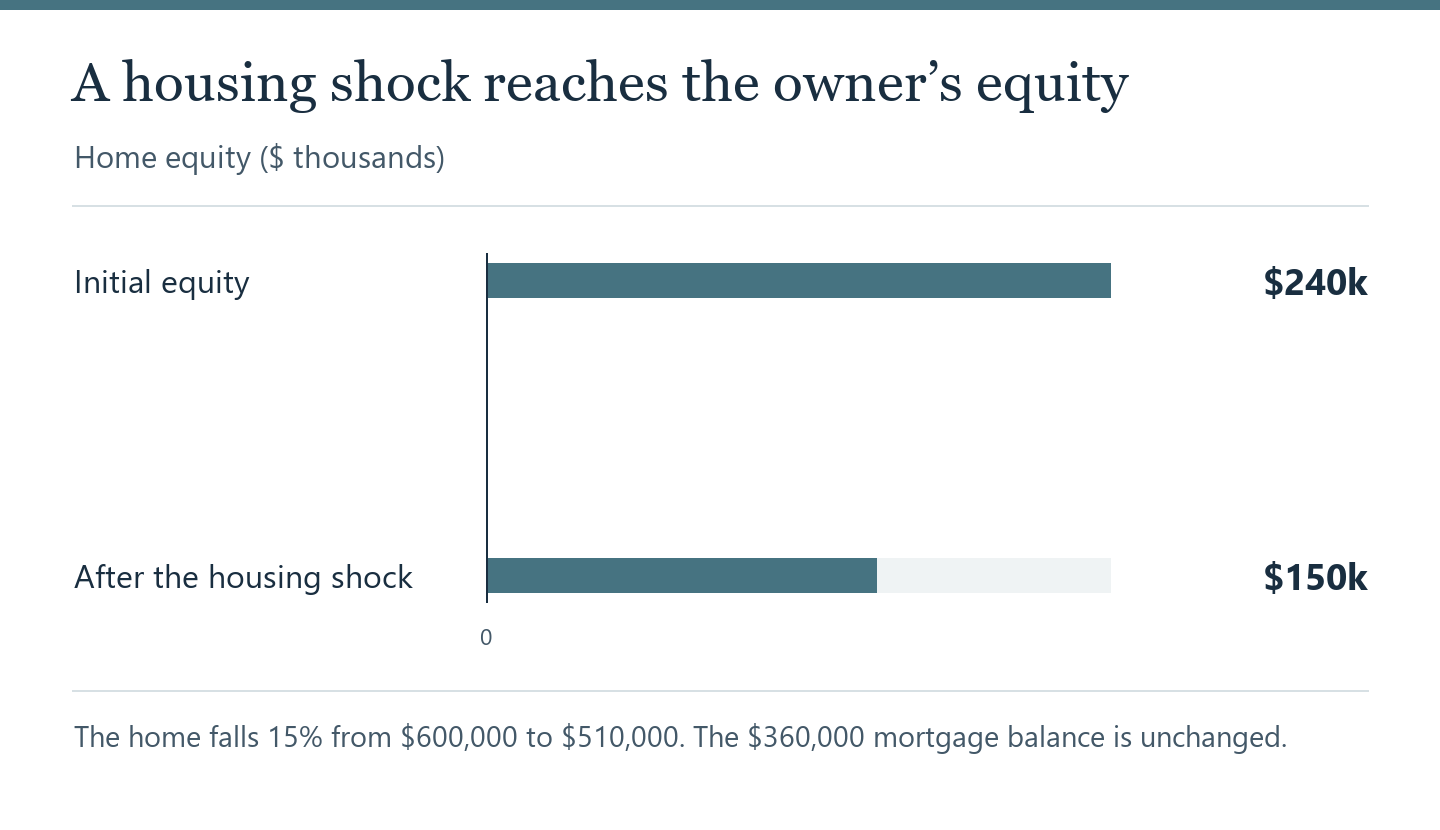
With the home worth $600,000 and the mortgage outstanding at $360,000, the original equity cushion is $240,000. A 15 percent price decline lowers the property value to $510,000. If the debt is unchanged, equity falls to $150,000, a $90,000 or 37.5 percent decline in home equity. The household does not necessarily owe that loss in cash today, and it continues to receive housing services by living there. But the option to sell, refinance, or move for work can become less valuable. The problem becomes more acute if the decline coincides with reduced income and an urgent need to relocate.
Housing is also a partial hedge against the cost of living in that specific home. A family expecting to stay for many years can value stable access to its neighborhood even when a market quote falls. A household planning to move to a more expensive region in six months faces a different risk. Local sale prices and the cost of the next home may not move together. Transaction expenses, mortgage portability, the interest rate on replacement financing, and the time between closing dates all affect the cash needed. Marking home equity down is useful for stress testing but incomplete as an account of the family's welfare or mobility.
A home equity line can be valuable liquidity only if it is actually available on the necessary terms. Its limit may depend on property valuation, income, or the lender's policies, and its interest rate may reset. Drawing it increases debt secured against the home. Planning to rely on a large undrawn line during a combined property and employment shock deserves a separate check on contractual access and repayment capacity. Counting the full line as cash in the baseline while ignoring the debt and variable interest in the downside case would create an illusory cushion.
The private business can reach personal assets
Suppose the surveying business has $80,000 in receivables, half due from one port operator. Its reported profit may include work completed but not collected. If the port extends payment by three months, the business can need cash for staff and insurance just as household distributions are expected to fund tuition. Taking a distribution to support the household may leave the company too little working capital to deliver the next contract. Leaving the cash in the business can protect its continuation while reducing resources for family obligations. The same dollar cannot simultaneously be counted as business contingency money and a household reserve.
A personal guarantee links the balance sheets in a more direct way. Assume a lender could seek up to $50,000 from the owner after collateral recovery if the equipment loan defaults, subject to the actual contract. The loss is contingent, not necessarily the face value of the loan today. In an orderly business sale the equipment may discharge much of the balance, whereas in a sudden sector downturn liquidation proceeds can disappoint. The correct stress identifies the debt outstanding, value of enforceable collateral, guarantee limit, and other claimants. Simply adding the business equity valuation to personal assets while suppressing the guarantee can understate the joint loss.
Ownership percentage and access also differ. A partner may own half a business without the right to require a distribution, sell to an outsider, or direct a liquidation. A shareholder agreement might require consent or set a valuation formula that differs from a recent optimistic transaction. Family business wealth can have significant long-term value and little capacity to fund an obligation on a particular date. The purpose of the analysis is to recognize those constraints, not to invent a precise discount from net asset value. A clear statement that distribution requires partner approval is more informative than an unsupported valuation to the nearest dollar.
Test the household's actual runway
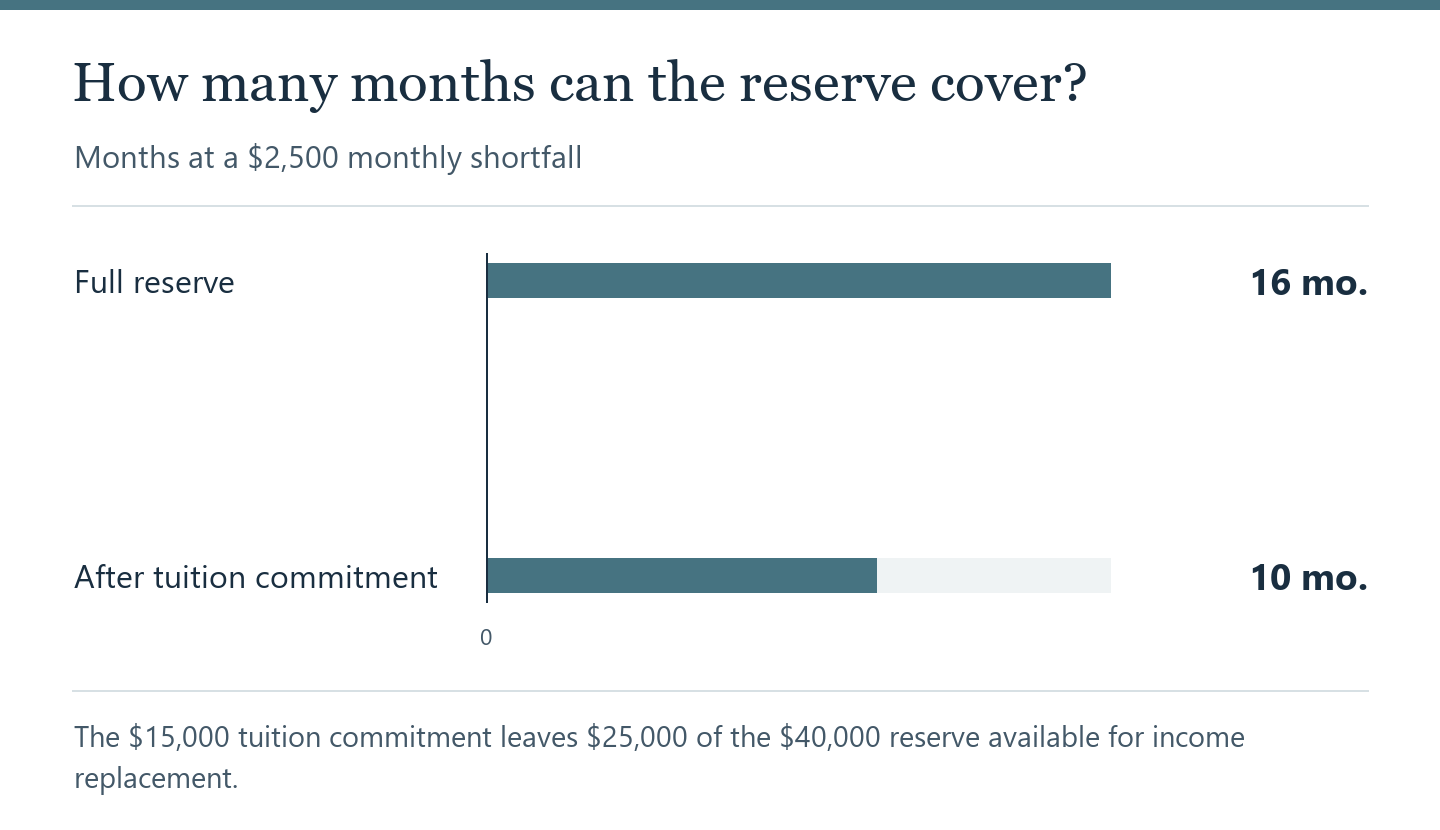
Assume essential personal spending and debt payments total $7,000 a month after tax. During a temporary income interruption the household expects $4,500 a month of dependable after-tax inflow, after accounting separately for business needs. The gap is $2,500 monthly. A $40,000 liquid reserve could cover sixteen months at that rate, ignoring interest and unexpected expenses. If $15,000 is already committed to a tuition deposit in six months, truly unallocated cash is $25,000, covering ten months of the same gap. A reserve can have a large account balance and a much smaller amount available for the specific stress being modeled.
If the family sells $20,000 of securities after a market decline, it may extend that runway, but sale proceeds depend on current prices, taxes, settlement, and any account restrictions. If the market falls 25 percent before the planned sale, securities originally worth $20,000 are worth $15,000 before costs, covering six more months of the $2,500 gap. The loss does not mean all securities must be treated as illiquid. It means a near-term liability should be matched to the cash that can actually be raised under adverse conditions. Retirement assets or pledged securities may have further restrictions that should be understood before counting them.
There is a useful reverse question. How large a monthly gap would exhaust the $25,000 unallocated reserve in six months? The answer is about $4,167 a month. If a simultaneous loss of overtime and a business distribution freeze plausibly creates a $5,000 gap, the existing runway is shorter than the six months the committee or family thought it had. The available responses include changing the timing of spending, increasing dependable liquidity, reducing concentration in a saleable asset, or securing a firm backup source. Each has a cost and addresses a particular failure mode. No universal cash allocation follows from the example.
Currency and future consumption can change the exposure
Suppose part of tuition will be payable in euros while the family earns and holds most cash in dollars. A €20,000 payment costs $22,000 when one euro costs $1.10 and $24,000 when it costs $1.20. The $2,000 difference is a currency exposure on a known future expense. Buying a dollar-denominated international equity fund does not necessarily hedge it. The fund may own global businesses, its equity values can fall, and the currencies of underlying revenues can differ from the fund's trading currency. The label on the account statement and the currency of future consumption are different pieces of the analysis.
If a relative has made a credible commitment to pay part of the euro tuition, the family may have a natural match. But a hoped-for gift is not the same as a binding, funded commitment. If the relative works in the same port industry, the gift may become less reliable just when other income falls. Similarly, a pension indexed to a broad consumer basket can help preserve some purchasing power without specifically matching tuition, medical costs, or local rents. Match obligations to assets by timing, currency, and the price of the actual thing to be bought. A broad inflation or currency hedge can leave a substantial basis difference.
Insurance adds another dimension. A policy can transfer a defined risk, such as property damage, subject to coverage, deductibles, limits, and claim settlement timing. It does not usually cover a general decline in home market value or discretionary business revenue unless specific terms apply. An owner relying on business interruption coverage should read the trigger, exclusions, waiting period, and maximum duration. Insurance proceeds received months after a loss do not entirely remove the need for immediate cash. Including expected protection is sensible only when the scenario being tested actually activates it.
Joint losses need a consistent baseline
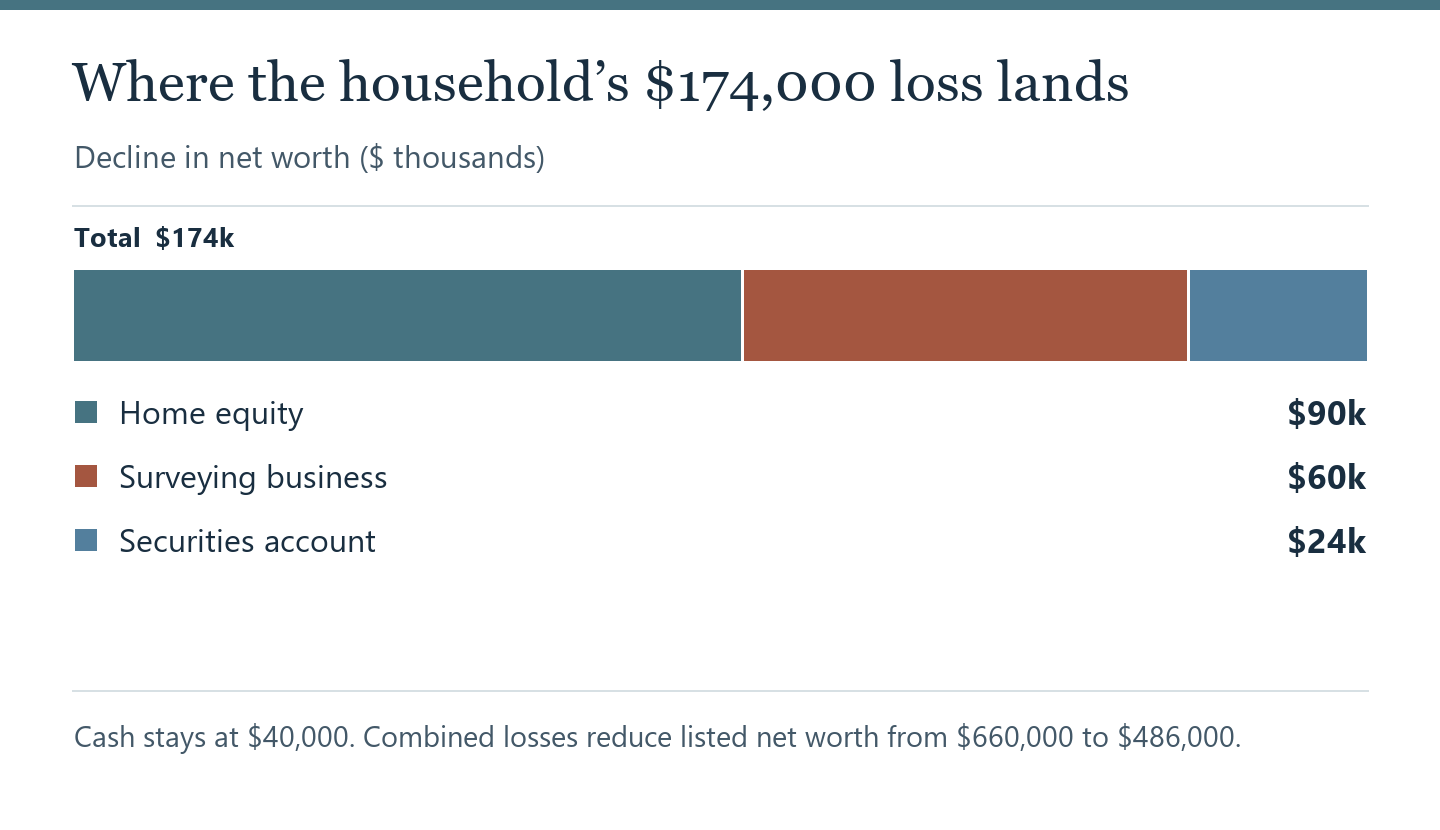
A simple whole-household stress can expose double counting. Keep the earlier $90,000 decline in home equity. Assume separately that the net equity value of the surveying business falls from $180,000 to $120,000 and that the $200,000 securities account declines 12 percent to $176,000. Hold the $40,000 cash reserve constant at the instant of the market shock. Listed net worth becomes $150,000 of home equity plus $120,000 of business equity plus $176,000 of securities and $40,000 of cash, or $486,000. The reduction from $660,000 is $174,000, the sum of $90,000, $60,000, and $24,000. That is about 26.4 percent of starting net worth, much larger than the securities account's 12 percent decline.
The $33,000 annual income loss from the separate example is a flow, not another immediate markdown of the same assets. If the new $120,000 business valuation already reflects reduced future business distributions, capitalizing the $24,000 reduction in distributions again would double count part of the same damage. A cash budget can still show how the lower distribution affects next month's spending. The balance sheet and the cash calendar answer different questions. Preserve both without adding every number from one to the other.
Likewise, if the business is valued under a continuing-operation scenario in which its loan remains current, do not also deduct the full personal guarantee as if default had already happened. Build a more severe liquidation scenario to test the guarantee, adjusting the business valuation and recoveries consistently. The household can then distinguish a significant market loss with adequate liquidity from an event that threatens personal assets beyond the business investment. Keeping the scenarios internally coherent makes the analysis credible despite uncertainty about the private company's exact value. A conservative assessment should make the bad case explicit rather than manufacture severity by counting the same claim twice.
Improve diversification where the decision is feasible
The household may have little ability or desire to sell its home or change careers merely to produce a prettier asset allocation. The securities account and the timing of future savings may be the most flexible tools available. Before adding an industry fund, ask whether the family's existing salary, business customers, property market, and employee shares already behave like that industry in a downturn. Before taking a long-duration bond position, compare the maturity and currency with planned tuition. Before investing every spare dollar, check whether the business reserve and personal reserve have been counted twice. A targeted change to one liquid account can reduce an economic concentration without forcing changes to valued parts of family life.
A numerical concentration estimate can help, provided the uncertain private valuations are labeled. In the original $660,000 net-worth illustration, the combination of business equity and home equity is $420,000, about 63.6 percent of the listed total. This does not mean 63.6 percent is perfectly correlated with the port industry. Some property value reflects wider housing supply and other employers, and the surveying business may serve unrelated customers. The figure is an invitation to investigate a common regional driver. If the family also owns $20,000 of shipyard stock inside its $200,000 securities account, do not add that $20,000 to total assets again. Reclassify the exposure within the existing total.
An annual review can be short. Update reliable cash, debt maturity and reset dates, major changes in the business's customer mix, employment benefits, guarantees, and the next few years of large commitments. Revisit the stress when a mortgage resets, a job changes, the business signs a major contract, tuition is denominated in another currency, or an employer award vests. The review is not improved by constantly revaluing personal property or assigning a daily price to a career. Its job is to identify whether a plausible common shock could create a cash shortfall or force a damaging sale.
The brokerage account remains important, but it is one adjustable part of a larger economic position. A diversified securities mix may be appropriate even for a family with concentrated local assets; it simply cannot be evaluated in isolation. Count each dollar once, distinguish income from liquid capital, and match the most important obligations to resources that remain usable when the household's main sources of wealth are under pressure together. That is the sense in which diversification extends beyond what a brokerage statement can show.
Related research

ResearchCross-Asset Allocation
Turnover, Fees, and Taxes Can Change an Allocation Result
Two portfolios can own similar markets, report the same gross return, and leave their owners with different amounts to spend.

ResearchCross-Asset Allocation
Write an Investment Policy Before the Next Difficult Market
A policy written during a calm meeting can answer questions that become much harder when prices fall.

ResearchCross-Asset Allocation
Scenario Probabilities Should Not Pretend to Be Precise
A foundation's finance committee is shown a slide with three economic scenarios. Next to each is a percentage carried to one decimal place.