
ResearchCross-Asset Allocation
Write an Investment Policy Before the Next Difficult Market
- Report or archive date
- Archive placement November 11, 2026
- Reading time
- 13 min read

Summary
A policy written during a calm meeting can answer questions that become much harder when prices fall.
A policy written during a calm meeting can answer questions that become much harder when prices fall. Who can authorize a sale? Which assets fund next month's obligation? What weight range is acceptable after markets move? When is a genuine change in the institution's needs sufficient to change the policy itself? A document filled with assurances about taking a long-term view may answer none of these questions. A useful policy gives the people responsible for real money enough direction to act under stress and enough flexibility to respond when the facts underlying the original decision have changed.
For example, Harbor Arts Trust starts its policy year with $5 million of investable assets and a regular commitment to fund local arts programs. Its trustees want the programs to continue through difficult markets without unnecessarily sacrificing the purchasing power of future grants. They also need to replace equipment at a community venue in eighteen months. The trustees set aside money for the equipment, assign responsibility for payments, and agree on the conditions that would bring an investment decision back to the board.
Identify the institution, the assets, and the objective
The policy applies to the $5 million pooled investment account. A building used directly for arts programs and donations legally restricted to named projects are outside that pool. The treasurer reports those items separately so trustees can see the institution's overall financial position without treating restricted funds as available to buy securities or pay general grants. The reporting currency is U.S. dollars. The trust measures success partly by whether grant and equipment payments can be made when due, and partly by the change in purchasing power of the long-term pool after distributions and costs. A nominal market gain alone does not establish that both objectives have been met.
The annual recurring grant budget is initially $180,000. The equipment commitment is $240,000 in eighteen months. Assume the equipment price is fixed in dollars and the grants are spread evenly over the year. The trustees adopt a planning objective of maintaining long-term purchasing power while funding the regular grants. They do not insert an assumed investment return into the policy as if it were guaranteed income. At inception the $180,000 grant is 3.6 percent of $5 million. If the asset base falls to $4 million and the dollar grant remains fixed, the same spending becomes 4.5 percent. The relationship between grants and capital deserves review even when the board honors existing commitments.

The written objective also identifies which losses the trust can bear. Short-term market volatility is acceptable for capital not needed for imminent payments. A shortfall on a signed program commitment or a forced sale of illiquid assets before the equipment bill is due is a more serious failure. A long horizon does not apply to all dollars equally. The grant due next month and the endowment intended to support artists for decades belong to the same institution but have different clocks. The policy should show how much cash stands behind each clock without counting a single dollar twice.
Name the reserve and calculate its job
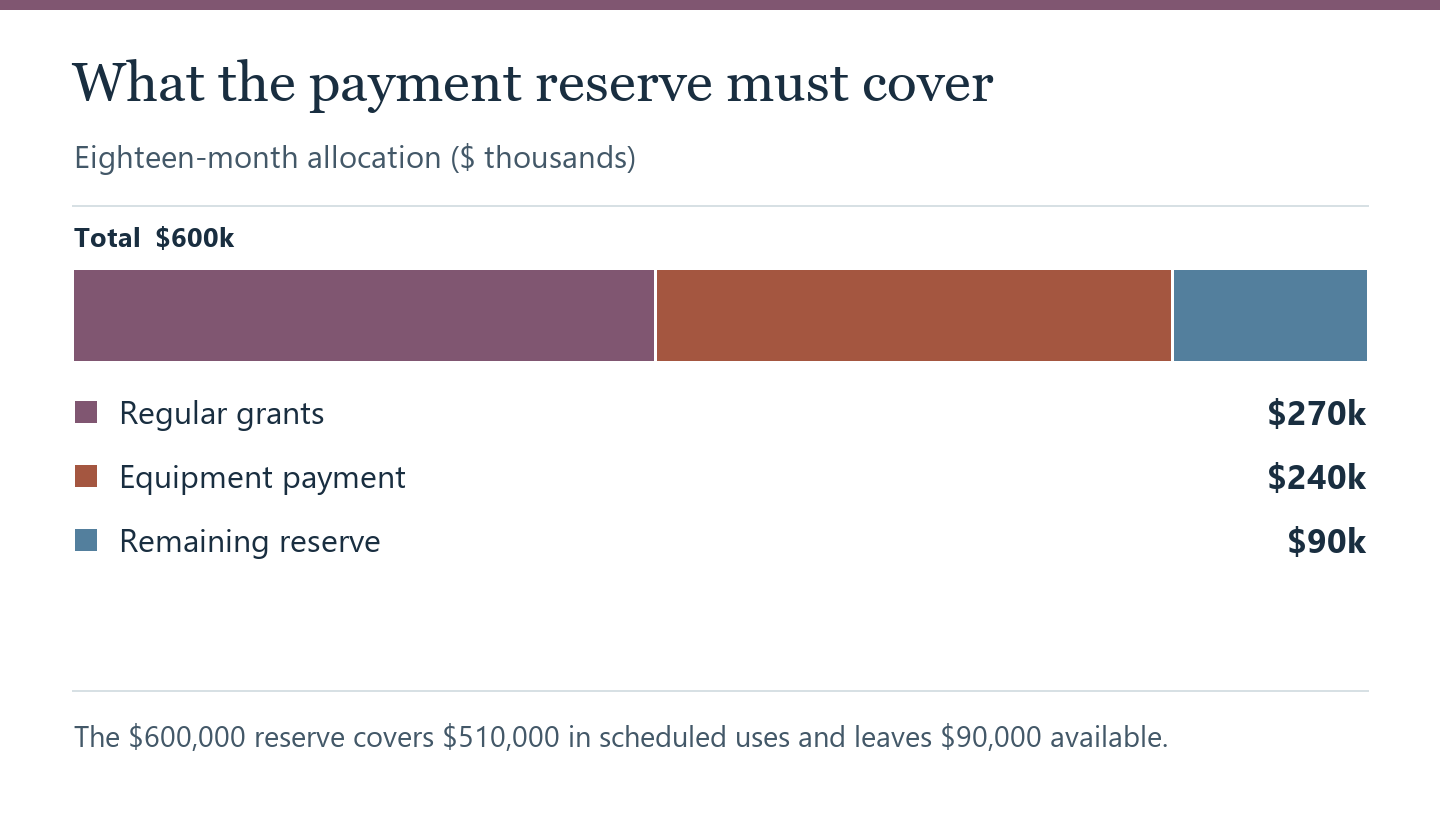
At adoption the trust assigns $600,000, or 12 percent of assets, to a payment reserve in accessible cash and short U.S. government instruments aligned with expected disbursements. The next eighteen months of regular grants total $270,000. Adding the $240,000 equipment payment gives $510,000 of identified obligations over that period. The initial reserve exceeds this amount by $90,000 before interest and incidental expenses. Future income or contributions may replenish the reserve, but uncommitted donations are not counted as available funds in the initial coverage calculation. Restricted donations are counted only for the particular uses they are allowed to fund.
The custodian and treasurer keep a dated cash schedule, not just a percentage target. An instrument maturing after the equipment payment may be safe in a credit sense but exposes the trust to market price and settlement risk if it must be sold early. A Treasury bill already promised as collateral or restricted by an agreement cannot also be counted at face value as grant cash. The treasurer confirms settlement dates, accessible balances, account authority, and any early sale costs before reporting that a payment is covered. Reserve income is recorded when it belongs to the trust and is available on the required date.
The $90,000 cushion is a starting margin, not free money for a new project. Moving the equipment purchase three months earlier would change when cash is required; it need not change the equipment price. A 15 percent cost overrun on the assumed $240,000 bill adds $36,000 of cash need, shrinking the initial margin to $54,000. Combining both changes might require maturities to be moved even though total reserve dollars still appear sufficient. If expenses or signed grants increase enough to exhaust the cushion, the treasurer brings an updated funding plan to the committee before any additional commitments are made.
Define the long-term allocation and permitted exposures
Of total starting assets, the trust assigns 48 percent to diversified public equities, 40 percent to high-quality dollar investment-grade bonds, and 12 percent to the payment reserve. In dollars those targets are $2.4 million, $2 million, and $600,000. The equity sleeve is intended to support long-run purchasing power through broad exposure. The bond sleeve provides income, diversification, and resources that may replenish the reserve, with duration and credit monitored separately. The reserve is managed against payment dates. All three sleeves appear inside the same total, so the reserve is not added on top of the $5 million when performance or allocation is calculated.
The trust’s policy in this case permits diversified, transparent vehicles aligned with these purposes and requires the committee to document fees, liquidity, holdings, currency exposure, and the investment process before approving a new vehicle. It prohibits discretionary borrowing for the trust and pledging reserve assets to support investment positions. Existing funds can contain contractual or derivative exposures, so a vehicle's label is insufficient to establish compliance. Material embedded leverage, concentrated credit, or unusual liquidity terms require explicit analysis before selection. The point is to make the underlying risk understandable, not to assume a fund with a reassuring name fits a short payment obligation.
The ordinary equity monitoring band is 43 to 53 percent of total assets. Bonds ordinarily range from 35 to 45 percent. The reserve has a target of 12 percent, but its scheduled dollar floor takes precedence over mechanically restoring a percentage. Those bands describe ranges for monitoring rather than three independent maximum positions that can be held simultaneously. Actual weights must sum to 100 percent. A change in obligations can legitimately make the reserve percentage temporarily higher or lower. The treasurer explains the dated need, the amount available, and the plan for the next review instead of asserting compliance from percentages alone.
Rebalancing can be tested before prices fall
Suppose equities fall 20 percent, bonds are unchanged, and no distributions or contributions have yet occurred. Equities decline from $2.4 million to $1.92 million. Bonds and reserve remain $2 million and $600,000, leaving $4.52 million. The equity weight is about 42.48 percent, below the 43 percent lower monitoring band. Returning equity to its 48 percent target would require $2.1696 million, a purchase of $249,600. The treasurer must check upcoming payments and the bond weight as well as the equity band. Spending the reserve automatically to buy shares would defeat its stated purpose.
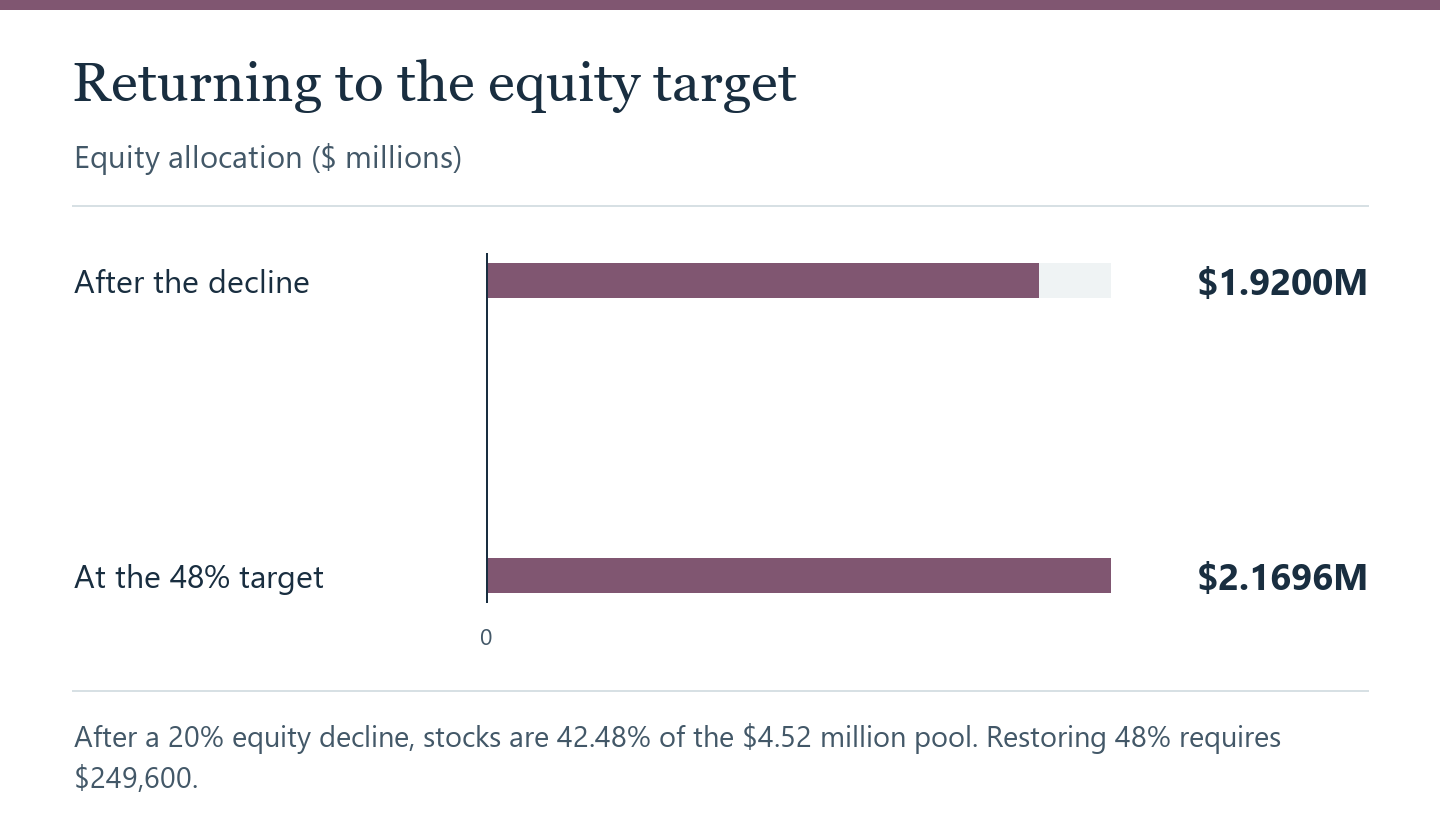
If the purchase were funded entirely from bonds, equities would become $2.1696 million and bonds $1.7504 million. The bond share would be about 38.73 percent, within its ordinary range. The unchanged $600,000 reserve would be about 13.27 percent of the smaller total. These three weights sum to 100 percent after rounding. The proposed transaction restores the example's equity target while retaining coverage for identified payments. It is not an automatic instruction to buy at any price. The committee checks trading costs, actual holdings, liquidity, subsequent known cash flows, and whether the underlying obligations or risk capacity have changed.
Now imagine an unrestricted $250,000 donation is firmly committed and settles before the proposed rebalance. Simply buying $249,600 of equities on the old calculation would be wrong because the donation increases total assets. The new pool would be $4.77 million and the 48 percent target $2.2896 million. Starting equities are still $1.92 million, requiring $369,600 of purchases to hit the target. Investing all $250,000 of the donation in equities would leave a further $119,600 to transfer from other assets. The policy therefore specifies that material known external cash flows must be recognized before calculating trades. A contribution can ease funding needs while changing the target dollar amount.
Decide what triggers attention and what authorizes action
The treasurer reviews cash availability monthly and before any major distribution. The investment committee reviews exposures, performance, and band breaches quarterly and receives prompt notice when a material breach, liquidity restriction, custody issue, or change in a major obligation arises. The portfolio manager may implement ordinary trades within delegated authority. A move outside permitted instruments, a material change in strategic targets, or use of money designated for a signed commitment requires trustee approval under the institution's governance documents. Operational authority to execute a trade is separate from authority to amend the policy.
A band breach triggers a documented review, not a compulsory trade at an arbitrary intraday price. The decision record includes current weights, pending cash flows, expected trading cost, the effect on reserve coverage, and the date of the next check. If the committee defers action because a known contribution will settle soon, it names that date and explains the alternative if the funds do not arrive. If liquidity has deteriorated, it identifies what can be traded in reasonable size and what cannot. A policy allowing discretion without a record can become indistinguishable from hindsight. A policy denying all discretion can force an unnecessary or damaging trade.
The trust also considers continuity. The custodian must have appropriate instructions, an authorized backup can process ordinary grant payments if the treasurer is unavailable, and payment instructions are verified through the institution's established controls. An urgent market decision does not suspend the ordinary controls that protect assets from erroneous transfers. At the same time, the board should know who can respond before a payment deadline rather than discover that every signatory is traveling. Operational readiness is part of investment policy when the objective includes delivering money on specific dates.
Choose benchmarks that correspond to each decision
The trust's policy benchmark uses the stated target weights applied to prespecified total-return references for broad equities, investment-grade dollar bonds, and short U.S. government bills. The committee records the exact index version, currency, reinvestment convention, and a quarterly rebalancing calendar before the evaluation period. A reserve measured against a bill reference can show how competently cash was managed; coverage of actual grant obligations remains a separate measure of whether that cash did its job. A broad equity index can provide market context without becoming the primary performance test for a portfolio required to hold bonds and grant cash.
Suppose annual reference returns are 8 percent for equities, 3 percent for bonds, and 2 percent for bills. Applying inception weights for a single period with no interim rebalance gives 0.48 times 8 plus 0.40 times 3 plus 0.12 times 2, or 5.28 percent. The 5.28 percent result uses the starting weights for the entire year. With quarterly rebalancing, calculate the return for each quarter using the appropriate weights and link those returns. Fees, trading, tracking differences, currency, and external contributions should be reconciled. A time-weighted comparison measures investment performance differently from the experience of dollars contributed just before a market decline.
For a sample benchmark schedule, the trust selects the MSCI ACWI Net Return Index in U.S. dollars for global equities, the Bloomberg U.S. Aggregate Bond Index on a dollar total-return basis for bonds, and the FTSE 3-Month US T-Bill Index in dollars for the reserve. This combination makes a choice about global equity exposure, the bond market's interest-rate and credit profile, and the reserve's short maturity. If the trustees later wish to exclude an equity region or materially shorten the bond target, they should amend the mandate prospectively rather than quietly swap to whichever historical index gives the most flattering comparison. A reference does not require the trust to buy a particular commercial fund.
On the last available valuation date of each calendar quarter, the reporting agent closes the current benchmark period and restores the stated weights for the following period. It uses the same reporting currency and source for successive observations, identifies any holiday-related date mismatch, and documents how restatements are treated. For accountability, the annual report presents the actual portfolio net of its investment costs alongside the policy reference and explains material differences, including the cost of holding readily available payment cash. Individual sleeves can be reviewed against their own references, but those reviews do not replace the test of the overall portfolio's ability to pay grants.
If an index stops being published, the investment committee proposes a successor that still matches the mandate and records the effective date. Until the trustees approve that successor, the report identifies the missing reference explicitly. Choosing a replacement after observing subsequent returns would undermine the value of the policy precisely when an investor needs a consistent record.
The trustees also review the real economic outcome. If nominal assets rise but program costs rise faster, the trust may be less able to fund future grants. If regular distributions exceed sustainable income and growth for an extended period, the board may need to revisit spending or fundraising even if the manager matches the benchmark perfectly. Conversely, a year below a broad equity index can be acceptable if the policy benchmark was followed and grants were delivered during market stress. These questions belong to different decisions, and the report identifies the decision maker responsible for each.
Write the stress cases in terms of cash and control
One test combines an equity decline with a loss on bonds. Suppose equities fall 25 percent and bonds 8 percent from the original starting values, while the reserve holds its nominal value before disbursements. Equities fall to $1.8 million and bonds to $1.84 million, leaving $4.24 million including cash. The market loss is $760,000, or 15.2 percent of initial assets. The original $510,000 of identified eighteen-month payments remains covered by $600,000 of reserve. Making those payments would leave $90,000 of that initial reserve, assuming no replenishment, reserve income, or overrun. Coverage of the near-term promises is intact while long-term spending capacity has clearly weakened.
A different test leaves market values temporarily unchanged but assumes the venue needs an extra $180,000 of urgent repairs. The eighteen-month commitments increase to $690,000, exceeding the $600,000 reserve by $90,000. An allocation report showing the reserve exactly at 12 percent would offer false comfort. The board could stage nonessential repairs, obtain unrestricted donations, or transfer liquid assets after reviewing their risk and settlement. The point of the rule is to make the shortfall visible while alternatives are available. Maintaining the percentage target is secondary to ensuring that actual signed obligations can be met.
A combined case is harder: both markets fall, donors delay support, and the equipment bill rises. The board should identify which commitments can legally be deferred and which cannot, how quickly bonds could settle, whether prices in the statement are executable, and who is authorized to revise the spending plan. It should test whether the reserve remains free of restrictions and whether the same outside donor has already been counted to solve two shortfalls. For each uncovered payment, the treasurer records the amount, the last date a transfer can settle, and the person authorized to release the funds.
Specify when the policy itself changes
The trustees review the policy annually and after a material change in mission, operating reserves, expected grants, legal restrictions, investment access, or the size and timing of obligations. A decline in market prices alone triggers the existing monitoring process; it does not automatically redefine the strategic objective. A documented change in the ability to tolerate loss can justify an amendment even during stress. The record identifies what changed, the evidence, the alternatives considered, the effective date, and any transition costs. Old benchmarks and policy versions remain available for evaluating decisions taken when they were in effect.
New assets or unusual strategies need an explicit purpose in the entire portfolio. A proposal should explain what problem the asset solves, what existing exposure it duplicates, how it will be valued, how much cash can be withdrawn in stress, and what fees or leverage it introduces. A claim of attractive returns does not answer the reserve question. A product marketed as low volatility may be ineligible if withdrawal restrictions prevent timely grant payments. A sophisticated strategy might be suitable for long-term capital but unsuitable for money already committed to equipment. The committee should assess the use before the marketing category.
The final document should be short enough to use in a real meeting and complete enough that another trustee could reconstruct the decision. Write down the dollar obligations, the target exposures, the action limits, who can decide, and how performance and liquidity will be checked. Record which payments are already binding and which amounts depend on estimates. Update the dates and estimates when the underlying facts change. Harbor Arts Trust cannot prevent a difficult market by adopting a policy. It can decide in advance which promises must be honored, what evidence justifies a change, and who has the authority and resources to act when waiting is no longer an option.
Related research

ResearchCross-Asset Allocation
Diversification Includes the Risks Outside a Brokerage Account
A family can sell every energy stock in its investment account and remain deeply exposed to an energy downturn.

ResearchCross-Asset Allocation
Turnover, Fees, and Taxes Can Change an Allocation Result
Two portfolios can own similar markets, report the same gross return, and leave their owners with different amounts to spend.

ResearchCross-Asset Allocation
Scenario Probabilities Should Not Pretend to Be Precise
A foundation's finance committee is shown a slide with three economic scenarios. Next to each is a percentage carried to one decimal place.