
ResearchCross-Asset Allocation
Hedging a Currency Has a Cost and a Purpose
- Report or archive date
- Archive placement June 23, 2026
- Reading time
- 13 min read

Summary
A university laboratory in the United States has committed to buying a microscope from a German manufacturer.
A university laboratory in the United States has committed to buying a microscope from a German manufacturer. The invoice is for one million euros, payable in three months. Elsewhere on campus, the endowment holds a European bond portfolio worth one million euros today. The purchasing office wants to buy euros forward. The endowment is considering selling euros forward. Both proposals can be entirely sensible. The laboratory owes euros in the future. The portfolio owns something whose dollar value depends partly on the euro. Before calculating what a hedge might earn or cost, the university has a more basic question to answer. Whose future payment is the institution trying to protect?
A currency hedge is easiest to understand as an exchange of specific cash flows. Name the currency, the amount, the delivery date, and the purpose. Those details distinguish a commitment to pay a supplier from an investment whose value can change every day. They also explain how a derivative that loses money can fulfill its intended purpose, and how a profitable derivative can leave its owner with an unwelcome exposure. A currency forecast is optional in this analysis. Knowing what obligation or asset the contract is supposed to offset is indispensable.
Start with the conversion on the statement
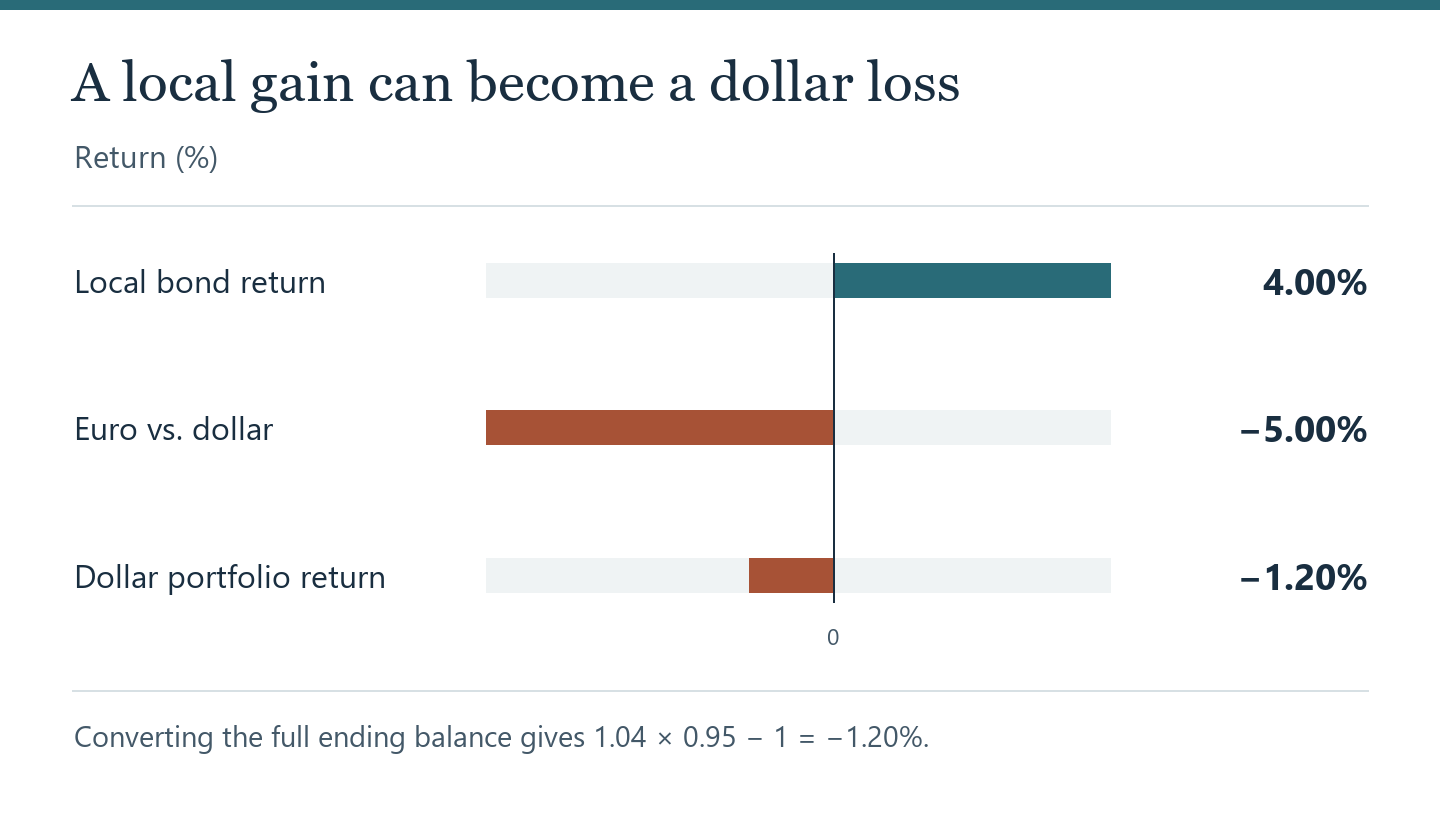
Imagine a dollar-based foundation buying one million euros' worth of securities at $1.10 per euro. Its starting investment is $1.10 million. Three months later the securities are worth €1.04 million, including income retained in the portfolio. Their euro return is 4 percent. If each euro now buys $1.045, the dollar value is $1,086,800. A holder measuring purchasing power in dollars has lost $13,200, or 1.2 percent, despite the gain in local currency.
It is tempting to add the local return of 4 percent to the exchange-rate change of minus 5 percent and call the dollar return minus 1 percent. At the end, however, all €1.04 million are converted at the new rate, including the €40,000 gain. Multiplying 1.04 by 0.95 gives 0.988. The gap between the quick estimate and the actual return is twenty basis points. The gap grows when either move is large. It can also be important in a performance report that tries to explain small differences between otherwise similar funds.
Now run the conversion at $1.155 rather than $1.045. The same €1.04 million is worth $1,201,200, a dollar gain of 9.2 percent. The European securities performed identically in the two cases. A committee rewarded for choosing European securities could look brilliant or disappointing depending on which currency outcome occurred. That does not make the currency outcome irrelevant. It means the mandate should say whether taking euro risk was part of the manager's assignment and how the committee intends to judge it.
Match an invoice, then try matching a portfolio
For the microscope, suppose the foundation's bank offers to sell €1 million in three months at $1.105 per euro. If the university signs a deliverable forward on those terms, keeps the contract until maturity, and the supplier invoice is unchanged, the university will need $1,105,000 to obtain the euros. A stronger euro in the meantime will not increase that dollar amount. A weaker euro will not reduce it. The institutional benefit is that the purchasing office can set a budget for a known invoice. The contract says nothing about whether the microscope is good value or whether the laboratory will obtain the grant it expects.
For the investment portfolio, reverse the trade. The foundation agrees to sell €1 million at $1.105 on the same future date. Return to the case in which the ending spot rate is $1.045. Compared with selling the euros at spot, the forward adds $60,000. The securities converted at spot are worth $1,086,800, giving a combined value of $1,146,800, before any separate expenses. Relative to the original $1.10 million, the return is about 4.25 percent. Equivalently, deliver €1 million into the contract for $1,105,000 and sell the extra €40,000 at spot for $41,800. Using those two routes to the same answer is a good way to catch a sign error.
If the euro instead finishes at $1.155, the forward subtracts $50,000 relative to spot. The dollar value of the securities rises to $1,201,200, leaving $1,151,200 after the forward loss, or a return of about 4.65 percent. The wide gap between the two unhedged outcomes has narrowed considerably. Yet the hedged outcomes still differ by $4,400. The endowment sold the euro amount it owned at the beginning. The €40,000 earned afterward remained exposed to a difference of eleven U.S. cents per euro. A known invoice and an uncertain future portfolio value require different promises.
The arithmetic also separates a judgment about the securities from a judgment about the hedge. Selling the opening principal forward did nothing to guarantee the securities' 4 percent euro gain. If a borrower defaults or European bond yields rise, the local asset value may fall. A stronger hedging program could account for anticipated coupons and planned subscriptions with greater precision. It still could not turn a risky issuer into a creditworthy one. An investment committee explaining this strategy should be able to identify the risk it retains as clearly as the one it transfers.
Where the forward rate comes from
Why was the forward rate in this example different from today's $1.10 spot quote? Think of two ways to have a euro available in three months. One can arrange the future exchange today, or buy slightly less than a euro today and let it earn euro interest. Financing the latter transaction in dollars also incurs dollar interest. Under simplified assumptions, the forward rate equates the cost of those two routes. The result depends on the interest rates for the same dates and on which currency is quoted per unit of the other.
For a second, separate illustration, assume simple annual interest of 4 percent in dollars and 2 percent in euros for exactly one quarter. Ignore credit differences, dealing spreads, collateral costs, and day-count complications. A euro due at quarter end can be obtained by depositing roughly €0.995025 now, since that amount multiplied by 1.005 is one euro. At $1.10 per euro the deposit costs about $1.094527 today. Financing it at 1 percent for the quarter makes the future dollar cost about $1.105473. The equivalent formula takes spot, multiplies it by 1.01, and divides by 1.005. The rounded $1.105 offer in the portfolio illustration was a separate assumed dealing rate.
Someone selling euros at a forward rate above spot may describe the difference as favorable forward points. Someone buying euros faces the opposite side of the same quote. Neither can infer from those points that a bank expects the spot exchange rate to rise by the same amount. Today's cost of financing and carrying positions is enough to create forward points even if two investors disagree entirely about where spot is headed. Change the interest-rate ordering and the direction of the points can reverse without changing the operational reason for the hedge.
Actual participants face different funding arrangements. A financial institution may have to use scarce balance-sheet capacity to provide the offsetting trade. Collateral requirements, demand for particular currencies, and differences in access to funding can move observed forward terms away from the simple two-deposit relationship. The cross-currency basis is one way professionals describe that difference. The sign convention depends on which currency leg receives the adjustment. A useful discussion of the basis therefore starts with a quoted pair and maturity, identifies the convention used, and asks what the foundation would actually pay or receive. An isolated declaration that the basis has widened is too vague to put into a budget.
The cost that appears and the one that does not
Hedging costs are often discussed as if a single explicit fee would appear on a statement. Part of the economic effect is already embedded in the forward rate. There can also be a dealing spread, operational expenses, and the cost of making liquid assets available as collateral. An institutional investor comparing two proposals should ask for quotes on the same currency pair, side of the trade, settlement date, and amount at approximately the same time. Otherwise the apparent difference in price may reflect comparing two different transactions.
Suppose one dealer will buy €1 million from the foundation at $1.1050 and another at $1.1046, with the same date and other terms. The first quote delivers $400 more at maturity. Relative to the $1.10 million opening asset value, the difference is about 3.64 basis points. That calculation is useful because it converts a visually small quote difference into the units of the investment decision. It does not measure the entire cost of hedging. A dealer with the higher quoted rate might require a different collateral schedule or settlement arrangement. Those provisions can matter more than four ten-thousandths of a dollar per euro.
Take collateral seriously even when the portfolio appears well protected economically. If the euro appreciates sharply, a foundation that sold euros forward can show a loss on the derivative and a higher dollar value for its foreign assets. Under an agreement requiring variation margin, it may have to post cash before liquidating any securities. Assume a $45,000 cash call arrives while the investment holding the offsetting gain cannot settle a sale for several days. The currency hedge can succeed in economic terms while creating an immediate need for dollars. A report that nets the asset and hedge into one line may conceal precisely the cash demand the treasurer must meet.
Backing a derivative with cash is not the same as spending all that cash on the day the position opens. The institution may earn interest on collateral, depending on its agreement. It may also have to hold a safer, more liquid asset than it would otherwise have chosen. The opportunity cost depends on the alternative and on when the cash is needed. Treating the entire collateral balance as a fee overstates expense. Ignoring the liquidity requirement understates the resources needed to maintain the policy during a difficult market.
What the next contract changes
The microscope invoice ends on a particular day. The euro bond portfolio may remain invested for years, while the hedge can mature every month or quarter. When the existing contract expires, the foundation must decide how many euros to sell next, for what maturity, and on what terms. Today's forward stabilizes a particular future conversion. It provides no promise about the rate or spread available for the following contract.
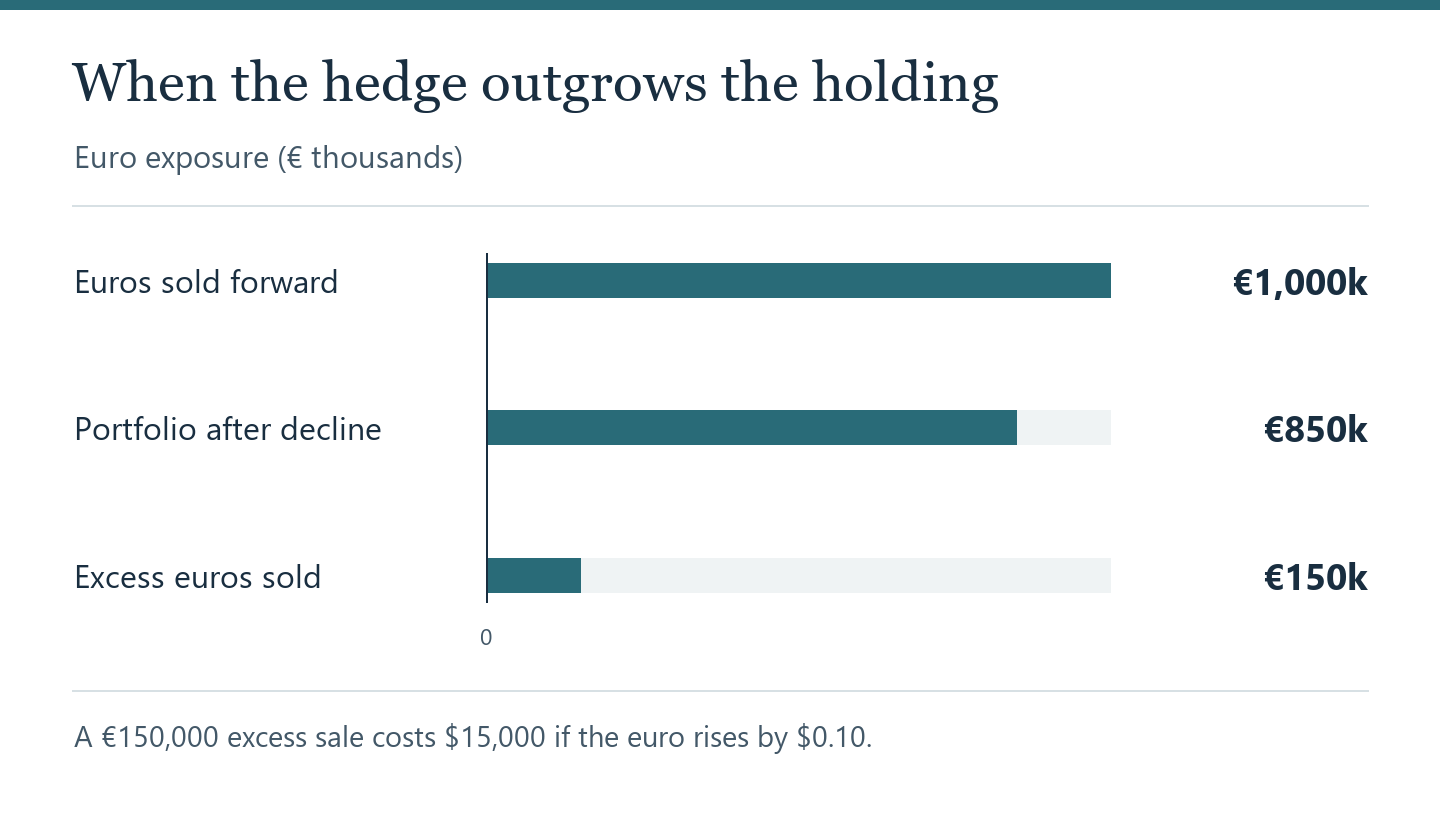
Imagine the original €1 million bond portfolio has fallen to €850,000 before the next sizing date. A standing instruction to sell another €1 million would leave €150,000 more sold forward than the portfolio's current value. If the euro then rises by ten U.S. cents, the extra amount alone creates a $15,000 adverse currency effect, before considering changes in the assets themselves. A procedure that seemed conservative at inception has generated a new exposure. Subscriptions, redemptions, income paid out in cash, and asset sales can all create comparable differences between the actual holding and the contract amount.
A policy can manage these differences in several ways. Frequent resizing reduces the time a large mismatch can persist, although it may create more trades and small dealing costs. A tolerance band permits modest deviations while specifying when someone must act. Planned withdrawals can be incorporated before a fund sells assets rather than discovered afterward when the hedge has become too large. No particular band or trading frequency fits every mandate. The investment office should be able to explain how the expected cash flows, liquidity of the holdings, and minimum economical trade size informed the choice.
A hedge can also miss its target even if the opening notional is exactly right. The securities may be priced at their local market close, the exchange rate fixed later, and the derivative marked using a different convention. A fund's reporting currency may differ from the currency of the underlying security's economic cash flows. A euro-listed company may earn most of its revenue elsewhere. Selling euros against the quoted market value reduces one layer of translation exposure while leaving the company's commercial sensitivities intact. Those remaining risks will generally appear through the euro price of the security, where a currency forward on the fund cannot reach them directly.
Return to the institution's own currency needs
The lab and the endowment sit on the same campus. What if the university were free to use part of the euro portfolio to pay the invoice? It might already own an asset denominated in the currency it needs. Selling every euro forward in the investment office and buying the same amount forward in procurement could create two transactions that offset at the institutional level. Identifying a natural match can save dealing costs and simplify cash planning. Before netting anything, the treasurer has to check who legally controls the assets, whether gifts are restricted, when the portfolio can settle, and how certain its euro value really is.
Suppose €600,000 can be set aside in an available euro deposit for the invoice and the remaining assets belong to a restricted endowment. The purchasing office then has a €400,000 uncovered obligation if the invoice remains €1 million. At $1.105 per euro, arranging a forward purchase for just that balance would lock in $442,000 of additional dollar spending. The first €600,000 still has an economic cost to the university because it gives up those euros. Calling that part of the microscope free would confuse a source of payment with the value of the purchase.
Half-hedging an asset portfolio can be equally sensible for a different reason. In the first portfolio example, selling €500,000 forward at $1.105 would add $30,000 in the weaker-euro case and subtract $25,000 in the stronger-euro case. The combined dollar values would be $1,116,800 and $1,176,200. On the same opening investment, the returns are about 1.53 percent and 6.93 percent. The point of running those figures is to make the consequences of the fraction visible. Half the opening principal hedged does not imply half of all conceivable portfolio losses prevented. It refers to a quantity of currency sold for one maturity.
One complication belongs on the purchasing office's calendar well before any performance report. What happens if the manufacturer moves delivery back six weeks? The invoice remains denominated in euros, but an otherwise well-matched contract now matures before the bill. The university can take delivery of the euros and hold them until payment, if the documents and cash budget permit. It can also discuss closing or extending the transaction. Either course has a price determined by the terms then available. Moving a date in the equipment schedule does not automatically move it in the bank contract. Telling treasury about a delay when the manufacturer first reports it gives the institution more choices than telling treasury on settlement day.
The opposite timing problem arises if the laboratory receives a discount for prompt payment. Paying early could save euros on the invoice while leaving a forward purchase scheduled after the new due date. The value of the discount should be compared with the total cost of obtaining euros earlier and dealing with the original hedge. A nominal discount of €3,000 sounds attractive in isolation. It may be more or less attractive once the university includes cash interest, settlement arrangements, and the cost of changing the contract. This is an operational decision a treasurer can analyze without making a directional call on the euro. It also explains why a hedge register belongs beside the list of purchase orders and payment dates, as well as in the investment office's risk report.
How a committee can tell whether the policy worked
A useful performance page begins with local asset performance, shows the conversion effect, and then records the derivative result, expenses, and any cash flows from subscriptions or withdrawals. Every line needs a consistent valuation date. The committee can compare the actual portfolio with a clearly specified unhedged version and with a version hedged at the policy ratio. That design separates the choice of strategic currency exposure from differences caused by execution, timing, or the selection of securities. Comparing a hedged portfolio only with an unhedged index leaves much of the reported difference unexplained.
Consider the strong-euro outcome again. A board member sees the $50,000 derivative loss and asks whether the manager made a poor trade. The treasurer can answer with three records. The first shows the amount and date authorized before the exchange rate moved. The second reconciles the higher dollar asset value with the derivative loss. The third shows how much cash the institution needed along the way. A contract correctly sized and executed to reduce variation in dollar purchasing power can produce exactly such a loss. If it was the wrong size or the collateral call forced the sale of an unrelated holding, those are separate, consequential findings that a positive combined return can easily hide.
The microscope provides a final test that works without any financial jargon. On delivery day, did the laboratory have the euros it owed, on the date it owed them, within the dollar budget it had agreed? The equivalent investment question requires one extra step. Did the hedge leave the institution with the amount of currency risk it intended while allowing its underlying investments to perform their own economic jobs? Recording the answers in those terms makes costs visible, keeps the purpose intact, and gives the next committee something more dependable to evaluate than whether yesterday's currency move happened to favor the derivative.
Related research

ResearchCross-Asset Allocation
Volatility and Drawdown Describe Different Risks
Two investment accounts finish June with exactly the same amount of money. They began with the same balance in January, earned the same six monthly returns in a different order, and had no deposits, withdrawals, or fees.

ResearchCross-Asset Allocation
A Satellite Theme Should Fit the Whole Portfolio
The first question at the investment meeting sounded easy. How much of the portfolio was invested in the new technology theme?

ResearchCross-Asset Allocation
AI Exposure Reaches Beyond Technology Stocks
The first invoice at a new computing campus may come from a civil engineer. The last unpaid invoice in a failed project may belong to an electrical contractor.