
ResearchFixed Income
Liquidity Can Disappear Before a Bond Defaults
- Report or archive date
- Archive placement September 29, 2026
- Reading time
- 13 min read

Summary
A bond can keep paying while becoming difficult to sell at its displayed value. An original execution example separates the quoted spread, available transaction size, price impact, and settlement timing that determine how much cash a holder can actually raise.
Payment capacity and sale capacity are different
A company makes its coupon payment on time. Its bond still appears in an account with a reasonable estimated value. Yet the holder needs cash and discovers that the available bid is substantially lower than expected. No default is required for that situation to occur. The issuer's obligation to pay and the market's willingness to buy are separate relationships.
Credit risk concerns the promised payments and the possibility that they will not arrive as agreed. Market liquidity concerns the terms on which a position can be traded now, in a specified size and within a specified period. The two can deteriorate together, but one does not have to wait for the other.
A useful liquidity question is therefore concrete: how much cash could this position raise, by what date, after realistic execution costs? Saying that an issue is large, that it traded recently, or that its issuer has a strong rating does not fully answer that question.
The distinction becomes especially important when an investor's need for cash is inflexible. A patient holder may be able to wait for a better opportunity, although improvement is not guaranteed. A holder facing a payment deadline may have to accept the available terms. The same security can therefore create different practical risks in two portfolios.
Four dimensions belong in the conversation
The bid-ask spread is the gap between the prices at which a market participant is willing to buy and sell a specified quantity. It provides information about the cost of immediate trading at those quotes. It does not necessarily reveal the cost of trading a much larger amount.
Depth describes the quantity available at stated prices. Price impact concerns how execution prices or the market move as an order is absorbed. Resilience concerns how trading conditions recover after demand or supply consumes available liquidity. Each describes a different aspect of the market, so no single number should be expected to capture them all.
The market structure matters. Some Treasury trading occurs through central order books with posted quantities. Many corporate bond transactions instead involve requests for quotes and dealer intermediation. A depth example can explain the economics; actual order-book visibility varies by bond and market.
Settlement adds a further practical question. An agreed sale is not the same as cash already available to spend. The applicable settlement process, holidays, transfer conditions, and any failure to complete a transaction can affect when proceeds arrive. A liquidity plan needs both an execution assumption and a cash-availability date.
An ordinary-market execution example
Consider a holder of $1 million face value of one bond, marked at a clean price of 100. The position's displayed clean value is $1 million. Assume settlement occurs on a coupon date so accrued interest is zero, and ignore commissions and other fees initially. Every quote in the exercise is per $100 face value.
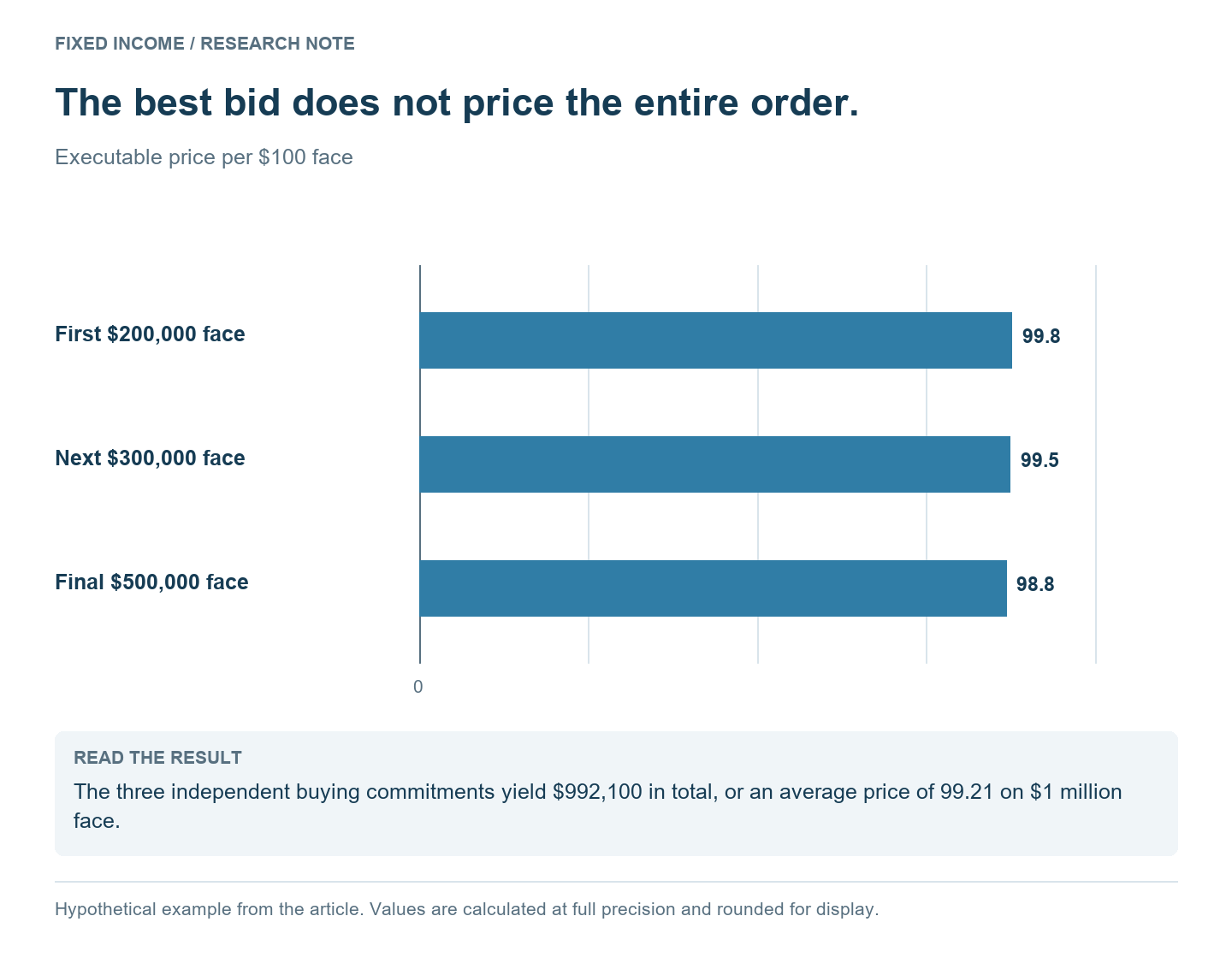
Suppose executable buying interest is available for the first $200,000 face at 99.80, the next $300,000 at 99.50, and the final $500,000 at 98.80. Treat these as independently available commitments for the stated quantities in one simplified execution. They are not overlapping indications from dealers who might be quoting the same underlying buyer.
Selling the first piece raises $199,600. The second raises $298,500. The last raises $494,000. Total proceeds are $992,100, equivalent to an average price of 99.21. The shortfall from the displayed $1 million mark is $7,900, or 0.79%.
Now suppose the best displayed offer to a buyer is 100.20 while the best bid remains 99.80. The quoted spread is 0.40 price point, or 0.40% of the 100 midpoint. That spread applies to the quoted size. Selling the entire position at 99.80 would incorrectly assume that the best bid could absorb all $1 million face.
A sale of only $100,000 face could fit within the first buying commitment and raise $99,800 under these assumptions. The same bond therefore has different average execution costs at different quantities. Liquidity is a relationship between an order and available counterparties, not simply a permanent property attached to the security's name.
Stress changes both the price and the available capacity
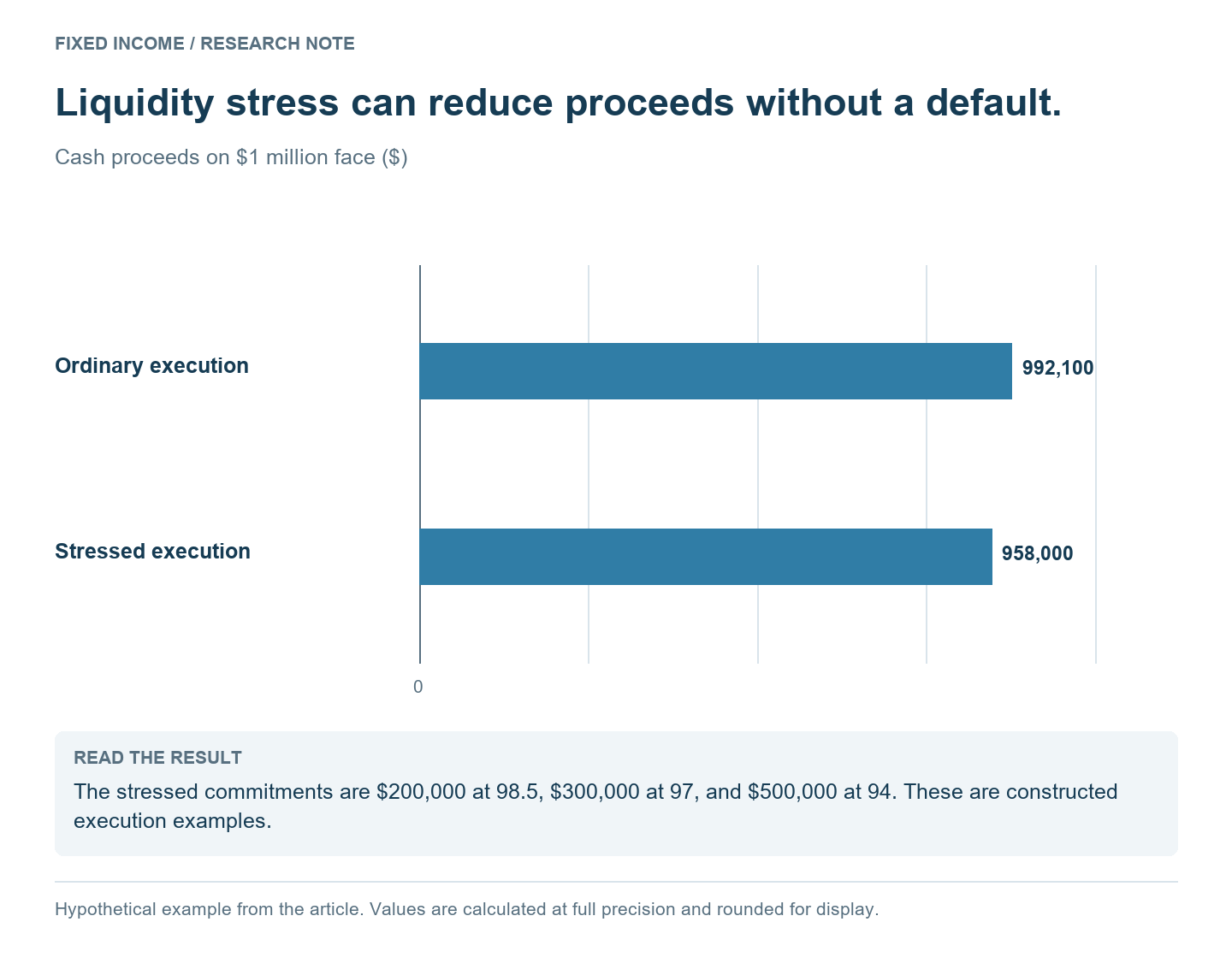
For a separate stressed scenario, retain the same $1 million face amount and the same starting mark of 100. Assume buying commitments are now $200,000 face at 98.50, $300,000 at 97.00, and $500,000 at 94.00.
The three pieces raise $197,000, $291,000, and $470,000. Total proceeds are $958,000, an average price of 95.80. The gap from the starting mark is $42,000, or 4.20%. The issuer has not defaulted in this exercise. The assumptions describe a more costly immediate exit.
Selling only the first $500,000 face would raise $488,000, an average price of 97.60 and a 2.40% shortfall from face value. Multiplying that smaller-sale percentage by the full position would understate the modeled cost of liquidating everything, because the remaining buying interest is at a lower price.
The example does not prove that the entire price gap is a pure liquidity premium. In a real market, the reference mark may be stale, and new information about rates or credit may also affect bids. The exercise isolates transaction-size effects by specifying the prices directly. Interpreting an observed gap requires investigating the mark and the market together.
Translate a cash requirement into the amount that must be sold
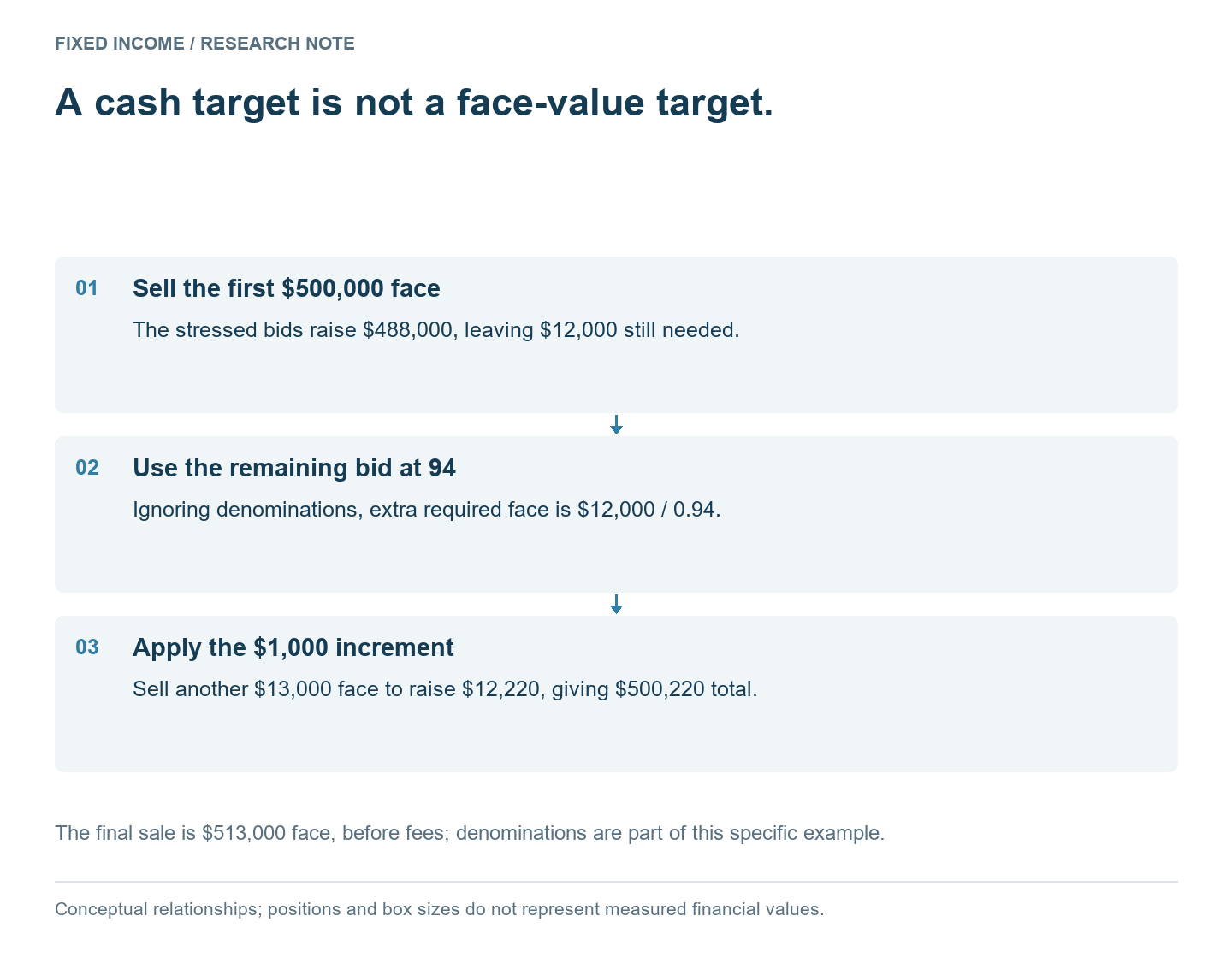
Suppose the holder needs $500,000 of actual cash in the stressed scenario. Selling $500,000 face does not meet that need; it raises only $488,000. Another $12,000 of proceeds must come from the remaining buying interest at 94.
Ignoring minimum denominations, the additional required face amount is approximately $12,765.96, calculated by dividing $12,000 by 0.94. If the bond must be sold in $1,000 face increments in this setup, the holder would sell another $13,000 face. Total face sold becomes $513,000, and total proceeds become $500,220 before fees.
This is why liquidity budgets should be expressed in cash proceeds rather than nominal holdings. A portfolio can hold more than enough face value on paper and still require a larger sale than expected. Fees or a change in executable quotes could increase the amount needed further.
The assumption that all commitments remain available also matters. In real execution, quotes can expire or change while an order is being arranged. A sequence of favorable small quotes is not automatically a binding commitment to buy the entire amount. Confirmed capacity, price, and timing belong together in the estimate.
An account mark is not a standing purchase offer
A displayed valuation may be based on recent trades, dealer observations, comparable securities, or a pricing model. It can be useful for estimating portfolio value while still differing from an executable bid for a particular position. The difference is not automatically evidence of misconduct or an incorrect model; it may reflect distinct valuation purposes and conditions.
Start by checking the mark's timestamp and price convention. A clean price excludes accrued interest, while a full value includes it. A stale last trade may reflect a different market environment, and a small transaction may not represent a larger sale. Comparing unlike quantities or dates can create an apparent liquidity problem that partly comes from inconsistent measurement.
Then examine the trade context. A dealer-to-dealer transaction, a purchase from an investor, and a sale to an investor can carry different execution economics. A transaction history helps reveal activity, but it does not guarantee that the same price remains available. Reported trades are evidence about completed transactions, not promises about future ones.
The research question is how much confidence the available observations support. A single recent trade is better than no information in some respects, but a broader set of comparable observations can reveal dispersion and changing conditions. The appropriate conclusion may be a range of plausible proceeds rather than one falsely precise sale value.
Why intermediaries may quote less aggressively
A dealer buying a bond may need to hold it until another buyer appears. During that interval, market prices can change, financing is required, and balance-sheet capacity is occupied. A wider bid-ask spread or smaller quoted quantity can compensate for those risks or reflect a limit on the inventory the dealer is willing to carry.
When volatility rises, the uncertainty between purchase and resale can increase. An instrument that was easy to hedge may become less well matched by available hedges. If many investors seek to sell similar positions at once, dealers may face one-sided demand rather than a balanced stream of buyers and sellers.
These mechanisms do not mean every unfavorable bid is justified by one particular cause. They provide questions to investigate. Is the difficulty specific to one issuer, shared across an industry, or visible throughout a broader market? Are quotes widening, quantities shrinking, or settlement becoming slower? Different patterns imply different constraints.
The investor should also distinguish a dealer's own capacity from the total market's capacity. One counterparty's reluctance does not prove no buyers exist elsewhere. At the same time, several dealers may rely on overlapping sources of demand. Simply adding every indicative quantity can overstate independent capacity, which is why the earlier exercise explicitly assumed nonoverlapping commitments.
Funding liquidity can intensify market liquidity pressure
Funding liquidity concerns the ability to obtain cash or financing to meet obligations. It can interact with market liquidity when assets are pledged as collateral. A holder may be solvent under a long-term valuation yet face an immediate cash requirement if lenders reduce the amount they will advance against those assets.
For a separate example, assume collateral worth $1 million supports $900,000 of borrowing, corresponding to a 10% haircut. If the lender changes the permitted advance to 80% of the same collateral value, the borrowing capacity falls to $800,000. The borrower must provide $100,000 of repayment or other acceptable support under the assumed terms, even though the collateral's displayed value has not changed.
If that cash is unavailable, selling assets may become necessary. Simultaneous sales by several financed holders can put pressure on executable prices, which may then reduce collateral values further. The size and direction of the feedback depend on the contracts and available buffers; it is not an inevitable outcome of every haircut change.
The lesson is to separate an asset's repayment horizon from the financing horizon used to hold it. A ten-year bond financed through borrowing that can be repriced or withdrawn much sooner contains a timing mismatch. The ability to hold until maturity depends partly on the stability of that funding arrangement.
Funds add a collective cash-flow problem
A fund can own many bonds and still face concentrated liquidity demands if investors withdraw at the same time. Diversification across issuers reduces some credit concentrations, but it does not automatically diversify the timing of shareholder redemptions or eliminate a common need to sell assets.
Cash balances and maturing securities can absorb some withdrawals. Once those resources are insufficient, the manager must decide which holdings to sell and on what terms. Selling the easiest assets first may preserve execution quality initially while leaving a less liquid remaining portfolio. Selling proportionally may instead require immediate concessions in harder-to-trade holdings.
Different fund structures handle these pressures differently. Exchange-traded shares can change hands among investors without every transaction requiring the fund to sell bonds. Creation and redemption activity creates another connection to the underlying portfolio. An open-end mutual fund has a different transaction process. Neither structure can make the underlying assets' liquidity constraints irrelevant.
A fund's published liquidity information, holdings, borrowing arrangements, and redemption terms should be read together. A smooth net asset value history is not sufficient evidence that every asset could be sold quickly during stress. Infrequent trading can sometimes make reported values look stable precisely because fresh transaction evidence is limited.
Avoid mistaking inactivity for safety
A bond that does not trade may show little day-to-day price movement. That apparent calm can reflect a lack of observations rather than a lack of economic risk. When a meaningful transaction finally occurs, the price may adjust sharply to information that accumulated over time.
This affects comparisons of volatility. A frequently traded security provides many observations of changing value. An infrequently traded one may rely more on estimates or stale prices. Comparing their measured volatility without acknowledging that difference can make the less observable asset appear safer than its executable value warrants.
It also affects correlations. If one asset's reported price responds promptly and another's responds later, their contemporaneous returns may appear weakly related even when they share underlying risks. A diversification argument based entirely on those reported returns can therefore overstate the protection available during simultaneous selling.
Research should look beyond the neatness of the price series. Transaction frequency, dispersion, quote size, valuation method, and the age of observations all help explain what the series can support. The absence of a visible price decline is not the same as evidence that a position can be sold at yesterday's mark.
Prepare for the cash need before the market is stressed
A practical liquidity plan starts with obligations and plausible withdrawals by date. It identifies cash already available, scheduled receipts, and assets that may need to be sold. The estimates should use realistic sale proceeds and settlement dates rather than assume every holding can immediately produce its accounting value.
Stress the amount as well as the price. A larger-than-expected withdrawal can move execution into less favorable buying interest, as the example demonstrated. Stress timing too: a manageable need next quarter can be difficult tomorrow if sale proceeds cannot arrive in time.
Potential responses have trade-offs. Holding more cash can reduce forced-sale risk but changes the portfolio's income and exposure. Distributing purchases across maturities can create scheduled principal receipts but does not guarantee enough cash for every surprise. A credit facility may provide flexibility, but its availability and conditions should be tested under the same stress that affects the assets.
Order instructions also involve trade-offs. A limit can constrain the acceptable price while leaving the order partly or entirely unfilled. Seeking more quotations can improve information but takes time, and quotes can change. Breaking an order into smaller pieces may reduce immediate impact in some conditions, but it does not guarantee a better total result if the market moves while execution continues.
Separate patience from an assumption of recovery
The final cash reconciliation should include costs that the execution example initially excluded. In the stressed example, selling $513,000 face raised $500,220 before fees. If the combined transaction charges were a $300, net proceeds would be $499,920, leaving an $80 shortfall against the $500,000 requirement.
With the assumed $1,000 minimum increment and remaining buying interest at 94, selling one additional $1,000 face would add $940 of gross proceeds. If the total charges remain $300, selling $514,000 face would produce $500,860 net. The extra amount is driven by the specified fee and denomination constraints, not by a change in the bond's promised principal.
That small example captures a broader operational principle: enough value is not always enough usable cash. A maturity payment expected after a deadline cannot fund an earlier obligation without an interim arrangement. Collateral pledged to support existing borrowing may not be freely available for a second use. A facility counted as a backup must have sufficient undrawn capacity and conditions that the borrower can satisfy.
Avoid double counting the same resource in several contingency plans. If a bond sale is supposed to repay a secured lender, all of its proceeds may not also be available for an unrelated withdrawal. If cash is reserved for an imminent operating expense, treating it as an unrestricted investment buffer overstates flexibility. The plan should identify who can use each resource, for what purpose, and when.
The exercise is more informative when performed before a cash shortfall becomes urgent. Record the expected proceeds, the assumptions behind them, and a less favorable alternative. Then compare the required deadline with the earliest credible cash-availability date. A precise estimate of sale value is of limited help if the money arrives after the obligation must be met.
Liquidity planning is therefore not only a forecast of market spreads. It is a reconciliation of positions, commitments, execution terms, and timing. The market component can be uncertain even when the contractual component is clear; keeping both visible makes the remaining uncertainty easier to manage.
A holder without an immediate cash need may choose to wait. That flexibility can be valuable, but it should not be confused with proof that the old price will return. The market may be reflecting lasting changes in rates, credit, or required risk compensation as well as temporary trading pressure.
To justify waiting, revisit the issuer's payment capacity and the portfolio's own obligations. Confirm that the original liquidity need has genuinely been deferred or covered. A position is not safely long term merely because selling it now would be uncomfortable.
The conclusion should reconcile three views of the holding: the cash it promises over time, its estimated present value, and the cash an actual sale could raise on the required date. Differences among those views are not unusual. Understanding them is what keeps a normally paying bond from becoming an unexpected source of financing pressure.
Related research

ResearchFixed Income
From a Rate Hike to a Bond Portfolio Scenario
The September policy increase is an observed decision. A bond portfolio's response still depends on changes in market yields, cash-flow timing, and the investment horizon. A worked scenario shows how to connect those inputs without treating a policy move as an automatic portfolio loss.

ResearchFixed Income
Income, Price Changes, and Reinvestment Make Up Total Return
Coupon income is only one part of a bond investment's result. A complete cash-flow reconciliation distinguishes price changes, reinvestment earnings, costs, and outside contributions—and explains why an initial yield and a realized compound return can differ.

ResearchFixed Income
A Credit Rating Is a Starting Point for Research
A rating condenses a credit opinion into a category. Useful bond research expands that category back into its assumptions, identifies the exact obligation being rated, and examines the consequences of a changing credit profile before relying on the label.