
ResearchFixed Income
A Credit Rating Is a Starting Point for Research
- Report or archive date
- Archive placement September 8, 2026
- Reading time
- 13 min read

Summary
A rating condenses a credit opinion into a category. Useful bond research expands that category back into its assumptions, identifies the exact obligation being rated, and examines the consequences of a changing credit profile before relying on the label.
What the letter cannot tell you alone
Two bonds display the same credit rating. One matures next year and is backed by a business with a substantial cash balance. The other matures in fifteen years and depends on a business that must repeatedly refinance. The shared category can be relevant to their credit comparison without making their price sensitivity, liquidity, or investment outcomes equivalent.
A credit rating expresses an opinion about creditworthiness under an agency's definitions and methodology. It is not a guarantee that payments will arrive, an appraisal of every source of market risk, or a conclusion that the current price is attractive. The rating can help organize research, but its usefulness depends on knowing what it covers and what it leaves out.
The most productive response to a rating is to read the reasoning behind it. What assumptions support the category? Which developments could cause it to change? Does it apply to the issuer generally or to the specific security being considered? How recently was the assessment reviewed, and what information has arrived since then?
Those questions turn a compact label into a research agenda. They also prevent a common mistake: treating a familiar rating symbol as permission to stop examining the borrower, the contract, and the price.
Identify the exact object being rated
An issuer-level assessment and an instrument-level assessment need not be the same. A company can have several obligations with different guarantees, collateral, repayment priority, currencies, and contractual protections. The ability of the business to generate cash matters to all of them, but the claim on that cash can differ.
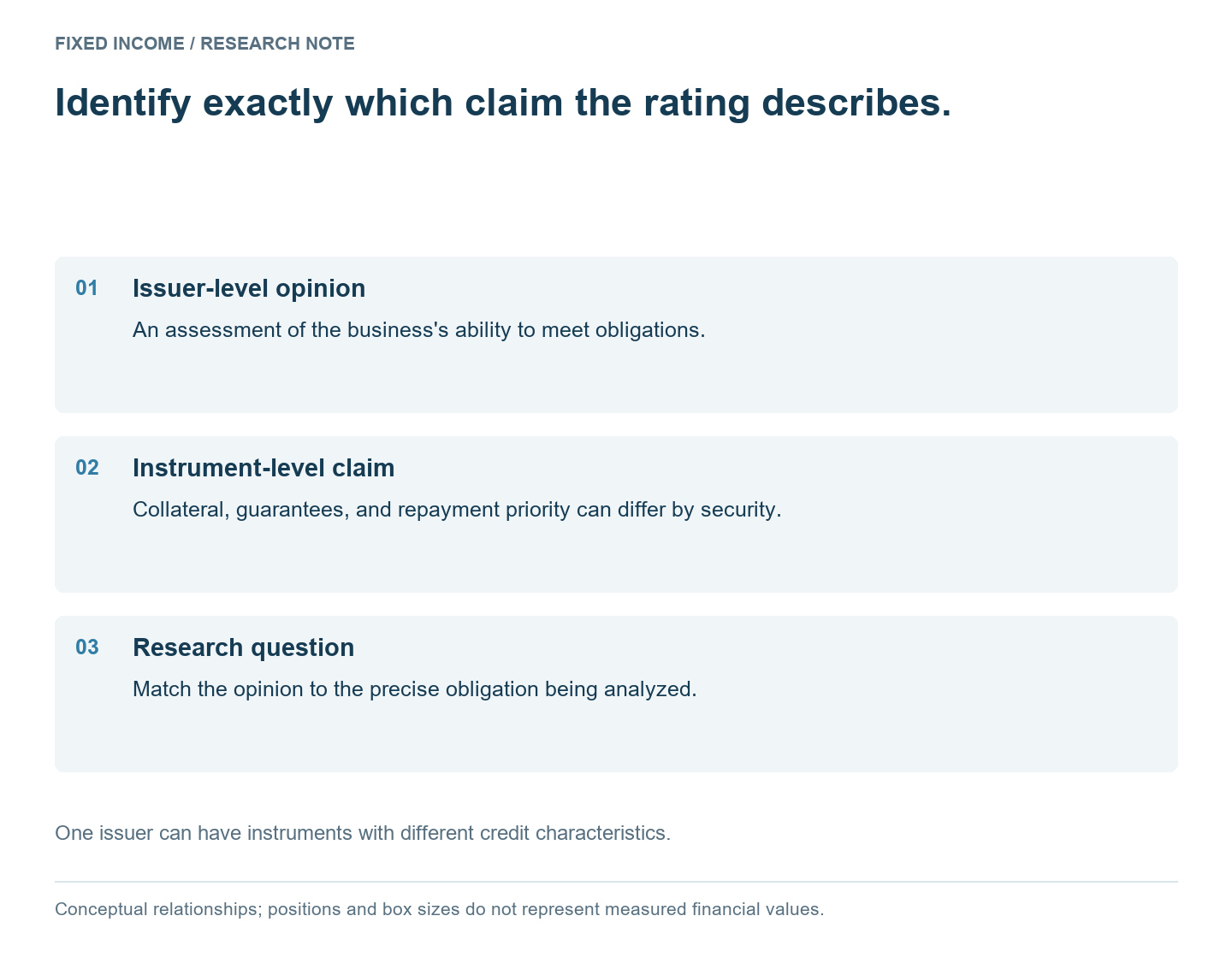
Start with the legal issuer. A parent company's recognizable name on a presentation does not establish that it guarantees every subsidiary obligation. Likewise, ownership of a subsidiary does not automatically make its assets available to every creditor of the parent. The documents defining the claim matter more than a visual association between related corporate names.
Next match the rating to the instrument. Check the security identifier, currency, maturity, seniority, and any guarantee. A short-term rating is not interchangeable with a long-term rating, and an agency's national scale is not automatically comparable with its global scale. The definitions determine the intended comparison.
For a group, imagine a profitable operating subsidiary with its own secured borrowing and a parent company that relies on distributions from that subsidiary. The parent may have valuable ownership interests, but its creditors can face a different path to cash than the subsidiary's direct lenders. The relevant question is how funds can legally and practically move through the group under stress.
Categories are ordered judgments, not equally spaced numbers
Rating scales rank relative credit assessments. They are not rulers on which the distance between every neighboring category has identical economic meaning. Assigning consecutive numbers to letter grades can make a spreadsheet easier to sort, but it does not create a validated measurement of default risk.
For example, S&P's long-term global scale uses BBB- as the lowest investment-grade category and BB+ as the next category below that boundary. That distinction is useful for understanding its terminology. It does not imply that every issuer just above the boundary has the same cash-flow resilience, or that moving across the boundary changes economic risk by a fixed amount.
Different agencies have their own symbols, definitions, and analytical approaches. A comparison should consult those definitions rather than assume that a visually similar mark has identical content. Even where market practice groups ratings into broadly comparable categories, the underlying opinions can differ for substantive reasons.
An average portfolio rating needs special care. A portfolio containing very strong and highly speculative credits is not necessarily equivalent to a portfolio concentrated in intermediate-quality credits, even if a numeric coding produces the same average. Loss distributions, concentrations, and exposure to common shocks remain different. The underlying holdings should remain visible behind the summary.
Read the conditions supporting the opinion
A rating rationale usually becomes more useful when translated into a small set of operating and financing conditions. For a manufacturer, these might include demand stability, pricing power, production costs, maintenance investment, liquidity, and leverage. For a bank or insurer, a different set of balance-sheet and regulatory considerations may be central. One ratio should not be forced across sectors that operate differently.
Pay particular attention to forecast assumptions. An expectation of falling leverage may depend on retained cash, an asset sale, or an acquisition delivering anticipated earnings. Those are different mechanisms with different execution risks. A forecast that debt will decline is more informative when it identifies the cash source and the competing uses of that cash.
Management's financial policy also matters. A company can generate substantial cash and choose to distribute it, repurchase shares, or finance an acquisition rather than repay debt. The ability to reduce leverage and the intention to do so are not identical. A credit assessment should consider both capacity and behavior.
When reviewing a rationale, distinguish the agency's assumption from an observed result. A planned disposal is not cash already received. An expected efficiency improvement is not a completed reduction in expenses. Keeping those categories separate makes it easier to identify when the basis for the opinion is changing.
Reconstruct the ratio before debating the threshold
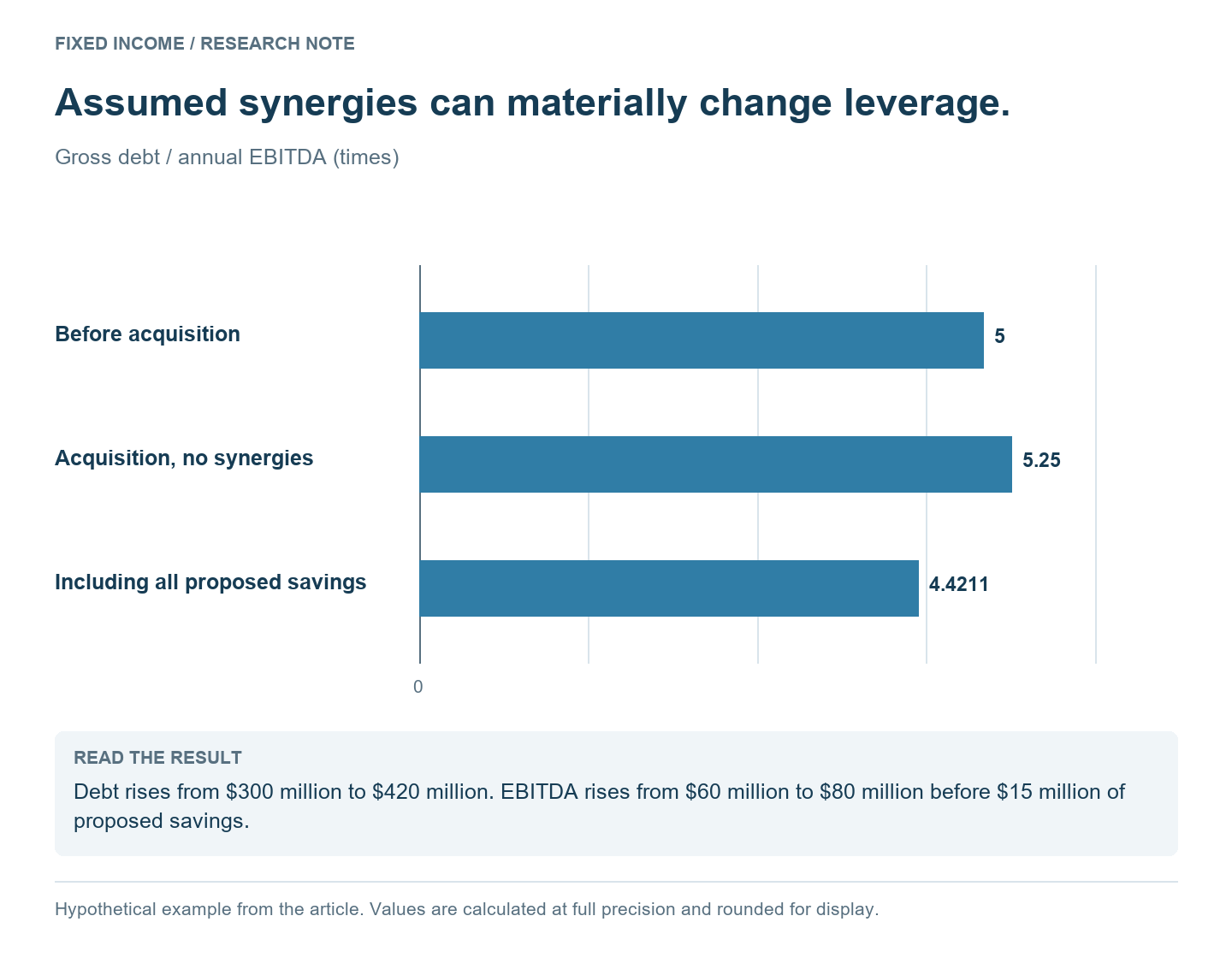
Consider an industrial company with $300 million of debt and $60 million of annual EBITDA, a measure of earnings before interest, taxes, depreciation, and amortization. Its simple gross debt-to-EBITDA ratio is 5.0 times. That calculation is clear, but it is only one possible input to a credit assessment.
The company proposes an acquisition financed with $120 million of additional debt. Assume the acquired business contributes $20 million of annual EBITDA before any claimed synergies. Pro forma debt becomes $420 million and EBITDA becomes $80 million, producing leverage of 5.25 times. The acquisition increases earnings, yet it also increases this leverage measure.
Management separately identifies $15 million of potential annual cost savings. Including all of those savings immediately would raise adjusted EBITDA to $95 million and lower the ratio to approximately 4.42 times. The arithmetic is correct; the analytical question is whether the savings are achievable, incremental, recurring, and available on the assumed timetable.
If implementation requires cash costs or disrupts operations, the path to that adjusted figure matters. If some savings overlap with improvements already included in the acquired business's earnings, counting them again exaggerates the denominator. A ratio cannot resolve those judgments merely by displaying more decimal places.
An agency may also adjust debt or earnings differently from management. Comparing two reported leverage numbers without reconciling their definitions can create a disagreement that is partly about accounting treatment. Build the bridge between the inputs before deciding that one analyst is more optimistic or conservative.
Outlooks and review signals are additional information
Asset disposals provide another test of the ratio's meaning. Return to the acquirer with $420 million of debt and $80 million of EBITDA before the proposed synergies. Suppose it sells a business for $50 million and uses every dollar of those proceeds to repay debt. The sold business contributed $10 million of the original EBITDA.
Debt falls to $370 million, but EBITDA also falls to $70 million. The simple leverage ratio becomes approximately 5.29 times, slightly above the original 5.25 times. Describing the transaction only as a $50 million debt reduction would miss the earnings that leave with the business.
That arithmetic does not establish that the disposal is a bad credit decision. It may improve liquidity, remove a volatile operation, reduce maintenance spending, or simplify the company. Those effects require their own analysis. The example shows why a rating discussion should not reduce every strategic action to its headline effect on debt.
The timing of the proceeds matters as well. A signed sale agreement that has not closed may not fund a debt payment due next week. Taxes, transaction expenses, retained obligations, or restrictions on the use of proceeds can also reduce the cash available for repayment. The numerical exercise assumes none of those deductions so the numerator-and-denominator effect remains visible.
When an issuer presents a target leverage figure after several planned actions, reconstruct each action separately. Add the debt and earnings from acquisitions, remove the debt and earnings associated with disposals, and distinguish completed savings from expected savings. This makes the forecast auditable and reveals which assumptions carry the most weight in the claimed improvement.
A rating outlook indicates an agency's assessment of the potential direction of a rating under its definitions. A watch or review designation can highlight a developing event or a more immediate question. The exact meaning and time horizon depend on the agency; the labels should not be treated as interchangeable across providers.
A negative outlook is not the same as a completed downgrade. A review can also resolve without the initially feared outcome. The value of these signals lies in the conditions they identify, not in converting them into a countdown to a predetermined action.
Suppose an issuer is being reviewed after announcing a debt-financed acquisition. The eventual assessment might depend on the final price, financing mix, asset disposals, or evidence about operating integration. Research should track those variables. Repeating the review label without following the transaction does little to improve understanding.
The absence of a warning label is not proof that risk cannot change quickly. An unexpected legal, operational, or financing event can alter an issuer's position before a previously published assessment is updated. A rating is part of a dated information set, and ongoing research must continue between formal actions.
Migration is different from default
A bond can be downgraded and continue making every scheduled payment. Its market value may nevertheless decline if investors demand more compensation for risk. A holder forced to sell can experience a loss without any contractual default. Conversely, a rating change that was widely anticipated may add little new information to the market price at the moment it is announced.
To understand historical rating behavior, analysts often examine transitions from one category to another over a defined interval. Such information needs a population, a starting date, a horizon, and rules for withdrawn ratings and defaults. A transition table is a description of a specified sample, not a universal law of motion for every issuer carrying the same symbol.
Consider an original cohort of one hundred issuers observed for two years. At the end, eight have a higher rating, eighty-two remain in their starting category, nine have a lower nondefault rating, and one has defaulted. The endpoint shares are 8%, 82%, 9%, and 1%. They sum to 100% because the exercise assigns every issuer to exactly one outcome.
The 1% figure is a two-year observed default frequency in that cohort. It is not a one-year rate and should not be divided or compounded into another horizon without further assumptions. It is also not a measured probability for any named issuer. A different economic period, sector mix, or selection method can produce a different result.
Endpoint categories do not show every event along the way. An issuer might be downgraded and later upgraded back to its original category. A table that records only the final category would classify it as unchanged at the endpoint. Interpreting that row as “no credit volatility occurred” would overread the data.
Count issuers and dollars separately
In the same cohort, suppose the single defaulting issuer represents 10% of the initial debt principal rather than 1%. The issuer-count default frequency is still 1%, but the share of principal associated with the default is 10%. A portfolio concentrated in that issuer would have a very different experience from one giving each issuer equal dollar weight.
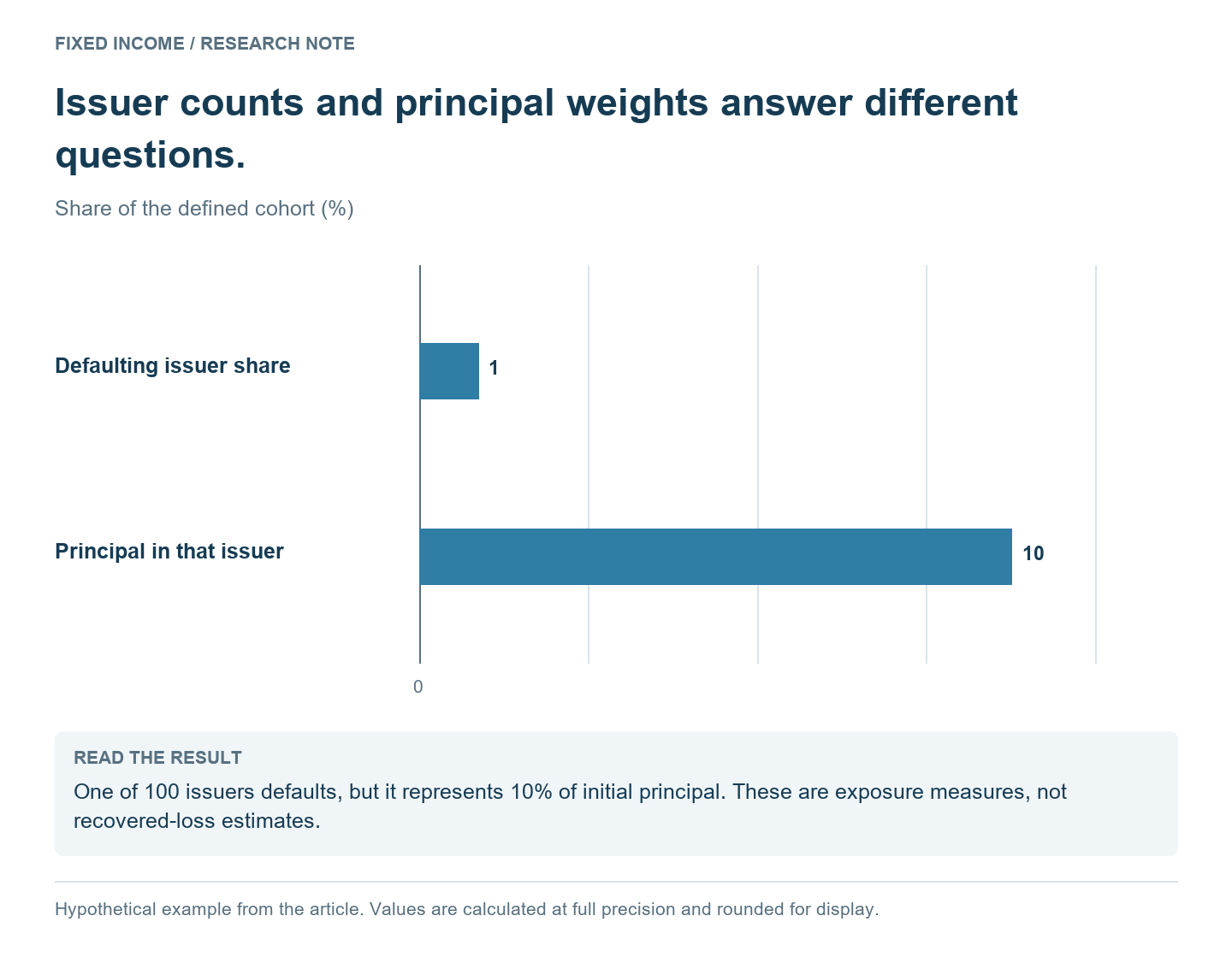
Assume, for this exercise, that the defaulted principal recovers 40% and every other principal amount is repaid in full. With the defaulting issuer representing 10% of principal, the principal loss is 6% of the total: 10% multiplied by a 60% loss given default. Under equal principal weights across all one hundred issuers, the corresponding principal loss would be 0.6%.
These figures ignore coupons, timing, costs, and discounting. They isolate the effect of concentration and recovery. The same count of defaults can accompany sharply different dollar outcomes, so a statement about default frequency is incomplete when used to describe portfolio performance.
Recovery itself is not fixed by the mere fact that default occurred. The available assets, claim priority, guarantees, restructuring terms, and time required to receive proceeds all matter. A recovery paid several years later is not economically identical to the same amount received immediately. Different rating frameworks may place different emphasis on default likelihood and expected loss, so consult the definition before inferring either from a symbol.
Market prices can move before a formal action
Suppose an issuer reports a major operating setback and its bond spread widens before a rating review is completed. The market may be incorporating the same public information on a different timetable. A subsequent downgrade confirms a changed assessment but need not be the original cause of the entire earlier price decline.
The reverse can also occur: a rating action may contain information or analysis that investors had not fully anticipated. A useful event study therefore needs timestamps, prior expectations, comparable market movements, and other news released around the same time. A chart with a vertical line on the downgrade date cannot establish causality by itself.
The bond's government-rate exposure further complicates the picture. Its spread can widen while its overall yield falls if the reference government yield declines by more. Its price could rise despite worsening credit sentiment. Looking only at the direction of price can therefore misidentify the credit development.
The research record should separate changes in the issuer's finances, changes in the rating opinion, and changes in market pricing. They are connected, but their dates and magnitudes need not match. This separation helps avoid both dismissing ratings as useless whenever prices move first and treating every rating action as an unanticipated shock.
Thresholds can affect demand without defining fundamental value
Some investment mandates, index rules, or contracts refer to rating categories. Crossing a threshold can affect eligibility or create a need for review or sale under those particular rules. The consequences depend on which rating providers count, how multiple ratings are combined, when changes take effect, and whether exceptions or cure periods apply.
It would be inaccurate to assume that every investor must sell immediately after a downgrade below investment grade. A mandate might permit some lower-rated exposure, use a different aggregation rule, or allow discretion. Another may impose a firm restriction. Read the actual rule before projecting a wave of forced transactions.
For a fund with a hard eligibility boundary, the relevant risk is not only whether the issuer eventually defaults. A downgrade could require a sale at an unfavorable time. That possibility can matter to portfolio construction even if the manager believes the bond's long-run recovery prospects remain acceptable.
At the same time, anticipated selling is not automatically evidence that a bond is cheap. The weaker rating may reflect a real deterioration in repayment capacity. Technical demand and fundamental credit analysis belong in the same evaluation, but one should not erase the other.
Understand incentives without assuming the conclusion
Credit-rating agencies use different business arrangements. In an issuer-paid model, the entity seeking a rating pays for the service; other arrangements can involve subscribers or investors. Payment structures can create potential conflicts of interest. Recognizing that possibility is part of evaluating the process, not proof that a specific rating is wrong.
A serious assessment asks how the agency separates commercial and analytical functions, documents methodology, handles reviews, and discloses relevant limitations. It also compares the opinion with other available evidence. Assuming complete objectivity would be unwarranted; assuming every opinion is invalid because someone paid for the analysis would be equally unhelpful.
Differences between agencies can identify useful research questions. One might give more weight to liquidity, another to a longer-run business assessment or a different adjustment. Before averaging their conclusions, examine the reasons. A disagreement that exposes an uncertain acquisition assumption is more informative than a consensus produced by ignoring the distinction.
Registration or regulatory recognition also should not be confused with official approval of an individual rating. Oversight of the process and accuracy of a particular forward-looking judgment are separate issues. The analytical responsibility remains to understand the obligation and the assumptions supporting its repayment.
Turn the rating rationale into a monitoring plan
For the acquirer, the first monitoring question is whether the transaction closes on the assumed terms. The second is whether the acquired earnings arrive and the integration costs remain within the financing plan. The third is whether cash retained after necessary spending actually reduces debt. These observations test the pathway behind the adjusted leverage ratio.
That plan should include upcoming debt maturities and access to cash, not just annual earnings. A business can be profitable over a year while facing a financing gap on a particular date. Restricted cash, seasonal working capital, and conditions on committed facilities can affect whether reported liquidity is usable when needed.
Keep a separate price assessment. An improving credit can still offer unattractive compensation at an expensive price, while a deteriorating credit may require careful analysis rather than automatic dismissal at every price. The rating helps describe one dimension of risk; expected cash flows, alternative opportunities, and potential losses are still needed to evaluate the security.
The final research conclusion should be capable of standing without the letter grade. It should explain who owes the money, where repayment cash comes from, what could interrupt it, how the claim is protected, and how much uncertainty remains. The rating then becomes a useful external judgment to compare with that analysis, rather than the analysis itself.
Related research

ResearchFixed Income
Floating-Rate Debt Still Carries Risk
A resetting coupon can reduce exposure to changes in a reference rate. It does not automatically protect against worsening credit, a changing required spread, illiquidity, or falling future income. The contract determines which risks actually move with the coupon.

ResearchFixed Income
From a Rate Hike to a Bond Portfolio Scenario
The September policy increase is an observed decision. A bond portfolio's response still depends on changes in market yields, cash-flow timing, and the investment horizon. A worked scenario shows how to connect those inputs without treating a policy move as an automatic portfolio loss.

ResearchFixed Income
Liquidity Can Disappear Before a Bond Defaults
A bond can keep paying while becoming difficult to sell at its displayed value. An original execution example separates the quoted spread, available transaction size, price impact, and settlement timing that determine how much cash a holder can actually raise.