
ResearchEquity Strategy
Ownership Before Stock Picking
Chapter 1 · Stock Research from First Principles
- Report or archive date
- Archive placement January 12, 2026
- Reading time
- 23 min read

Summary
Understand business ownership, share count, total return, dividends, and compounding before selecting individual stocks.
A share of stock is an ownership interest in a business. Its quoted price tells you what a share trades for; understanding the investment requires looking at the business, the rights attached to the shares, and the price paid for those rights.
Consider Harbor Bread, a neighborhood bakery. What do you own when you buy one of its shares? Amounts are in U.S. dollars.
By the end, you should be able to calculate an ownership percentage, explain what happens when a company issues shares, distinguish a stock price from a company's equity value, and calculate a return that includes dividends. You will also build a short research note that separates what you know from what you still need to investigate.
1 What you own when you buy a share
Harbor Bread sells bread and pastries from one shop. It owns ovens, mixing equipment, and delivery equipment. It rents its storefront, buys ingredients, and pays employees. The business depends on people returning often enough, and spending enough, to cover these costs and support future investment.
Imagine that Harbor Bread has divided its common equity into 100 identical shares. You buy 10. Your ownership interest is 10 out of 100 shares, or 10%.
Ownership percentage = Shares you own ÷ Total shares outstanding × 100
Your ownership percentage = 10 ÷ 100 × 100 = 10%
The company owns its equipment. Owning 10% of its shares does not give you permission to take home 10% of the ovens or collect 10% of each day's sales. Your rights arise from the shares you hold. Common shares typically include voting rights on certain matters and a claim on distributions made to common shareholders, subject to the company's rules and the rights of other claimants.
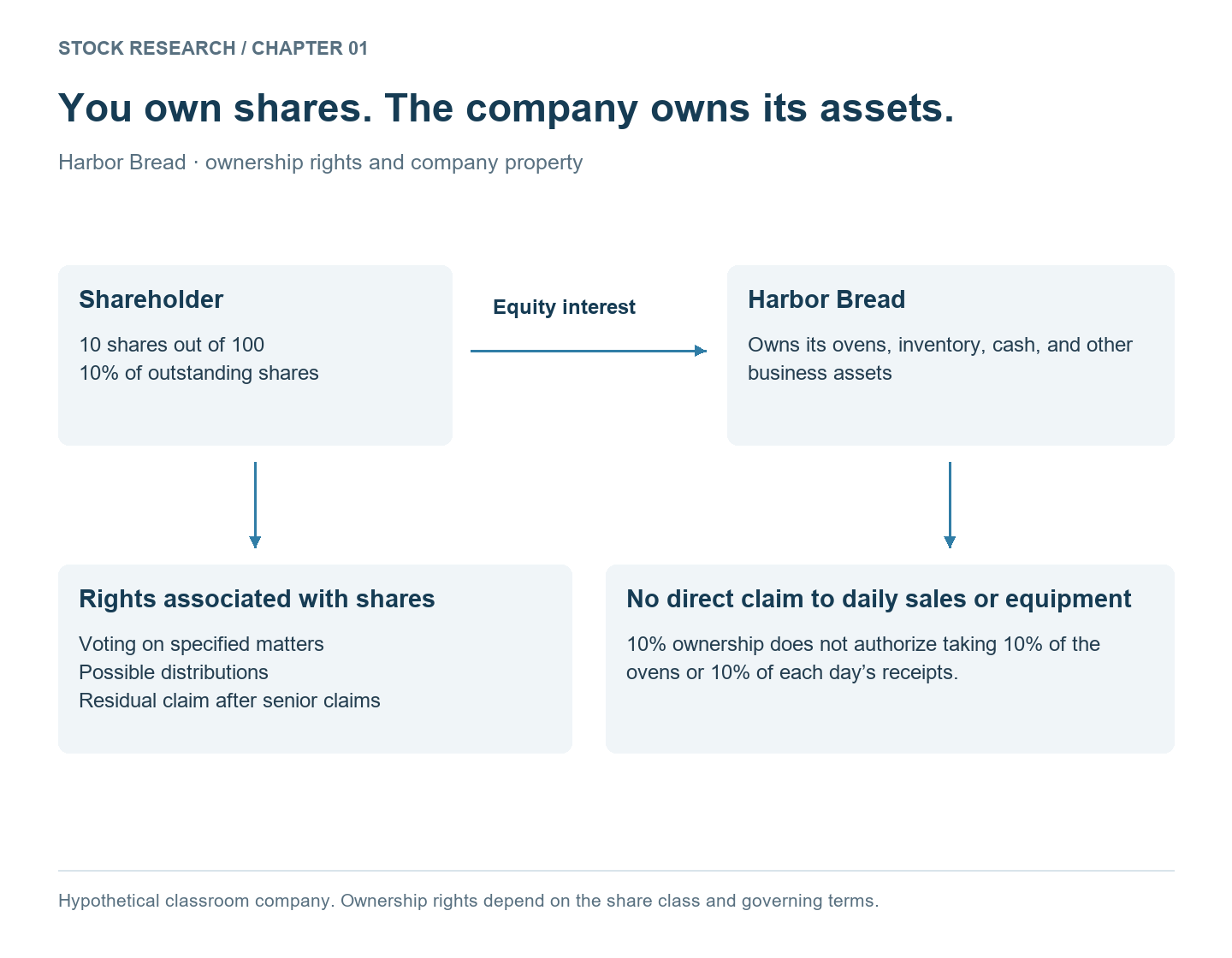
In a public company, shareholders generally elect directors rather than manage daily operations themselves. Management runs the business under the board's oversight. A small shareholder normally has little influence alone, and different share classes can carry different voting rights. Always identify the class being analyzed before assuming that every share has identical rights.
A company can earn a profit without distributing it. Harbor Bread might retain money to replace an oven, open another location, or strengthen its finances. A common dividend is a distribution the company declares; it is not a fixed payment that automatically arrives whenever the company reports earnings.
For now, all Harbor Bread shares have identical economic and voting rights. That assumption keeps the arithmetic simple. When examining an actual company, the share structure becomes part of the research.
Where the purchase money goes
If Harbor Bread sells newly issued shares, the company receives the proceeds, less any issuance costs. This is a primary transaction: the business is raising capital.
If you buy existing shares from another investor, your payment generally goes to the seller. This is a secondary transaction. Most ordinary stock exchange purchases work this way. The company does not receive fresh cash every time its stock changes hands.
That distinction explains why a rise in the stock price does not automatically refill a company's bank account. A higher price can affect its financing choices, but a quoted gain and a cash injection are different events.
2 Connect ownership to the business
Start with a description you could explain to someone who has never heard of the company. For Harbor Bread, that description might be: “The bakery earns most of its revenue by selling bread and pastries to neighborhood shoppers. It also supplies a few local cafés.”
Revenue is the amount earned from sales before expenses. Suppose the bakery sells 20,000 items during a month at an average price of $4. Monthly revenue is 20,000 × $4, or $80,000. That number says nothing by itself about how much profit remains.
If ingredients, labor, rent, and all other expenses for the month total $74,000, including interest and taxes, simplified net income is $6,000. Net income is the profit remaining after expenses. It differs from cash received because accounting records revenue and expenses under rules that do not always match the timing of cash payments.
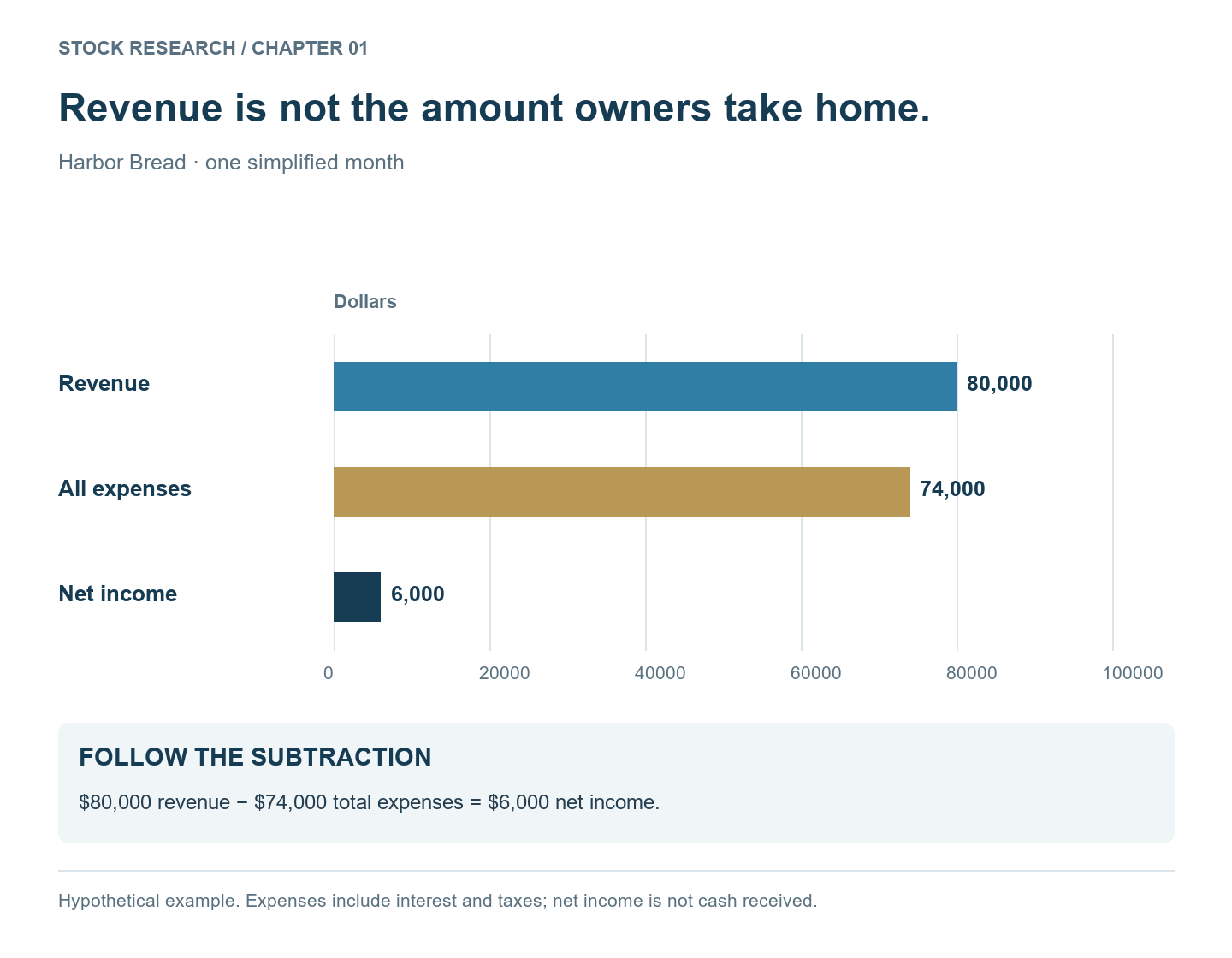
For example, a café could buy bread on credit and pay the following month. Harbor Bread may record the sale before collecting the cash. Buying an oven also uses cash, while its cost is generally recognized as an expense over its useful life rather than entirely when purchased. Later chapters will connect these differences through the financial statements.
At this stage, ask what would change the bakery's economics. A higher selling price might increase revenue per item but drive some shoppers away. A second location might increase sales while adding rent and payroll before enough demand develops. A more efficient oven might reduce waste, but its purchase still needs funding.
These questions apply to larger businesses too. A semiconductor manufacturer depends on orders, production yields, equipment costs, and the utilization of its factories. An airline depends on passenger demand, fares, fuel, aircraft, and operating reliability. Knowing the industry's name is only a starting point; research needs to explain how activity turns into profit and cash.
Write down the main product, who buys it, how the business gets paid, and its largest costs. If these points remain unclear, a valuation ratio will be difficult to interpret.
3 Follow the share count
An ownership fraction has two parts. Your shares are the numerator, the number above the fraction line. Total shares outstanding are the denominator, the number below it. Your percentage can change even when you keep exactly the same number of shares.
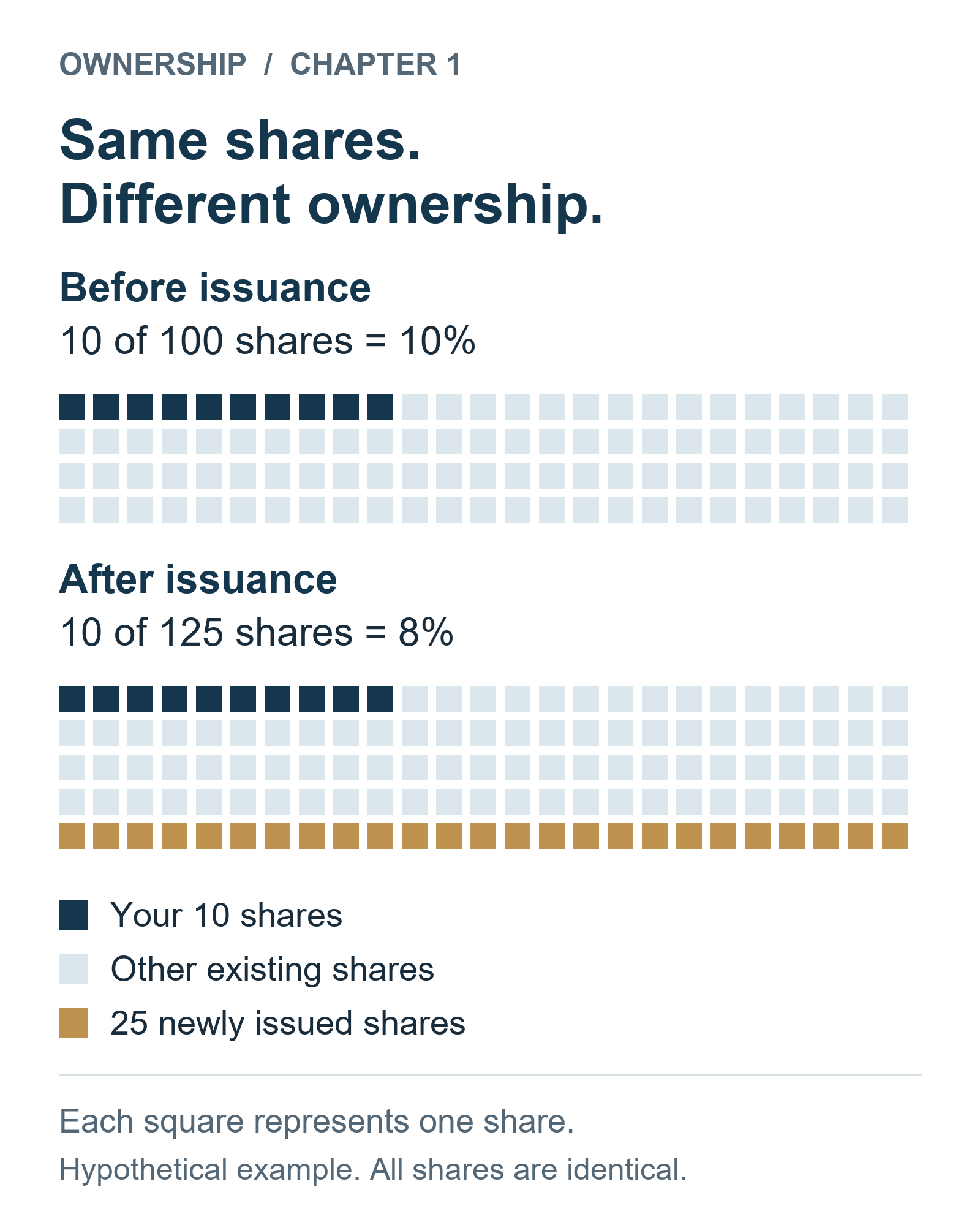
Harbor Bread begins with 100 shares outstanding. You own 10. The company then issues 25 new shares to other investors, bringing the total to 125. You still own 10 shares.
Before issuance = 10 ÷ 100 = 10%
After issuance = 10 ÷ 125 = 8%
Your ownership falls by 2 percentage points, from 10% to 8%. Relative to your original ownership, that is a 20% reduction: 2 ÷ 10 = 20%. Percentage points measure the difference between percentages; percent change measures the difference relative to a starting value.
This reduction in percentage ownership is dilution. It does not, by itself, tell you whether the dollar value of your holding has fallen. The company has also received something in exchange for the new shares.
Issuing shares at the assumed value
Assume the entire common equity is worth $10,000 before the issuance, or $100 per share. Here, equity value means the assumed economic value of the common shareholders' collective interest. It is not the company's cash balance or its accounting book value.
The company issues 25 shares for $100 each and receives $2,500. Assume there are no fees and nothing else changes. Adding that cash increases the assumed equity value from $10,000 to $12,500.
Equity value after issuance = $10,000 + $2,500 = $12,500
Value per share after issuance = $12,500 ÷ 125 = $100
Your 10 shares are still worth $1,000. You own a smaller percentage of a larger equity value. The immediate ownership dilution has not reduced your holding's value under these assumptions.
Now change only the issuance price. Suppose the company sells the same 25 new shares for $60 each. It receives $1,500, giving an assumed equity value of $11,500 and a value per share of $92. Your 10 shares are now worth $920.
This second result follows from issuing shares below the assumed pre-issuance value. In practice, that value is uncertain, offering terms vary, and the business may need financing urgently. The exercise isolates the arithmetic; it does not establish that every discounted offering destroys value or that every offering at the recent market price preserves it.
What the company does with the proceeds matters next. A useful expansion could create additional value. An unproductive project could consume the cash. Evaluate the financing terms and the investment funded by them together.
Which share count to use
Outstanding shares are the shares currently held by shareholders. Authorized shares represent the number the company is permitted to issue under its governing documents. Authorized but unissued shares do not belong in the current ownership denominator.
Companies can also report different share counts for different purposes. A count on a particular date is useful for estimating ownership or market capitalization on that date. Earnings per share uses a weighted-average count over the reporting period. Employee awards and convertible securities may create additional potential shares. Read the label and date before using a number.
4 Understand stock splits
A two-for-one stock split gives each shareholder two shares for every share previously held. If Harbor Bread has 100 shares before the split, it has 200 afterward. Your 10 shares become 20, so your ownership remains 10%.
Assume the total equity value remains $10,000. The value per share changes from $100 to $50. Your holding remains worth $1,000 because 20 × $50 equals 10 × $100.
The split changes the units in which ownership is expressed. It does not supply cash to the company or create additional business assets. A reverse split combines shares and changes the per-share price in the opposite direction, with the same basic principle.
This matters when looking at a price chart. An unadjusted series could appear to fall sharply on a split date even though a shareholder's economic position did not suffer that mechanical loss. Check whether historical prices and share counts have been adjusted consistently before comparing different dates.
5 Understand the claims ahead of common shareholders
Common equity is a residual claim. In a simplified liquidation, common shareholders receive what remains after claims with higher priority have been satisfied. Creditors stand ahead of common shareholders, and preferred stock generally has priority over common stock for specified distributions and liquidation proceeds.
Preferred stock has its own terms, and its payments are not interchangeable with the legally required payments on debt. The word “preferred” describes particular rights; it does not mean that the security is automatically a better investment.
Consider a separate business whose assets could be sold for $1,000. Assume it has $600 of obligations ahead of common equity, no preferred shares, and no selling or administrative costs. The amount remaining for common shareholders is $400.
If asset realizations fall to $800 while those obligations remain $600, the common shareholders' residual falls to $200. A 20% fall in asset value has produced a 50% fall in the residual value of equity. At $600 of realizations, nothing remains for common shareholders in this simplified example.
| Asset realizations | Prior obligations | Common equity residual |
|---|---|---|
| $1,000 | $600 | $400 |
| $800 | $600 | $200 |
| $600 | $600 | $0 |
The calculation illustrates how fixed obligations can amplify changes in equity value. Actual liquidation involves claim priorities, expenses, and uncertain recovery values. A balance sheet's recorded asset amounts are not necessarily the prices those assets would fetch in a sale.
An operating company is usually assessed as a continuing business rather than a collection of assets being liquidated. Even then, obligations matter: interest, debt repayments, and other commitments compete for cash. Research into growth should include the financing needed to sustain it.
6 Distinguish share price from company value
A $5 stock is not automatically less expensive than a $40 stock. The number of shares changes the scale of the comparison.
Pine Components has 100 million shares outstanding at $5 each. Cedar Instruments has 10 million shares outstanding at $40 each. For this example, each company has one common share class.
Market capitalization = Current share price × Shares outstanding
Pine Components = $5 × 100 million = $500 million
Cedar Instruments = $40 × 10 million = $400 million
Cedar has the higher per-share price but the lower market capitalization. Neither fact tells us which company offers better value. We would still need to understand earnings, financial obligations, future prospects, and the uncertainty around them.
Market capitalization is the market value of the equity represented by those shares. It is not annual revenue, money in the bank, or the price of all the company's assets. When businesses have different amounts of debt and cash, comparing equity values alone leaves out part of their financing structure. A later chapter introduces enterprise value to address that comparison.
A stock that falls from $100 to $50 is similarly not proven to be a bargain. Its outlook might have deteriorated enough to justify the decline, or the market might have become overly pessimistic. Establishing either view requires examining what changed in the business and in the expectations embedded in its price.
7 Learn earnings per share before using a valuation multiple
Earnings per share, usually shortened to EPS, expresses earnings attributable to common shareholders on a per-share basis. In a simple company with a constant share count and no preferred stock, divide net income by common shares outstanding.
For a separate earnings example, consider a company with annual net income of $200 and 100 common shares outstanding throughout the year. It has no preferred stock. Basic EPS is $200 ÷ 100, or $2.
In actual financial statements, basic EPS uses earnings available to common shareholders and a weighted-average share count. Diluted EPS also reflects the effect of potentially dilutive securities under the applicable accounting rules. Use the company's reported figures and definitions rather than automatically dividing annual earnings by the latest share count.
EPS is not a promised dividend. This company could earn $2 per share while retaining all of the earnings. The accounting profit attributed to a share and the cash distributed to its owner are different quantities.
The price-to-earnings ratio, or P/E, compares a share's price with an earnings-per-share figure. A trailing P/E generally uses past earnings; a forward P/E uses estimated future earnings. The period and earnings definition must match across comparisons.
P/E = Share price ÷ Earnings per share
At a $60 share price and $2 EPS, the P/E is 30. Investors are paying $30 in share price for each $1 of annual earnings represented by that EPS figure. A P/E of 30 is not a promise that an investor will receive the purchase price back in 30 years. Earnings can change, and they need not be distributed.
Now suppose EPS increases by 20%, from $2 to $2.40, but investors become willing to pay only 20 times earnings rather than 30 times. The implied share price is $2.40 × 20, or $48. Earnings rose, yet the share price fell 20% from $60.
The arithmetic can also be written as 1.20 × (20 ÷ 30) = 0.80. The 20% improvement in earnings was more than offset by the lower multiple investors assigned to those earnings.
This is one reason a compelling business story can produce a disappointing investment result. The entry price may already assume strong growth. Even successful execution can fall short of those expectations, or investors may demand a lower multiple as uncertainty or competing opportunities change.
A low P/E also needs interpretation. Earnings may be temporarily elevated, the business may face a lasting decline, or the figure may include unusual gains. When EPS is zero or negative, an ordinary positive P/E comparison is not useful. A ratio organizes a question; the business analysis has to answer it.
8 Calculate the return you actually earned
An investor's return can include both a change in the share price and cash distributions. Consider one share bought for $50, held over a specified period, and valued at $54 at the end. During that period, it pays a $1 cash dividend.
Assume no purchases or sales during the holding period, no dividend reinvestment, and no fees or taxes. The price gain is $4 and the cash dividend is $1, giving a $5 gain on the original $50 investment.
Total return = (Ending price − Beginning price + Cash dividends) ÷ Beginning price
Total return = ($54 − $50 + $1) ÷ $50 = 10%
Price appreciation contributed 8 percentage points and the dividend contributed 2 percentage points. Together they produced a 10% holding-period return. This is not automatically an annual return; the holding period must be specified before annualizing it.
If the ending price were $45 instead, total return would be ($45 − $50 + $1) ÷ $50, or −8%. The dividend would reduce the loss without eliminating it. A share that paid no dividend but rose from $50 to $55 would produce the same 10% gross return as the first example.
If you still hold the share, the price change is unrealized. Selling realizes the gain or loss and converts the position to cash. An unrealized loss still reduces the current market value of your holding; keeping the position open does not make that change disappear.
Include the costs you actually pay
Use the first example again, but add a $1 purchase fee and a $1 selling fee. Your initial cash outlay is $51. Selling at $54 leaves $53 after the selling fee. Including the $1 dividend, you receive $54 in total.
Net gain = $54 − $51 = $3
Return after these fees = $3 ÷ $51 = 5.88% rounded
The denominator is $51 because that is the amount you committed, including the purchase fee. Taxes, if applicable, would require a separate calculation.
When using a published return series, check its treatment of distributions. Some adjusted price series or total-return indexes already include dividends. Adding them again would overstate performance. Cash dividends held aside, dividends reinvested, and additional deposits also produce different calculations, so identify which situation the data describes.
9 See what changes when a dividend is paid
A dividend transfers cash out of a company to its shareholders. To isolate that transfer, assume a company's common equity is worth $1,000, including $100 of cash, and it has 100 identical shares. Each share is worth $10.
The company pays a $1 dividend per share, distributing all $100 of that cash. Holding everything else constant, $900 of equity value remains in the company, or $9 per share. An investor with one share now has a $9 share and $1 in cash.
The investor's combined value remains $10 in this simplified calculation. Counting both the old $10 share value and the new $1 dividend would count the distributed cash twice.
Actual market prices also respond to news, expectations, and trading. They need not move by exactly the dividend amount when a stock begins trading without the right to receive that distribution.
A high dividend yield therefore needs investigation. If an annual dividend is $2 and the stock price is $50, the indicated yield is 4%. If the price falls to $25 while the stated dividend remains $2, that calculation rises to 8%. The higher yield may reflect a lower price and concern that the payment cannot be sustained. Check the company's cash generation, obligations, and declared policy before treating a quoted yield as dependable income.
10 Put the Harbor Bread case together
We can now follow one continuous ownership example from purchase through a new share issuance and a later dividend. For this case, assume identical common shares, no debt or preferred shares, no fees or taxes, and no reinvestment of dividends.
At the start, Harbor Bread has 100 shares and a total equity value of $10,000. You buy 10 shares at $100 each, spending $1,000. You own 10% of the company.
The company then raises $2,500 by issuing 25 shares at $100 each. Assume the cash adds dollar for dollar to equity value. The company now has 125 shares and $12,500 of equity value. Your 10 shares remain worth $1,000, while your ownership percentage falls to 8%.
Over the rest of the year, the business develops. At year-end, assume its total equity value immediately before a dividend is $13,750. Dividing by 125 shares gives $110 per share. This increase in value is an assumption about the business; it is not an assertion that net income equaled $1,250.
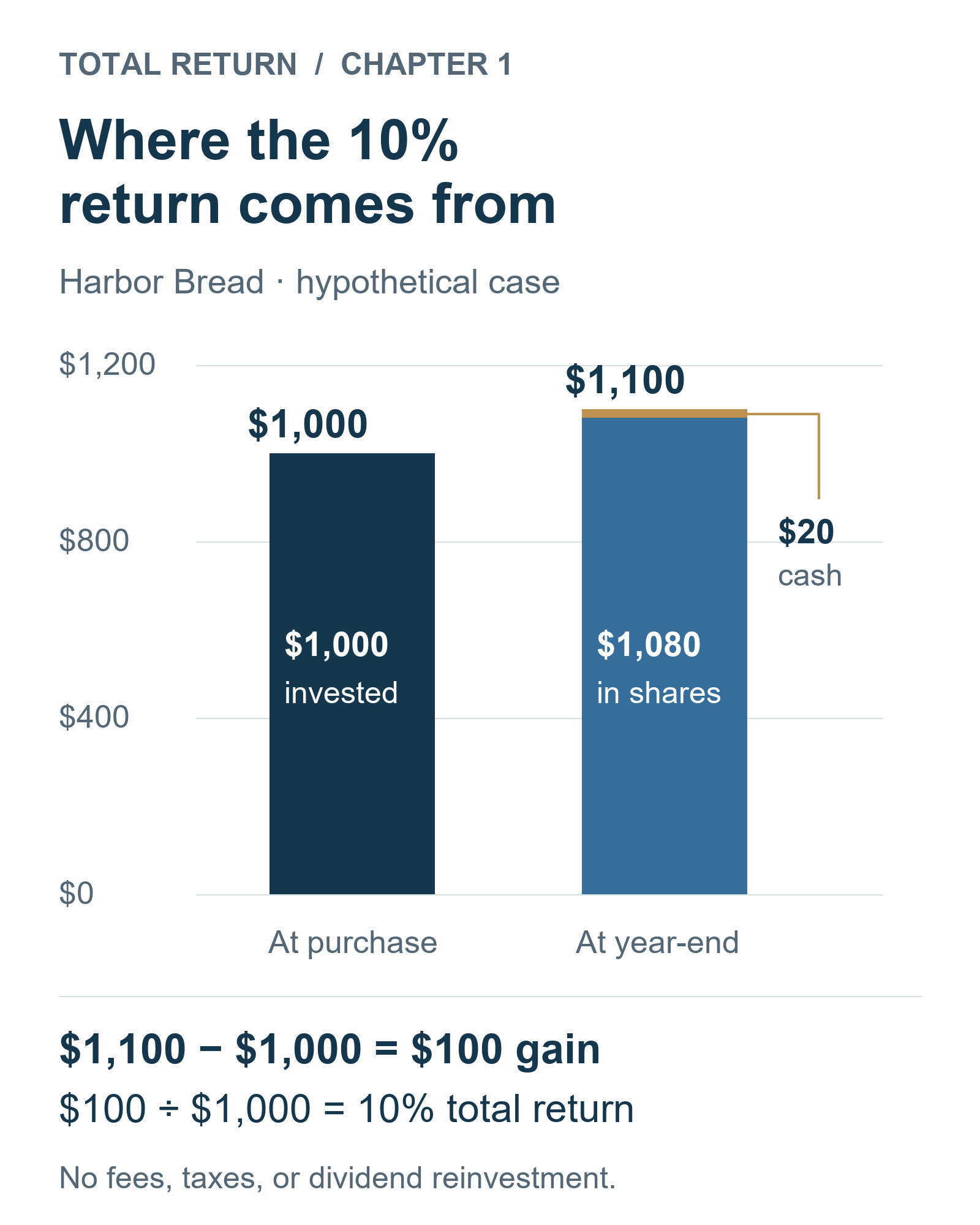
Harbor Bread pays a $2 dividend per share, distributing $250. Holding other factors constant, equity value then falls to $13,500, or $108 per share. Your 10 shares are worth $1,080, and you have received $20 in cash.
| Measure | At purchase | After issuance | After year-end dividend |
|---|---|---|---|
| Total equity value | $10,000 | $12,500 | $13,500 |
| Shares outstanding | 100 | 125 | 125 |
| Value per share | $100 | $100 | $108 |
| Shares you own | 10 | 10 | 10 |
| Your ownership | 10% | 8% | 8% |
| Your shares are worth | $1,000 | $1,000 | $1,080 |
| Dividend cash received | $0 | $0 | $20 |
Your ending wealth from this position is $1,080 + $20 = $1,100. Relative to the initial $1,000, the gain is $100 and the total return is 10%.
Total return = ($1,080 + $20 − $1,000) ÷ $1,000 = 10%
Notice how the results fit together. Your ownership fell from 10% to 8%, but your investment still earned a positive return. The new investors' $2,500 increased the company's funds without becoming a gain in your account. The dividend became cash you hold and was removed from the remaining equity value. Every amount belongs in the calculation once.
11 Understand compounding and recovery
Across several periods, returns compound because each period starts with the value left by the previous one. Assume $1,000 earns 10% in each of two years, with all returns retained in the investment and no deposits, withdrawals, fees, or taxes.
After year 1 = $1,000 × 1.10 = $1,100
After year 2 = $1,100 × 1.10 = $1,210
The two-year gain is 21%, not 20%. The second year's return applies to the first year's gain as well as to the original money. A constant 10% is an assumption used for the calculation.
Now consider a 20% gain followed by a 20% loss. The same $1,000 becomes $1,200 and then $960. The arithmetic average of the two returns is zero, yet the investment has lost 4%. Adding annual percentages does not reproduce the compounded result.
The different bases also explain recovery arithmetic. After losing 20%, a $100 holding is worth $80. It needs a $20 gain to return to $100, which is 25% of the new $80 base. After a 50% loss, a 100% gain is required to recover the original value.
These examples do not tell us what a stock will do next. They explain why evaluating an investment requires tracking the path of wealth and the losses along that path. The course later introduces drawdowns and the Sharpe ratio after establishing the return calculations those measures depend on.
12 Write a first research note
Choose a company whose product you can describe. Use its current annual filing, recent quarterly information, and share disclosures to assemble a one-page note. For many U.S. public companies, Form 10-K contains the annual business discussion and financial statements, while Form 10-Q provides quarterly information. A proxy statement can help explain voting arrangements and other governance matters.
Work through the following prompts in your own words. Record the date of each financial figure in your research notes so that a stale share count or an old earnings period does not slip into a current comparison.
-
Business: What does the company sell, who pays for it, and what are its main costs? Explain the revenue model in two or three sentences.
-
Ownership: Which share class are you examining? How many shares are outstanding, as of what date, and what might increase that number?
-
Financial obligations: What claims must the business support before common shareholders benefit? Identify the major obligations without trying to complete a full credit analysis yet.
-
Price and earnings: What is the current share price, what market capitalization does it imply, and which earnings period would you use for a P/E comparison? If earnings are negative or unusual, say so.
-
Expectations: What would the business need to achieve for the current price to make sense? Describe the important assumptions rather than simply writing “strong growth.”
-
Open questions: What have you not established? Name one development that would make your view more favorable and one that would make it less favorable.
It is acceptable to finish with unanswered questions. A useful note makes those gaps visible and identifies the next evidence needed. Being able to describe a company is progress; it does not establish that its stock is attractively priced.
13 Practice exercises
For Exercises A through G, ignore fees and taxes unless stated otherwise. Show the calculation as well as the answer.
A Ownership after an issuance
A company has 800 shares outstanding, and you own 40. It issues 200 shares to other investors. Calculate your ownership before and after issuance. Express the change in percentage points and as a percentage reduction. Does that calculation alone establish the change in your holding's dollar value?
B Comparing market capitalizations
Company North has 60 million shares trading at $8. Company South has 12 million shares trading at $30. Calculate each market capitalization. Which company has the lower equity market value? What additional information would you need before calling it less expensive relative to its business?
C Return with a dividend
You buy one share for $80 and sell it one year later for $86. You receive a $2 dividend during the year. Calculate price return, the dividend's contribution relative to the purchase price, and total return.
D Compounding
A $1,000 investment earns 25% in year 1 and loses 20% in year 2. Calculate the ending value and cumulative return. Explain why the arithmetic average annual return of 2.5% does not describe the investment's compounded growth.
E Earnings growth and the multiple
A stock has annual EPS of $4 and trades at a P/E of 25. One year later, EPS is $4.40 and the P/E is 20. No dividend is paid. Calculate both share prices, EPS growth, and the price return.
F A dividend transfer
A company has total equity value of $2,000 and 100 shares outstanding. It distributes $2 per share in cash. Holding other factors constant, calculate the remaining equity value, the value per share, and the combined value of one share plus the cash received.
G A split and an issuance
You own 12 of a company's 120 shares. First, it completes a two-for-one split. Next, it issues 60 additional shares to new investors. Calculate your shares and ownership after each event. Identify which event changes your ownership percentage.
H Return after fees
You buy two shares for $40 each and pay a total purchase fee of $2. Later, you sell both shares for $44 each and pay a total selling fee of $2. You have received $1 in dividends per share. Ignore taxes. Calculate your initial cash outlay, final cash received, and net return, rounded to two decimal places.
I Explain the complete case
Return to Harbor Bread in Section 10. Explain why the $2,500 raised from new investors is not part of your personal investment gain. Then show why using the pre-dividend $110 share value and adding the $2 dividend would overstate your final return.
14 Answers and reasoning
A Ownership after an issuance
Initially, 40 ÷ 800 = 5%. After issuance, 40 ÷ 1,000 = 4%. The reduction is 1 percentage point, or 20% of the original 5% ownership. The company receives proceeds from issuing shares, so the ownership calculation alone cannot establish a dollar gain or loss. You also need the issuance terms and the resulting equity value.
B Comparing market capitalizations
North's market capitalization is 60 million × $8 = $480 million. South's is 12 million × $30 = $360 million. South has the lower equity market value despite its higher share price. Assessing relative value still requires the businesses' earnings, cash generation, obligations, growth prospects, and risks. Neither a lower market capitalization nor a lower share price completes that analysis.
C Return with a dividend
The price gain is $6, so price return is $6 ÷ $80 = 7.5%. The $2 dividend contributes $2 ÷ $80 = 2.5 percentage points. Total return is ($86 − $80 + $2) ÷ $80 = 10%. Because the specified holding period is one year, this is also the return for that year under the stated assumptions.
D Compounding
The investment rises to $1,000 × 1.25 = $1,250, then falls to $1,250 × 0.80 = $1,000. Its cumulative return is zero. The 25% gain and 20% loss apply to different starting values. Their arithmetic average of 2.5% is a valid average of those two percentages, but it is not the compound annual growth rate. The compound annual growth rate here is 0% because wealth finishes where it started after two years.
E Earnings growth and the multiple
The initial share price is $4 × 25 = $100. The later price is $4.40 × 20 = $88. EPS increases 10%, but the price return is ($88 − $100) ÷ $100 = −12%. The multiple falls 20%, and the combined effect is 1.10 × 0.80 = 0.88. Adding 10% and −20% would miss the interaction between the two changes.
F A dividend transfer
The company distributes 100 × $2 = $200, leaving $1,800 of equity value. Each share is then worth $1,800 ÷ 100 = $18. One share plus the $2 received in cash is worth $20, the same as the original $2,000 ÷ 100. The transfer alone has not created additional wealth in this example.
G A split and an issuance
After the split, you own 24 of 240 shares, still 10%. After the issuance, you own 24 of 300 shares, or 8%. The split changes the number of units representing your interest. The issuance increases the denominator without increasing your share count, reducing your ownership by 2 percentage points. Its effect on value requires information about the proceeds and business value.
H Return after fees
Initial outlay is (2 × $40) + $2 = $82. Sale proceeds after the selling fee are (2 × $44) − $2 = $86. Dividends add 2 × $1 = $2, bringing final cash received to $88. Net gain is $88 − $82 = $6, and return is $6 ÷ $82 = 7.32% rounded. Include the purchase fee in the denominator and subtract the selling fee only once.
I Explain the complete case
The new investors pay $2,500 to the company in exchange for their own shares. You receive neither that cash nor additional shares. Immediately after issuance, your existing 10 shares remain worth $1,000 under the case assumptions.
At year-end, the $110 pre-dividend value includes the $2 per share that the company is about to distribute. Using $110 plus $2 would count that cash twice and imply an incorrect return of 12%. The consistent ending calculation is 10 × $108 + $20 = $1,100, which gives a 10% return on your $1,000 initial investment.
Related research

ResearchEquity Strategy
Risk, Time Horizon, and the First Research Rules
Before researching a stock, identify the job the money must do. A compelling business cannot make an inflexible payment deadline disappear. An investment can eventually recover and still fail the person who needs to sell before that recovery arrives.

ResearchEquity Strategy
Understand the Business Before Reading the Ticker
A stock screen can identify a company in seconds. Understanding why that company earns money takes longer. Before discussing a share price, explain what is sold, who pays for it, why the buyer chooses it, and what remains after the costs of delivering it.

ResearchEquity Strategy
Read Financial Statements as One Connected System
Financial statements describe the same business from different angles. The income statement measures performance over a period. The balance sheet records a position at a date. The cash flow statement explains changes in cash. The statement of equity explains changes in the owners' accounting interest. Reading them together is more powerful than memorizing ratios from each separately.