
ResearchEquity Strategy
Risk, Time Horizon, and the First Research Rules
Chapter 2 · Stock Research from First Principles
- Report or archive date
- Archive placement February 4, 2026
- Reading time
- 22 min read

Summary
Before researching a stock, identify the job the money must do. A compelling business cannot make an inflexible payment deadline disappear. An investment can eventually recover and still fail the person who needs to sell before that recovery arrives.
Before researching a stock, identify the job the money must do. A compelling business cannot make an inflexible payment deadline disappear. An investment can eventually recover and still fail the person who needs to sell before that recovery arrives.
When will you need the money? Which losses would put those plans at risk? Several holdings can share the same weakness. Answering these questions helps you decide which investments deserve further study. Amounts are in U.S. dollars.
1 A useful definition of risk starts with the consequence
Consider three different disappointments. A stock falls for a month while the business remains healthy. A business loses its competitive position and never restores its earning power. An investor must sell a sound business during a market decline to pay an unavoidable bill. These events involve different mechanisms, although all can produce a loss on an account statement.
Volatility describes variation in returns. It is measurable, useful, and incomplete. Permanent damage to a business, an inability to access money, and a forced sale are also important. A share with a temporarily stable price can conceal a weak balance sheet. A volatile share can represent a strong business purchased at an excessive valuation. Price behavior alone does not settle either question.
Separate the probability of an event from its consequence. A small chance of losing money needed for housing may matter more than a larger chance of a modest decline in a paper practice account. Probability estimates are often uncertain themselves. Writing a number beside a scenario does not make that number measured or reliable.
A practical risk statement has three parts: what could happen, how it would reach the investment, and why the resulting loss would matter. “The company is risky” is difficult to use. “Its largest buyer can cancel orders, fixed factory costs would remain, and debt comes due before the next major product launch” identifies a chain that can be investigated.
Trace the event to the payment
To practice the risk statement, imagine a manufacturer whose largest purchaser is postponing a factory. The first effect is a delayed order. The second may be unused production capacity. The third may be weaker operating cash flow while wages and rent continue. The fourth could be difficulty repaying a loan. The stock quotation might react before all four steps appear in financial statements because investors are reassessing the possibility of that chain.
Each link requires different evidence. A postponement announcement supports the first link. The supplier's cost structure informs the second. Its cash balance, collection terms, and borrowing arrangements inform the third and fourth. Do not move directly from an alarming headline to a precise loss estimate. Conversely, do not dismiss a threat simply because the most recent annual earnings remain positive.
Now add the investor. If the money is needed next quarter, an unfavorable quotation can create a funding problem even if the supplier eventually replaces the order. If the money is uncommitted, the key question may be whether the business can survive the delay without damaging shareholders. The same security can therefore create different practical consequences in two otherwise identical accounts.
This approach also helps distinguish evidence from emotion. “I dislike seeing red numbers” describes a reaction. “A decline would force the cancellation of a necessary payment” identifies a constraint. Both deserve attention, but they should not be recorded as the same fact.
2 Willingness to accept a loss and capacity to absorb it
Risk tolerance describes the discomfort someone is willing to experience. Risk capacity concerns the consequences they can financially withstand. These are related but different. Feeling comfortable with uncertainty does not create money for a payment due next month. Conversely, having financial flexibility does not guarantee that someone will stick with a plan during a decline.
There is also a third issue: the amount of risk a goal would require under a proposed plan. If the proposed return is implausibly high, increasing risk does not repair the plan. The target, contribution amount, deadline, or spending assumption may need reconsideration. A stock selection process cannot solve an arithmetic shortfall by confidence alone.
Imagine Elena has $12,000 reserved for a $12,000 tuition payment in eight months. Marcus has $12,000 earmarked for a flexible project that may begin in eight years. Neither amount includes their separate emergency reserves. The balances are identical; the consequences of a decline are not.
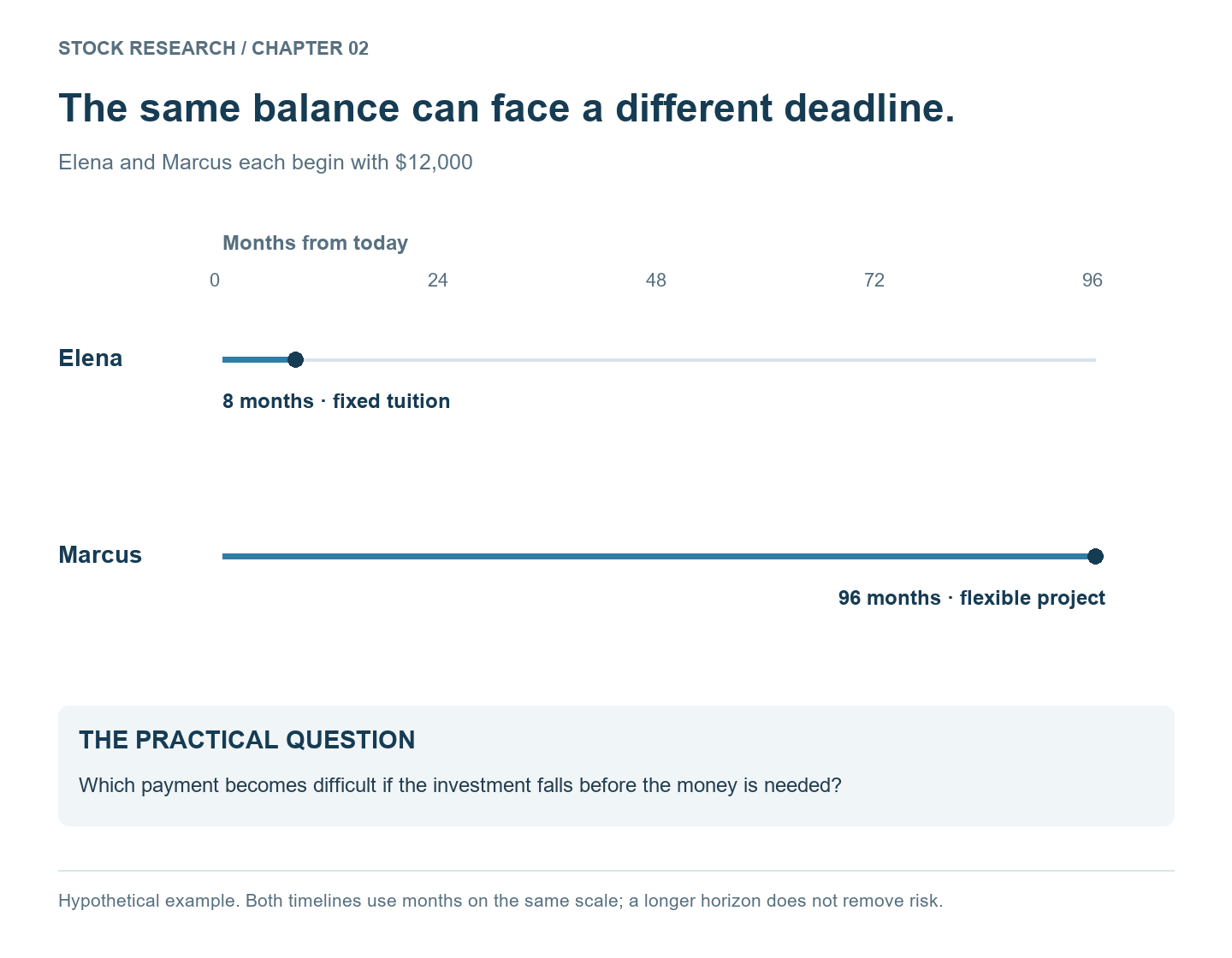
If either balance falls 25%, it becomes $9,000. Elena faces an immediate $3,000 funding gap if the payment remains fixed. Marcus may have time to make additional contributions, delay the project, or reassess the investment. None of those options ensures recovery, but they change the decision. A long horizon provides flexibility, not immunity.
The appropriate lesson is to match research and investment choices to constraints. It is not to assign every person with an eight-year horizon the same stock percentage. Income reliability, other obligations, existing holdings, and the flexibility of the goal also matter.
Test the plan without demanding a market rescue
Suppose a separate goal requires $18,000 in two years, the starting balance is $12,000, and planned contributions total $4,000 over those two years. Ignoring investment returns, the plan supplies $16,000 and leaves a $2,000 shortfall. That is a planning gap. It is not evidence that a volatile stock is the appropriate instrument to close it.
It would also be incorrect to divide the $2,000 gap by the eventual $16,000 and call the result the required two-year return. The additional $4,000 will not necessarily be invested for the entire period. Timing matters. A contribution on the final day has almost no time to earn a return before the payment. A detailed projection would place each contribution on its actual date and apply explicitly assumed returns from that date onward.
Before making that projection more complicated, identify the controllable choices. Can contributions increase? Is part of the expense optional? Can the deadline move? Those questions may produce a more dependable solution than selecting a stock because its optimistic scenario fills the gap. A return target is an output of a proposed plan, not a promise that markets offer a suitable opportunity.
Finally, test willingness using a specific dollar outcome. Ask what actions a fall from $12,000 to $9,000 would trigger. A person who says they can tolerate a 25% decline may answer differently when they connect the $3,000 loss to a concrete goal. That difference is useful information for the plan.
3 Turn a deadline into a cash-needs schedule
“Long term” is too vague for a useful plan. Write down the amount needed, the earliest date it may be required, and how much the date or amount can change. Separate a planned expense from an emergency reserve. Do not count the same dollars as available for two different commitments.
Suppose a household has $30,000 in financial assets. Of this, $8,000 covers a known payment in six months, $10,000 is a separately designated emergency reserve, and $12,000 has no scheduled use for several years. Calling all $30,000 “long-term money” would erase the first two jobs. The arithmetic leaves $12,000 after the two reservations, but that fact alone does not establish an appropriate stock allocation.
Next examine what could change. A job loss might increase cash needs at the same time that stocks fall. An employer's stock may be especially exposed to the same economic forces as the employee's salary. Money that appears uncommitted in a calm scenario may become essential in a difficult one.
Liquidity belongs in this schedule. Market liquidity is the ability to trade near prevailing prices without materially moving the market. Personal liquidity is the ability to meet payments. A stock may trade actively while being unsuitable for a fixed near-term obligation because its price can decline. The ability to sell and the ability to recover the amount needed are different promises.
Stress the income side of the household
Cash needs and investment losses can arrive together. Consider an employee with $40,000 of employer shares and $10,000 in a separate emergency reserve. If the shares decline 35%, their quoted value becomes $26,000. If a simultaneous interruption in employment requires $6,000 of reserve spending, only $4,000 of that reserve remains. The household has suffered a $14,000 investment loss and used $6,000 to meet expenses. The withdrawal is not an investment loss, but it reduces the remaining ability to wait.
This is why a risk review should include employment and major commitments, not only the securities account. A supplier, its employee, and its local property market may share an economic exposure even when the assets have different labels. The purpose is to identify overlap, not to pretend that every household relationship can be summarized by a reliable correlation coefficient.
Keep an orderly sequence in the worksheet: opening resources, investment changes, spending, and ending resources. Treating spending as a negative investment return makes the investments look worse than they performed. Ignoring spending makes the household appear more resilient than it is. Both mistakes can lead to an unsuitable conclusion.
Access restrictions also matter. A balance can exist on a statement while withdrawal conditions, settlement, or an account restriction prevent immediate use. Check the actual arrangement before counting an asset as money available for a deadline. An assumed ability to borrow should be recorded separately from cash already held.
4 Losses and recovery use different starting amounts
A percentage loss is measured against the balance before the decline. The gain needed to recover is measured against the smaller balance afterward. This explains why an equal percentage gain does not undo an equal percentage loss.
Start with $100. A 20% decline leaves $80. Returning to $100 requires a $20 gain on $80, or 25%. A subsequent 20% gain would produce only $96. Multiplying the growth factors gives the same result: 0.80 × 1.20 = 0.96.
Required recovery gain = Loss fraction ÷ (1 − Loss fraction)
| Loss from starting value | Remaining from $100 | Gain needed to recover |
|---|---|---|
| 10% | $90 | 11.11% |
| 20% | $80 | 25.00% |
| 30% | $70 | 42.86% |
| 40% | $60 | 66.67% |
| 50% | $50 | 100.00% |
These calculations assume no deposits, withdrawals, dividends, fees, or taxes. Additional contributions can rebuild an account balance, but that does not mean the original investment recovered. Keep investment performance separate from money added later.
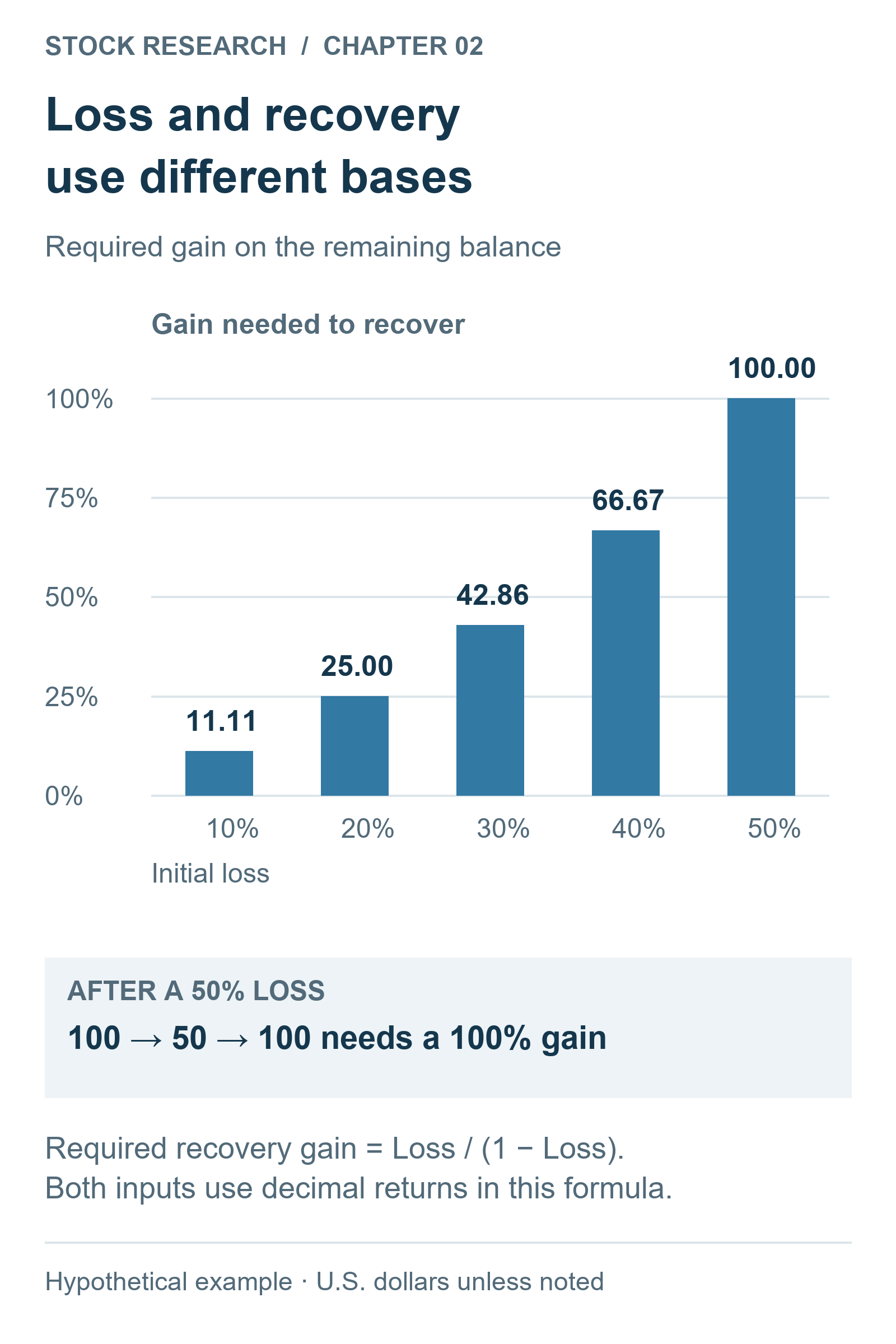
At a 100% loss, no finite percentage return on the remaining zero balance restores the original capital. This is one reason to distinguish a temporary quotation decline from a business failure. Time cannot compound money that no longer exists in the investment.
5 Build a scenario loss budget before a forecast
A loss budget is a way to describe consequences under stated assumptions. It is not a guarantee that a portfolio cannot lose more. Begin with the dollars exposed, then apply a decline. Avoid hiding the result behind a percentage that feels small.
Assume a $20,000 paper portfolio contains a $2,000 position in one company. That position has a 10% starting weight. If it falls 40% while every other holding stays unchanged, the position loses $800 and the portfolio loses 4%. The remaining portfolio value is $19,200.
Portfolio effect from one position = Starting weight × Position return
Here, 10% × −40% = −4%. The result changes if the other holdings also decline. If the remaining $18,000 falls 10%, it loses another $1,800. Total loss becomes $2,600, or 13% of the original portfolio. A single-position calculation is useful only when its treatment of the rest of the portfolio is explicit.
Now imagine that an exercise limits the modeled loss from one idea to $600 under an assumed 30% decline. Dividing $600 by 0.30 gives a $2,000 position. If the actual decline is 60%, however, the loss is $1,200. The assumed decline was an input, not a protective device.
A useful worksheet records the position amount, at least two decline scenarios, the combined effect of related holdings, and any cash that might be needed during the decline. There is no universal loss budget that belongs in every person's account.
Reverse the scenario to find the breaking point
Most scenario exercises start with a decline and calculate the loss. A reverse exercise starts with a consequence and asks what combination could produce it. This can reveal when a seemingly small position uses more financial flexibility than expected.
Take a $30,000 paper portfolio with $6,000 in one company and $24,000 in the remainder. Suppose a review threshold is a $4,500 portfolio loss. If the remainder loses 10%, it contributes $2,400 of that loss. The individual company needs to lose another $2,100 for the threshold to be reached. Relative to its $6,000 starting value, that is a 35% decline. The combined decline is 15% of the original portfolio.
This does not predict that either decline will happen. It shows that the portfolio reaches the stated threshold under a specific pair of assumptions. If the original note considered only a 35% company decline while treating everything else as unchanged, it would show a 7% portfolio loss and miss more than half of the combined scenario's effect.
A reverse scenario is especially helpful when several positions depend on one spending cycle. It makes the hidden “all other holdings unchanged” assumption visible. Keep it separate from a probability forecast and from a maximum possible loss. A more severe combination can exceed the threshold, and a lower quotation may coincide with an urgent withdrawal.
6 Count economic exposures, not just ticker symbols
Owning several stocks can reduce dependence on one company. It does not necessarily reduce dependence on one economic outcome. A chip designer, a semiconductor equipment supplier, a data-center developer, and a utility serving the same expansion cycle may all be affected by a slowdown in computing investment.
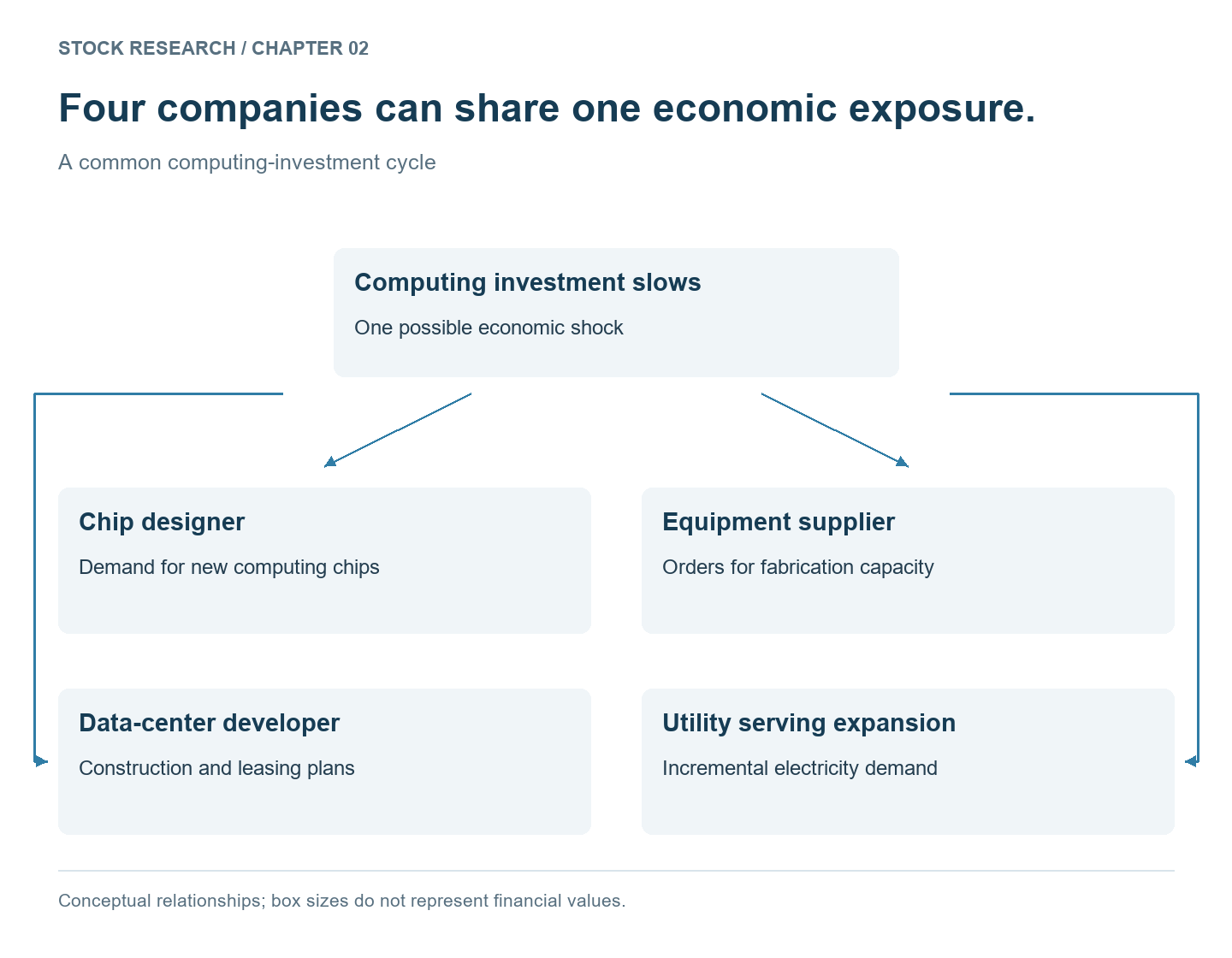
The businesses differ, and their responses will not be identical. Still, four ticker symbols do not automatically represent four independent sources of risk. Ask who ultimately pays, which spending budget funds the purchase, and what causes that budget to contract.
For a simple concentration exercise, a $10,000 paper portfolio contains $4,000 in Company A, $3,000 in Company B, $2,000 in Company C, and $1,000 in cash. A and B depend on the same industry. In a shock, A falls 30%, B falls 20%, C rises 5%, and cash earns zero during the measurement period.
The dollar changes are −$1,200, −$600, +$100, and $0. Together they produce a $1,700 loss, or 17%. The 70% combined exposure to A and B matters more than the number of company names on the screen. This scenario does not estimate the probability of such a shock; it illustrates its consequence.
Diversification also has limits. Broad market declines can affect many holdings together. Historical correlations can change, particularly under stress. Adding a security that behaves similarly to existing holdings may provide less protection than its different label suggests.
7 Separate business uncertainty from price uncertainty
A research note should identify what is unknown about the business and what is unknown about the price paid for it. A company might execute its plan well while the stock delivers a disappointing return because the purchase price already assumed even stronger results.
Suppose a business earns $2 per share and trades at $40, a price-to-earnings multiple of 20. Earnings later reach $2.20, but the market applies a multiple of 16. The resulting price is $35.20. Earnings rose 10%; the price fell 12%. No dividend is included in this example.
That outcome is not a contradiction. A share price reflects both the earnings associated with each share and the valuation placed on those earnings. Chapter 6 will examine that relationship more carefully. For now, write separate questions: what could damage operating results, and what expectations might already be embedded in the price?
Uncertainty can sometimes be reduced through research. Reading a debt maturity note can reveal when repayment is due. Uncertainty about future demand cannot be eliminated in the same way. Better research often changes the range of plausible outcomes rather than producing a single certain answer.
Write the evidence that would change your confidence
A strong research process separates three statements: what is observed, what is inferred, and what remains unknown. “The company's largest buyer represented one-third of revenue” is an observation if supported by an appropriate disclosure. “The buyer may have bargaining power” is an inference. “The next contract will be renewed at a lower price” is a forecast that requires additional assumptions.
Putting all three into a single confident sentence hides how much reasoning lies between the disclosure and the conclusion. Instead, ask which next fact would most reduce the uncertainty. A contract term, renewal decision, or customer concentration trend may be more useful than another general article about the industry.
Confidence should respond to evidence quality as well as the number of supporting observations. Five articles repeating one press release do not create five independent confirmations. A company presentation and a seller's promotion may share the same underlying assumption. When the supporting material is circular, a large folder can contain very little additional information.
Disconfirming evidence deserves a place in the notebook before the next result arrives. If a thesis depends on stable replacement demand, write down how you would recognize weakening orders. Do not define the test so narrowly that unfavorable information can never qualify. A useful thesis can survive scrutiny because its assumptions are reasonable, not because its wording makes it impossible to challenge.
8 A watchlist is a research queue
A watchlist contains ideas worth investigating. It need not contain securities ready to buy. Treating every interesting business as an immediate transaction encourages skipped steps and makes an expanding list of names feel like progress even when understanding remains shallow.
Give each candidate a short research question. For a factory equipment supplier, the question might be whether replacement demand can support revenue when new factory construction slows. For a software business, it might be whether renewals remain profitable after the cost of retaining users. The question determines which evidence should be collected next.
Use separate statuses such as not yet understood, awaiting evidence, sufficiently researched for a paper valuation, and rejected. A rejected idea is a useful output if the reason is clear. “I cannot establish how the reported growth turns into cash” is more informative than leaving the name indefinitely on a favored list.
Record the date and the information available then. Without that record, a later result can quietly rewrite the original reasoning. A good outcome does not prove that the original process was sound, and a bad outcome does not by itself identify which assumption failed.
9 Check identity and incentives before believing a pitch
Before evaluating a claim, verify the identity of the business and the security. Similar names, promotional websites, and screenshots of trading accounts are not substitutes for an official filing or a verified exchange listing. A familiar logo does not establish who operates the page displaying it.
Promises of guaranteed high returns, pressure to act immediately, requests to move a discussion into a private payment channel, and instructions to keep an opportunity secret are reasons to stop. An investment thesis should survive ordinary questions about financial statements, custody, costs, and the identity of the parties involved.
Check incentives as well as credentials. A writer may own the stock, receive promotional compensation, or benefit from trading activity. An executive may emphasize a measure that makes compensation targets easier to reach. An incentive does not automatically make a claim false, but it affects how independently the claim should be checked.
Never send funds merely to test whether an offer is legitimate. Separate the research task from the payment task. The first stock-selection skill is sometimes recognizing that the available information does not justify proceeding at all.
10 Write rules that can change a decision
A useful rule specifies an action when a condition is met. “Be careful” is not operational. “Do not complete a paper valuation until the most recent annual report and the debt maturity schedule have been read” is observable. It also makes missing work visible.
Create rules for information quality, portfolio exposure, and review timing. Information rules might require an explanation of how revenue becomes cash. Exposure rules might require a combined industry scenario before adding another related company. Review rules might identify the next earnings release or refinancing date as the next point for reassessment.
Avoid rules that pretend to control the market. A rule to sell after a fixed decline can still encounter an overnight price gap. A rule to buy only profitable companies can still admit weak accounting or an excessive valuation. Rules organize decisions; they do not remove the need to understand their failure modes.
Finally, decide what would invalidate the thesis before owning the stock. A deteriorating fact and a fluctuating price are different signals. If the thesis requires stable renewal rates, define what evidence of deterioration would trigger a review. Do not continually move that threshold after unfavorable information appears.
Distinguish a process failure from an unfavorable outcome
Imagine two paper research decisions. In the first, the researcher documents cash needs, reads the company filings, tests several coherent scenarios, and concludes that an unresolved debt maturity prevents further action. The stock subsequently rises. In the second, the researcher ignores the same maturity, copies an optimistic price target, and also observes a rising stock. The identical market outcome does not make the processes equivalent.
The first decision can be reasonable using the information available at the time. The second might still contain a serious omission despite its favorable result. If a review rewards only the direction of the next price move, it encourages hidden risks to accumulate until one eventually matters. Equally, calling every unfavorable outcome bad luck prevents learning from avoidable mistakes.
A useful review asks whether the necessary information was gathered, whether the calculations matched the inputs, and whether the decision respected the stated constraints. Then it asks what the new outcome teaches about the assumptions. Keep those questions separate. You can improve a process without pretending that an uncertain result should have been perfectly foreseeable.
Paper practice helps because a decision record can be written before any purchase. Record the quotation, the available information date, the unresolved question, and the next review trigger. Reading the note later is more instructive than reconstructing your memory after learning what the stock did.
11 Practice before looking at the answers
A. A $15,000 balance is needed for a fixed payment in five months. It falls 20%. Calculate the remaining balance and funding gap. Explain why the possibility of a later recovery does not resolve the immediate problem.
B. A $100 investment loses 30%. What percentage gain restores it to $100? What happens if it rises only 30% afterward?
C. A $25,000 paper portfolio has a $3,000 position that falls 35%. All other holdings are unchanged. Find the dollar loss and portfolio return. Then assume the other holdings fall 8% and recalculate.
D. A teaching loss budget is $500 under an assumed 25% decline. What position amount fits that scenario? What loss results if the position instead falls 70%?
E. Three companies sell different products to the same airline industry. Does holding all three necessarily provide broad diversification? Name two shared exposures worth investigating.
F. A stock has earnings per share of $3 and a multiple of 18. Earnings rise to $3.30 while the multiple falls to 15. Calculate the two prices and the price return, excluding dividends.
G. Rewrite this watchlist entry so it identifies research work: “Interesting company. Strong future. Buy after a dip.”
H. An online promoter offers a guaranteed monthly return and says audited statements will be available only after a deposit. What should happen before any valuation discussion?
12 Worked answers and reasoning
A. The loss is $15,000 × 20% = $3,000, leaving $12,000. The payment still requires $15,000, so the gap is $3,000. A recovery after the deadline cannot pay the bill on time. The relevant issue is the timing of access to the required amount, not simply whether the investment could someday recover.
B. The remaining amount is $70. The required gain is $30 ÷ $70 = 42.86%. A 30% gain instead produces $70 × 1.30 = $91. Both percentages are mathematically correct because they use different starting balances. Labeling those balances prevents the common mistake of canceling the two percentages.
C. The position loses $1,050, equal to 4.2% of the $25,000 portfolio. The other $22,000 then loses $1,760 under the second scenario. Combined loss is $2,810, or 11.24%. The first answer described an isolated shock. The second incorporated a broader decline; neither should be presented as the other.
D. The position amount is $500 ÷ 0.25 = $2,000. A 70% decline loses $1,400. The loss budget depended on the assumed decline and did not cap the actual outcome. An additional scenario is necessary when a larger loss would materially change the decision.
E. The holdings can share dependence on airline capital spending, passenger demand, fuel-related financial pressure, or access to aircraft financing. Different products can still draw on the same spending cycle. Research should map those relationships before describing the portfolio as broadly diversified.
F. Initial price is $3 × 18 = $54. Later price is $3.30 × 15 = $49.50. Price return is ($49.50 − $54) ÷ $54 = −8.33%. A 10% earnings increase did not offset the decline in the valuation multiple. The example demonstrates valuation risk without assuming that the business failed.
G. One workable revision is: “Determine whether replacement orders can cover fixed costs if new-project orders decline. Read segment disclosures, compare order conversion with cash collections, and build a downside operating case before considering valuation.” The revision names evidence and a decision sequence. A lower quotation alone would not answer the business question.
H. Stop the payment process. Verify identity, the security, and the legitimacy of the offer through independent channels. Guaranteed returns and payment before basic disclosure are reasons to question the offer itself. Calculating an attractive projected return would not address that problem.
Integrated exercise: two deadlines and one apparent surplus
Consider a separate household with $36,000 in financial assets. It owes $9,000 in four months and maintains a $12,000 emergency reserve. The remaining $15,000 is provisionally available for a flexible long-term goal. A proposed paper portfolio for that remainder holds $6,000 in one industry and $9,000 elsewhere. Model a 40% decline in the industry and a 15% decline elsewhere. At the same time, assume an unexpected expense consumes $3,000 of the emergency reserve. Calculate the investment loss, the remaining goal balance, and the remaining reserve. Decide whether the fixed payment is still fully funded.
The industry loses $2,400. The other holdings lose $1,350. Combined investment loss is $3,750, leaving $11,250 for the flexible goal, a 25% decline in that portfolio. The separate reserve falls from $12,000 to $9,000 because of spending. The $9,000 fixed-payment allocation remains intact under the assumptions. Total remaining financial assets are $29,250 before the scheduled payment: $9,000 plus $9,000 plus $11,250.
The calculation illustrates the value of assigning dollars distinct jobs. If the researcher had counted the entire $36,000 as stock-investment capital, the fixed payment and reserve would also have been exposed. If they had counted the reserve as part of the $15,000 long-term amount, the plan would have promised the same money twice.
The model has a boundary: it assumes no investment loss in the separately held payment and reserve amounts. It also excludes interest, taxes, and other cash flows. A real worksheet must identify the actual instruments and conditions supporting that assumption. The exercise establishes a way to organize constraints; it does not prescribe these dollar allocations for another household.
Decide what can change before choosing a security
An effective constraint review separates fixed commitments from adjustable preferences. The amount due on a known bill may be fixed, while the timing of a discretionary project may be flexible. The distinction should come from the actual obligation, not from a hope that an inconvenient payment can be postponed after markets decline.
Write a fallback action for each important constraint. If income stops, which spending changes first? If a goal's funding falls short, can contributions increase or the project shrink? If the answer is that nothing can change, acknowledge that limited flexibility before evaluating the potential upside of a stock. A compelling forecast does not create a fallback resource.
Then identify what research can and cannot resolve. Reading a company filing can clarify a maturity date or ownership right. It cannot guarantee a future selling price on the day a household needs cash. This boundary helps avoid spending hours refining a company forecast when the central problem is an inflexible funding requirement. The first research decision is whether the proposed investment question fits the money's purpose.
13 Your research notebook
Write a one-page entry with five headings: the money's purpose, the earliest possible withdrawal date, the consequences of a significant loss, existing economic exposures, and the evidence needed before an idea advances. Use dollars alongside percentages. State which assumptions are known and which are guesses.
For a practice company, finish with one sentence beginning “I would need to reconsider this idea if...” The sentence should identify a change in evidence rather than a desire to avoid regret. In the next chapter, you will build the business explanation that makes such a sentence meaningful.
Related research

ResearchEquity Strategy
Ownership Before Stock Picking
Understand business ownership, share count, total return, dividends, and compounding before selecting individual stocks.

ResearchEquity Strategy
Understand the Business Before Reading the Ticker
A stock screen can identify a company in seconds. Understanding why that company earns money takes longer. Before discussing a share price, explain what is sold, who pays for it, why the buyer chooses it, and what remains after the costs of delivering it.

ResearchEquity Strategy
Read Financial Statements as One Connected System
Financial statements describe the same business from different angles. The income statement measures performance over a period. The balance sheet records a position at a date. The cash flow statement explains changes in cash. The statement of equity explains changes in the owners' accounting interest. Reading them together is more powerful than memorizing ratios from each separately.