
ResearchCross-Asset Allocation
Start a Portfolio With a Time Horizon
- Report or archive date
- Archive placement January 8, 2026
- Reading time
- 13 min read

Summary
A portfolio does not have one clock. Its obligations, reserves, and long-term ambitions can come due at different times. Separating those clocks helps explain which losses can be endured, which payments cannot wait, and why an attractive expected return may still be unsuitable for a particular job.
Begin with the date on the invoice
Imagine a small organization preparing to restore a historic workshop. It has money available for an equipment payment, a reserve for unexpected repairs, and capital intended to support educational programs over the next decade. All three amounts appear in the same account. Economically, they serve different purposes.
The equipment supplier expects payment on a specified date. The repair reserve may be needed without much notice. The educational capital can remain invested longer, although its eventual purchasing power matters. A single account balance conceals those differences. A single description such as balanced or growth-oriented does little to resolve them.
The first allocation decision is therefore not a choice between a stock fund and a bond fund. It is a decision about which money must accomplish which task, by when, and with what room for disappointment. Investments can then be evaluated against those tasks instead of against a general preference for higher returns.
This approach does not produce a universal set of portfolio percentages. It produces a map of constraints. The same investment can be reasonable for one part of the map and poorly matched to another. Time matters because spending cannot always be postponed until markets recover.
Distinguish the first payment from the final objective
A goal described as ten years away may include payments much sooner. A construction project can require a deposit now, equipment purchases later, and continuing operating support after completion. An education program can begin next year and continue for a decade. The final date does not describe the entire financing need.
Write a schedule of expected outflows rather than assigning the whole goal to its last year. Identify which dates are contractual, which are estimates, and which can move. A payment that can be deferred six months has a different risk profile from a payment that would trigger a serious operational problem if missed.
Inflows also belong on the schedule, but their reliability matters. A signed commitment, a forecast of future donations, and hoped-for investment gains are not interchangeable. A plan that assumes uncertain inflows will arrive precisely when risky assets fall may depend on several favorable outcomes at once.
The schedule should preserve uncertainty instead of hiding it in a single total. A range of repair expenses and a fixed equipment invoice deserve different treatment. Their amounts may be similar, yet their timing and consequences create different demands on the portfolio.
Give the reserve its own explanation
An emergency reserve has an uncertain withdrawal date, which does not make it long-term capital. Its purpose is availability when an adverse event occurs. The possibility that it will remain untouched for years does not remove the possibility that it will be needed tomorrow.
The relevant questions include how quickly it can be accessed, whether its value could decline before access, and whether the same event could affect other resources. A reserve for a business interruption is less dependable if it is invested in assets likely to suffer during that same interruption.
It is useful to distinguish predictable spending from contingencies. Predictable spending has a known or estimated payment schedule. Contingencies require a judgment about plausible needs and alternative funding. Combining them without explanation can either overstate the amount genuinely available for investment or leave idle resources without a clear purpose.
No single reserve multiple works for every situation. The strength of other cash flows, the flexibility of expenses, and the consequences of a funding delay all matter. The analytical task is to explain the reserve's job and the assumptions behind its size, not to give an arbitrary cash percentage the appearance of precision.
Willingness and ability to take risk can disagree
Willingness concerns the experience of uncertainty: how an investor responds to price declines, disappointing results, and the temptation to change plans. Ability concerns whether a loss would prevent essential payments or materially damage the objective. These dimensions can point in different directions.
Someone may feel comfortable with volatile investments while depending on the money for an imminent obligation. Confidence does not make the obligation flexible. Conversely, a well-funded long-term pool may have substantial capacity to bear fluctuations while its decision makers remain uncomfortable with them.
Neither dimension should simply override the other. A portfolio that is financially tolerable but behaviorally impossible to maintain may be abandoned at an unfavorable moment. A portfolio that feels exciting but cannot support its required payments may fail even if its long-run investment thesis eventually proves correct.
The useful discussion is concrete. Describe a loss in dollars, its timing, the resulting funding gap, and the decisions it would force. A statement that a portfolio could fall substantially is less informative than an explanation of which project would have to shrink, which payment would require outside funding, or which objective could be delayed.
A numerical comparison makes the tradeoff visible
Consider a pool of $250,000. It has a $60,000 payment due at the end of a nine-month planning period and a separate $30,000 contingency reserve. The remaining $160,000 supports a longer-term objective. These amounts illustrate a framework, not an allocation recommendation.
Suppose one approach exposes the entire $250,000 to a risky investment. A second approach keeps the $90,000 assigned to the payment and reserve stable in nominal value for this simplified period, while exposing $160,000 to the same risky investment. Ignore interest, taxes, fees, and any withdrawals before the scheduled payment.
If the risky investment loses 20%, the first approach falls to $200,000 before the payment and $140,000 afterward. Under the second approach, the risky portion falls to $128,000. Adding the unchanged $90,000 produces $218,000 before the payment and $158,000 afterward.
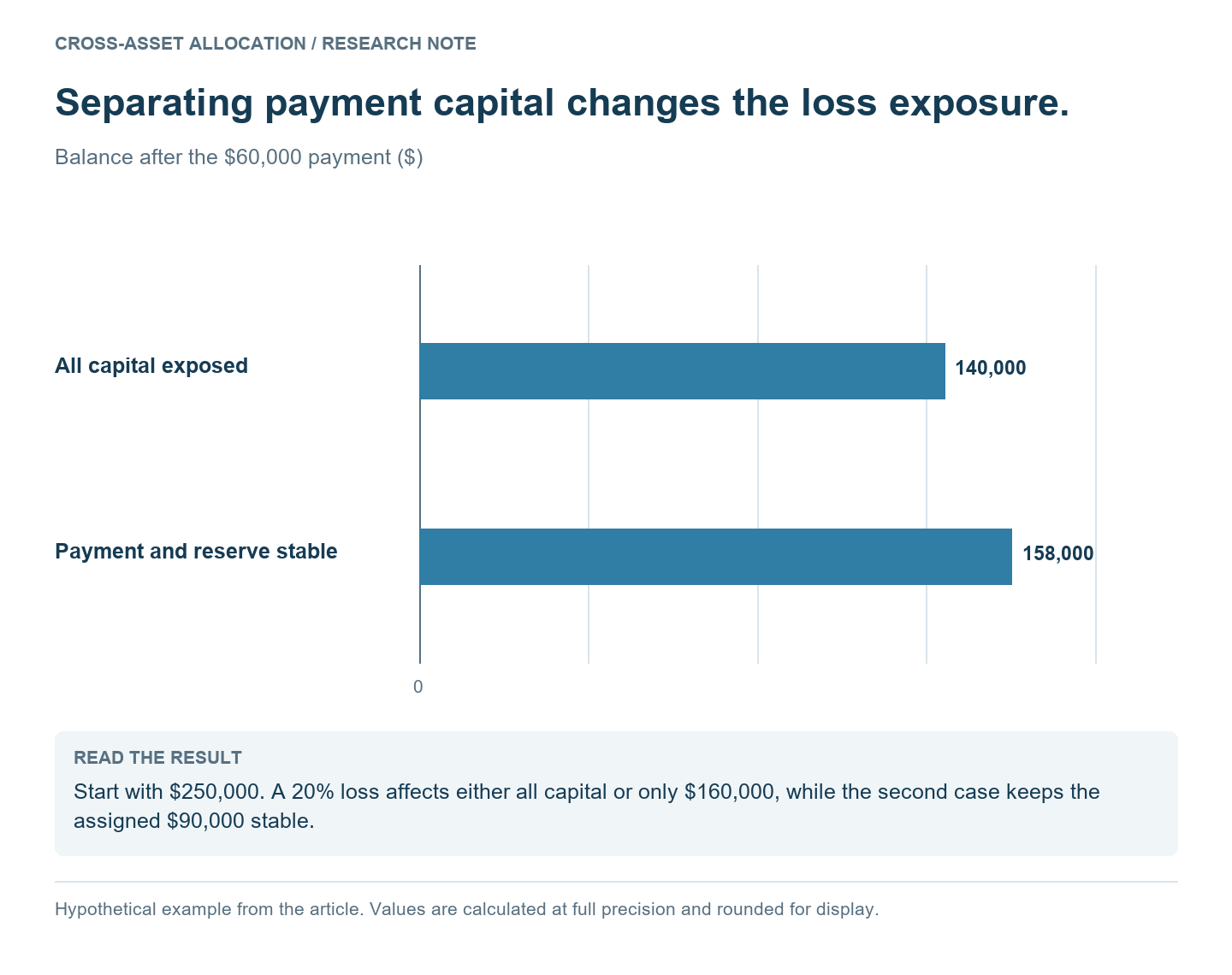
The second approach has $18,000 more after the payment in this scenario because less capital experienced the loss. Its remaining balance consists of the $30,000 reserve and $128,000 of longer-term capital. Separating the purposes made the exposure difference explicit; the account labels themselves did not create protection.
Now change the risky return to positive 20%. The first approach reaches $300,000 before payment and $240,000 afterward. The second reaches $282,000 before payment and $222,000 afterward. It now trails by $18,000. Maintaining payment capacity involved an opportunity cost when the risky investment performed well.
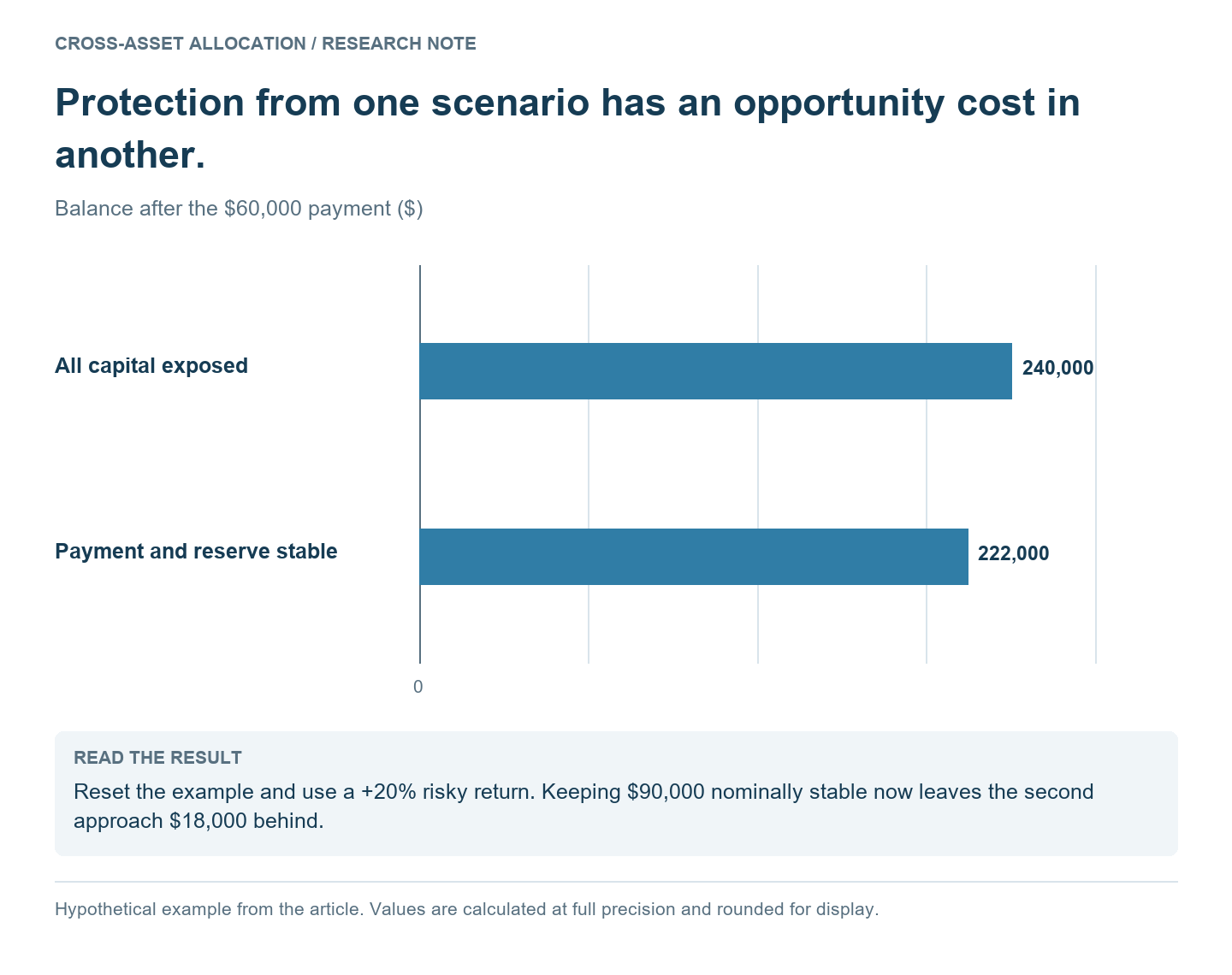
Those paired scenarios prevent a misleading presentation. A reserve is not a device that improves every outcome. It can reduce dependence on favorable market conditions when spending arrives, while limiting participation in favorable returns. Its value must be judged against the purpose it serves.
An investment's maturity is not its entire risk profile
A payment date can guide the search for investments with compatible cash-flow dates. However, a security's stated maturity does not by itself establish that the required amount will arrive. Credit quality, contractual terms, currency, and the possibility of needing to sell early remain important.
A long-maturity bond may have a dependable contractual payment in its own terms while its market price fluctuates substantially before that date. A bond fund generally does not promise to return a particular investor's original purchase amount on that investor's preferred spending date. The holdings and portfolio policy need to be understood.
Cash-like instruments also differ. A deposit, a money market fund, and a short-term debt security are not identical claims. Access arrangements, protections, liquidity provisions, and potential value changes depend on the instrument. A familiar account label should not substitute for reading the relevant terms.
For a simplified present-value example, a certain $40,000 payment due in exactly one year would require approximately $38,461.54 today if an instrument could deliver a certain 4% return over that same year, with no costs or taxes. The calculation is $40,000 divided by 1.04. The certainty is an assumption of the example, not a property assigned to every short-term investment.
Long horizons change the problem without eliminating loss
Longer-term capital has more time before a planned withdrawal, which can provide flexibility through periods of market weakness. It may also have more opportunity to benefit from reinvested income and business growth. Neither feature guarantees a favorable result or a particular recovery date.
An investment can suffer permanent impairment, not merely temporary volatility. A business can lose its competitive position; an issuer can fail to meet obligations; an asset can be purchased at a valuation that leaves little room for disappointment. Waiting does not automatically repair those problems.
The long-term question also includes purchasing power. A nominal balance that remains unchanged for many years may finance less activity later if the relevant costs rise. Avoiding visible price fluctuations can therefore leave the objective exposed to a quieter form of shortfall.
The correct comparison is among different risks relative to the objective. Market risk, inflation risk, reinvestment risk, and the risk of insufficient growth do not disappear when one of them is reduced. A long horizon permits a different balance among them; it does not authorize ignoring the others.
Translate future objectives into their economic units
Some objectives are fixed nominal amounts. Others are quantities of goods or services: a year of instruction, replacement equipment, building maintenance, or a specified level of ongoing support. Those objectives can become more expensive even when their physical scope stays unchanged.
Use the cost that actually matters. An organization's payroll, utilities, and specialist equipment may not rise at the same rate as a broad consumer price index. The index can provide context, but the spending plan should identify which costs dominate and how uncertain their future prices are.
A program costing $100,000 today would cost about $128,008 in ten years if its cost rose exactly 2.5% annually. That is a compounded planning assumption. If the cost path differs, the required future amount changes as well.
This distinction prevents a common misunderstanding. A portfolio's nominal gain is not the same as progress toward an objective. Progress depends on both the portfolio's value and the cost of what it must finance. A performance report that shows only investment growth can miss a widening funding gap.
Check whether outside income disappears at the wrong time
The portfolio's time horizon cannot be assessed entirely inside the investment account. Other sources of cash can extend the period before assets must be sold. They can also be less reliable than expected precisely when markets are weak.
For a manufacturer, a downturn could reduce orders, weaken operating cash flow, and lower the value of investments exposed to the same industry. Treating projected business income as a dependable reserve would understate the combined problem. The funding plan needs a scenario in which those resources deteriorate together.
For a grant-supported organization, renewal dates and funding concentration may matter more than the apparent regularity of past receipts. Several grants tied to one sponsor or economic condition may offer less independence than the number of grant agreements suggests.
This is not an argument for assigning a precise market value to every future receipt. It is an argument for testing dependence. Ask which inflows are secure, which can vary, and whether adverse investment outcomes would coincide with a need to draw more heavily on the portfolio.
A horizon can shorten unexpectedly
An objective can move forward because of an opportunity, an emergency, or a change in circumstances. An initially flexible project may become contractual after a purchase agreement is signed. The portfolio should be reviewed when the obligation changes, not only when markets move.
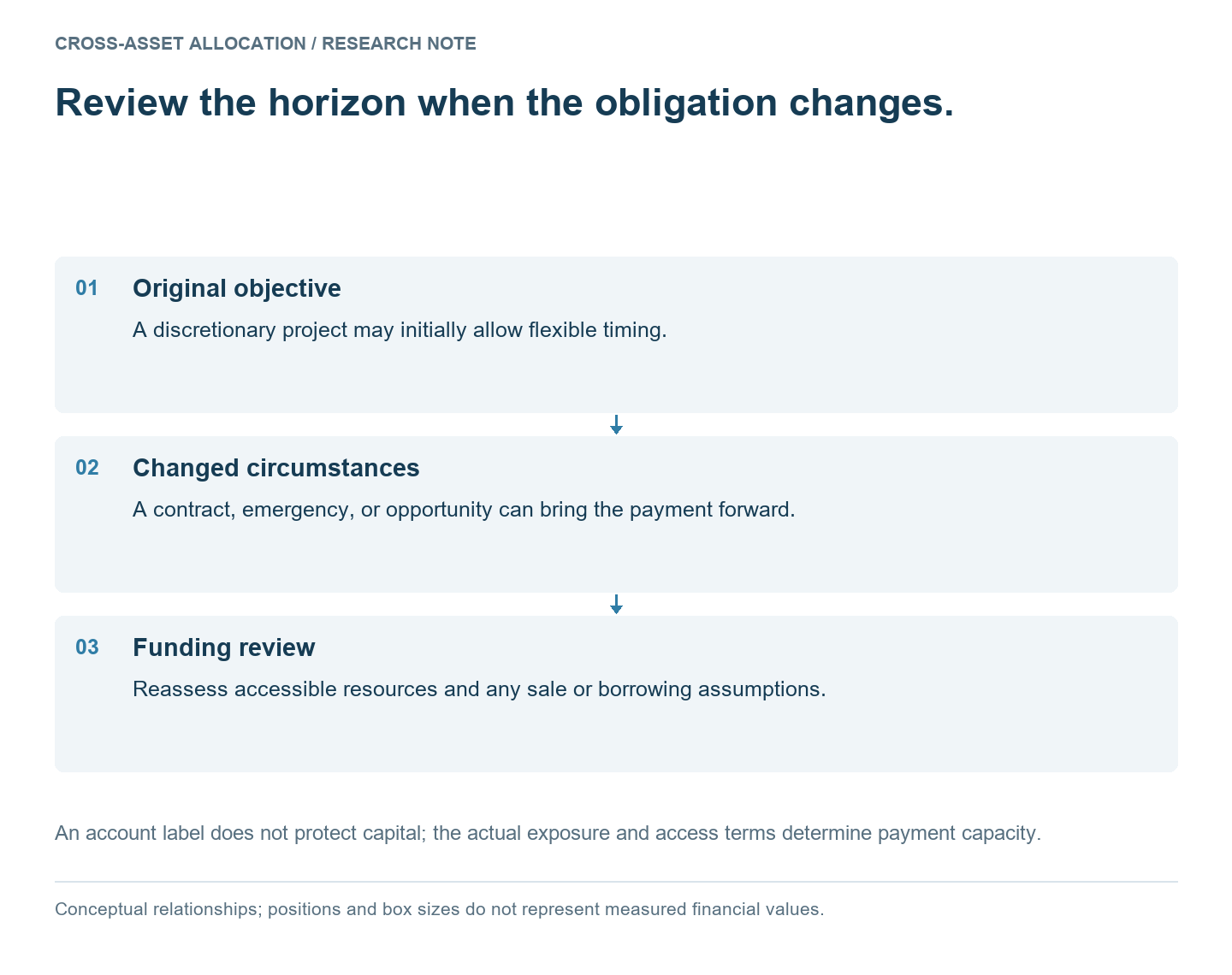
The review should identify the newly committed amount and date, then consider whether the existing assets still match them. Assuming that a long-term allocation remains suitable after the spending schedule changes confuses the original plan with the current obligation.
The reverse can also occur. A canceled project or delayed expenditure may release capital for a different purpose. That change does not automatically require buying riskier assets, but it should prompt a fresh assessment of the money's job rather than leaving an obsolete reserve unexplained.
Useful review triggers are therefore linked to decisions: a signed contract, a material change in income reliability, a revised budget, or a new restriction on withdrawals. These triggers are easier to defend than reallocating whenever a headline makes the near future feel unusually certain.
Examine the proposed escape route
A plan sometimes accepts a mismatch because it assumes an alternative source of funding will be available. The organization might expect to borrow temporarily, sell a property, or accelerate fundraising if the portfolio is down when a payment arrives. Those options deserve the same scrutiny as the investments themselves.
Borrowing capacity can depend on collateral values, operating income, covenants, and lender decisions. A credit line that looks adequate in normal conditions may be less useful when several of those conditions deteriorate together. Interest expense also changes the eventual cost of the project. Treating borrowing as free, certain backup financing can make an otherwise fragile plan appear well funded.
Selling property involves another clock. Finding a buyer, negotiating terms, and completing a transaction may take longer than the payment deadline allows. A quoted value is not a guaranteed amount of immediately available cash. A discounted sale could solve the timing problem while creating a different economic loss.
The funding memorandum should distinguish committed alternatives from possibilities that still require someone else's agreement. An uncommitted fallback is worth considering in a scenario, but it should not silently become the base-case source of payment. If the primary plan works only when the fallback works, the fallback is part of the primary plan and needs to be evaluated accordingly.
Use a payment ladder without confusing it with a guarantee
For a series of scheduled obligations, matching different assets to different payment dates can make the financing structure easier to inspect. Rather than treating the entire project as one distant withdrawal, the organization can map which receipts are intended to support each stage.
The map should include the timing of interest and principal, any reinvestment required between receipt and payment, and the currency in which the obligation must be settled. Receiving money too early creates a reinvestment decision; receiving it too late creates a funding gap. A close match reduces one uncertainty without necessarily removing credit or liquidity risk.
It should also show what happens if a milestone moves. A contractor's delay might postpone a payment, while a change in delivery terms might bring it forward. The investment structure should be reviewed against the revised schedule rather than defended simply because it matched the original one.
This exercise is valuable even before any instrument is selected. It reveals whether the proposed portfolio is solving a return problem, a timing problem, or both. That distinction often explains why an investment with a lower expected return can still be the more effective tool for a particular commitment.
Avoid making every account a separate portfolio
Separating purposes is an analytical exercise; it need not require a separate investment account for every goal. Several accounts can serve one objective, and one account can contain resources assigned to several objectives. The economic allocation should be visible across the whole arrangement.
Otherwise, duplication can creep in. An organization may count the same cash balance as both a project payment reserve and an emergency reserve. It may also hold several funds that each look diversified while collectively concentrating exposure to the same market drivers.
Record the assignment of capital without pretending that accounting labels change the underlying assets. If the designated reserve is invested in a volatile security, the reserve remains volatile. If a payment depends on selling a restricted or illiquid investment, the designation does not make the sale easier.
The practical aim is a reconciliation: total resources should equal the amounts assigned to obligations, contingencies, and longer-term uses, allowing for any resources intentionally left unassigned. That reconciliation makes double counting visible before an adverse event exposes it.
Measure success on the appropriate clock
Money reserved for a near-term payment should not be judged solely against a rising stock index. Its task is to support the payment under the stated constraints. Conversely, a long-term growth pool should not be judged only by whether its balance avoided fluctuations during a single quiet month.
This does not excuse poor implementation or unnecessary cost. Each component still needs a relevant comparison and a review of whether it is performing its intended role. The comparison should reflect the mandate rather than whichever asset class recently produced the highest return.
For the workshop, a useful review would ask whether the equipment payment remained funded, whether the repair reserve was accessible, and whether the longer-term capital remained on a plausible path toward its educational objective. These are related questions, but they are not the same question.
The combined portfolio also needs attention. A collection of individually reasonable components can still be too costly, too concentrated, or insufficiently funded in total. Purpose-based analysis improves the questions asked; it does not exempt the whole arrangement from evaluation.
Write the funding decision before choosing the product
A short funding memorandum can state the obligation, date, flexibility, intended source of payment, and consequence of a shortfall. It can then explain which risks the assigned capital may bear and which changes would require a review. Products enter the discussion after those decisions are visible.
The memorandum should distinguish a desired return from a required outcome. An ambitious growth target is not made more achievable simply by calling it necessary. If reasonable scenarios reveal a funding gap, the available responses may include changing contributions, reducing scope, extending time, or reconsidering the objective itself.
That is why the date on the invoice matters. It connects investment choices to consequences outside the portfolio statement. A well-designed allocation gives each commitment a credible funding path and makes the remaining uncertainty explicit, rather than hoping that one attractive return forecast can satisfy every clock at once.
Related research

ResearchCross-Asset Allocation
Dollar Weights and Risk Weights Are Not the Same
Dividing capital evenly does not necessarily divide portfolio risk evenly. A two-asset calculation shows how volatility and covariance determine each holding's contribution to overall fluctuations, why a small allocation can matter disproportionately, and where this measurement stops being useful.

ResearchCross-Asset Allocation
Correlation Is Conditional, Not Permanent
An asset's diversification role depends on what is driving returns, how the exposure is measured, and which conditions the portfolio must survive. Three market scenarios show why a historical correlation is an input to judgment rather than a permanent description of the relationship between investments.

ResearchCross-Asset Allocation
Cash Can Be an Asset With a Specific Job
Cash is often discussed as either an idle balance or a prediction that markets will fall. A more useful assessment separates operating liquidity, planned spending, and optional investment capital. Each purpose has different requirements, opportunity costs, and reasons for changing the balance.