
Weekly Research
September Payroll Growth Is Modest in the Initial Release
- Report or archive date
- Coverage September 28–October 4, 2026
- Reading time
- 10 min read

Summary
September 28–October 4: the labor observation adds a new constraint to the policy discussion.
A business deciding whether to buy a second service van needs to know how much work has already been booked, who can perform it, and whether buyers will still pay by the time the van arrives. The national jobs report answers a different set of questions. It counts payroll employment, surveys households, records hours and earnings, and revises prior estimates as more information comes in. In the week ending October 4 the new evidence pointed to modest September hiring after a stronger August. That shift matters, but it cannot by itself tell a business whether demand has weakened, available labor has become scarce, or an investment has improved productivity enough to reduce the need for additional staff.
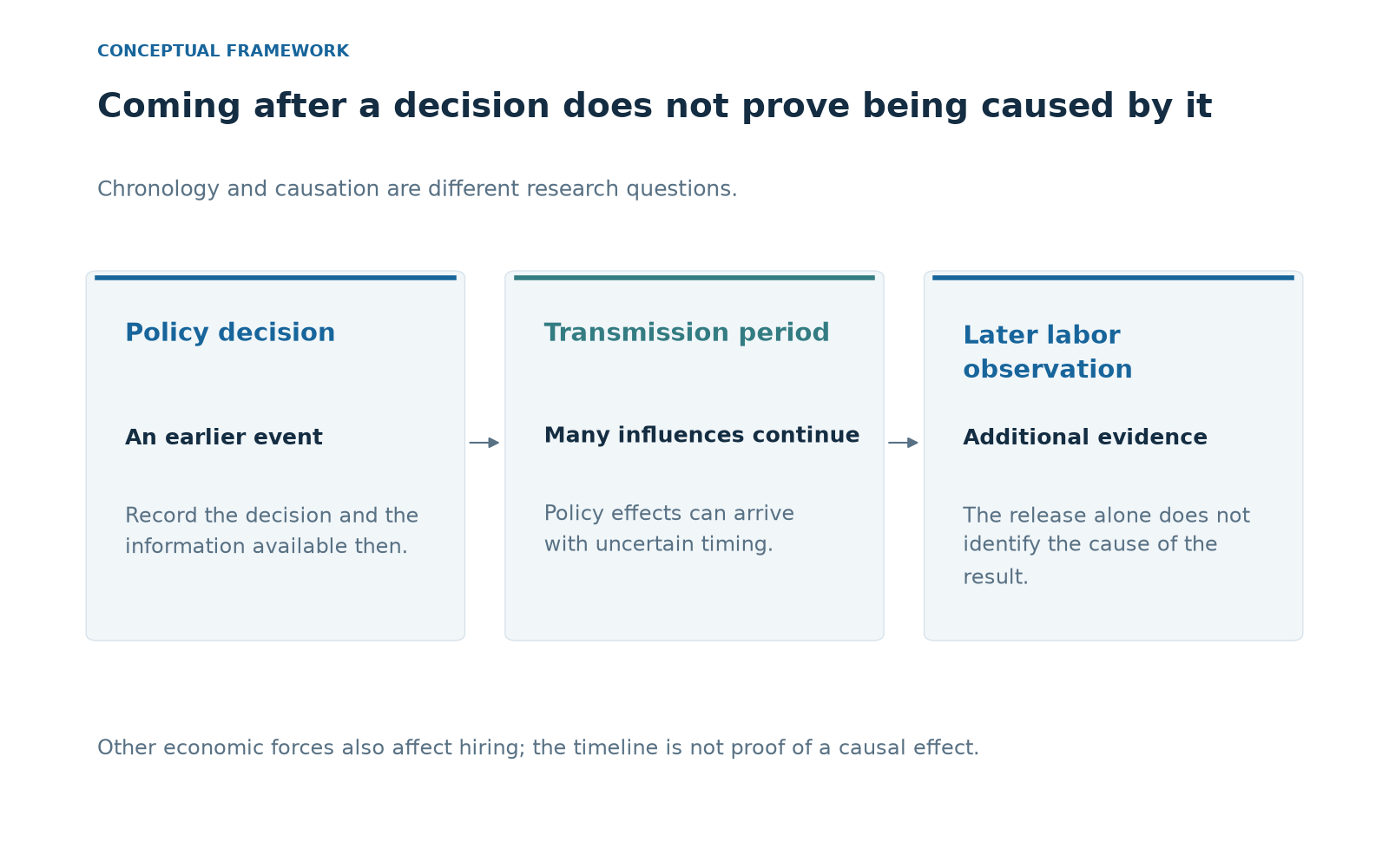
The October 2 release put September's initial nonfarm payroll gain at 29,000 and the unemployment rate at 4.2 percent. Major industries generally showed little monthly change. The prior twelve months had averaged gains of 45,000. July and August were revised down by a combined 60,000. The Federal Reserve had just raised its target range to 3.75–4.00 percent in September. Importantly, the employment survey reference period is not a clean post-meeting experiment. The release date followed the policy decision, but that is insufficient to attribute the hiring result to the increase. Financing, hiring plans, and actual employee start dates have different lags.
Three vintages of July
July payrolls were first reported down 23,000. The following release revised July to a gain of 21,000. The latest report revised it to a decline of 10,000. Thus a month that changed sign twice ended with an estimate only 13,000 above its initial reading, while the intermediate estimate would have suggested a more favorable outcome. This is a particularly clear reason to distinguish what the data currently say from what an analyst could have known when writing a prior issue. A chart built from current history can be perfectly valid for describing the present estimate and misleading for judging past decisions.
August was reduced from an initial 162,000 gain to 133,000. July, August, and September in the latest release therefore sum to 152,000 jobs, an average around 50,700 per month. That picture is less dramatic than extending August's initial increase indefinitely, but more constructive than extrapolating July's negative reading. Just as importantly, subtracting September's 29,000 gain from the prior 60,000 downward revision does not mean the country lost 31,000 jobs in September. The new estimate for September is positive, while the previously reported level of growth through August was revised lower. A summary of news can be negative relative to prior expectations even when the current monthly change is positive.
A three-month average can smooth noise and still conceal a change of direction within the period. A twelve-month average adds context but includes conditions that may no longer hold. A better interpretation uses both, then checks whether the details point in the same direction. In this release the aggregate workweek was stable, average hourly earnings rose slightly, and most industries did not report large changes. Those details do not support describing the number as a broad employment collapse. Neither do they justify an assertion that hiring had accelerated across the economy. The modest language is supported by the distribution of the data.
The shift within health care
Health care continued its upward trend with 17,000 more jobs, below the average 33,000 monthly gain over the previous twelve months. Ambulatory services trended up 13,000 and hospitals 12,000, while nursing and residential care facilities lost 9,000. Those three movements sum to about 16,000, with the small remainder attributable to other categories and rounding. An investor who adds the subsectors and then adds the headline health-care gain again would count some jobs twice. More substantively, rising total employment can coexist with contraction at certain kinds of facilities. The location of activity matters to suppliers and to workers with specialized skills.

Consider a business servicing diagnostic equipment at hospitals and outpatient centers. Its revenue depends on installed equipment, maintenance schedules, utilization, and the buyers' ability to pay for additional coverage. More outpatient employment could coincide with higher test volumes and increased service calls. It could instead reflect staffing a new facility before patient activity has begun, or a shift of services away from a hospital with an existing maintenance contract. A national subsector payroll gain gives the company a lead to investigate. It does not state how many machines are in use, when warranties expire, or whether new work will be contracted to an outside service provider.
Suppose the service company has ten technicians who each provide thirty billable hours weekly after travel, training, and administration. At a realized $120 per billable hour, weekly revenue is $36,000 from 300 billable hours. A 5 percent increase in service calls adds fifteen hours if each call has the same average duration. The firm could meet that demand by increasing billable hours per technician from thirty to 31.5, before adding a job. Conversely, hiring a new technician who spends the first month in training adds payroll without immediately increasing billable work. Hiring and output can move on different timetables even in a growing service market.
How a staffing decision reaches cash
Assume the extra fifteen billable hours generate $1,800 of revenue each week. Added parts and travel cost $450 and overtime or other incremental labor costs $750, leaving $600 before fixed expenses. If the company instead hires a full-time specialist with a weekly total cost of $1,600 and uses the same $450 of parts and travel to meet just those fifteen hours, the immediate contribution is negative $250. A new hire may still be sensible if another recurring contract is likely, overtime is unsustainable, or the firm must guarantee a response time it cannot meet with current staff. The decision turns on the expected duration and timing of demand, not on whether the latest aggregate jobs number is positive.
The van decision adds a capital constraint. A second vehicle costing $60,000 does not consume its full economic value the moment it is bought, but it does require cash or financing. The first month's service revenue may be invoiced in arrears and collected sixty days later. Parts may need to be stocked immediately, and the employee is paid before collection. The business can therefore face weaker cash as its order book improves. A lender can evaluate that exposure by reviewing signed service agreements, cancellation terms, the remaining warranty period of equipment, recent collection days, and the resale value of the van. The contract dates show whether the first repair will generate cash before the first vehicle payment falls due.
The installed-base calculation is particularly helpful here. Suppose 200 machines are under consideration for full-service maintenance, but 80 remain under manufacturer warranty and 40 are at facilities already covered by competitors' multiyear agreements. There are only 80 immediately addressable machines if there is no overlap between the excluded groups. An estimate that treats all 200 as potential paying contracts this quarter exaggerates demand substantially. If the groups overlap, the analyst must identify that overlap before subtracting both. This is the same accounting discipline applied to nested industry jobs data: establish the units, the period, and which observations belong to more than one category.

Hours and compensation provide a second check
Average hourly earnings on private nonfarm payrolls reached $37.81, five cents higher than the previous comparable observation and up 3.0 percent over twelve months. The average private workweek remained at 34.4 hours. Multiplying the two rounded current levels gives about $1,300.66 in weekly earnings at those average measures. With hours unchanged, a five-cent increase adds roughly $1.72 over 34.4 hours. That is a calculation on averages, before deductions and before any adjustment for consumer prices. The median requires the distribution of individual weekly earnings. Changes in employees’ schedules and job mix can shift the average independently of individual raises.
In manufacturing the average workweek was unchanged at 40.6 hours and overtime held at 3.0 hours. Employment in manufacturing changed little, up 9,000, and was up 72,000 from a recent December 2025 low. Construction employment was up 11,000 in September, with nonresidential specialty trade contractors continuing to trend higher. Financial activities changed little on the month at negative 7,000, but were down 129,000 from a May 2025 peak, including a large decline in insurance-related employment. Different comparison windows reveal different conditions. An industry can stabilize in the latest month while remaining well below a prior peak.
The household survey put participation at 61.8 percent and the employed share at 59.2 percent. Unemployment had stayed within a narrow 4.1 to 4.3 percent range since March. About 1.9 million people had been unemployed for at least twenty-seven weeks, representing 27.1 percent of the unemployed. That last figure is a share of people meeting the unemployment definition, not a share of the entire labor force. A near-stable unemployment rate can coexist with distress among people unemployed for a long time, and a small payroll gain tells little about the distribution of income among them. Accurately naming denominators helps put the human consequences in view.
The interest-rate decision is part of the backdrop
Between September 25 and October 2, the two-year Treasury par yield moved from 4.81 to 4.83 percent, and the ten-year from 5.17 to 5.28 percent. The difference between the ten- and two-year rates widened from 36 to 45 basis points. A modest initial payroll result was therefore part of a week ending with a higher ten-year benchmark. It would be wrong to claim that the jobs number caused the whole move; the dates span several sessions and market prices respond to expectations as well as realized observations. The comparison does caution against assuming a weak-looking labor headline automatically lowers every financing rate.
For the service company, the van financing quote may be a fixed term loan, a lease, or a draw on a revolving bank facility. A higher down payment can matter more than a small change in the coupon if cash is being used to stock parts and bridge receivables. For a buyer of its shares, expected cash after reinvestment matters more than revenue per technician alone. For a creditor, the availability of cash before the next payment and the ability to recover equipment in a downside case can dominate the same income forecast. Each investor can use the macro release without assuming an identical financial payoff.
One practical question is whether the company's new contracts are billed for time, service availability, or completed repairs. A fixed availability contract pays for readiness even in a quiet month, but it can make a burst of failures costly. Billing by time can reward a fuller schedule while leaving the firm exposed to slow weeks. Paying by completed repair creates the risk that unavailable parts delay billing despite hours worked. A change in employment or utilization can affect each contract differently. The next useful evidence may be the terms of the contract, not another national release.
How much evidence would change the view?
A September gain within a pattern of modest hiring warrants attention to industry breadth, hours, and subsequent revisions. Broad gains and more hours, accompanied by stable participation and sustained collections at service businesses, would support a stronger view of demand. Declining hours and greater difficulty translating bookings into paid work would strengthen the weaker case. September CPI had not yet been published at this week's cutoff, so an exact real-earnings conclusion for that month would be premature. The central bank's higher target and the labor release address different time intervals; neither can be treated as a complete explanation of the other.
For the owner considering the van, a measured decision could be to use short-term rental capacity for a signed trial contract, compare travel time and repair revenue with its assumptions, and commit to the permanent vehicle when contracted work covers its fixed costs. Renting can cost more per week and make a specialist less productive if the vehicle lacks the right equipment. Buying too early can leave capital idle. The point is to identify what information the trial can obtain, at what price, and by what date. That kind of decision responds to uncertainty more effectively than treating a modest payroll gain as permission to expand or as a command to stop.
An especially useful sign is the time from receiving a service call to receiving a usable part. If technicians spend more time waiting for components, the firm may have a capacity problem without a shortage of labor. Hiring one more technician will not make a missing component arrive faster. If parts are plentiful but customers are waiting days for an engineer, the diagnosis changes. Tracking outstanding calls by their blocking reason can distinguish a materials bottleneck, a staffing shortage, and lack of demand, all of which might otherwise appear as a weak change in revenue per employee.
September's first employment estimate was positive and small. The revisions were material, aggregate hours provided little evidence of renewed acceleration, and industry detail revealed important differences beneath the national headline. For a reader interested in what happens next, those facts point toward a concrete investigation: distinguish payroll jobs from paid hours, identify the contracts that convert those hours into revenue, and establish when revenue becomes cash. That sequence preserves what the report actually measured while giving it practical relevance for an investment decision.
Related research

Weekly Research
Refinancing Becomes a More Concrete Test After the September Increase
September 21–27: the policy change matters through actual maturities and cash flows.

Weekly Research
A Softer Hiring Signal Shifts Attention to Cash Conversion
October 5–11: earnings quality matters when the demand outlook becomes less certain.

Weekly Research
The Fed Raises Its Target Range in September
September 14–20: the policy baseline changes, while the size of the economic response remains uncertain.