
ResearchFund Flows
A Country Fund Is Not a Complete Map of Cross-Border Capital
- Report or archive date
- Archive placement July 23, 2026
- Reading time
- 1 min read

Summary
Vehicle location, portfolio exposure, and the investor’s home country are separate dimensions.
A fund labeled for a country or region does not provide a complete measure of capital moving into that economy. Its investors may live elsewhere, the fund may be domiciled in another jurisdiction, and the companies it owns may earn much of their revenue abroad. Those distinctions matter when interpreting international flows.
Identify what actually moved
Fund classifications are based on investment objectives and product definitions. They organize a dataset; they do not automatically identify the nationality of the ultimate investor or the destination of every dollar of economic activity.
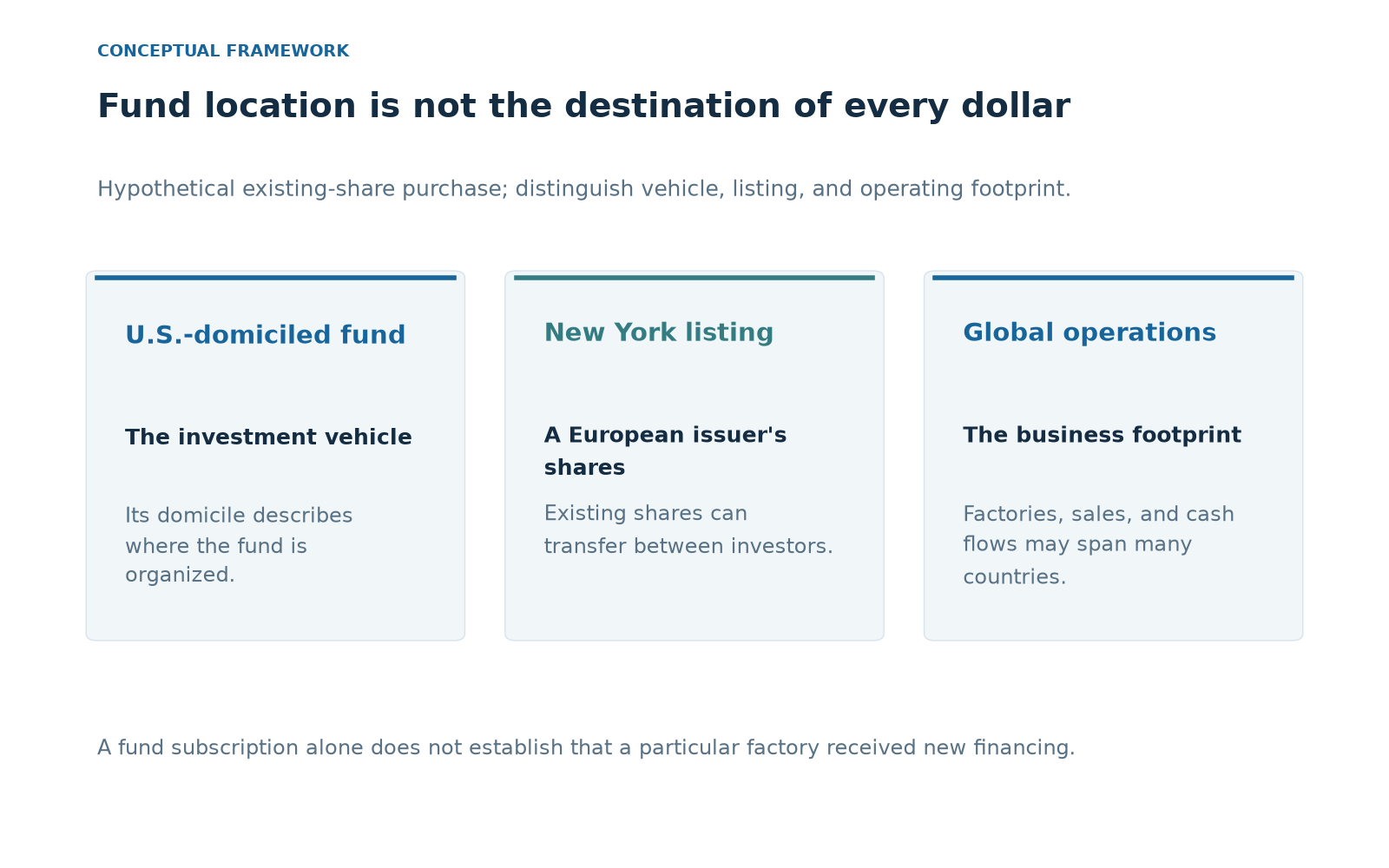
Consider a U.S.-domiciled fund buying shares of a European company listed in New York. The company sells globally and holds cash in several currencies. A subscription into that fund cannot, by itself, establish that European factories received new financing. Much secondary-market trading transfers existing securities between owners.
The same care applies to redemptions. Money leaving one regional fund may enter another fund with overlapping holdings. It may also remain invested through a separately managed account that the dataset does not cover.
Keep the currency question separate
An unhedged investor’s return reflects both the asset and the exchange rate. A hedged share class changes that exposure. Combining the two without noting the distinction can obscure whether demand is for the underlying securities, the currency, or a particular product structure.

Large international transactions can also reflect benchmark changes, tax considerations, or institutional mandate transitions. These mechanisms are plausible explanations to investigate, not conclusions that can be inferred from the flow number alone.
Use several kinds of evidence
Country-fund data can contribute to a broader view alongside securities holdings, balance-of-payments statistics, issuance, and currency markets. Each measures a different part of the system and has its own reporting lag. A strong research note uses these distinctions to narrow its claim. It describes observed fund demand while avoiding the unsupported leap from a product label to a complete national capital-flow story.
Related research

ResearchFund Flows
Before Comparing Flows, Compare the Coverage
Different fund universes can produce different headlines without either dataset being wrong.

ResearchFund Flows
Persistence Matters More Than a One-Week Flow Record
A large observation becomes more informative when its scale, breadth, and durability are understood.

ResearchFund Flows
ETF Trading Volume Is Not the Same as New Investment
Why a busy trading day may leave the number of fund shares largely unchanged.