
ResearchFund Flows
Before Comparing Flows, Compare the Coverage
- Report or archive date
- Archive placement May 7, 2026
- Reading time
- 1 min read

Summary
Different fund universes can produce different headlines without either dataset being wrong.
Two flow reports can describe the same week in opposite terms. One may cover mutual funds, another may include ETFs, and a third may track only selected institutional accounts. Before treating the disagreement as a market signal, the analyst should determine whether the reports measure the same universe.
Define the sample
ICI’s reporting framework distinguishes weekly estimates from monthly survey figures and organizes funds by investment objectives. Those choices affect what appears in a category. An equity fund classification is not identical to a complete inventory of every equity exposure held by its investors.
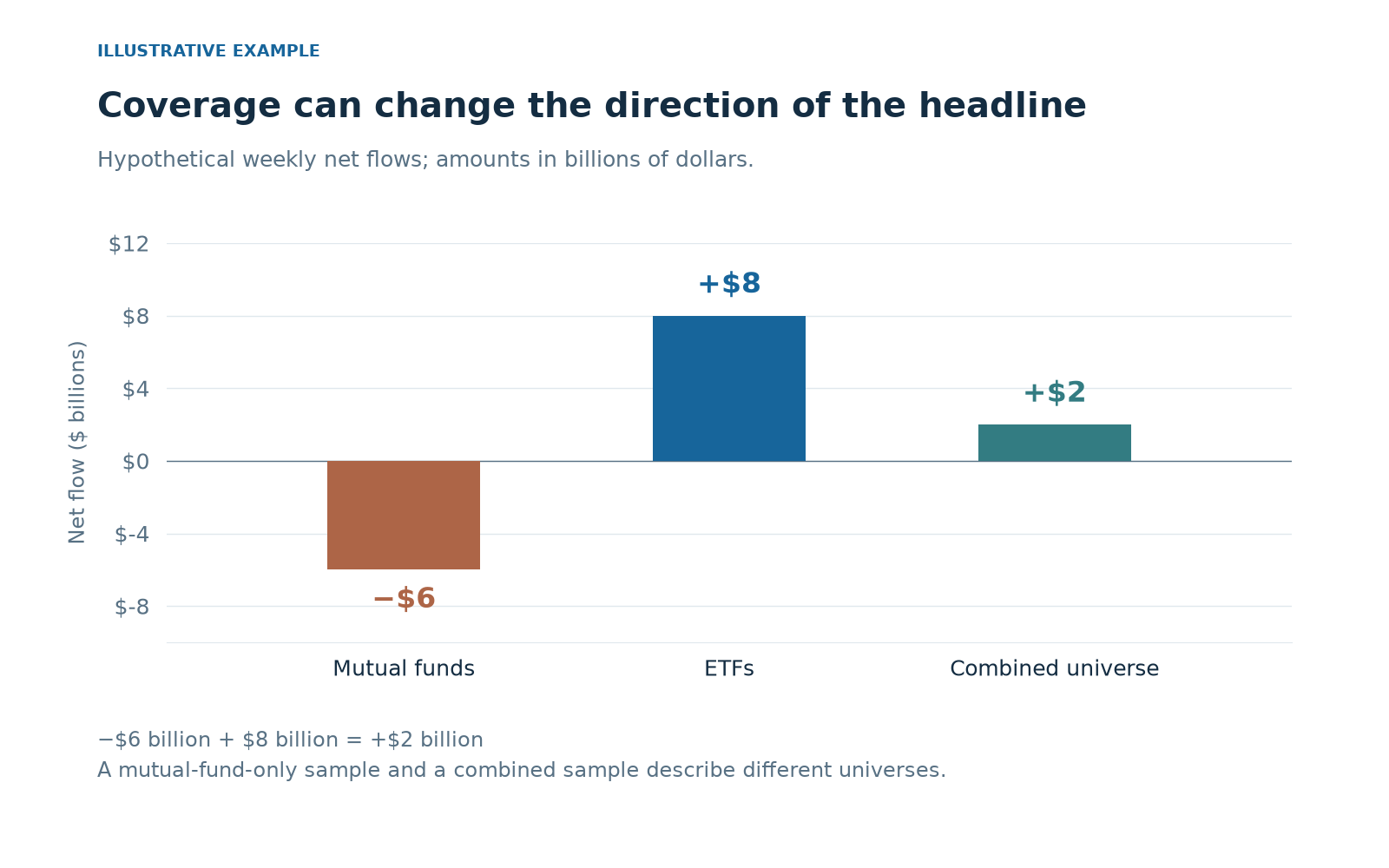
In a week, investors withdraw $6 billion from traditional mutual funds and add $8 billion to ETFs holding similar securities. A mutual-fund-only report shows outflows, while a combined view shows net inflows. Neither figure alone proves that investors abandoned or embraced the underlying market.
Conversions and reorganizations can further complicate the comparison. A transfer between legal structures may create a dramatic change in one category without an equivalent change in economic exposure. Large observations deserve a check for such structural events before a behavioral interpretation is attached.

Compare Matching Reporting Periods, Units, and Data Versions
Reporting weeks may end on different days. Some figures are preliminary estimates; others include later revisions. Currency conversion can change the apparent dollar size of international assets. A careful comparison aligns period, universe, units, and vintage before calculating a difference.

Classification also matters over time. A fund can change mandate, or a provider can revise category rules. A historical series may then contain a break that looks like investor activity. Documentation is part of the evidence, not an optional appendix.
Write the conclusion at the right scale
The strongest flow commentary states exactly what the dataset supports: for example, estimated net subscriptions within a specified group of funds during a specified period. It then discusses plausible explanations without claiming to observe every investor. Precision about coverage may make a headline less dramatic, but it makes the analysis more reliable and easier to compare across time.
Related research

ResearchFund Flows
ETF Trading Volume Is Not the Same as New Investment
Why a busy trading day may leave the number of fund shares largely unchanged.

ResearchFund Flows
A Country Fund Is Not a Complete Map of Cross-Border Capital
Vehicle location, portfolio exposure, and the investor’s home country are separate dimensions.

ResearchFund Flows
Fund Flows and Market Returns Measure Different Things
A change in assets is not automatically evidence of investors adding or withdrawing money.