
ResearchFund Flows
ETF Trading Volume Is Not the Same as New Investment
- Report or archive date
- Archive placement March 19, 2026
- Reading time
- 1 min read

Summary
Why a busy trading day may leave the number of fund shares largely unchanged.
An ETF can trade actively all day while very little new capital enters the fund. Existing shares can pass repeatedly between buyers and sellers. That secondary-market activity is different from the creation or redemption of ETF shares through the fund’s primary-market mechanism.
ETF Share Creation and Redemption vs. Exchange Trading
The SEC’s ETF bulletin describes how authorized participants create or redeem large blocks of shares, generally using a specified basket of assets or cash. Ordinary exchange trading does not require a new creation for every purchase.
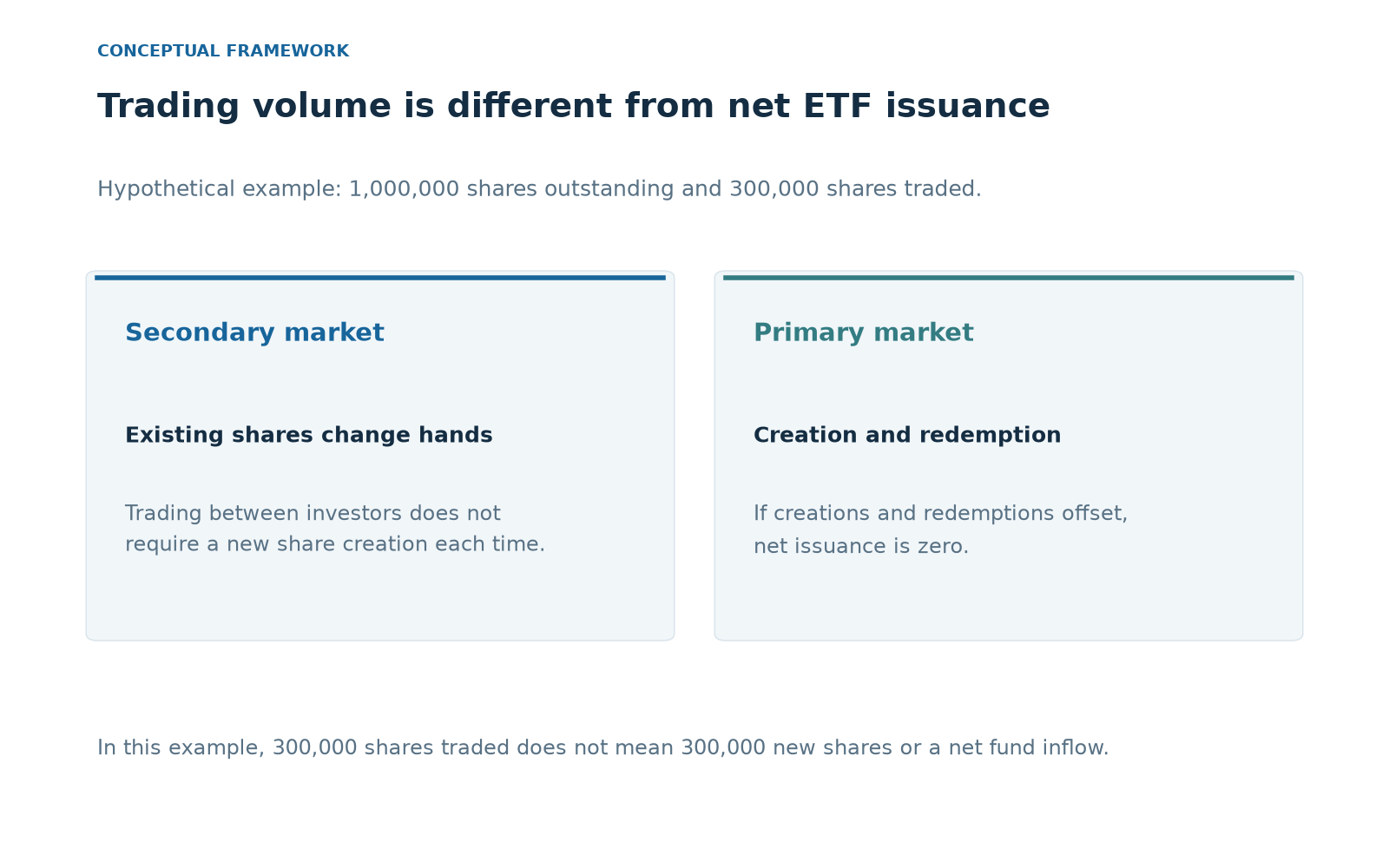
Suppose an ETF has one million shares outstanding. Investors trade 300,000 shares during the day, but creations and redemptions offset. The trading volume is substantial; net issuance is zero. Calling the volume an inflow would confuse turnover with a change in the fund’s share base.
The distinction matters especially during volatile sessions, when investors may trade existing shares rapidly. High volume can indicate active price discovery or repositioning without identifying the direction of net investment into the underlying portfolio.

What Net ETF Share Creation Can—and Cannot—Show
Net creation is stronger evidence of a change in fund size than turnover, but it still does not reveal every economic motive. Market-making inventory, arbitrage, hedging, and transitions between vehicles can affect the process. The broader portfolio decision may sit outside the ETF itself.

An analyst should also distinguish share changes from dollar estimates. The conversion depends on the relevant price or net asset value and the provider’s methodology. Comparing datasets without checking those conventions can create artificial discrepancies.
Ask a narrower, better question
Instead of declaring that investors are buying an asset class because an ETF traded heavily, ask whether shares outstanding changed, whether similar funds experienced offsetting movements, and whether the pattern persisted. The evidence can support a measured statement about vehicle demand. It usually cannot establish the identity, conviction, or future intentions of the investors behind it.
Related research

ResearchFund Flows
Fund Flows and Market Returns Measure Different Things
A change in assets is not automatically evidence of investors adding or withdrawing money.

ResearchFund Flows
Before Comparing Flows, Compare the Coverage
Different fund universes can produce different headlines without either dataset being wrong.

ResearchFund Flows
A Country Fund Is Not a Complete Map of Cross-Border Capital
Vehicle location, portfolio exposure, and the investor’s home country are separate dimensions.